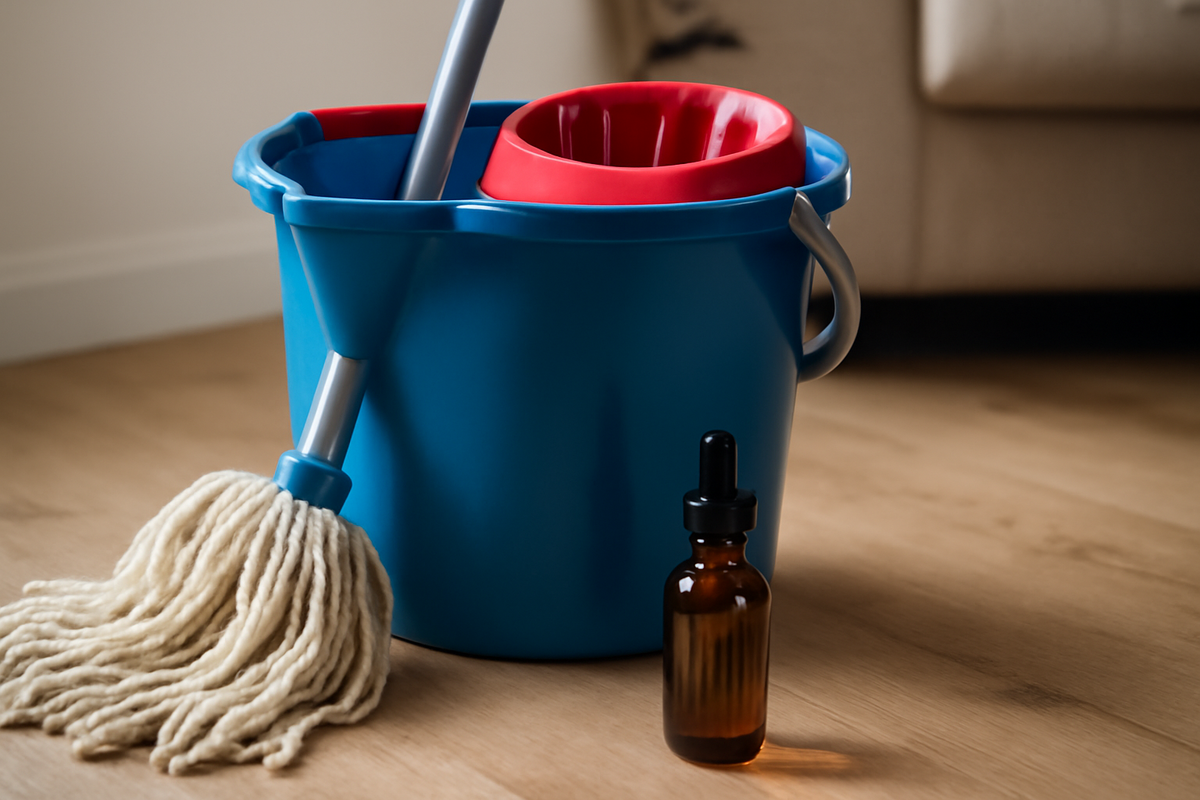
The water in the mop bucket was still, a small, cloudy pond catching the square of afternoon light that fell across the kitchen floor. The house hummed with the soft drone of a distant dryer and the faint tick of the hallway clock. It smelled like… nothing, really. A bit of dust. A shadow of last night’s garlic. The ghost of a lemon-scented spray from three days ago. I stirred the water with the mop head, watched the suds twist lazily, and felt that familiar, slightly disappointing thought: in an hour, it’ll smell like wet mop and tap water again.
Then I remembered the tiny, amber glass bottle tucked behind the flour canister.
Two drops. That’s all the label ever promised I’d need. Not a capful, not a splash — just two, delicate, almost ceremonial drops. I unscrewed the cap, and even before I tilted the bottle, the scent lifted out: cool and bright, like snapping a fresh leaf between your fingers, with a soft hint of sweetness that caught at the back of the nose. Not sharp, not sour. Definitely not vinegar.
Two drops fell into the bucket, blooming into faint whorls on the surface before vanishing. I swished the mop once, twice. The whole character of the water shifted — it now smelled like the first five minutes of opening the windows on a breezy day after a long, stuffy winter.
The Quiet Magic of Two Drops
There’s something oddly theatrical about the way cleaning products are marketed: sprays, foams, power scrubbers, “extra strength” gels that promise to melt soap scum like villains in a superhero movie. Vinegar has become a kind of DIY darling — the pantry hero of the cleaning world. But as anyone who’s mopped a kitchen with vinegar water knows, the reality is… complicated.
Sure, vinegar works. It cuts grease, lifts residue, and makes glass shine. But it also smells like, well, vinegar. Even when it dries, there’s often a faint, sour afterglow that clings to the air. If you live with someone who is smell-sensitive — or if you’re just tired of your living room smelling like a salad bar — the shine starts to lose its charm.
That’s what led me, and a lot of others, to a quieter kind of cleaning magic: essential oils used sparingly and thoughtfully in something as simple as a mop bucket. Not in a diffuser puffing clouds into the air, not in a candle flickering on the mantle, but in the most practical, least glamorous corner of the house: a pail of warm water on the floor.
Two drops. No vinegar. No harsh chemical cloud. And yet, the house smells fresh for days.
The Nose Knows: Why Scent Lingers (or Doesn’t)
Walk into a forest after rain and the smell wraps around you — earthy, resinous, sharp, green. That scent lingers because it’s not just in the air; it’s steeped into leaf litter, bark, earth, and stone. It clings to surfaces. Your home works the same way. Odors aren’t just floating around — they’re resting in fabrics, trapped in tiny scratches in the floor, nesting in baseboards and corners.
When you mop, you’re not only lifting dirt; you’re resetting the story your house is telling through smell.
Most fragranced cleaners blast through the room like loud music. They’re strong, showy, and then, like a song on the radio, they end. The scent fades quickly because the liquid evaporates and leaves very little behind. Vinegar has the opposite problem: its character is so sharp that the ghost of it seems to hang on even when there’s technically nothing left.
Essential oils, in contrast, act more like a soft-spoken person with something interesting to say. A few molecules cling to surfaces as you mop — the floor, the baseboards, the legs of chairs — and from there, they evaporate slowly. The result isn’t a punch of perfume but a gentle, persistent presence that you notice every time you walk back into the room.
The “Two Drop” Trick in Simple Terms
Here’s how that tiny amount works:
- Warm water helps disperse the oil into microscopic droplets.
- Soap or floor cleaner (even a little) acts like an emulsifier, helping the oil spread more evenly instead of floating in blobs on the surface.
- As you drag the mop across the floor, those droplets catch on surfaces and begin to evaporate over hours, sometimes days.
It’s less like spraying perfume in the air and more like gently brushing a whisper of scent onto every step your feet will touch.
Inside the Bottle: Choosing the Right Two Drops
Not all scents are created equal, and not all essential oils behave the same way. Some vanish quickly; others hang on like the last light at dusk. Some smell like a walk in the pines; others, like a bakery at dawn.
Gentle Stars for a Fresh-Smelling Home
These are some of the most beloved options people use in mop buckets when they want to avoid vinegar and heavy cleaners:
- Lemon or Sweet Orange – Bright, sunny, and uplifting. Smells like a clean kitchen without that “fake lemon candy” edge if you choose a good-quality oil.
- Lavender – Soft and floral with a herbal backnote. Feels like clean sheets and quiet Sunday mornings.
- Eucalyptus – Cool, airy, and fresh. It gives a subtle “spa” feeling, lovely in bathrooms and entryways.
- Peppermint – Brisk and energizing. A little goes a long way, and it can make a tired room feel awake.
- Tea Tree – Earthy and medicinal, best blended with lemon or lavender. Often chosen for its “clean” character more than its beauty.
You don’t need a whole apothecary. Start with one bottle that makes you instinctively inhale deeper when you open it. That’s usually your nose telling you, “Yes, this is home.”
A Handy Comparison of Popular Mop-Bucket Scents
| Oil | Scent Mood | How Long It Tends to Linger | Best Rooms |
|---|---|---|---|
| Lemon | Bright, crisp, clean | Moderate | Kitchen, dining area |
| Lavender | Calming, cozy | Long | Bedrooms, hallway |
| Eucalyptus | Airy, spa-like | Moderate–long | Bathroom, entryway |
| Peppermint | Cool, energizing | Moderate | Office, living room |
| Tea Tree | Earthy, medicinal | Long | Mudroom, bathroom |
How to Do It: A Small Ritual in a Big, Busy Day
There’s a rhythm to mopping that hasn’t really changed in generations: fill, dip, wring, swipe, repeat. But when you add scent thoughtfully, the whole act shifts from chore to small ritual — ten or fifteen minutes where your senses get to breathe.
A Simple, Vinegar-Free Mop Bucket Mix
Here’s one easy way to do it:
- Fill your mop bucket with warm water (not scalding; just pleasantly warm to the touch).
- Add your usual mild floor cleaner or a tiny squirt of gentle dish soap (especially if your floors are sealed tile, vinyl, or laminate). Stir lightly with the mop.
- Take your chosen essential oil, hold it over the bucket, and add exactly two drops. Not six, not ten. Two.
- Swish the mop in the bucket to help disperse the oil.
- Mop as you normally would, moving out from the farthest corner of the room toward the door.
- Let the floors air dry. Open a window if the weather is friendly; if not, simply let the scent gather as the water disappears.
The floor dries, the bucket empties, the day moves on — but the hint of that scent remains, woven into the fibers of the rug’s edge, cradled in the grain of the floorboards, tucked along the baseboards where the cloth passed.
More Than Clean: How Your Home’s Smell Becomes Its Story
We remember places partly by how they smell. The old apartment with the permanent undertone of dust and radiator heat. The cabin that always smelled like pine and woodsmoke, even in July. Your grandmother’s house, with its quiet layers of laundry soap, cocoa, and a whisper of perfume that lived in the curtains long after she left the room.
When you choose how your home smells, you’re choosing how it will sit in memory — yours and the people who cross your threshold.
There is a quiet intimacy to walking into your own living room two days after mopping and catching a faint curl of lavender waiting for you. It’s not a blast of artificial fragrance, not a chemical swirl that clings to your clothes. It’s more like the scent lives here, the way light lives in a favorite window. A presence, not a performance.
And it doesn’t ask much of you. There’s no elaborate routine, no daily spray schedule. Just two drops in the bucket on cleaning day, and the room quietly remembers for days.
This small act — this choice of scent — can shape how you feel about your home even when it’s not photo-ready. On the days when the mail is piled on the table, when there’s one sock abandoned halfway down the hall, when breakfast dishes are still lounging in the sink — the air still murmurs: Someone cares for this place.
Picking a “House Scent” That Feels Like You
Some people like to pick one aroma as their “signature house scent,” the way people once picked a signature perfume. For others, each room gets its own atmosphere. You can think of it like a landscape:
- Kitchen as citrus grove – Lemon or orange in the mop bucket makes counters and floors smell like sunshine after the dishes are done.
- Bathroom as misty spa – Eucalyptus or a eucalyptus-lavender blend keeps the space feeling cool, airy, and fresh.
- Bedrooms as evening garden – Lavender, or a gentle floral blend, lingers softly at floor level, rising when you move.
- Entryway as first impression – Peppermint or a citrus-herb mix greets guests with something bright and welcoming.
You don’t need to be perfectly consistent. Life rarely is. But having one or two familiar scents that recur around your home can make the entire space feel more intentional, more loved.
Safety, Surfaces, and Sensitivity
Even gentle, plant-based substances deserve respect. Essential oils are concentrated — more like spices than vegetables. A little can transform a room; a lot can overwhelm it.
- Always dilute. Essential oils should never go on your floor (or skin) undiluted. Two drops in a bucket of water is, for most households, beautifully enough.
- Mind the surfaces. Most sealed floors — tile, vinyl, laminate, sealed hardwood — do well with a lightly scented mop. For unsealed or specialty surfaces, do a tiny test patch first or stick with plain water and cleaner.
- Consider sensitive noses and paws. Pets and some people can be sensitive to strong aromas. That’s one reason two drops is such a sweet spot: it scents the space gently rather than filling it with intensity.
- Ventilation is your friend. Crack a window if you can. It keeps the air feeling clean rather than heavy, even with good scents.
It’s easy to assume “more drops = more clean,” but the cleanliness comes from the water, the soap, the motion, and the attention you’re giving the space. The oil is there to shift the mood, not to sanitize the universe. Stopping at two drops is not a compromise; it’s a kind of grace.
When the Mop Dries and the House Falls Quiet
Later that evening, after the bucket was emptied and turned upside down to dry, after the mop was leaned quietly in the corner, the house slowed to its nighttime rhythm. The last dishes clicked into the rack. A lamp was switched off. Shoes were kicked under a bench.
Walking barefoot across the kitchen, the floor felt cool and faintly smooth underfoot. As I passed the dining doorway, a soft, almost unnoticeable wave of scent rose — clean, herbaceous, a trace of citrus threaded through it. It wasn’t something you could point at. It just made the room feel more awake, somehow, and more at peace.
There, in the middle of an ordinary hallway, I caught myself breathing deeper. The day’s noise and rush slid off a little more easily. The house smelled like it had been recently loved, not just recently scrubbed.
All that from two nearly invisible drops, vanishing into a bucket of warm water.
No vinegar. No neon-blue cleaner bouquet. Just a quiet, lingering freshness that made the space feel more like the home I wanted it to be — a place that greets you softly at the door and then stays kind to your senses for days.
Frequently Asked Questions
Can I really use only two drops of essential oil in my mop bucket?
Yes. Two drops in a standard household mop bucket of warm water are usually enough to create a subtle, long-lasting scent without overwhelming the room or irritating sensitive noses.
Do I need to add vinegar for the scent to last?
No. The scent comes from the essential oil itself and the way it lightly clings to surfaces as you mop. Vinegar isn’t necessary for fragrance and can add an unwanted sour note.
Will the essential oils damage my floors?
On most sealed surfaces (tile, vinyl, laminate, sealed hardwood), a very small amount of diluted oil is generally safe. Avoid using oils on unsealed or specialty floors, and always test a small, hidden area first if you’re unsure.
Which essential oil is best for making my home smell fresh?
It depends on your taste. Lemon and sweet orange feel bright and clean, lavender is calming, eucalyptus smells fresh and spa-like, and peppermint is energizing. Start with one you naturally enjoy when you smell it from the bottle.
Can I mix different essential oils in the same bucket?
Yes, but keep the total amount small. For example, use one drop of lemon and one drop of lavender rather than four or five drops total. Simple blends tend to smell more natural and less overpowering.
How long will the scent usually last after mopping?
In many homes, a light, pleasant scent can linger for one to three days, sometimes longer in smaller or less drafty rooms. It’s not constant perfume — more like a gentle background note that appears when you enter the space.
Is it safe for pets if I mop with essential oils?
Many households use small amounts of essential oil safely, but pets can be more sensitive to certain scents, especially in high concentrations. Using only one or two drops in a whole bucket of water reduces risk, but if your pet has respiratory issues or specific sensitivities, consult your vet and consider skipping the oils in their main living areas.

Hello, I’m Mathew, and I write articles about useful Home Tricks: simple solutions, saving time and useful for every day.