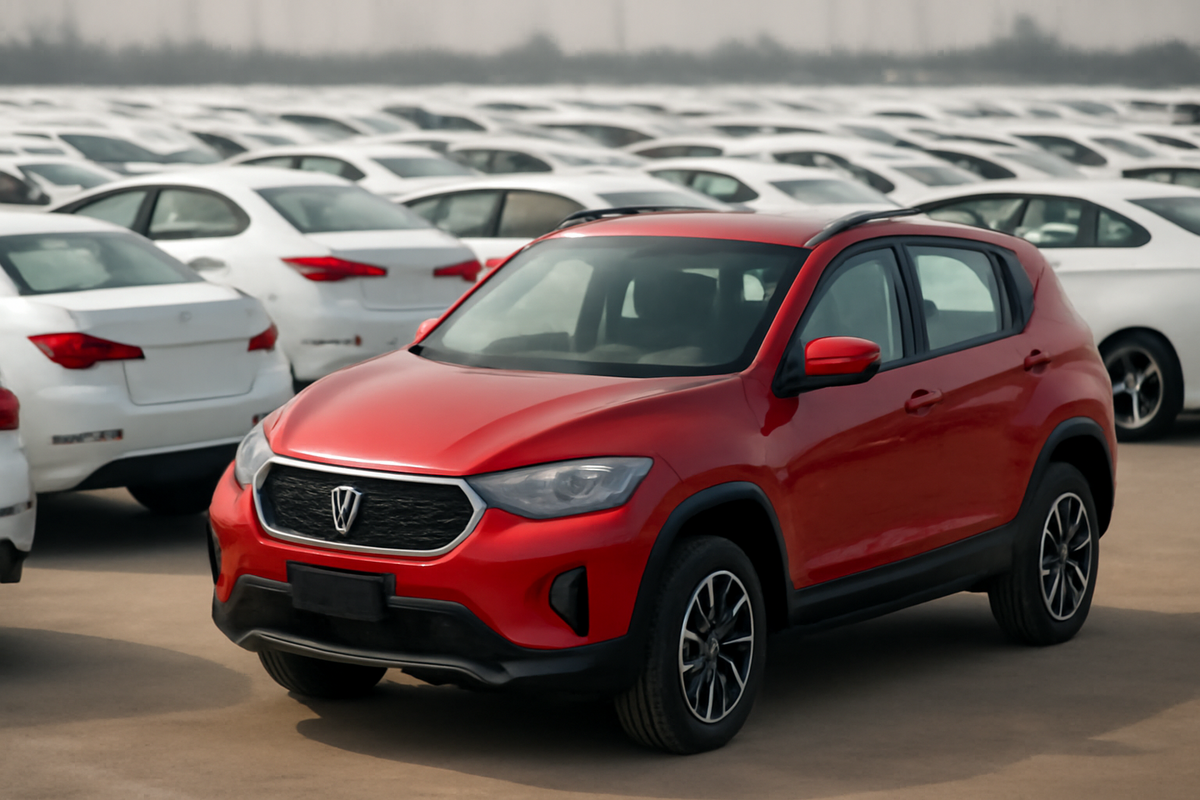
The heat hangs low over a port city somewhere along China’s eastern coast. Containers sit like giant dominoes in quiet rows, painted in scuffed blues and reds, each metal box filled with pieces of someone’s future. A dockworker in a faded vest leans against a stack of tires, watching as a line of compact sedans eases up the ramp, engines humming, paintwork flashing under the midday sun. Some cars gleam with the crisp, confident shine of new engineering; others, if you stand close enough, show the tiny betrayals of rushed assembly—a misaligned panel, a door that needs a firmer push, a rattle in the dash that no one wants to hear.
For years, scenes like this have played out quietly. China’s car exports—especially to developing countries—have poured out of ports in record numbers, a metal river reshaping streets and highways from South America to Africa to Southeast Asia. Many of those cars have been good, even excellent. But some, everyone knows, have not. They’ve arrived in dusty border towns and booming capital cities missing basics: reliable after-sales support, durable parts, or any guarantee that replacement components will still be on the market five years down the line.
Now, as stories circulate about stranded owners waiting months for a simple part, abandoned vehicles sitting gutted behind roadside repair shops, and cheap sedans turned into expensive lawn ornaments, Beijing has decided it’s had enough. China, the world’s manufacturing behemoth, is drawing a line in the sand: it plans to ban the export of low-quality cars and vehicles without spare parts, a move driven by something as fragile—and as powerful—as reputation.
The Quiet Cost of Cheap Cars
Walk through an open-air market in an African city where Chinese cars have arrived in waves, and you’ll hear the stories between stalls of mangoes and mobile phones. A taxi driver who proudly bought a low-cost Chinese sedan three years ago now keeps it parked for weeks at a time because a crucial part failed and no one in town—no dealer, no mechanic, no back-alley genius—can find the replacement.
He’ll tell you how the car seemed like a miracle at first. Easy payments, shiny paint, Bluetooth on the dashboard. For a while, it carried families to weddings, children to school, traders to the edge of town. Then the suspension gave out on one side. A mechanic shrugged, lifted the car on a jack, and muttered that the part was “special”—a polite code for: this is going to be complicated.
That driver isn’t alone. Each broken promise travels faster than any marketing campaign. In small workshops near dusty highways and in cramped urban garages, mechanics trade grim jokes about “orphans”—vehicles whose parts catalogs seem to vanish the moment the warranty expires. In some places, entire fleets of budget Chinese vehicles are parked in lots like a forgotten experiment, picked over for whatever pieces can be reused.
On paper, the export numbers have been dazzling. China has surged into the position of one of the world’s top car exporters, powered by aggressive pricing and a massive industrial base. But reputations aren’t built on unit counts; they’re built on what happens after the sale. The stories that stick aren’t about low prices—they’re about whether the car still starts on a cold morning after five hard years, whether the air conditioning still works in the burning months before the rains, whether a cracked headlight can be replaced without hunting the internet for obscure suppliers.
Why Beijing Is Stepping In
The decision to restrict exports of low-quality vehicles and cars without spare parts isn’t only about protecting foreign buyers; it’s a calculated act of self-preservation. China’s leaders have watched as “Made in China” has slowly climbed the value ladder—from cheap toys and electronics to sophisticated smartphones and electric vehicles. They know how fragile that climb is.
Imagine a sprawling global map in a government meeting room in Beijing, pins marking every new market where Chinese cars have landed. In some regions, those pins shine with promise: sales are rising, local dealers are opening, and customers are trading up to newer models. In others, the pins are surrounded by question marks: complaints of poor durability, no after-sales service, a lack of technical training for mechanics. Those question marks can easily turn into warning labels: Don’t buy these cars. They’re trouble once they break.
For a country betting big on electric and smart vehicles—a sector that demands trust over decades—that kind of reputation damage is dangerous. Once consumers in emerging markets decide that Chinese cars are disposable, they will approach the next generation of advanced EVs and smart vehicles with suspicion, no matter how good the technology really is.
So the new policy is both shield and scalpel. By targeting low-quality exports and vehicles without spare-part security, China aims to cut away the weakest parts of its export machine, leaving the stronger brands and better-built cars to define its global image. The message to manufacturers is blunt: if your cars can’t be supported, they can’t leave the country.
The Anatomy of a Promise: Quality, Parts, and Time
When you buy a car—whether in a bustling Chinese city or a remote village in Latin America—you’re really buying a long-term promise. Not just a promise from the company, but a promise from a whole system: factories, suppliers, logistics firms, local dealers, mechanics, training programs, and digital catalogs. For some exporters, that system has been patchy at best.
To understand what’s changing, picture how a single vehicle travels from assembly line to overseas street. First, it rolls off the line in one of China’s megaplant complexes, where robotic arms move with gliding precision and human workers check fit and finish under harsh white lights. Tests are run, documentation is stamped, and the car is loaded—onto trucks, onto trains, onto ships.
But what happens behind that first gleaming wave—the quiet backup, the aftercare? That’s where weaknesses have shown. Some smaller or less established manufacturers chased fast export deals without building robust overseas service networks. Cars were sold into distant markets with vague promises that “parts will be available,” but supply chains for those parts were never properly forged.
In response, China’s new stance focuses on two intertwined pillars: basic quality standards and spare-parts assurance. That means vehicles must not only meet certain technical benchmarks at the time of sale; they must also carry with them a credible plan for future maintenance—inventory of parts, clear documentation, and distribution networks that actually work.
In a way, the policy forces an uncomfortable but necessary question: Is this a car, or is it a short-lived product with no future beyond a few years? If it’s the latter, it no longer qualifies to represent China abroad.
What Changes for Exported Vehicles?
Although every detail of policy will evolve in practice, the core of the shift can be understood simply. Here’s a compact look at what the new direction means in concrete terms:
| Aspect | Before | Emerging Direction |
|---|---|---|
| Vehicle Quality | Wide range, from high-end to very basic models with inconsistent durability. | Tighter screening to prevent export of low-quality, non-durable vehicles. |
| Spare Parts Availability | Often unclear; some models have limited or no parts support overseas. | Export allowed only if a sustainable spare-parts system and support network exist. |
| After-Sales Service | Highly uneven; strong for big brands, weak or absent for smaller exporters. | Greater emphasis on service commitment, training, and long-term support. |
| Brand Impact | Fast volume growth but mixed reputation in some regions. | Slower but more sustainable growth, focused on trust and reliability. |
Winners, Losers, and the Roads In Between
In a small dealership on the edge of a West African city, a salesman runs his hand along the hood of a compact Chinese EV, its charging port hidden behind a smooth panel. He’s heard rumors about the policy shift; he’s seen the news clips, translated and shared in messaging groups. To him, the change feels like both a threat and an opportunity.
If the flow of ultra-cheap, poorly supported vehicles slows to a trickle, he might sell fewer units to the most price-sensitive buyers. But the cars he does sell could be easier to stand behind. Fewer angry customers demanding parts he can’t provide. Fewer awkward phone calls to importers who shrug and say, “We’re still checking with the factory.”
For mechanics, the change might mean garages filled with brands that take standardization and continuity more seriously. Parts that arrive in weeks instead of months. Service manuals that are accurate and updated. Training sessions offered by manufacturers who now see the value of investing in the hands that will keep their cars on the road.
For smaller Chinese manufacturers that have been surviving on thin margins and quick export deals, the new rules could be painful. They may have to either lift their game or retreat from overseas markets altogether. Some will likely pivot to focus on domestic sales or components; others may fold or merge into larger players with the reach and discipline to build real global brands.
But for the bigger, more ambitious automakers—the ones already investing heavily in electric platforms, software, and global design studios—this moment is a quiet triumph. The policy undercuts less serious rivals and reinforces a narrative they’ve been trying to build: that Chinese vehicles can stand shoulder to shoulder with established Japanese, European, and Korean brands not just in showrooms, but in 10-year-old parking lots, with the odometer well past 150,000 kilometers.
From Steel and Circuits to Stories and Trust
On a wide avenue in a Southeast Asian capital, late afternoon traffic moves like a sluggish tide. Amid the swirl of motorbikes and buses, you can pick out the silhouettes of Chinese SUVs and sedans—some brand-new, with crisp LED signatures, others older, paint dulled by sun and rain. Drivers lean on their horns, edge into gaps, and swipe at navigation apps glowing on center screens.
What you can’t see from above is the shifting layer of stories forming around these vehicles. A delivery driver who switched from an old used European van to a new Chinese electric van and found that, to his relief, the battery really does last all day. A family whose budget sedan developed an early engine issue, but whose local dealer replaced the part quickly because the warehouse actually had it in stock. A taxi company that cautiously bought a small batch of Chinese hybrids, then doubled its fleet after a year of smooth operation.
These are the stories China wants to multiply, and the policy against exporting low-quality vehicles without parts is an attempt to prune away the narratives that do the opposite: the broken axles on remote roads, the dashboards that die, the cars left to rust for lack of a small but crucial component.
Global trade isn’t just about goods; it’s about the stories that trail behind them. Each exported car is like a quiet ambassador from its country of origin. When it starts each morning without complaint, when its brakes remain firm in the rain, when the right part arrives in time to fix it, it whispers: You can trust where I came from.
China has long been known for its ability to produce at scale, to flood the world with products that are affordable, functional, and available. Now it’s trying to be known for something more mature, more demanding: the ability to deliver not just volume, but confidence.
In the Factory, a Different Kind of Pressure
Back in the manufacturing plants, the ripples of this shift are already changing the air. Quality inspectors know that the checklist isn’t just about meeting minimum specifications; it’s about meeting the invisible expectations of distant drivers who will never walk these floors but who will judge the car, mercilessly, over the years it spends with them.
Engineers and logistics planners are pressed to think beyond the launch date: Can this part be sourced consistently for a decade? What happens if a supplier goes under? Is there a plan to maintain software updates for connected features long after the first shine of novelty fades?
Somewhere on a line, a worker rechecks the alignment of a door, the torque on a bolt, the snug fit of a wiring harness. That small act of care is suddenly connected to a trading policy announced in Beijing, a taxi driver in Nairobi, a mechanic in São Paulo, and a future headline about whether Chinese EVs have “arrived” as trusted global citizens.
The decision to cut off low-quality exports isn’t a magic wand. There will still be missteps, recalls, and hard lessons. But it’s a signal that China understands a truth that every long-haul trucker, auto mechanic, and veteran driver already knows instinctively: the real value of a vehicle is measured not in the first year, but in the tenth.
The Long Road Ahead
Night falls over that same port where the containers wait and the cars line up for their journey outward. Sodium lamps flicker to life, bathing the scene in a tired orange glow. Somewhere, a clerk clicks through manifests, cross-checking models and destinations, ensuring that the right paperwork is attached. Soon, some vehicles will be turned away, deemed not fit to carry the flag of Chinese industry abroad—not because they don’t run, but because the support behind them is hollow.
Others will roll forward, up ramps and into the belly of a ship, bound for new landscapes and unfamiliar drivers. They’ll face potholes, monsoon rains, desert heat, congested ring roads, and unsparing daily use. Their real test begins far from the factory, on those uneven, ordinary roads of people’s lives.
In the end, China’s move to ban exports of low-quality cars and vehicles without spare parts isn’t just a bureaucratic adjustment; it’s a recognition that industrial ambition without responsibility is a dead end. The country is betting that reputation is worth protecting—even when that means shipping fewer cars, more slowly, with more care.
There will always be demand for the cheapest car on the lot, the one that just barely gets you moving. But more and more, drivers from Lima to Lagos to Lahore are learning an expensive truth: a cheap car without a future isn’t really cheap at all. It’s a risk, a gamble, a story that may end too soon on the side of a road with the hood up and no parts in sight.
China wants to rewrite that story—to send out vehicles that can grow old with the families and businesses that depend on them. Somewhere out there, a ten-year-old Chinese car, still running strong on its third set of brake pads and second battery, will be the quiet proof that this turning point mattered. That, in a world awash with products, choosing what not to export can be as powerful as choosing what to sell.
FAQ
Why is China banning exports of low-quality cars?
China aims to protect its global reputation and ensure that its vehicles are seen as reliable, long-term investments. Reports of poorly supported, low-quality cars damaging trust in Chinese brands have pushed policymakers to act.
Does this mean all cheap Chinese cars will disappear from export markets?
Not necessarily. Lower-cost cars can still be exported, but they will need to meet basic quality standards and be backed by a credible spare-parts and service system. “Cheap” is not banned; “unsupported and unreliable” is.
How will this affect car buyers in developing countries?
In the short term, some ultra-low-cost options may become harder to find. Over time, buyers should benefit from more durable vehicles, better access to spare parts, and more consistent after-sales service.
What does this change mean for local mechanics and workshops?
It could make their work easier and more predictable. With stronger parts support and better documentation, mechanics will be able to repair Chinese vehicles more efficiently and confidently, rather than improvising around missing components.
Will Chinese electric vehicles (EVs) also be affected?
Yes. EVs depend heavily on long-term support for batteries, electronics, and software. The same logic applies: only those models with reliable quality and sustainable after-sales and parts support will be encouraged for export.
Is this policy mainly about politics or business?
It’s both. Politically, it protects China’s national image; economically, it pushes manufacturers toward higher-quality, higher-value exports. In global markets where trust is essential, reputation and business strategy are tightly connected.
Can this move really change how people see Chinese cars?
Not overnight. But as fewer unsupported, low-quality vehicles reach foreign roads and more durable, well-served models stay in use for years, everyday experience can gradually shift perceptions—from skepticism to cautious trust, and eventually to confidence.

Hello, I’m Mathew, and I write articles about useful Home Tricks: simple solutions, saving time and useful for every day.