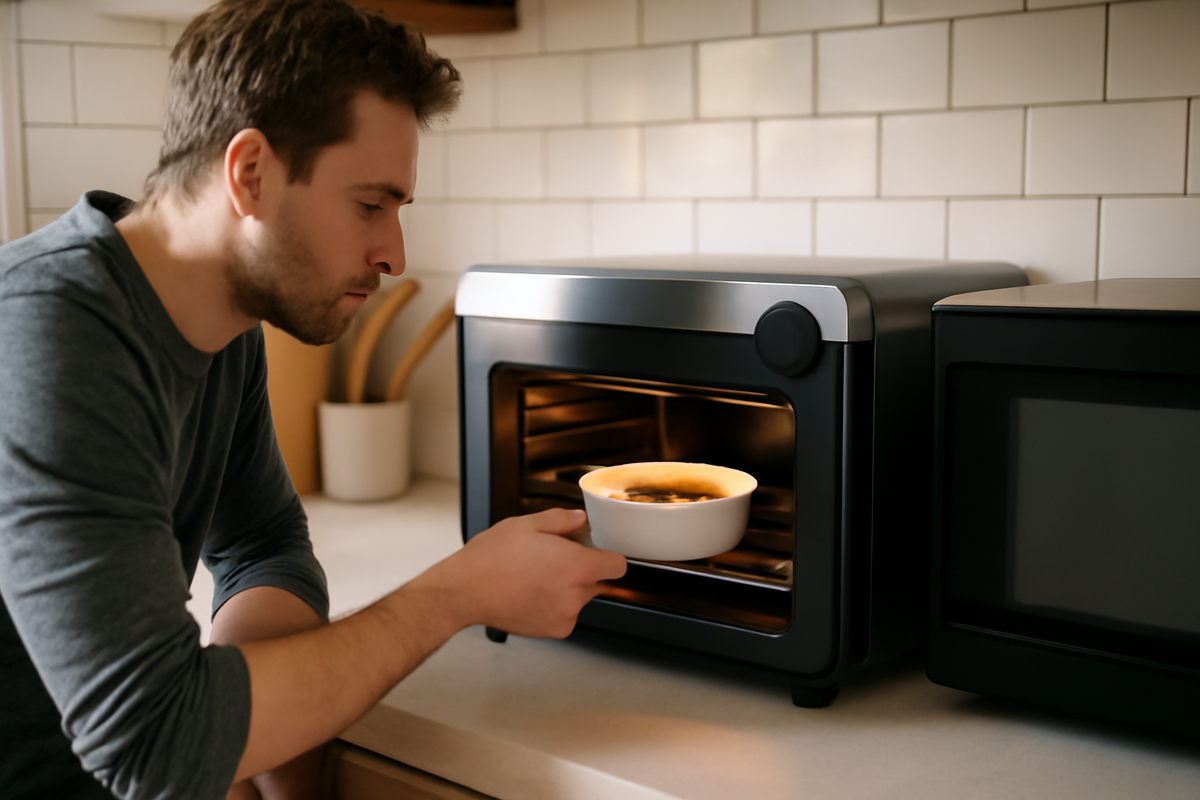
The first time you hear it, you don’t quite believe it: a soft exhale, like a distant kettle just beginning to whisper. Then comes the faintest crackle, a shimmer of sound beneath the kitchen hum. No spinning glass plate. No harsh, buzzing fan. No boxy door slamming shut. Just a warm, amber glow filling a sleek chamber on your countertop, the quiet promise of heat being shaped—carefully, intelligently—around your food.
You watch as last night’s roasted vegetables—cold, limp, and usually destined for a sad, rubbery microwave reheat—come back to life. Edges crisp. Aromas bloom again, trailing rosemary and garlic through the room. Steam rises, but the carrots stay bright, the potatoes stay tender, and the skin on a wedge of leftover chicken crackles back into something that feels freshly cooked. In under five minutes, your dinner doesn’t just look edible. It looks inviting. It smells like a second chance.
This isn’t a microwave. This is its quiet challenger: a new generation of countertop “smart ovens” powered by focused, controlled heat—think high-intensity convection, air‑frying, and smart sensors working together to do the one thing your microwave has never really mastered: make food taste like it was meant to.
The Microwave’s Long Reign Is Cracking
For almost eighty years, the microwave has been the unquestioned monarch of convenience. Push a button, wait a minute, eat. It’s the kitchen’s shortcut key, the thing we turn to when we’re tired, impatient, or hungry in that sharp, irritable way that doesn’t care how the food tastes, as long as it’s hot.
But listen closely: the complaints are getting louder. Soggy pizza. Chewy bread. Overheated edges with icy centers. Reheated leftovers that somehow taste both too dry and suspiciously damp. Vegetables that go from crisp and bright to dull, rubbery shadows of themselves. We smile and accept it, because it’s fast. Yet somewhere in the back of our minds, a small voice keeps asking: is this really the best we can do?
The science hasn’t changed much since microwaves first arrived. They excite water molecules with electromagnetic waves, heating food rapidly from the inside out. It’s ingenious, but it’s blunt. No control over texture. Little care for browning, crisping, or caramelization—the exact things that make food feel alive and satisfying. The microwave nukes; it doesn’t coax.
And as our relationship with food shifts—toward whole ingredients, toward home cooking, toward a slower, more sensory appreciation of what we eat—the old trade-off of “fast but bad” is starting to feel less acceptable. We want fast. But we also want good.
The Quiet Rise of the Smart Countertop Oven
Enter the new contender: a compact kitchen device that looks like a cross between an air fryer, a mini oven, and something vaguely futuristic. No rotating plate. No opaque door. Instead, you get a glass front, interior lights, and a chamber designed to move hot air with precision, wrapping your food in controlled waves of heat.
These smart ovens and multi‑mode “air‑fry ovens” don’t just blast hot air and hope for the best. They combine:
- Rapid convection that circulates air evenly for faster, more uniform heating
- High heat capabilities that can brown and crisp, not just warm
- Sensors and presets that adjust time and temperature based on what you’re cooking
- Multiple modes—reheat, bake, roast, air fry, dehydrate, grill, even slow cook in some models
It’s like someone asked: what if “reheating” didn’t have to mean “compromising”? What if leftovers could feel like a second performance, not a faded echo?
Imagine this: cold fries, those fragile, once‑crisp things the microwave ruins without fail. In the new oven, four or five minutes at a blast of hot, circulating air and they come out golden again, edges chattering when you bite into them. The same goes for roasted vegetables, baked pasta, even slices of pie. Instead of collapse and sog, you get structure, contrast—heat with character.
The Sensory Difference: What This Device Does That Microwaves Can’t
This is where the new device quietly pulls ahead—not on paper, but in your senses. It’s in the sound of fat sizzling at the edges of yesterday’s roasted chicken skin. In the soft crackle as cheese on last night’s pizza reawakens, bubbling into new golden patches. In the scent that rises—warm, layered, alive—like you’ve just cooked from scratch instead of pressing “reheat.”
Microwaves are masters of speed, but they are terrible at texture. They don’t brown. They don’t crisp. They don’t coax moisture back into a balanced state; they just jolt it. That’s why microwaved bread turns gummy, why reheated fried foods taste like their own sad caricatures. The new generation of smart ovens approaches heat like an instrument, not a hammer.
You can watch it happen. Through the glass, you see the surface of your food develop a new life: shallow browning here, a faint glisten there. Air whirls silently, guided by fans hidden in the walls. In tiny bursts, heating elements glow brighter and dim, never blasting constantly, instead pulsing to maintain a precise temperature. There’s an artistry to it, but it’s mostly invisible, coded into presets like “Reheat Pizza” or “Reheat Roast.”
Open the door and the air that rushes out smells like a kitchen in motion, not a break room in an office building. There’s roasted garlic instead of that oddly flat “microwave hot” scent. There’s caramelizing cheese, crisp potato, toasted crumb. Your eyes recognize it even before your tongue does: this is what food is supposed to be like.
| Feature | Typical Microwave | New Smart Oven |
|---|---|---|
| Heating Style | Microwave radiation, uneven hot spots | Convection + focused heat, even circulation |
| Texture | Soft, soggy, sometimes rubbery | Crisp edges, tender centers, actual browning |
| Best For | Beverages, soups, simple thawing | Leftovers, frozen foods, baking, roasting |
| Energy Use | Short bursts, but often inefficient for texture | Slightly longer, but more efficient per result |
| Experience | Functional, fast, uninspiring | Fast enough, flavorful, sensory |
Speed vs. Satisfaction: How Fast Is “Fast Enough”?
Here’s the big question: can anything actually beat the microwave’s speed? A device that can make a plate of food steaming hot in under a minute is hard to argue with—until you start paying attention to what it costs you.
Not money. Experience.
Most of the new countertop smart ovens aren’t trying to win the under‑one‑minute race. Instead, they aim for a sweet spot: two, three, maybe five minutes. Long enough to transform your food properly; short enough that you’re still firmly in convenience territory. It’s an adjustment in mindset as much as in technology.
Think about the last time you heated up leftovers in the microwave. You probably hovered by the door, hitting “add 30 seconds” once, maybe twice. You stirred, you rearranged. You checked for cold spots. By the time you finally sat down, a couple of minutes had passed—only what you got at the end was a plate of heat, not a plate of pleasure.
With a smart oven, the time you spend waiting feels different. You hear a soft fan, maybe the gentle staccato of fat sizzling. The smell of your food slowly enters the room. You find yourself laying out a fork and knife instead of just grabbing a spoon and your phone. It’s not “cooking” in the full, labor‑intensive sense, but it’s more than mere nuking. It asks you to meet your meal halfway.
For many people, that trade feels worth it. Three or four extra minutes to turn leftovers into something you actively look forward to, instead of tolerating, seems less like an inconvenience and more like a small gift you can give yourself several times a week.
The Future on Your Countertop: Smarter, Smaller, More Intentional
Part of the reason this new device is poised to replace the microwave isn’t just what it does—it’s how easily it fits into modern life.
Our kitchens are shrinking. Apartments are smaller. Many of us don’t have the space or the desire for a full‑sized oven, a microwave, an air fryer, and a toaster. We want one thing that can do most things well. That’s where these multi‑mode ovens begin to shine.
In one compact unit, you can reheat last night’s pasta bake with a bubbling, browned top. You can roast vegetables for dinner, toast thick slices of sourdough in the morning, air fry chickpeas for a crunchy snack in the afternoon. Some models let you dehydrate fruit, slow cook stews, or roast a small chicken from raw. It’s a kind of quiet consolidation: more abilities, less clutter.
On a busy weeknight, that matters. You slide a sheet pan of marinated tofu and broccoli into the chamber, tap a preset, and walk away. Twenty minutes later the house smells like sesame and garlic. Tomorrow, the leftovers get the same chamber, this time set to “reheat,” and they come back with edges that still crunch.
The device doesn’t need your constant supervision. Sensors check temperature and humidity. Algorithms adjust fan speed and heating intensity. The cycle ends with food that tastes cared for, even if you barely lifted a finger. That’s the quiet promise humming beneath the calm surface of its glass door: previously, convenience meant compromise. Now it doesn’t have to.
Why This Device Might Actually Replace Your Microwave
Of course, every “microwave killer” story needs to answer one hard question: will people really give up a machine that’s so woven into our daily habits? The answer might not be dramatic or sudden. It might start with simple, ordinary moments.
You reheat pizza in your smart oven one night and realize you can never go back to the limp microwave version. You try fries. Then roasted vegetables. The pattern repeats: better, better, better. One day you catch yourself only using the microwave for coffee and tea—and then you discover that your new oven has a gentle “keep warm” or low‑heat setting that holds beverages at a perfect drinkable temperature without boiling them to oblivion.
The microwave doesn’t vanish overnight. It just gradually becomes obsolete, the way DVD players did, the way landlines did. It sits there, used less and less, overshadowed by a device that does 90% of what it does—and does it better, with actual respect for your senses.
Here’s the crux: the new device isn’t just selling speed. It’s selling quality of life. It’s saying, You don’t have to choose between quick and delicious anymore. And in an era where time feels scarce and food has become one of the few daily pleasures we can reliably count on, that promise lands softly but powerfully.
Living With the Change: A Day in a Post‑Microwave Kitchen
Picture a day with this new device fully integrated into your routine.
Morning: The kitchen is still dim, the light outside a pale suggestion behind the curtains. You slide a slice of yesterday’s baguette into the oven, hit “toast,” and in a few minutes, the crust is shattering under your teeth the way it did the day you bought it. Your coffee stays warm, held gently on a low‑heat setting while you answer emails or pack a bag.
Midday: Lunch is leftover roasted vegetables and grain from last night. In the microwave, this would turn into a lukewarm, vaguely steamy pile. In the smart oven, five minutes turns it into something else entirely: char brought back to the broccoli, a bit of chew left in the grains, flavors lifted and brightened instead of flattened.
Afternoon: You’re craving something salty and crisp. Frozen cauliflower bites go into the chamber. Ten minutes later, they emerge golden and crackling, dipping beautifully into a bowl of yogurt sauce. No deep fryer, no separate air fryer clogging up your counter.
Evening: Dinner itself—sheet‑pan salmon with lemon and asparagus, or marinated tempeh with sweet potatoes—cooks in the same device that’s been reheating and crisping all day. You sit down to eat while the room smells like roasted citrus and herbs. Later, that last fillet of salmon goes into the fridge, knowing it can come back tomorrow not as a sad, overcooked slab, but gently rewarmed, skin revivified to near‑crispness.
By the end of the day, you realize: no door on the microwave opened. Not once.
Is the Microwave Really Done For?
There will always be loyalists to the old ways—people who love the instant gratification of pressing a single button and watching leftovers spin in a familiar glow. And to be fair, microwaves remain very good at a few specific things: rapidly heating water, defrosting in a hurry, warming up soup when you have exactly three minutes between meetings.
But revolutions in the kitchen rarely come from erasing what came before. They come from making a slightly better promise and delivering on it quietly, day after day, until one morning you look around and realize the old tool just doesn’t make sense anymore.
The new smart oven doesn’t need to beat the microwave at everything. It just needs to be good enough at speed while being vastly better at flavor, texture, and versatility. It needs to ask you for two or three minutes more in exchange for food that makes you close your eyes for a second because it tastes like a small mercy at the end of a long day.
Is that enough to dethrone a decades‑old icon of convenience? Standing in a softly lit kitchen, listening to the gentle rush of air and the quiet crackle of something delicious coming back to life, the answer feels less like a prediction and more like an inevitability.
What to Look For If You’re Ready to Make the Switch
If you’re already imagining your microwave slowly inching toward the donation pile, here are a few things to pay attention to when considering its successor:
- Reheat function quality: Does it have dedicated presets for pizza, fries, casseroles, and general leftovers?
- Temperature range: Can it go low enough to keep food warm and high enough to truly crisp and roast?
- Size vs. footprint: Is the cooking chamber large enough for your typical meals, yet compact enough for your counter?
- Interior design: Are the racks, trays, and crumb drawers easy to remove and clean?
- Noise and heat: Does it run quietly? Does it flood the room with excess heat, or keep things fairly contained?
In the end, you’re not just choosing an appliance. You’re choosing a new baseline for what “fast food” at home can mean. Not something that just fills your stomach quickly, but something that engages your senses, that respects the work you put into cooking—or the care someone else did.
The microwave gave us speed. This new generation of smart countertop ovens gives us something we might need even more now: the ability to move quickly without losing the small pleasures that keep us human—like the sound of a crust crackling, the smell of herbs blooming back to life, the quiet satisfaction of leftovers that don’t feel like an apology.
Frequently Asked Questions
Will a smart countertop oven really replace every function of my microwave?
For most people, yes—especially for reheating, cooking frozen foods, and everyday meals. The one area where microwaves still excel is ultra‑rapid heating of liquids, like a mug of water in under a minute. Many users find that they rarely miss this once they adjust their routine, but if you constantly heat beverages at top speed, you may keep a small microwave or rely on a kettle.
Does food actually reheat faster than in a traditional oven?
Absolutely. Smart countertop ovens preheat quickly and use high‑speed convection to move hot air around your food. Reheating that might take 15–20 minutes in a full‑size oven often takes 4–8 minutes in a well‑designed smart oven, with much better texture than a microwave.
Are these devices difficult to clean?
Most models are designed with removable trays, racks, and a crumb or drip pan that slides out easily. Because there’s no splattering like in a microwave and the interior surfaces are typically nonstick or stainless steel, regular quick wipes and tray washing usually keep things tidy.
Do smart ovens use more energy than microwaves?
Per minute, they can draw more power than a microwave. However, they often use that energy more effectively. Because they can cook and reheat a wider variety of foods properly, you’re less likely to double‑cook, throw out failed leftovers, or run multiple appliances. Over time, that efficiency can balance or even outweigh the slightly higher draw.
What kinds of food benefit most from the switch?
Anything with a texture you care about: pizza, roasted vegetables, fries, bread, pastries, baked pasta, roasted meats or tofu, and most cooked grains. These foods come out crisp where they should be crisp, tender where they should be tender, instead of becoming limp or rubbery. Soups, stews, and simple drinks also reheat well, but the real transformation is in dishes that need both heat and structure.

Hello, I’m Mathew, and I write articles about useful Home Tricks: simple solutions, saving time and useful for every day.