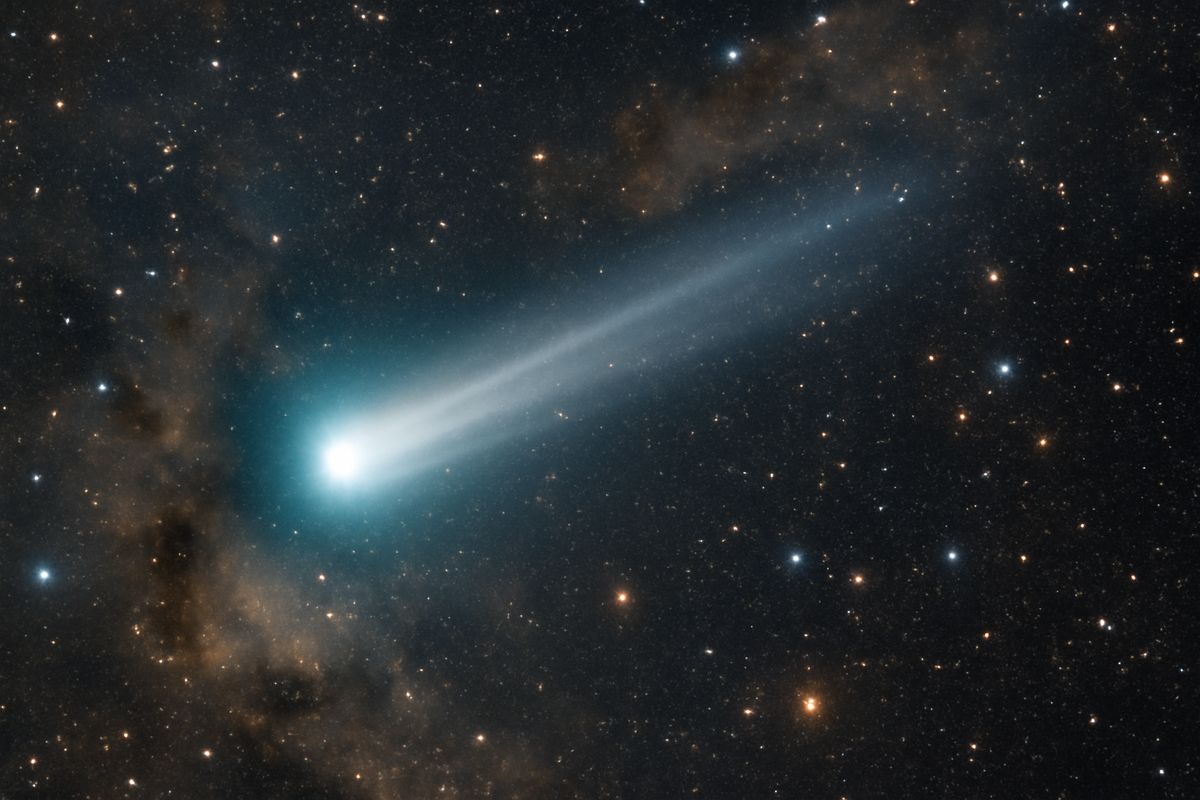
The comet arrived in our skies quietly, like an unannounced traveler slipping through a side door of the galaxy. For weeks, it was just a rumor in the data—faint streaks of light in survey images, a whisper of motion against a static sea of stars. Astronomers labeled it formally, 3I ATLAS, the third confirmed interstellar comet ever discovered. But for many of them, it quickly became something else: a rare chance to watch a visitor from another star system come close enough to touch with their finest instruments. Now, a series of new, stunning multi-observatory images has turned that quiet rumor into a vivid portrait, revealing the comet in unmatched detail and reshaping how we imagine the deep space between the stars.
A Visitor From Elsewhere
Interstellar objects are, by definition, wanderers. They are born around distant suns, in disks of dust and ice not so different from the one that gave our own solar system its planets and comets. But something—perhaps a gravitational scuffle with a giant planet, or a slow, chaotic tug of neighboring stars—kicks them out. Once exiled, they travel the galaxy as solitary migrants, rarely passing close enough to any given star to be noticed. We’ve confirmed only three of these visitors so far: ʻOumuamua, 2I/Borisov, and now 3I ATLAS.
3I ATLAS made its first appearance in early survey data as a thin smudge, no different from countless other faint comets. It was the trajectory that gave it away. Its path across the sky was too fast and too open, following a hyperbolic orbit that would never loop back. It was not simply another long-period comet dropping in from the Oort Cloud. This was an object that had never been bound to the Sun at all, threading our neighborhood on a one-time flyby before vanishing back into the interstellar dark.
By the time astronomers confirmed its interstellar nature, telescopes around the world and in orbit had turned toward it. Observatories in Chile, Hawaii, the Canary Islands, and space-based instruments above Earth’s atmosphere began to share their views, layering wavelengths and techniques to form a unified portrait. Each image was a piece of a puzzle: visible light revealing the graceful tail, infrared showing hidden heat, radio observations tracing molecules streaming off the nucleus. Together, they offered something we had never had before—an almost tactile sense of an alien comet’s true nature.
The Sky Through Many Eyes
If you could sit in a quiet field on a cold, clear night and see 3I ATLAS the way modern observatories do, your vision would need to transform. The sky would no longer be a simple dome of stars. It would become a layered tapestry of wavelengths, each tuned to a different secret of the universe. That is, in essence, what scientists have built by coordinating observations from a global network of telescopes: a shared, composite eye, far more powerful than any single instrument.
The visible-light images of 3I ATLAS arrive first, and they are intoxicating. Against a velvet-black background, the comet’s nucleus is a sharpened pinprick of brightness at the center of a misty glow, the coma. A pale tail stretches away, dust-like, curving gently as the solar wind catches it. The shapes we’ve seen a thousand times in other comets are there, but there’s a freshness to the view, a subtle strangeness—like recognizing a familiar tree species, then realizing it has grown in an entirely different forest.
Switch to infrared, and the scene deepens. In these wavelengths, the coma takes on texture. Warmer regions near the nucleus glow more brightly, hinting at where jets of gas and dust erupt from sunlit cliffs and fissures. Fine structures begin to appear—faint fans, arcs, and shells that betray the comet’s rotation and the rhythm of its outgassing. It no longer feels like a static smear of light. It feels alive, changing from hour to hour as it spins and sheds its icy skin.
Then come the spectra, those streaks of rainbow-split light that act as barcodes of chemistry. Different observatories contribute different slices: some capturing near-ultraviolet emissions from excited gases, others analyzing the infrared fingerprints of organic molecules. Every dip and spike in these spectra corresponds to a specific atom or molecule—water vapor, carbon monoxide, cyanide, complex organics. When astronomers combine all this, they begin to reconstruct the comet’s interior story: what it’s made of, how it formed, and how long it has been drifting between the stars.
The Unfamiliar Heart of an Alien Comet
There is a particular thrill in learning that something looks familiar and utterly foreign at the same time. 3I ATLAS, in the new multi-observatory images, fits this paradox perfectly. In broad strokes, it behaves like a normal comet: as it approaches the Sun, its ices warm and sublimate, feeding a surrounding coma and stretching out a tail. But tucked inside that normalcy are small but telling differences, and those differences come alive in the stitched-together views from multiple instruments.
The nucleus itself is too small and distant to resolve as more than a point, but its behavior speaks volumes. The intensity and structure of its coma—the halo of gas and dust around it—reveal that 3I ATLAS is unusually active for its size. Some images show narrow, jet-like features, faint but distinct, hinting at localized vents on the surface. Others, taken just hours apart, catch small changes in the jet pattern, like a spinning sprinkler viewed in slow motion. From these subtle shifts, astronomers infer the comet’s rotation period and the orientation of its spin axis, piecing together a three-dimensional model out of fleeting glows of light.
What makes 3I ATLAS truly compelling, though, is its chemical fingerprint. Multi-wavelength observations show a mixture of ices and organics that overlap heavily with what we see in comets born in our own solar system—water, carbon monoxide, carbon dioxide, traces of more complex carbon-based molecules. Yet the relative proportions are off, tweaked in ways that hint at a different birthplace. Some volatiles appear surprisingly abundant, others unexpectedly scarce. It’s as though the recipe for making a comet was the same, but the local pantry—some distant protoplanetary disk around another star—stocked different balances of ingredients.
At high contrast in some of the new images, the tail of 3I ATLAS looks almost like brushstrokes, with fine, filamentary structures embedded in a broader glow. These filaments trace the paths of dust grains of different sizes, sifting away under the competing pulls of sunlight and gravity. Their precise curvature and spacing give astronomers a way to probe the dust’s properties—how dark or reflective it is, how quickly it accelerates under solar radiation. Again, the comet feels familiar, but the details carry the accent of another star system.
The Shared Language of Collaboration
Behind every image of 3I ATLAS is a story of collaboration as intricate as the comet’s own tail. No single telescope could have unraveled its chemistry, dynamics, and structure alone. Instead, scientists choreographed a global campaign, aligning schedules across continents and orbital paths. Ground-based observatories had to contend with weather, moonlight, and the comet’s changing position in the sky. Space-based instruments had their own constraints, from limited fuel for attitude adjustments to strict observing queues.
Yet, night after night, data arrived. Teams processed frames, removed noise, calibrated spectra, compared measurements. They shared preliminary results through internal networks, adjusting plans on the fly. One team’s radio detection of a particular molecule would inform another team’s infrared priorities. Visible-light images revealing unexpected jets would prompt higher-cadence follow-ups to catch transient events. In the background, computer models churned, trying to reconcile theories of how such an object might have formed and then wandered far enough to intersect with our Sun.
The outcome of that effort is more than the images themselves; it is a composite understanding embedded in them. When you see a high-resolution, full-color view of 3I ATLAS, you are not just looking at photons captured in a single moment. You are seeing weeks and months of coordinated attention translated into a single visual narrative: an alien body, stripped of anonymity by sheer collective curiosity.
How 3I ATLAS Compares to Other Interstellar Visitors
3I ATLAS is only the third known interstellar interloper to pass through our solar system, and each has felt like a chapter in a developing story. ʻOumuamua, the first, was strangely elongated and lacked the obvious coma of a typical comet. 2I/Borisov, the second, looked more like a textbook comet, with an unmistakable tail and outgassing. 3I ATLAS, in these newest images, seems to land somewhere in between: clearly cometary, but displaying quirks that keep theorists awake.
The table below summarizes some of the key differences astronomers discuss as they compare these rare visitors. It’s not exhaustive, but it offers a sense of how 3I ATLAS fits into the growing family portrait of interstellar objects.
| Feature | ʻOumuamua (1I) | 2I/Borisov | 3I ATLAS |
|---|---|---|---|
| Type | Asteroid‑like, no clear coma | Active comet with clear tail | Active comet, strongly imaged in multiple wavelengths |
| Appearance | Elongated, tumbling, mysterious acceleration | Dusty coma, classic comet morphology | Richly structured coma and tail, multiple jets |
| Key Surprise | Non‑gravitational motion, odd shape | Comet so similar to solar‑system ones | Subtle but significant chemical differences |
| Scientific Focus | Shape, origin, and outgassing physics | Comparative comet chemistry | Detailed multi‑observatory characterization |
Where ʻOumuamua left more questions than answers and 2I/Borisov suggested that other planetary systems can produce comets very much like our own, 3I ATLAS digs into the subtler differences. It shows that even when the overall script looks similar—a small icy body, warmed by a star into shedding its outer layers—the fine print can be rewritten by the conditions of another system’s birth. Tiny shifts in composition translate into distinct patterns of activity, different tail structures, and unique chemical signatures imprinted in the light we detect.
What We’re Learning About Other Solar Systems
Interstellar comets like 3I ATLAS are more than curiosities; they are physical samples of distant worlds that we cannot yet visit. Each grain of dust, each molecule of gas they release carries information about the environment where they formed. By comparing their compositions and behaviors to comets native to our solar system, astronomers begin to sketch the diversity of planetary nurseries across the galaxy.
The multi-observatory campaign on 3I ATLAS has sharpened some of those sketches. For example, the relative abundances of certain volatile compounds can tell researchers how much ultraviolet radiation the comet’s birth disk experienced, or how quickly its ices cooled and froze. Patterns in the dust—its size distribution, reflectivity, and response to sunlight—hint at the temperatures and pressures in that long-ago disk, as well as the mixing of material between its inner and outer regions.
There is also an emerging sense of statistics. Three interstellar objects are not many, but they are enough to suggest that comet formation may be a common outcome of planet-making across the galaxy. The more we find, the more we can start to ask quantitative questions: How typical is our solar system’s chemistry? Are certain kinds of organics universally present? Do most planetary systems fling out comets at similar rates, or is our local neighborhood unusually quiet or noisy?
3I ATLAS, with its unusually detailed portrait, becomes one of the anchor points in this early census. Its carefully imaged jets, its chemically nuanced coma, its well-tracked orbit all feed into models that will be used, years from now, to interpret the next dozen or hundred interstellar comets discovered by new, more sensitive surveys.
Watching a Brief, Bright Passage
There’s a bittersweet element to all of this. However well we document 3I ATLAS, it will not linger. Its hyperbolic trajectory guarantees that once it swings past the Sun and Earth, it will climb back out of the solar system and continue on, deeper into interstellar space. The detailed images we have now are moments borrowed from a journey that began long before humans, or Earth, or perhaps even the Sun existed.
Some astronomers like to imagine following it, riding alongside as it passes through the outer darkness. Beyond the range of solar warmth, its jets would fall silent, its coma collapse, its tail vanish. What would remain is a dormant, pitch-black shard of ice and rock, gliding endlessly through a medium so empty that millions of kilometers could pass without a single collision with a stray molecule. It would become invisible to any practical telescope, a ghost carrying within it the frozen imprint of an ancient star’s surroundings.
And yet, for a brief span of months, we see it clearly. The new images capture 3I ATLAS not as a lifeless shard but as an active, changing body, illuminated by a star it has never visited before and will never see again. We witness foreign ices turning to vapor under our Sun, foreign dust forming arcs and curtains in our sky. We watch its brightness curve rise and fall in carefully plotted charts, each point another heartbeat in a transient encounter between our solar system and the wider galaxy.
Future missions may one day attempt a rendezvous with such objects—a fast, agile spacecraft designed to intercept an incoming interstellar traveler, sampling its dust and ices directly. For now, the combined power of ground and space telescopes is the best we have, and 3I ATLAS shows just how far that approach can go. It feels almost like a rehearsal for a time when these encounters will be routine, cataloged and studied as a matter of course. But it also retains the magic of a first: the sense that we are just learning how to recognize the patterns of the galaxy playing out in our own backyard.
Seeing the Galaxy in One Comet
In the end, the most striking thing about the multi-observatory images of 3I ATLAS may not be a particular jet, or spectral line, or tail feature. It may simply be the realization that we are watching the galaxy talk to itself. Here is an object born in the disk of another star, shaped by forces and conditions that unfolded light-years away. It spends unthinkable ages in the dark, then happens to thread through our solar system, where a species on a small rocky planet has built the tools to notice, to stare, to interpret.
Through those tools, that chance alignment becomes meaningful. The colors and shapes in the images are not just pretty—they are language. They tell us that comet formation is a shared story across stellar systems, that ice and rock and organic molecules assemble and drift and occasionally get flung free, wherever stars are born. They hint that our own solar system, with its comets and planets and oceans, is not a one-off miracle but part of a broader pattern, variations on a theme written into the physics of disks and dust and gravity.
And so, when you look at the new portraits of 3I ATLAS, you are not just seeing a comet. You are seeing a fragment of another world, briefly illuminated by our Sun, decoded by many telescopes acting as one eye. You’re seeing a piece of the galaxy’s long, quiet conversation about how worlds are made and how far their pieces can wander. For a moment, that conversation passes close enough to hear, captured in sharp, vivid detail—and then, like the comet itself, it slips back into the dark, leaving us with images that will linger long after the traveler is gone.
Frequently Asked Questions
What is 3I ATLAS?
3I ATLAS is the third confirmed interstellar object—and specifically an interstellar comet—to pass through our solar system. The “3I” indicates it is the third interstellar object discovered, and “ATLAS” refers to the survey project that first detected it.
How do we know 3I ATLAS is interstellar?
Astronomers track its path very precisely. 3I ATLAS follows a hyperbolic orbit, meaning it is not gravitationally bound to the Sun and will not return. Its incoming speed and trajectory are consistent with an origin outside our solar system.
Why are multi-observatory images so important?
Different telescopes observe in different wavelengths and have different strengths. By combining visible, infrared, ultraviolet, and radio observations from many observatories, scientists build a much more complete picture of 3I ATLAS—its composition, activity, and structure—than any single telescope could provide.
How is 3I ATLAS different from comets in our solar system?
In overall behavior, it looks quite similar: it forms a coma and tail as it approaches the Sun. But detailed spectra and imaging show subtle differences in its chemical makeup and activity patterns, reflecting the conditions of the distant star system where it formed.
Can we see 3I ATLAS with the naked eye?
Most interstellar comets, including 3I ATLAS, are faint and require at least small telescopes or strong binoculars under dark skies to detect. Their brief visibility and rapid motion also make them challenging targets for casual observers.
Will 3I ATLAS ever return?
No. Its hyperbolic trajectory ensures that once it passes through the inner solar system, it will continue outward and never come back. This is truly a one-time encounter.
What do interstellar comets tell us about other solar systems?
They are physical samples of material from other planetary systems. By analyzing their ices, dust, and organics, astronomers infer the conditions in the disks where they formed—offering clues about how common different kinds of planets and planetary chemistry might be across the galaxy.

Hello, I’m Mathew, and I write articles about useful Home Tricks: simple solutions, saving time and useful for every day.