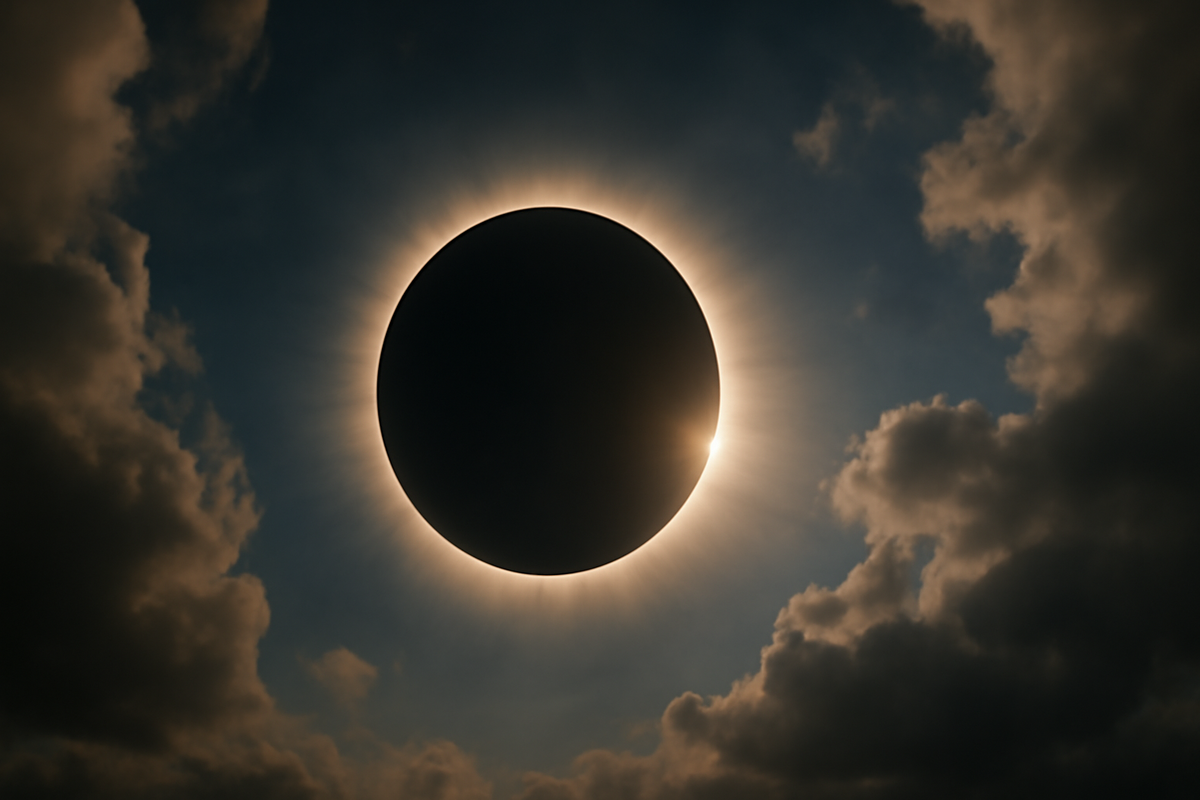
The first thing you notice is the silence. Not right away, not like a switch being flipped, but a slow hush that settles over the world like a heavy blanket. Birds stop. Insects quiet down. Even people’s voices, scattered along a field or park or rooftop, drift into whispers, as if they’ve stepped into a cathedral without quite knowing why. You look up, and the sun—our constant companion, our unblinking eye—has grown a bite, a dark curve eating away at its edge. You know this is coming, you’ve read about it, you’ve planned for it, and yet the feeling as day begins to let go is something you could never rehearse.
When Day Briefly Forgets It’s Daytime
In a human lifetime, there are a few cosmic events that anchor themselves into memory so deeply that you can recall the color of the air, the sound of your own breathing. A total solar eclipse is one of them, and the century’s longest one is on its way—a slender, precise path of darkness sliding across Earth, turning midday into a strange, brief twilight.
What makes this eclipse extraordinary isn’t only its length—several long, luxurious minutes of totality where the sun is completely hidden—but the intimacy of the experience. You can know all the numbers: the tilt of Earth’s axis, the distance to the moon, the careful clockwork of orbital mechanics. Still, what you feel when the last sliver of sun vanishes is older than language. Your skin knows something is not right; your instincts, tuned over eons of uninterrupted daylight, lean forward in alarm.
Planning ahead isn’t just about logistics, though those matter: where you’ll travel, what gear you’ll bring, how you’ll stay safe. It’s about creating the conditions to be fully present when that improbable, almost supernatural darkness descends. Because unlike a sunset, slow and forgiving, this is a brief betrayal of the ordinary. Blink at the wrong moment, and you’ll miss the diamond ring flash. Fumble with your camera too long, and the world will already be brightening again.
The Moon’s Slow Bite and the Gathering Chill
A total solar eclipse begins innocently. Hours earlier, the day is ordinary—a busy city street, a quiet farm, a beach where people are still laying out towels and ignoring the sky. The moon, invisible against the blue, starts to slide in front of the sun. With proper eclipse glasses, the transformation looks clean and clinical: a sharp black disc moving with deliberate patience. Without them, the sky is simply… bright, as it always is.
But then you notice the light beginning to turn odd. It isn’t darker yet, not really. It’s thinner, almost metallic, as if someone has removed a color you can’t quite name. Shadows sharpen, their edges unusually crisp. Leaves and branches cast tiny crescent-shaped spots of light on the ground, small projections of the half-eaten sun flickering on sidewalks, on tent walls, across the hood of your car.
As the moon covers more of the sun, a coolness creeps in. On a hot day, it can feel like stepping into the shade of an enormous invisible tree. The wind may pick up, changing direction in subtle ways, as if the atmosphere itself is unsettled. Animals pay attention. Cows cluster. Birds flock to their roosts. Streetlights might flicker on, confused by the falling light levels. All of this, and the main event—totality—still lies ahead.
Somewhere along that narrow band on Earth, known as the path of totality, people will already be gathering. They’ll have come by car, train, bus, bicycle, and sheer determination. They’ve traded money, time, air miles, maybe even vacation days planned years in advance, for just a few elongated minutes of strangeness. They’re watching the same crescent sun, feeling the same gathering hush, knowing that soon, briefly, the world will not behave the way it is supposed to.
Why This Eclipse Is So Rare—and So Long
Total solar eclipses happen more often than most people realize—about every 18 months somewhere on Earth. But most are short: a muscled, heart-pounding minute or two of darkness, then gone. The century’s longest total solar eclipse will stretch those minutes, giving the moon’s shadow a longer, more generous sweep of the clock.
The exact duration of totality depends on a balancing act: how close the moon is to Earth, how near Earth is to the sun, and where you stand along the path. During this coming event, the moon will be relatively close to us in its orbit, making it appear larger in the sky. At the same time, Earth will be at a distance from the sun that shrinks the solar disc just enough. The result: a perfect overlap and a totality that lingers.
From some prime locations, the sun will remain completely hidden for over six minutes. That might not sound like much until you live through it. Imagine the longest, most charged six minutes of your life, packed with subtle colors, strange shadows, a horizon glowing sunset-bright in all directions at once, and above it all, the sun’s crown—its ghostly corona—spilling into space.
This is not just another eclipse; it is the kind people will reference in old age. “I was there,” they’ll say. “I saw the day go dark and the stars come out while my watch still said noon.” They’ll remember the chill on their arms, the roar of cheering from strangers, the brief, ecstatic panic of the natural world resetting and then, with a sudden brightness, starting again.
Choosing Where You’ll Stand in the Shadow
Before you get to the poetry, there’s the planning. Eclipses are precise, but they are also weather-sensitive. A single stubborn cloud can erase the show. So choosing where you’ll stand in that path of racing shadow becomes part strategy, part weather gamble, part personal pilgrimage.
You’ll want to be within the path of totality, not just “near it,” not “close enough.” Outside that narrow band, you might see the sun turn into the thinnest sliver imaginable, but you will never see the sky fall into true eclipse darkness. Totality is the difference between watching a storm on the horizon and standing directly under the downpour.
Some will chase clearest skies, checking historical climate data and cloud cover maps to decide whether a desert plateau, a coastal region, or a high mountain valley offers better odds. Others will choose the place that feels right: a childhood town, a favorite landscape, somewhere they’ve always wanted to visit. The eclipse becomes a frame, an excuse—cosmic punctuation for a journey that’s as much about Earth as sky.
It helps to think of the day in stages. There’s the long lead-up as the sun is slowly eaten away; the short but explosive totality in the middle; and the afterglow as daylight returns in reverse. Each phase feels different. Each deserves its own attention.
| Stage | Approximate Duration | What to Notice |
|---|---|---|
| Partial Eclipse Begins | 60–90 minutes | Crescent sun through glasses, changing light, sharper shadows, odd coolness. |
| Last Minutes Before Totality | 5–10 minutes | Crescent light patterns under trees, animals reacting, a deepening hush. |
| Totality (Full Coverage) | Up to ~6+ minutes (location dependent) | Corona visible, stars and planets appear, 360° “sunset” on horizon, temperature drop. |
| Return of the Sun | 60–90 minutes | Light and warmth return, sounds of nature resume, gradual return to normal. |
Packing for a Few Minutes That Might Change You
There is a particular kind of packing that feels almost ceremonial. This isn’t throwing clothes in a bag for a generic weekend away. This is preparing for a rendezvous with the sky. Each item you bring is there to protect a sense: your sight, your hearing, your comfort, your ability to remember.
Start with eclipse glasses—the one nonnegotiable. They must meet modern safety standards for solar viewing, with the right certification, not just a pair of dark sunglasses or something improvised. The sun can still burn through your eyes during the partial phases, and even the thinnest crescent is bright enough to cause permanent damage if you stare without protection. Treat them like a seatbelt for your vision: simple, essential, unglamorous.
If you plan to photograph, consider how you can do it without sacrificing your own experience. Filters for your camera lens during the partial phases, yes. Tripod, perhaps. But remember there will be thousands of images more precise and technically beautiful than anything you can take. What they won’t have is your heartbeat behind them. Sometimes the best plan is to snap a quick photo at the beginning of totality, then let the camera hang around your neck while you look with your own eyes.
Bring layers; the temperature drop can be surprising, especially if you’re already at altitude or in a breezy open space. A blanket or small camp chair can make the waiting period comfortable. Snacks, water, and a thermos of something warm turn a scientific event into a picnic with the cosmos. If you’re in a rural area, a headlamp or small flashlight will help when darkness falls abruptly and you’re fumbling with gear.
Most of all, pack intention. Decide, ahead of time, how you want to spend those minutes. Will you stand in silence? Will you shout along with the crowd? Will you take notes in a small journal, capturing impressions as they arrive? Plan not just the journey to get there, but the way you hope to inhabit those fleeting, elongated minutes when day forgets itself.
Listening to the World React
When the moon finally covers the last exposed sliver of sun, there is often a shared, involuntary sound from the crowd—an exhale, a shout, sometimes an eerie silence. Then other sounds rush in. You might hear the sudden chittering of crickets, as if night has been plugged into a speaker system all at once. Birds that had been circling head home in a rush. Dogs may bark, unsettled by a sky that no longer matches their body’s sense of time.
If you stand still enough, there’s a chance you’ll hear your own heartbeat in your ears. The darkness isn’t as complete as midnight; it’s a soft, deep twilight, like the last light before true night. But it feels wrong in the middle of the day, and that wrongness reaches into your nerves. You are, for once, completely aware of the fact that you live on a planet hurtling through space, with a companion moon capable of blotting out the star that feeds you.
Look around, not just up. The horizon becomes a 360-degree ring of color: oranges and pinks in every direction, like standing at the center of the world’s largest sunset. Streetlights glow. Car headlights pop on. Somewhere, a child is asking a quiet, frightened question. Somewhere else, someone is crying softly for reasons they can’t quite name.
Then look back up. With the glaring disc gone, the sun’s corona spreads outward in delicate, ghost-white plumes—fine threads of light held in place by the sun’s magnetic field. Depending on solar activity, it may look compact and feathery or wild and reaching. Nearby, a bright planet or two will appear, punching through the dimness. Stars you never see in the daytime reveal themselves. The sky you thought you knew has new depth.
What Happens When Light Returns
The end of totality happens fast. A bead of sunlight appears at the edge of the moon—a sudden, dazzling point called the diamond ring. The first flash can be shockingly bright after the darkness, like floodlights snapping on in a dark room. It signals two things at once: that you must put your eclipse glasses back on, and that this brief nighttime has passed.
There’s a bittersweetness here. You’ve waited months or years for this, traveled who knows how far, and now the universe is taking it back minute by minute. The strange cold begins to lift, warmth brushing your cheeks, your arms. Crickets quiet down, birds resume their chatter, as if someone has pressed “play” on a paused world.
The partial phases that follow can feel like an epilogue, but they offer their own gentle magic. Crescents broaden into fat smiles, then half-moons of light through the trees, then the familiar comfort of full sunshine. You can breathe a little deeper. The tension—cosmic, animal, emotional—releases gradually.
People begin to stir. They check their phones, swap impressions, pack up blankets and cameras. Yet conversation has changed. Strangers who barely nodded earlier now share stories; there’s a sense that everyone has just traveled through something large together, even though no one moved at all. The eclipse is over, but its imprint lingers: in goosebumps, in shaky laughter, in the way people keep sneaking backward glances at the sky, as if expecting it to misbehave again.
Carrying the Shadow Forward
Long after the last crescent of shadow has slid away, you might find that the eclipse follows you. It will be there when you wash the dust off your hands that evening, wondering if it really got as dark as you remember. It will be there when you scroll through blurry photos and realize the best ones aren’t the pictures at all, but the expressions on faces turned upward.
For many, a total solar eclipse rearranges something inside. It can compress the scale of your life into perspective: all your deadlines and grocery lists and minor grudges briefly dwarfed by moving shadows and burning crowns of plasma. You stood on a spinning rock in the path of a traveling darkness that could be predicted to the second, a choreography larger than any story you’ve told yourself about how the world works.
This is why people chase them, crisscrossing continents to stand for just a few minutes under the moon’s shadow again and again. It isn’t just about astronomy. It’s about humility, awe, and a kind of shared vulnerability. In those minutes, humanity stands together, necks craned, united by a single bright absence in the sky.
So plan, yes. Book your travel early if you can. Study maps of the path. Check the weather trends. Find your spot on a hill, a rooftop, a field, or a quiet stretch of countryside. Pack your glasses, your layers, your snacks, your wonder. Arrange your life so that on that particular day, at that particular time, you can stop everything and stand in the path of the shadow.
Because for just a brief slice of the century, the dependable day will forget itself. Noon will look like the edge of night. The sky will reveal a side of the sun usually hidden from you. The world around you will shiver, hush, and then, slowly, resume. And you’ll be there—not just as a spectator, but as a small, aware creature caught in the precise, beautiful gearwork of the cosmos, watching the lights dim and return.
Frequently Asked Questions
Is it really dangerous to look at a solar eclipse without proper glasses?
Yes. Looking at the sun without certified solar viewing glasses can cause serious, permanent eye damage, even when most of the sun is covered. Ordinary sunglasses are not safe. You can take off your glasses only during the brief totality phase, and you must put them back on the moment the sun begins to reappear.
How long will this “century’s longest” total solar eclipse last?
The exact duration depends on where you are along the path of totality, but at some locations, total darkness will last for more than six minutes. Most other total eclipses offer only about one to three minutes of totality, so this event is unusually long.
Do I need to be exactly in the path of totality to enjoy it?
To experience full darkness and see the sun’s corona, you must be inside the path of totality. Outside it, you will see only a partial eclipse. That can be interesting, but it will never produce the deep twilight, visible corona, or stars appearing in the middle of the day.
What if it’s cloudy where I am on eclipse day?
Clouds can block your view of the sun, but you may still notice the eerie dimming of light, changes in temperature, and reactions of animals. To improve your chances of clear skies, many people choose locations with historically low cloud cover for that time of year and remain flexible enough to move if forecasts change.
Can I photograph the eclipse with my phone?
Yes, but you should protect both your eyes and your device. During partial phases, your phone’s lens can benefit from a small solar filter, and you must always keep your eclipse glasses on while framing the sun. During totality, when the sun is fully covered, you can remove filters briefly and capture the corona—but consider limiting your photography so you don’t miss the experience itself.
Will animals really act differently during the eclipse?
They often do. Birds may head to their roosts, crickets may begin chirping, and domesticated animals can appear uneasy or confused. Many of these reactions are triggered by sudden changes in light and temperature, which mimic the rapid onset of evening.
Is it worth traveling a long distance just for a few minutes of darkness?
Only you can decide, but many who have made the journey describe the experience as one of the most powerful natural events they’ve ever witnessed. Those minutes are dense with sensation, emotion, and perspective—often enough to justify the miles, the planning, and the wait.

Hello, I’m Mathew, and I write articles about useful Home Tricks: simple solutions, saving time and useful for every day.