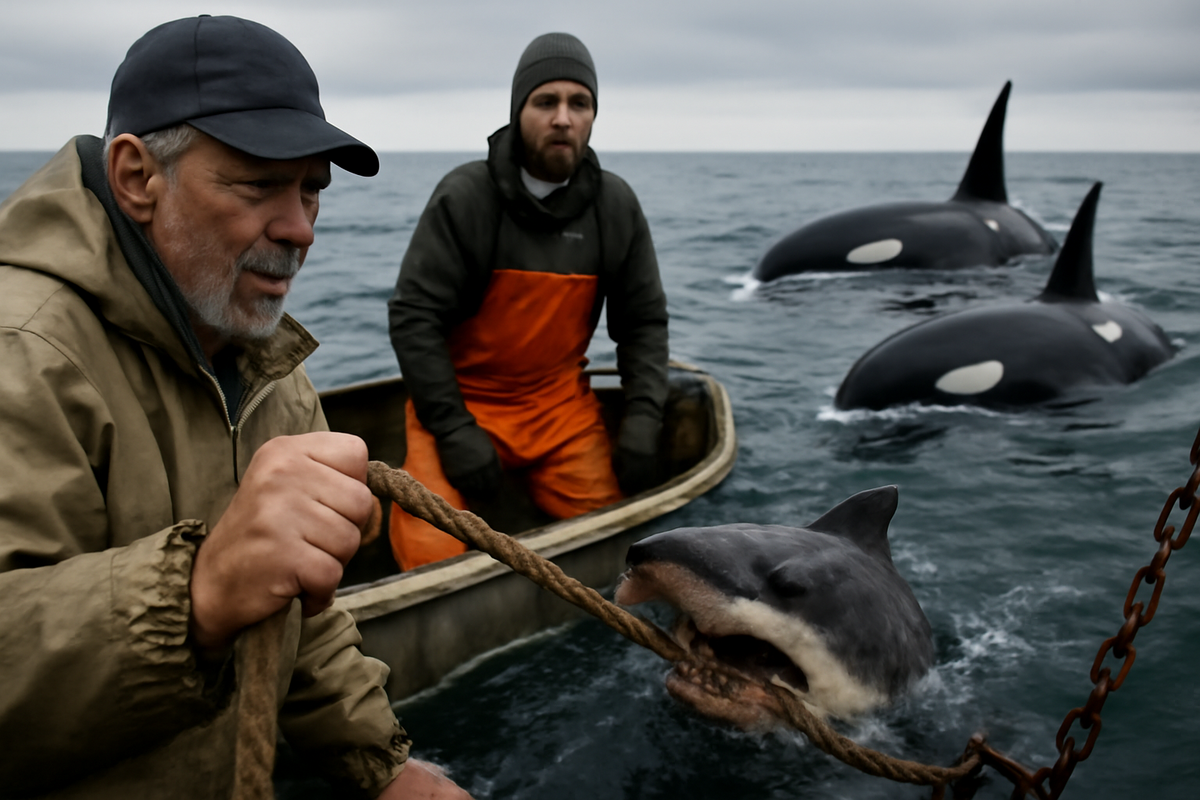
The sea was almost too calm the morning the orcas arrived. The kind of glassy, silver-blue calm that makes you forget how quickly the ocean can turn on you. Mike had just poured his second cup of coffee, leaning against the wheelhouse door of his small fishing boat, when he felt it—a tremor that wasn’t quite wind, not quite wave. The boat shivered under his boots, as if something large had passed beneath the hull. Then he heard Steve shout from the stern, voice tight enough to slice through the lazy stillness.
Circling Shadows in a Glistening Sea
There’s a particular kind of silence that descends when a predator appears on the water. Not the pleasant hush of dawn or the soothing lull of an incoming tide. This one is tighter, edged with the thump of your own heartbeat and the soft squeak of rope against metal. The men fell quiet as they spotted the first black-and-white shape cutting just under the surface, a shadow with a fin that rose like a black flag through the morning glare.
Orcas. A whole pod of them.
They came in hard and sudden, like a story already halfway told. One surfaced thirty feet off the bow, exhaling a sharp, explosive breath that misted in the cool air. Another slipped along the port side, its white eye patch gleaming like a watchful lantern. Then the circling began. Not cruising by, not passing through on their way to somewhere else. No—this was deliberate.
The orcas swept around the boat in wide, tightening arcs, their dorsal fins slicing through the slick water. Mike and Steve stood frozen at the rail, hands resting on the salt-sticky gunwale. Beneath them, the anchor rope hummed with the gentle surge of the sea floor pulling back, a quiet tautness. The engine was off. The boat was resting. They were, in the harshest terms, stuck.
“You seeing this?” Steve muttered, as one of the orcas rolled onto its side, passing close enough that they could see the mottled gray saddle patch behind its fin. The animal’s eye looked small and dark, but impossibly aware—an intelligence measuring them, boat and men both, as if assessing the shape of this unusual creature hovering above.
The Sudden Violence Below the Keel
At first, they thought the encounter would be like others they’d had—the casual curiosity of a passing pod, a brief spectacle of wild beauty before the animals vanished into deeper water. But this wasn’t that. The orcas’ circles tightened. Their movements sharpened. One surged under the boat so close they felt the thud of its body reverberate up the hull.
Then, as if someone flipped a hidden switch, everything erupted beneath them.
The anchor rope jerked violently. The boat lurched. Coffee sloshed in the mug, arcing brown trails over white fiberglass. Mike grabbed for the rail as the bow dipped forward, the boat dragged suddenly by a force that didn’t match the lazy pull of tide or current.
“Something’s on the rope!” Steve yelled, lunging for the anchor line where it disappeared over the bow roller. It went tight, then slack, then juddered again with a crunching vibration that traveled through the metal fittings.
What happened next passed in a chaos of impressions: a massive, pale shape rising out of the green depths on the starboard side; the flash of a gray back patterned not with the clean black-and-white armor of an orca but with scars and scratches; a jaw, wide and rough-edged, closing on something just out of sight beneath the bow.
“Shark!” Mike shouted, the word ripped from him like a reflex. A great white, easily fifteen feet long, twisted just below the surface, its muscular body flexing as it chomped again and again in short, brutal jerks. The anchor rope shivered with each impact, fibers creaking under the strain.
The shark wasn’t attacking the boat itself. It was locked onto the rope.
And all around them, the orcas kept circling.
The Strange Dance Between Hunters
Scenes like this have emerged in fishermen’s stories from remote coasts and well-worked fishing grounds alike, told in late-night dockside conversations with that careful blend of bravado and unease. Orcas closing in, not on the fish, not on the nets, but on the very space around the boat. And then, as if summoned by the commotion, sharks lunging at anchor ropes or lines, sawing into braided nylon with serrated teeth that can make short work of stubborn gear.
The pattern is blurry, sketched in anecdotes and radio chatter: a pod of orcas appears, behaves aggressively—surging close, pacing the hull, sometimes ramming or pushing smaller vessels. About the time the fishermen start planning their exit, something large and heavy grabs the anchor rope below, biting at it, chewing. As if the shark is trying to cut them loose, or drive them away, or stake its own claim to the patch of ocean that the orcas have just laid siege to.
Scientific research hasn’t fully caught up with these stories yet. Orcas and great white sharks are notoriously complex animals, highly intelligent, capable of changing their behavior based on experience. In some places, scientists have documented orcas attacking great whites, driving them off hunting grounds, even preying on them specifically for their nutrient-rich livers. In others, the dynamics are murkier, more like a silent negotiation of territories and opportunities.
But to the fishermen out there, engine off, rope down, boat rocking in the cradle of something they can feel but not see, the question is not an abstract one. It’s visceral. The shark’s teeth on the rope are as real as the tremor in their knees.
| Observation | Fishermen’s Description | Possible Explanation |
|---|---|---|
| Orcas circling anchored boats | “They encircle us, tight and deliberate, like they’re herding the boat itself.” | Investigative or territorial behavior; curiosity about engine noise or fishing gear. |
| Sharks biting anchor ropes | “Feels like something’s sawing through the line from below.” | Mistaken identity (rope as prey/entangled fish) or reaction to stress and commotion. |
| Orcas and sharks present together | “You see fins everywhere—some black and tall, some ghosting just under the surface.” | Predators converging on the same feeding area or carcass; complex interactions not fully understood. |
| Gear damage and cut ropes | “Anchor gone, line shredded clean like it went through a grinder.” | Shark bites, friction against hull or rocks, or tension failures during animal encounters. |
Stories from the Wheelhouse
Ask around in harbors where the ocean still feels close enough to breathe, and you’ll hear similar tales ripple through the conversations like tides running through a narrow channel.
A skipper out of a remote peninsula remembers a day when orcas pinned his small boat in place. “They formed this ring,” he told me, hands sketching invisible circles in the air, knuckles scarred white from years of rope work. “Every time I went to start the engine, one would surface right off the stern, like it was waiting. Then the anchor line went crazy. I thought we’d hooked onto a rock. Until I saw the tail.”
He described the shark as a dark missile rising out of the depths, mouth latched around the thick rope. With each shake of its head, the fibers shredded. The fishermen killed the engine again, hoping to ride out whatever was unfolding beneath them. “It felt like we’d dropped anchor into an argument we didn’t understand,” he said.
Another crew, farther south, watched as orcas harried a shark near their hooked longline, driving it away from their gear with uncanny coordination. “They weren’t interested in us,” one of the deckhands said. “We were just the unlucky audience. But you could feel every move in the hull—every push, every rush of water.”
In these stories, the details shift—the swell height, the color of the water, the length of the encounter—but some elements repeat with eerie consistency: encircling orcas, agitated sharks, anchor ropes or gear lines becoming the unexpected focus of underwater aggression. Boats become unwilling participants in a drama as old as life itself: predators meeting predators, with territory, food, and dominance at stake.
For the people standing on those trembling decks, what matters is not a perfect ethological explanation. It’s whether the anchor holds. Whether the rope survives the teeth testing its strength. Whether the boat, that thin shell of fiberglass or steel, remains ignored amid the collisions of bodies below.
Why Anchor Ropes? The Puzzle Under the Surface
To someone sitting safely ashore, the idea of a shark biting an anchor rope sounds almost absurd. There’s nothing appetizing about coarse synthetic fibers soaked in saltwater. And yet, talk to enough fishermen and a pattern emerges—shredded lines, lost anchors, the sickening, weightless drift when the boat begins to swing free with no tether to the seabed.
One explanation lies in perspective—or rather, the lack of ours. In murky water, from below, a rope stretching down from an object silhouetted against the sky might not look like a rope at all. It might resemble the body of a struggling animal, or a line attached to a hooked fish, especially if bait or bycatch is tangled around it. Sharks, guided by their electroreceptive senses and tuned to the vibrations of distress, may be zeroing in on the phantom signals of something “alive” shaking the rope.
Then there’s the possibility of displaced aggression. Imagine a shark suddenly surrounded by orcas—large, coordinated hunters with a reputation for targeting even formidable predators. The shark might redirect its stress toward the nearest tactile object: the rope, a physical thing it can grab, shake, tear. To us, it looks like deliberate sabotage. To the shark, it might be more like biting at confusion.
Some fishermen swear that the sharks arrive only after the orcas have circled for a while, as though drawn by the echo of chaos. There could be blood in the water from a kill out of sight, or the thrash of disturbed fish fleeing in all directions. In that atmosphere of churned-up signals, a rope vibrating under tension becomes another piece of the puzzle, another thing to test with teeth.
Meanwhile, orcas themselves are no strangers to interacting with boats. In certain regions, they’ve learned to target fishing gear, plucking fish from longlines with surgical precision. In others, reports have described orcas nudging, pushing, even ramming vessels. Whether it’s play, aggression, learning, or some mix of all three, we’re only beginning to understand just how quickly these animals can adapt their behavior.
Between Fear and Wonder on the Open Water
Out there, far beyond the breakwater, admiration and fear are never entirely separate emotions. They sit side by side, like two old crewmates who’ve learned to share a bench even when they don’t always speak.
There is the wonder: the sleek curve of an orca’s back as it rises through sun-striped water; the silent power of a shark veering up from the greenish dark, its skin marbled with old scars that map a lifetime of survival. There is the humbling knowledge that these animals have been negotiating power and risk in this liquid world for millions of years, long before humans first lashed planks together and called it a boat.
And there is the fear. The fast, bright kind that sharpens your senses when the boat vibrates from something unseen. When the rope that stands between you and a drifting, engine-dead nightmare begins to fray. When a predator’s head, larger than a person, materializes beside the hull with a casual ease that reminds you that in this equation, you are small, soft, and entirely outmatched.
Modern fishing vessels come with technology—radar, GPS, sonar screens glowing green and blue in the dim wheelhouse. But none of that feels particularly useful when the anchor line is shuddering and the horizon is nothing but a clean unbroken circle. In those moments, the oldest knowledge takes over. Fingers on rope. Eyes on water. Voices low but steady.
“You ride it out,” one veteran fisherman told me, his gaze drifting unconsciously to the harbor entrance as though replaying old storms and stranger encounters. “You don’t pick a fight with something that lives down there full-time. You just hope they don’t decide you’re in the way.”
What These Encounters Teach Us About Wildness
Stories of sharks biting anchor ropes after orcas aggressively encircle a boat might sound like maritime folklore, the kind of exaggerated tale that swells in the retelling. Yet, threaded through them is something quieter and more important: a reminder of how little control we truly have offshore, and how dynamic the relationships between wild animals really are.
We prefer our predators in separate chapters: orcas here, sharks there, humans looking on from a distance like objective narrators. But the reality is a swirling overlap of territories and instincts. Orcas may displace sharks from favored feeding grounds. Sharks may capitalize on scraps from orca kills. Both may respond to the sudden, persistent presence of human boats in ways we haven’t yet fully grasped.
For fishermen, these are not academic questions. Every shredded anchor rope is an expense, a delay, a risk. Every close encounter with orcas or sharks recalibrates the unspoken agreement between work and danger. They learn to read the water differently. To listen for distant blows on the surface, to scan for tall dorsal fins cutting the horizon, to feel the mood of the sea shift when large animals arrive.
Yet, ask many of them whether they’d choose a life without these moments, and the answer comes back complicated. The same wildness that threatens also draws them in, year after year, tide after tide. To be out there when an orca surfaces beside the bow, or when a shark’s shadow brushes the keel, is to stand in the doorway of a world still mysterious, still untamed.
In an age when so many landscapes have been domesticated, paved over, logged, or fenced, the open ocean remains one of the last places where human plans can be so easily, so casually overruled. You can chart your course, calculate your fuel, pick your fishing grounds based on satellite data—and still find yourself hovering over a patch of sea where apex predators are negotiating something entirely their own, and your anchor rope just happens to be in the middle.
On that quiet morning when the orcas encircled Mike’s boat and the shark tore at his anchor line, the rope eventually gave way. One last violent jolt, a sound like a muffled crack, and suddenly the tension vanished. The bow sprang up, the boat swung free, drifting with the lazy indifference of the surface swell once more. The shark slipped back into the green, the orcas widened their circles, then in a series of clean, powerful dives, vanished toward deeper water.
The men started the engine, hands moving with the jerky clumsiness that comes after adrenaline begins to burn off. The sea smoothed itself over the disturbance, keeping its secrets, as it always does. But for the crew, the memory of that moment hung in the air like salt, sharp and indelible.
Out there, among circling fins and humming anchor ropes, you’re reminded that the ocean is not a backdrop or a resource alone. It’s an arena of ongoing conversations between species—some subtle, some violent, many we can’t fully hear. Every bitten rope, every shredded line, every whispered story on a dark dockside is another fragment of that larger, restless narrative.
FAQ
Do sharks really bite anchor ropes?
Yes, fishermen in various regions have reported sharks biting anchor ropes and other lines. While scientific studies on this exact behavior are limited, physical evidence like shredded ropes and eyewitness accounts suggest it does occur, especially during high activity around boats.
Why would a shark bite a rope instead of prey?
Sharks may mistake ropes for struggling animals or gear holding hooked fish, particularly in low visibility. They also respond to vibrations and electrical signals; a tensioned, vibrating rope can attract investigative bites, especially in the chaos of multiple predators nearby.
What role do orcas play in these encounters?
Orcas are apex predators and highly intelligent. In some cases, their presence and behavior—encircling boats, hunting nearby, or displacing other predators—may create conditions that draw sharks in or agitate them, indirectly leading to rope-biting behavior.
Are these interactions dangerous for people on the boat?
Most of the danger is indirect. Sharks and orcas rarely target boats deliberately as prey, but their size and power can damage gear, compromise anchors, or jolt vessels. A cut anchor rope can lead to drifting in unsafe conditions, which is a serious risk for crews.
Is this behavior becoming more common?
It’s not fully clear. Fishermen’s reports suggest some regions are experiencing more frequent interactions with orcas and sharks around boats, possibly due to changes in prey distribution, climate shifts, or learned behavior in these animals. Better reporting and communication also make such stories more visible today.

Hello, I’m Mathew, and I write articles about useful Home Tricks: simple solutions, saving time and useful for every day.