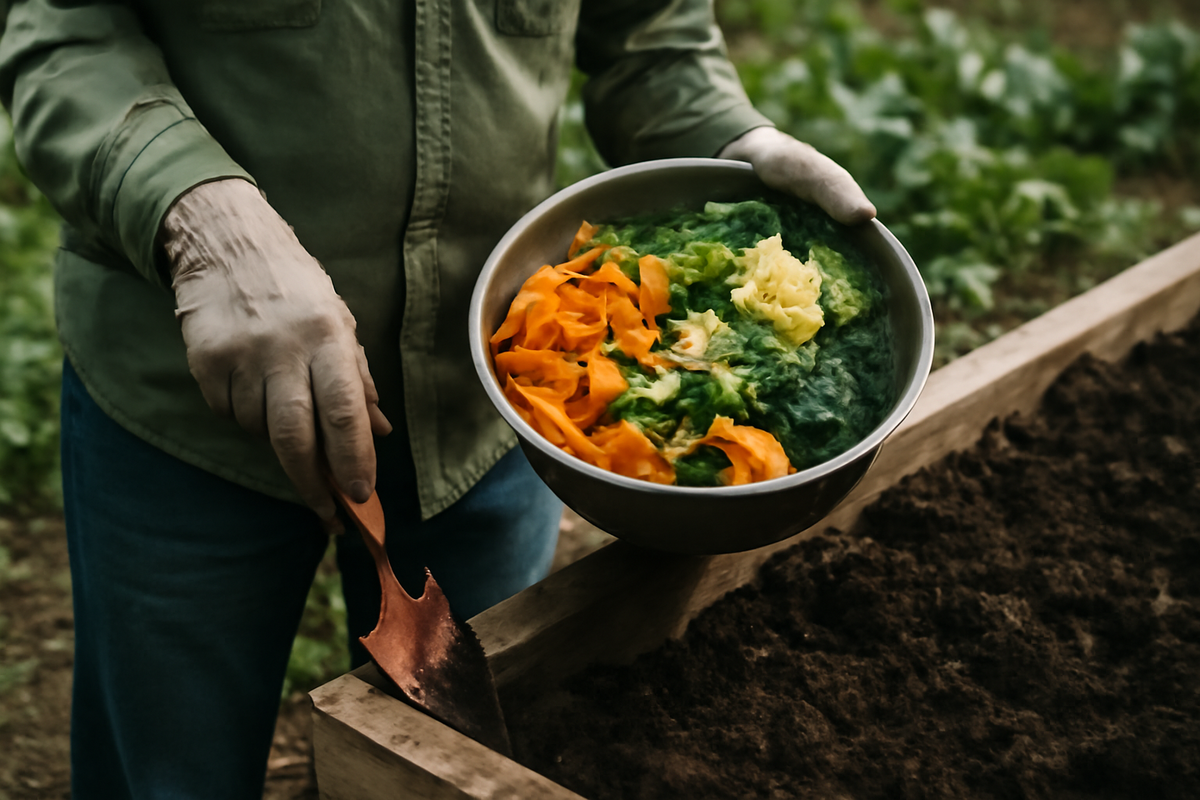
The first time I watched someone bury their dinner scraps like treasure, I thought they were joking. It was late summer, and the kind of warm evening where basil perfumes the whole yard and the air feels slow and honey-thick. My neighbor, Ana, stood in the garden with a dented metal bowl of what looked like compost-in-progress: crushed eggshells, onion skins, a banana peel, a handful of coffee grounds, the ragged ends of carrots and leeks. Instead of dumping it onto a compost pile, she knelt by a tomato plant, dug a shallow trench, and gently tucked the scraps into the earth as if planting something precious.
“Fertilizer,” she said, dusting her hands. “The kind you can’t buy in a bag.”
Those tomato plants? They were the size of small trees, heavy with fruit so sweet it tasted like the word “August” itself. That night I went home and looked differently at my kitchen trash bowl. What if this wasn’t waste at all? What if this was the most overlooked, powerful fertilizer I already owned?
The quiet revolution in your kitchen bowl
Across backyard fences, in apartment balconies, and on tiny urban patios, gardeners are whispering the same secret: the leftovers from your harvest – and even your kitchen – can outcompete expensive commercial fertilizers when used wisely. This isn’t about being frugal for frugality’s sake (although saving money never hurts). It’s about feeding the soil in a way that feels deeply reciprocal, almost intimate.
Instead of ripping nutrients from the earth and replacing them with something manufactured, these gardeners are looping the story back on itself. The carrot tops become food for the carrots that haven’t been planted yet. The cracked eggshells of breakfast become the calcium in next season’s peppers. The onion skins that once framed a stew return as a micronutrient-rich mulch under your roses.
If you listen to them talk, you’ll hear it in their language. They don’t say “waste.” They say leftovers. They say amendments. They say gifts. And they swear that, when used carefully, these homegrown fertilizers can rival — and sometimes surpass — what’s stacked in neat plastic bags at the garden center.
The slow magic beneath your feet
To understand why harvest leftovers work so well, you have to think like soil. Commercial fertilizers, especially synthetic ones, are like fast food for plants: a quick hit of nitrogen, phosphorus, potassium, often delivered in easily soluble forms. The plants gobble them up, grow fast, and look great in the short term. But the soil itself? It doesn’t always get better. In some cases, it can even get worse — compacted, depleted of organic matter, less alive.
Harvest leftovers work differently. They move at the speed of decomposition, not manufacturing. Banana peels, coffee grounds, crushed eggshells, vegetable stems, spent pea vines — these aren’t just nutrient packets. They’re food for the complex underground civilization of bacteria, fungi, worms, and insects. Those creatures, in turn, break them down into slow-release nutrients and humus that improve soil structure, water retention, and resilience.
If you’ve ever pushed your hand into a bed enriched with organic matter for years, you know the feeling. The soil doesn’t crumble so much as sigh; it’s loose, dark, faintly sweet-smelling, full of tiny roots and threads of mycelium. That’s what harvest leftovers build. Not just a fertilized plant, but a living system.
Eggshells: crunching calcium back into the soil
On a chilly spring morning, you might hear it: the brittle crackle of someone crushing eggshells in their hands before scattering them at the base of tomato plants. Eggshells are about 95% calcium carbonate, and calcium is a quiet hero in the garden, helping prevent blossom end rot in tomatoes, peppers, and squash, and contributing to strong cell walls in all plants.
The trick, experienced gardeners will tell you, is in the preparation and the patience. Whole or half shells break down at a glacial pace. Instead, they rinse them, dry them on a tray or in a low oven, then crush them as finely as possible — sometimes even pulsing them into a coarse powder in an old blender. This increases the surface area, helping the shells dissolve into the soil more efficiently over time.
Then the shells are worked into the top few inches of soil in planting holes or sprinkled in a ring around established plants. Not as a miracle overnight cure, but as a long-term, slow-release calcium bank that will keep giving for seasons to come.
Banana peels and coffee grounds: breakfast for the beds
On the edge of a tiny city balcony garden, a ceramic bowl sits by the sink. Every morning, the routine is the same: peel a banana, make coffee, then feed the plants. Banana peels, rich in potassium and a cocktail of trace minerals, get snipped into small pieces with kitchen scissors. Used coffee grounds — nitrogen-rich and beloved by soil organisms — get scooped up from the French press.
Instead of tossing them in the trash, the gardener pushes aside a bit of potting mix in each container and buries a handful of peel pieces beneath the surface. The coffee grounds are scattered thinly on top, never thick enough to form a mat, then gently raked in.
It smells like morning, like roasted beans and faint fruit. Over the next few weeks, the leaves on the balcony tomatoes deepen in color. The basil becomes so lush it has to be harvested in armfuls. The soil itself feels softer, more crumbly, less prone to drying into a hard crust.
Commercial fertilizers could have done the job, of course. But here, the ritual is half the point. Breakfast becomes a shared activity, a daily practice of giving back what was taken, one banana peel and coffee scoop at a time.
Leafy leftovers: greens that keep on giving
Walk through a garden in mid-harvest and you’ll see the aftermath of abundance: beet tops with ragged edges, outer cabbage leaves stripped from heads, carrot fronds piled in an emerald heap, pea vines yellowing after their final flush of pods. In many gardens, these would head straight to a compost bin. In others, they skip the middleman and go right back into the bed as green manure.
Gardeners lay these leafy leftovers between rows as a soft, verdant mulch. Within a few days, the greens start to sag, then collapse into a moist mat that shades the soil, keeping it cool and reducing water loss. As they decompose, they slowly leak nitrogen and other nutrients into the soil, feeding the next wave of crops — often fall plantings like kale, garlic, or cover crops.
In more intensive plots, those same leftovers get chopped with a sharp hoe or garden knife and lightly dug into the top layer of soil. The effect can be startling: where there was dry, tired soil after a summer of heavy harvest, a few weeks after incorporating plant residues, the earth looks darker, more alive, threaded with new roots and dotted with earthworm castings.
How these homemade fertilizers stack up
So how do harvest leftovers really compare to store-bought fertilizers? Gardeners who swear by them don’t just rely on gut feeling. Over seasons, they observe deeper color in leaves, more even growth, fewer nutrient deficiency symptoms, and soil that only seems to improve. While homemade inputs are less exact and slower-acting, they bring something to the table that bagged products rarely do: complex organic matter and a full spectrum of micronutrients.
| Source | Main Benefits | How Gardeners Use It |
|---|---|---|
| Crushed eggshells | Calcium, slight pH buffering, soil structure | Dried, crushed fine, mixed into planting holes or topsoil around tomatoes, peppers, brassicas |
| Banana peels | Potassium, small amounts of phosphorus and micronutrients | Chopped and buried shallowly near root zones, or soaked in water to make a mild “banana tea” |
| Coffee grounds | Nitrogen, organic matter, texture improvement | Thinly spread and mixed into topsoil or added to compost; often used around acid-loving plants |
| Leafy crop residues | Nitrogen, carbon, soil life stimulation | Used as surface mulch or lightly dug in as green manure after harvest |
| Onion/garlic skins | Trace minerals, mild pest deterrent for some gardeners | Brewing into a weak tea for watering, or shredded and added to compost or mulches |
Commercial fertilizers deliver known quantities of nutrients, which can be helpful for specific deficiencies or container-grown plants that need precision. But many home gardeners find that, once their soil has been consistently fed with organic leftovers for a few years, the need for those bright, granular pellets drops sharply. The plants seem to find what they need in a soil that’s become a self-service buffet.
Onion skins, garlic papers, and the scent of subtle alchemy
There’s a quiet ritual some gardeners save for late winter, when seed catalogs are dog-eared and the ground is still locked in frost. All season long, they’ve been saving the papery outer skins of onions and garlic, tucking them into a jar by the stove. When the jar is full, they pour warm water over the brittle layers and let them steep for a day or two, turning the liquid a faint amber, scented like the memory of soups.
Strained and diluted, that “onion skin tea” becomes a gentle tonic for seedlings and houseplants. While research on its exact nutrient profile is still emerging, gardeners love it as a low-risk, mineral-rich drench. Some swear it helps strengthen young stems and intensify leaf color. Others simply enjoy the feeling of continuity — last season’s aromatics, nurturing this season’s beginnings.
The remaining softened skins don’t go to waste either. They’re worked into potting mixes or tucked under mulch layers, where they break down quietly, thread by thread, into the soil web.
The trench method: burying treasure on purpose
If there is one technique that convinced many skeptics, it’s trench composting — the grown-up version of what I watched Ana do with her metal bowl of scraps. Instead of building a traditional compost pile, gardeners dig narrow trenches or holes right in their beds and bury kitchen and harvest leftovers directly where future roots will grow.
In autumn, they might dig a long trench down the center of a bed, fill it with chopped plant residues, fruit and vegetable scraps, crushed shells, and coffee grounds, then cover it completely with soil. Over winter, the buried material decomposes in place. By spring, when seedlings are ready to go in, that former scrap layer has mostly transformed into dark, soft soil. The bed feels springy underfoot, almost like a forest floor.
It’s a method that appeals to gardeners who don’t have space or patience for building and turning big compost heaps. It’s also deeply satisfying in a storytelling sense: the notion that every carrot peel has a literal place in the ground, that the bed remembers last season’s meals and feeds the next ones accordingly.
The boundaries and the balance
For all their benefits, harvest leftovers aren’t a free-for-all. The gardeners who use them successfully talk as much about limits as enthusiasm. Too many fresh coffee grounds in one place can create a dense, water-repelling layer. Large chunks of banana peel near the surface can attract pests. Adding diseased plant material back into the soil can carry problems forward instead of healing them.
So they chop things small. They bury instead of scattering where smells or pests might be a concern. They avoid tossing in meat, dairy, or oily foods, which break down poorly and can draw animals. They keep diseased foliage out of their in-bed experiments, sending those to municipal compost or burning where regulations allow.
And they pay attention. When leaves turn pale or growth seems stunted, they don’t insist that scraps alone will save the day. A soil test, a bag of balanced organic fertilizer, a targeted amendment like rock phosphate or kelp meal — these remain tools in the shed. But they become supporting characters, not the lead role.
Above all, they trust time. The first year may show modest changes. By the third season of consistent practice — always feeding the soil with what the garden and kitchen give back — the difference is unmistakable. Beds hold moisture longer in heatwaves. Roots run deeper. Earthworms appear where there were none. Plants stand back up faster after wind, survive drought with less sulking, and greet early frost with a kind of quiet sturdiness.
A new story of fertility
If synthetic fertilizers embody the idea of control — the right numbers, in the right ratio, in the right season — then harvest leftovers invite something softer, more relational. You start to notice patterns: how your tomatoes seem to lean toward the patch of earth that’s been fed crushed shells and banana skins for years. How your leafy greens respond in kind to the chopped stems of their predecessors laid down as mulch at their feet.
You begin to see your kitchen not as a separate world, but as the first chapter in the garden’s story of abundance. The onion you chopped for dinner once stood in soil; now its papery sheath stands ready to nourish the next seedling. The eggs from breakfast once contained the possibility of life; now their empty shells become the scaffolding for new growth, invisible but essential.
There is something deeply comforting in this closed circle; a sense that nothing really ends, it just changes form and direction. Gardeners who swear by harvest leftovers aren’t just saving money or avoiding synthetic chemicals. They’re writing a different kind of narrative about fertility — slower, more fragrant, occasionally messy, and profoundly rooted in reciprocity.
One evening, late in the season, you might find yourself standing over a bowl of scraps and pausing before the trash can. You might walk outside instead, dig a small hole, and place those leftovers into the cool, breathing dark. You might pat the soil back down and look at the space where nothing yet grows — and feel, suddenly, that you’re not throwing something away at all.
You’re planting next year’s harvest.
Frequently Asked Questions
Can harvest leftovers really replace commercial fertilizer completely?
In many home gardens with healthy soil, consistent use of harvest leftovers and other organic matter can greatly reduce or even eliminate the need for commercial fertilizers. However, if your soil is severely depleted or you grow heavy-feeding crops intensively, you may still need occasional targeted amendments based on soil tests.
Is it safe to bury kitchen scraps directly in my beds?
Yes, as long as you stick to plant-based materials like fruit and vegetable scraps, coffee grounds, tea leaves, and clean eggshells. Chop them small, bury them at least 10–15 cm deep, and avoid meat, dairy, oils, and diseased plant material to prevent pests and odors.
Will using coffee grounds make my soil too acidic?
Used coffee grounds are only mildly acidic and often close to neutral. When applied in thin layers and mixed into the soil or compost, they are unlikely to significantly change soil pH. Problems arise only when large, thick layers are left on the surface, which can create a dense, crusty mat.
How long do eggshells and banana peels take to break down?
Finely crushed eggshells can start contributing calcium within a growing season, but they also continue breaking down for years. Chopped banana peels usually decompose within a few weeks to a couple of months, depending on soil temperature, moisture, and microbial activity.
Can I use diseased plant material as fertilizer if I bury it deeply?
It’s best to avoid returning diseased stems and leaves directly to your beds. Some pathogens can survive in soil and reinfect future crops. Dispose of diseased material through municipal green waste systems, hot composting that reaches high temperatures, or other locally recommended methods.
Do harvest leftovers attract rodents or pests?
They can, if left on the surface or if you include meats, fats, or large chunks of food. To minimize problems, chop scraps small, bury them well, cover thoroughly with soil, and avoid animal products. In containers or small spaces, start with modest amounts and observe how your local ecosystem responds.
Is there a “right” ratio of different leftovers to use?
You don’t need exact ratios, but balance helps. Aim to mix “green” materials (fresh peels, coffee grounds, leafy residues) with “brown” materials (dried leaves, shredded paper, straw) over time. Diversity is your ally: the more varied your inputs, the wider the range of nutrients and benefits for your soil.

Hello, I’m Mathew, and I write articles about useful Home Tricks: simple solutions, saving time and useful for every day.