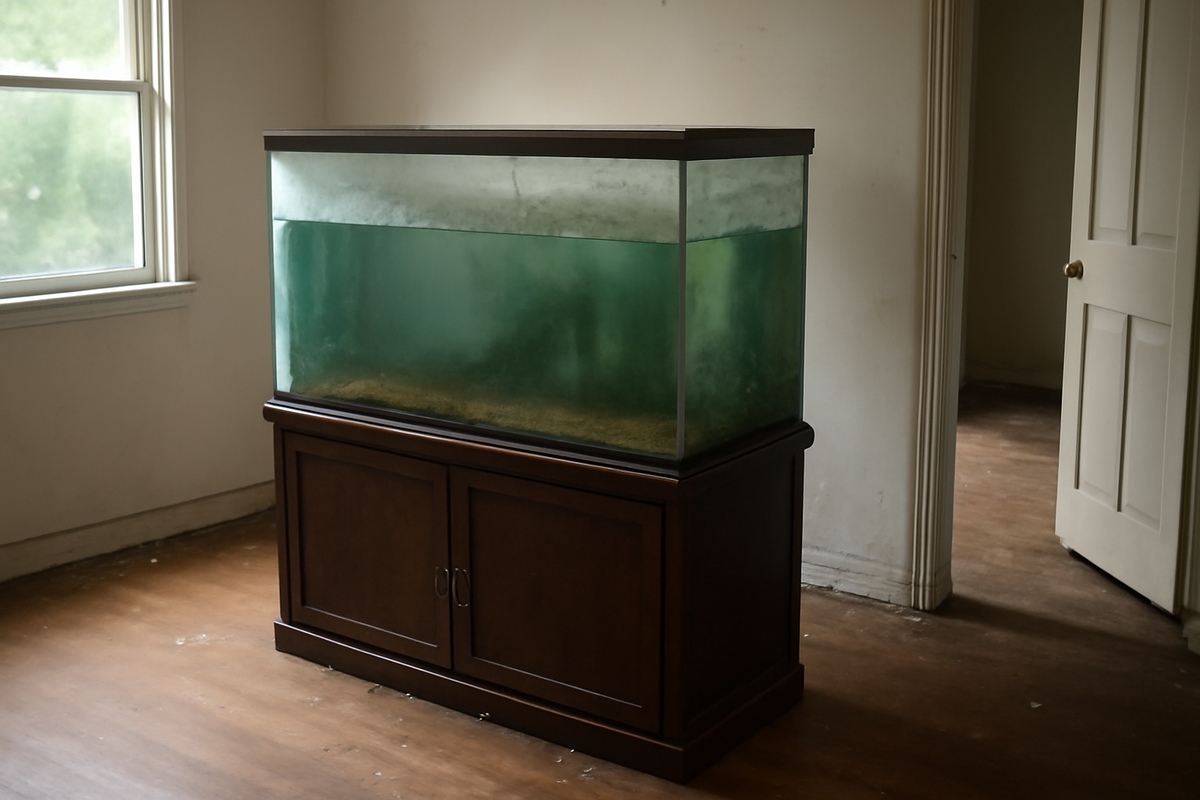
The first thing you notice is the silence. Not the ordinary kind that settles into an empty apartment, but a heavy, aquarium kind of silence—the kind that hums where a pump used to run, where water used to sigh and swirl. The big tank dominates the living room wall, a glass monolith stretching almost from one end to the other. It looks like something out of a hotel lobby or a boutique spa, only this one is sitting in a second-floor rental where the tenant has just been evicted after racking up more than $22,000 in unpaid rent.
The door stands open, the hallway light spilling across the threshold. On the floor, a faint line traces where a couch once sat, now just a rectangle of less-faded carpet. The air smells like dust, old coffee, and the faint mineral tang of evaporated water. The landlord, keys clinking nervously in his hand, just stares.
A Tank Too Big to Ignore
At first, you might miss the details. The tank is dark, its overhead lights switched off, the waterline sagging two or three inches below the rim. Long streaks of dried salt crust along the glass. A couple of filters still hang off the back, unplugged, like exhausted lungs. On the stand below, there’s a tangle of hoses, some cloudy bottles of water conditioner, a neglected algae scraper. A single magnet cleaner is stuck midway down the glass, frozen in time.
This was no casual hobby. This was a statement—a centerpiece, a dream, maybe even an escape. Whoever lived here poured time and money into this thing, once. You can imagine the glow that used to spill across the room at night, the soft whir of pumps humming like distant bees. Fish weaving through a forest of artificial coral, or maybe the lazy ballet of angelfish and tetras, plants waving like underwater grass.
Now, it’s a burden. A big, heavy, silent problem.
On the kitchen counter, the eviction notice still sits where it was taped—a pale rectangle that seems almost embarrassed to exist in the same space as this giant glass tank. Between the unpaid rent and the cost of clearing whatever’s been left behind, what started as one tenant’s private paradise has become someone else’s very real, very expensive headache.
The Ghosts in the Glass
The landlord walks closer, careful, as if the tank might protest or crack or reveal something terrible. Inside, the water is cloudy but not opaque—a murky tea color that suggests neglect more than catastrophe. No fish glide through the shadows. No snails cling to the glass. There’s only stillness, a ghostly echo of what this place once was.
There are faint rings on the glass where algae once grew in lazy circles. The substrate at the bottom—tiny gravel mixed with sand—lies disturbed in wide sweeps, as if someone once rearranged the tank in a rush. Plastic caves lean at awkward angles. A heater half-buried in gravel blinks a meaningless red light, still plugged into a power strip that hums on the floor, its cord stretched like a lifeline that no one bothered to cut.
Standing here, it’s easy to reconstruct the story: a tenant slowly falling behind on rent, maybe hoping to catch up, maybe promising “next month, for sure.” The tank, once a source of calm, becomes something else—a reminder, a financial drain, a responsibility too heavy to lift. The water changes get skipped. The filter pads go unchanged. The lights stay off more often. The rent notices stack up.
And then one day, the tenant is gone, and the tank stays, like a heavy, glass confession.
When a Hobby Becomes a Liability
From a distance, an aquarium is pure magic. Up close—as the landlord just discovered—it’s all logistics, weight, and hidden costs. This tank, by a rough guess, might hold 200 or 250 gallons. Water alone weighs more than eight pounds per gallon. That puts the total weight—water, glass, stand, rock, sand, equipment—well north of a thousand pounds. Maybe fourteen hundred. Maybe more.
You don’t just “pick up” a thousand pounds and walk it down the stairs.
The landlord calls a property manager. The property manager calls a mover. The mover laughs and says, “You need a specialist.” The specialist gives a quote that makes everyone go quiet. By the time you add up the cost of draining the tank, safely rehoming any surviving fish, breaking down the equipment, hauling it out, repairing the floor, and dealing with any water damage or electrical issues, the “free” aquarium is starting to look like a second unpaid rent bill.
The aquarium itself is a strange kind of asset. It’s valuable—but only to the right person, at the right time, in the right place. It’s like inheriting a baby grand piano in a third-floor walk-up: impressive, romantic, and ruinously expensive to move.
| Item | Estimated Cost (USD) | Notes |
|---|---|---|
| Professional tank removal | $600 – $1,500 | Includes drainage, disassembly, and labor |
| Disposal or transport | $200 – $500 | Depends on distance and weight |
| Floor repair & touch-up | $300 – $1,000 | Carpet replacement or flooring patch |
| Wall & paint repair | $150 – $400 | Moisture stains, holes, brackets |
| Electrical safety check | $100 – $250 | Inspect outlets and circuits |
By the time the landlord totals up the projected costs, the numbers scrape painfully close to the already staggering $22,000 owed. The unpaid rent is one thing. The aquarium is another kind of debt—less official, maybe, but just as real.
The Quiet Weight of Water
There’s something eerie about a tank in limbo. Water isn’t meant to just stand still. In nature, it runs, it moves, it circulates. Even in a home aquarium, it’s always in motion—pulled through filters, stirred by air stones, nudged by darting fins. Here, though, the water has settled. Dust specks float on the surface, small islands that drift lazily when someone walks by and the floor shivers.
If you press a hand to the glass, you can feel the coolness of it, the quiet insistence of that heavy, waiting mass. The landlord keeps a small distance, as if instinctively aware of the latent energy behind the glass. A thousand pounds of water, sitting above a downstairs neighbor’s ceiling, depends entirely on a seam of silicone and a frame that might be older than anyone admits.
No one wants to imagine what happens if that seam fails.
This is the part of aquarium keeping that rarely makes it into the Instagram stories and glowing YouTube videos. Water has a way of making everything more complicated. A 5-gallon tank can be drained into a bathtub with a bucket. A 250-gallon tank is a different creature. It needs a plan, a crew, a route, a place to go. It needs time and care—two things an evicted tenant running out of options probably didn’t have much of.
Somewhere, you can imagine that tenant scrolling late at night through classifieds: “Large aquarium for sale, must pick up,” hoping for a quick fix. Maybe they got lowball offers. Maybe no one wanted to climb the stairs and face that much glass and water. Maybe the reality of dismantling it was too much, one challenge too far on a list already too long.
So the tank stayed. And in the end, when the eviction became real and immediate, when the last boxes were carried down and the keys dropped off—or maybe not even that—the aquarium became a monument to everything that couldn’t be taken, everything too heavy to carry out the door.
The Landlord, the Law, and the Living Room Ocean
What do you do when someone leaves behind an artificial ocean?
For the landlord, the answer is more complicated than just “get rid of it.” There are procedures, timelines, and local regulations about abandoned property. In many places, a landlord can’t just throw things out the moment a tenant leaves. Items above a certain value may need to be stored for a set period or handled in specific ways. The line between “trash” and “asset” suddenly matters a lot.
This aquarium sits squarely in the gray zone. It’s not exactly trash. It’s also not something you can tuck neatly into a storage unit. It’s heavy, fragile, and potentially damaging if moved carelessly. It’s like being left with a grand gesture you never asked for.
So the calls begin: lawyers, property managers, specialty movers, even local aquarium clubs. Someone suggests listing it for free online—“Buyer must remove.” Someone else warns about liability: what if a seam gives way during removal and half the living room ceiling downstairs collapses in a roar of water, glass, and gravel?
The unpaid rent looms in the background, a number on a spreadsheet, while the tank looms in the foreground, a physical reminder that debts are not always just money. There’s time and risk and energy owed now too. The emotional tone of it all hangs heavy in the air, mingling with the faint smell of old fish food and damp silicone.
When Nature Moves In, Then Gets Left Behind
Even in its neglected state, the tank still tugs at something deeper—a stubborn echo of wild water in a man-made world. Aquariums are one of the most intimate ways people bring nature into their homes. Unlike a potted plant or a framed landscape, an aquarium is alive, dynamic. It asks for attention, teaches routines. It turns a corner of a living room into a small, curated ecosystem.
You can imagine the tenant—months or years back—standing in this same space, watching their fish dart through the water, the glow from the tank licking at the walls in shades of blue and green. Maybe they found solace here after long shifts. Maybe they sat here quietly at night when the world felt too loud, letting their gaze soften as fish traced loops in the softened light.
Nature in captivity is always a compromise, a contract written in filtration and feeding schedules and water changes. When life outside the glass starts to crumble—missed paychecks, unexpected bills, strained relationships—the contract inside the glass begins to crack too. The tank tells a quieter, more patient story of that unraveling.
That’s the thing about big aquariums: they make your life visible. They show when you’ve had the time to care and when you haven’t. They reveal the weeks you were too overwhelmed to siphon out debris or rinse a filter. They hold, in a murky silence, evidence of how well or poorly you’ve been managing things—not just as a fish keeper, but as a person staying afloat in your own turbulent water.
Lessons from a Room-Sized Fishbowl
In the days that follow, the landlord makes a decision.
The tank will go, but not with a careless smash and a rush of water down the hall. A local aquarium enthusiast hears about the situation and steps forward. They arrive with hoses, pumps, plastic tubs, and a small crew of friends who know how to choreograph the slow dismantling of a private ocean.
The room fills again with the sounds it had been missing: the gurgle of siphons, the trickle of water, the low murmur of people working together. Light flickers off wet glass. Gravel hisses as it’s scooped and bagged. The tank, once an immovable monument, begins to yield, inch by inch.
When the last of the water is drained and the glass finally lifts from the stand, the living room floor reveals a ghost print: a rectangle of less-faded carpet and a slight depression where the weight once rested. The room looks oddly bigger, and somehow emptier. The silence that returns is different this time—less charged, more like a deep exhale.
The unpaid rent still stands. The ledger will carry the scars of that $22,000 loss for a long time. But the tank is gone, taken to a new home where someone has the mental space, the financial margin, and the emotional bandwidth to tend it properly. Maybe, someday, it will glow again in another living room, casting moving patterns on different walls.
For the landlord, the whole episode becomes a kind of cautionary tale. Not just about screening tenants or writing clearer clauses into leases about large pets and heavy installations, but about the strange ways people try to bring calm into chaotic lives—and what happens when that calm becomes another source of stress.
Pets and plants and little homemade ecosystems can be anchors. They can also, without warning, turn into anchors in the other sense: dragging, heavy, difficult to pull up.
What We Carry, and What We Leave
In the end, this is a story about weight—the weight of glass and water, of unpaid bills, of unspoken struggles, of dreams that grow bigger than the space that holds them.
There’s something deeply human about wanting a piece of the wild indoors. A forest of houseplants, a window full of herbs, a jar of sourdough starter, a rescued stray cat, a towering aquarium—it’s all the same impulse. We reach for life and color and motion, even when the rest of our existence feels fluorescent-lit and spreadsheet-bound.
But every wild thing we invite in has needs of its own. Every tank, every terrarium, every living corner comes with invisible commitments: time, money, energy, emotional attention. Sometimes we sign up for those commitments without fully counting the cost. We picture the glow, the beauty, the soft soundtrack of bubbles. We don’t always picture the eviction notice, the missed rent checks, the landlord standing in the half-dark, staring at a silent, massive aquarium they never wanted.
The apartment will get repaired. Fresh paint will cover the marks where the stand pressed against the wall. New carpet will erase the tank’s silhouette. Another tenant will move in, carrying their own furniture, their own plants, their own arrangements of nature and comfort. The story of the giant aquarium will linger only in the memory of the landlord and the faded outlines of old photographs on the tenant’s phone.
Somewhere across town, in a new living room, that same glass tank might already be filling again. Fresh water rushing in, pumps priming, filters humming back to life. New fish will arrive, darting into strange territory, noses pressed to unfamiliar glass. The wild, once contained and then abandoned, will be tended again by different hands.
And maybe, one day, someone will stand in front of that tank after a long, grinding day and feel, for a few quiet minutes, that rare, soft wonder of watching water move in a world shaped by their own care.
But here, in this emptied apartment, with the echo of footsteps still fading down the stairwell, there’s just the memory of it. The ghost of an indoor ocean. The heavy lesson that what we bring into our lives—especially the big, beautiful, living things—never really belongs to us without cost.
FAQ
Can a landlord charge a tenant for leaving behind a large aquarium?
In many regions, yes. If a tenant abandons large items like aquariums, landlords can often charge for removal, disposal, and any related repairs. The exact rules depend on local laws and the terms of the lease, but a tank that causes extra labor and potential damage usually isn’t treated like ordinary trash.
Why are big aquariums so expensive to remove?
Large tanks can weigh more than a thousand pounds when full and still hundreds when empty. They’re fragile, bulky, and awkward to move down stairs or through narrow doors. Removal often requires specialized movers, pumps for draining, and sometimes even minor structural checks, all of which add to the cost.
Should tenants ask permission before installing a massive aquarium?
Absolutely. Most leases require landlord approval for any heavy or unusual installations. A big aquarium can stress floors, add moisture to the unit, and raise insurance concerns. Getting written permission helps protect both the tenant and the landlord if something goes wrong.
What are the hidden costs of owning a large aquarium?
Beyond the initial setup, big tanks come with ongoing costs: electricity for lights and pumps, water changes, filter media, food, replacement equipment, and sometimes structural considerations. They also demand regular maintenance time; neglect quickly turns any aquarium into a problem rather than a pleasure.
How can landlords avoid situations like this?
Clear communication and detailed leases help. Landlords can set size limits on tanks, require proof of renter’s insurance, or insist on professional installation for very large setups. Periodic inspections and open dialogue with tenants about big pets and heavy equipment can prevent a hobby from turning into a financial and physical burden later.

Hello, I’m Mathew, and I write articles about useful Home Tricks: simple solutions, saving time and useful for every day.




