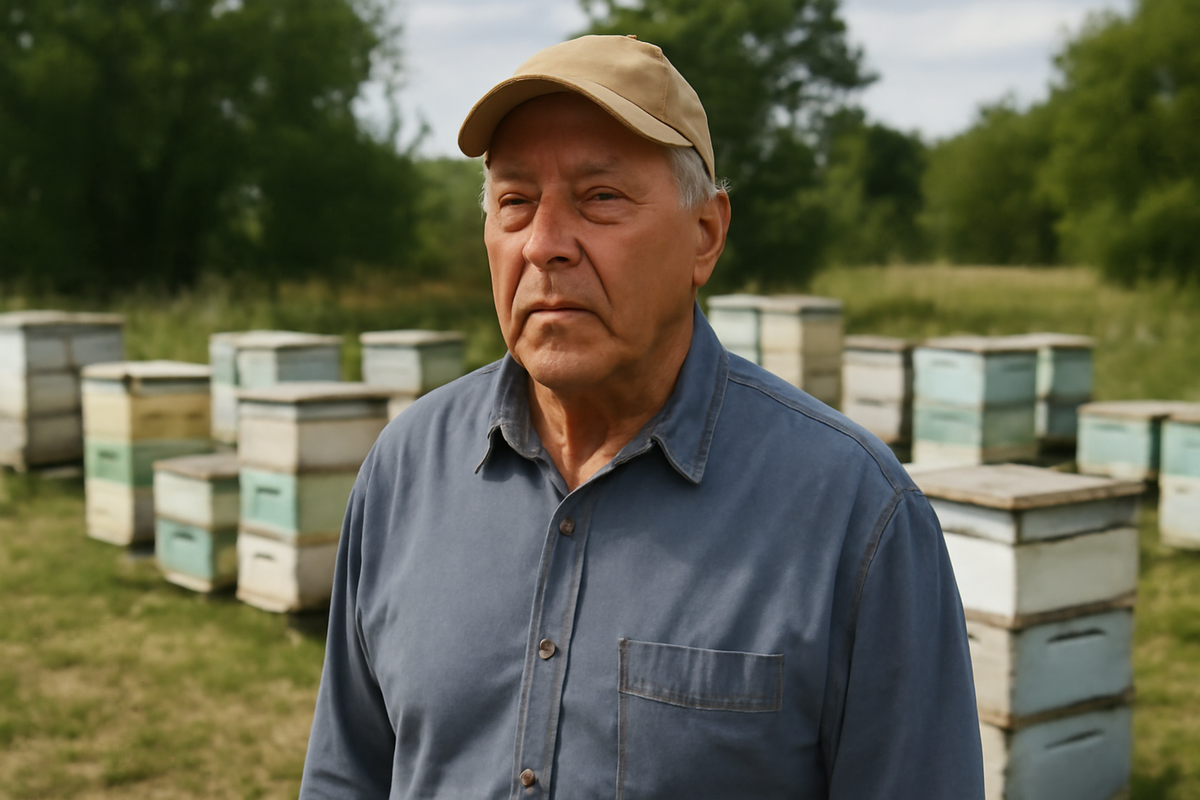
The first time anyone asked him if he was a farmer, Arthur laughed. The question arrived in a stiff white envelope, not a conversation. “Notice of Change in Property Classification,” the top line announced in a font that made his stomach tighten. Someone, somewhere in an office he’d never visit, had decided that the man who grew nothing more than dandelions and memories on his back field was now—on paper at least—a producer of agricultural commodities.
The cause of this unlikely transformation stood beyond his back fence: a few dozen wooden boxes, painted with fading blues and greens, humming softly in the summer heat. Beehives. Not his own. He didn’t own a veil or a smoker, and he still flinched a little when a bee bumped against his arm. But he’d lent a corner of his idle land to a young beekeeper from town, a quiet woman named Lena who’d arrived with a pickup truck, a nervous smile, and a desperate need for someplace—anyplace—the bees could live and work.
Arthur thought he was doing a small good deed. The tax office thought otherwise.
The Day the Letter Arrived
It had been a slow morning, the way mornings tend to be when you are retired and the clock has loosened its grip. Coffee on the porch. The dog dozing in a sun patch. A blue jay heckling everyone from the top of the maple. The letter changed the air in an instant.
Arthur slid a finger under the flap, careful by habit, the way he used to be with legal documents when he still wore a suit every day. He read it once. Then again. At the third pass, the words started to tilt, all their edges suddenly sharp.
According to the letter, his land was being reclassified as “agricultural use.” Because of that, he was now responsible for farm-related property taxes and compliance obligations. He was to file new forms, document any production, track income—if any—and be prepared for potential inspections. Non-compliance, it warned, could lead to penalties.
Farm-related taxes, for lending out a corner of his field. In exchange for exactly zero rent and a couple of jars of honey a year.
“You’ve got to be kidding me,” he said to nobody in particular, the dog lifting one eye in sympathy. Outside, the beehives shimmered under the sun, oblivious to the bureaucratic storm they’d triggered.
The Beekeeper and the Back Field
When Lena first came to him, it was early spring—the kind of day when the ground is still reluctant, but the air smells faintly of thaw and possibility. She had been knocking on doors for weeks, she admitted, searching for anyone with spare land who would let her place hives.
“I used to keep them on a friend’s orchard,” she explained, fingers curled around a chipped mug of coffee at Arthur’s kitchen table. “But he sold the property. New owners want it spotless. No bees.”
He’d looked past her shoulder then, through the window to the patch of field that sat wild behind the house—too small for real crops, too big to mow without resenting the gasoline. Thistle, clover, goldenrod, milkweed. It was, if he was honest, the most alive part of his land. Rabbits disappeared into its taller grasses; monarchs floated over the milkweed in August like orange paper lanterns.
“How much space do you need?” he asked.
“Not much. Just enough for a few hives. I’ll take care of everything. You won’t even know I’m here most days.”
He’d shrugged and said yes. It felt like something good he could do, a small act of kindness stitched into a world fraying at the edges. He made her promise one thing: that she’d tell him about the bees. He liked learning, liked knowing that the land he’d worked for forty years didn’t have to be only lawn and mortgage and property lines. It could be habitat. It could be useful again.
By mid-summer, the hum out back had become a low, steady presence, like the distant sound of a river you’d grown up beside. Lena arrived at odd hours, slipping in with her veil and her smoker, humming under her breath as she checked frames, hands moving with the careful confidence of someone who has learned to trust thousands of tiny lives clustered on wax.
“They’re strong,” she would say, as if reporting on old friends. “Your field is perfect. So much forage. They’re bringing in clover and wildflower nectar. Taste this.”
He’d stand beside her, sticky-fingered and grinning, tasting the land in a way he never had when it was just property value on a tax form.
The Moment a Favor Turns into “Agriculture”
The tax reclassification didn’t come with a conversation. It came, like weather and policy often do, from somewhere above the tree line. At first, Arthur assumed it was a mistake—a stray entry in the vast spreadsheet of the county’s land roll.
He called the number at the bottom of the letter. Eventually, after hold music and transfers, a polite but tired-sounding official explained it to him.
“Your property is now hosting commercial agricultural activity,” the voice said. “The beekeeper is running a business. The land is part of that business use.”
“But I’m not running anything,” Arthur protested. “I’m a retired accountant. I don’t sell honey. I don’t even own a bee suit.”
“Our assessment is based on land use, not occupation,” the official replied. “If your land supports production, it can be considered agricultural. That shifts the tax category.”
“So because I let someone help the bees, I’m a farm now?”
“In tax terms, yes.”
The call ended with no clear solution—just more forms, more acronyms, more pathways through the administrative maze. When he hung up, the house felt smaller. The good deed he’d been quietly proud of now looked, on paper, like a liability.
When a Local Story Escapes the Fence Line
The story might have stayed between Arthur, the county office, and the bees if his neighbor hadn’t mentioned it to a cousin who worked at a regional newspaper. A reporter called “just to clarify a few details.” Arthur, bewildered and still faintly amused, told her everything.
She came out one afternoon, notebook in hand, her shoes sinking slightly into the soft earth as they walked the perimeter of the field. The hives glowed honey-colored against the green. Bees floated around them, indifferent to human exasperation.
“So you’re telling me,” she said, “you let this beekeeper use the land for free, and now you’re being billed like a farm?”
“That’s the gist of it,” he replied. “I thought I was doing something good for the environment. Turns out the environment sends you paperwork.”
Her article ran under a headline that struck a nerve not only in their small town but far beyond it: a retiree trying to help pollinators, penalized for his trouble. In a country already tense about land rights, climate, and the shrinking space where good intentions can live without invoices, it took off.
Within days, the story had traveled: from local news segments to national radio shows, from rural Facebook groups to city-based environmental forums. People argued in comment sections, wrote op-eds, and called talk shows. Arthur watched it all unfold as if a stone he’d dropped casually into a pond had somehow opened into the sea.
| Perspective | Main Concern |
|---|---|
| Retiree Landowners | Being penalized for hosting hives or small ecological projects; fear of surprise taxes. |
| Beekeepers & Small Farmers | Losing affordable, flexible places to keep bees and grow food if collaborators pull back. |
| Tax & Zoning Officials | Needing clear, enforceable rules for land classification and revenue. |
| Environmental Advocates | Worry that red tape will discourage crucial pollinator and habitat projects. |
Where Law, Land, and Bees Collide
The more people learned, the more complicated the story became. What, after all, is a farm?
In legal terms, a farm might be defined by production thresholds, by whether goods are sold, by zoning codes written decades earlier with row crops and dairy operations in mind. But modern landscapes don’t always fit neatly into those old boxes.
A few hives in a retired man’s back field. A series of raised beds on a church lawn. A small cooperative garden in an abandoned lot. Are these hobbies, environmental projects, or agricultural enterprises?
Some argued that the tax office was only doing its job—that once land supports commercial activity, however small, it shifts categories. Allow too many exceptions, they warned, and you open loopholes big enough to drive corporate abuse through. If every property hosting a little “side agriculture” claimed exemption, local budgets could crumble.
Others saw a deeper problem: rules written without an ear tuned to the quiet revolution happening on the edge of our cities and towns. Across the country, more people are using unused spaces—retiree back fields, schoolyards, forgotten corners—to grow food, keep bees, plant native flowers. These micro-farms and pollinator havens don’t look like the big agriculture of policy documents, but they may be essential threads in a more resilient future.
“We need bees more than ever,” one environmental advocate said in a televised panel. “Pollinators support our food systems, our wildflowers, even the trees lining our streets. If bureaucracy punishes people who try to help, they’ll stop helping.”
The debate slipped quickly from Arthur’s particular case into a wider question: when does a favor to nature become a taxable event?
Fear, Frustration, and the Quiet Risk of Doing Nothing
One unintended consequence of the news coverage appeared almost immediately. Beekeeping associations and small-farm groups began hearing from worried landowners.
“I’d love to host hives, but I can’t afford higher property taxes,” one message read.
“We were about to start a pollinator strip on the church’s edge lot,” another email said. “Our board is nervous now. What if it changes our tax status?”
Stories filtered in from other regions where similar confusion had surfaced: school gardens bumping into zoning ordinances meant for commercial farms; urban rooftop beekeepers navigating building codes that had never imagined thousands of insects sharing space with weekend barbecues.
There is a particular kind of chill that descends when people who want to help the land feel legally exposed for doing so. Not a dramatic crackdown, but a slow erosion of enthusiasm. A neighbor who might have said yes to a local beekeeper now hesitates. A retiree who might have allowed a community garden chooses instead to keep the lot trimmed and empty. The cost isn’t measured in dollars, at least not immediately. It is counted in bees that never find forage, in children who never learn to plant seeds, in fields that stay silent.
Arthur felt that chill himself. For the first time since saying yes to Lena, he wondered if he’d made a mistake. “I don’t regret helping her,” he said, “but I do worry what happens next. For me. For others like me.”
Lena, too, felt the weight. “If folks see me as a tax risk,” she said, “where do I put the bees? They can’t live in an abstract policy. They need flowers, and flowers need land. Real land, with owners who have fears and mortgages and bills.”
Imagining Better Rules for Living with Bees
Amid the arguments, a quieter thread emerged: this didn’t have to be an all-or-nothing problem. Lawyers, planners, and environmental groups began sketching out possible solutions.
Some suggested special carve-outs, legal categories for “ecological stewardship uses” that would distinguish between full-scale agriculture and small-scale pollinator or community projects. Under such rules, a handful of hives or a modest native meadow could live on private land without triggering the same tax consequences as a commercial farm.
Others proposed clearer thresholds: only above a certain level of production or income would agricultural rules fully apply. Below that line, participation could be treated more like a conservation effort than a business expansion.
There was talk of simple agreements—a type of standard contract landowners could sign with beekeepers or gardeners, clarifying that the land use is limited, non-exclusive, and primarily ecological, not economic. Something plain-language, a few pages at most, that a retiree could read without reaching for an aspirin.
In some regions, officials even began to reconsider their own approach. A few tax offices quietly issued guidance reassuring residents that hosting a small number of hives for environmental reasons would not, by itself, reclassify their property. Not every place followed suit, but the conversation had started.
The Field at Dusk
During all of this, the bees continued, as bees tend to do, indifferent to talk shows and policy briefs. On late summer evenings, Arthur would walk the edge of the field and listen to them, a steady thrum woven into the chirp of crickets and the distant rush of highway.
He began to understand that what bothered him most was not the money—though the potential tax increase wasn’t trivial on a fixed income. It was the way the letter had translated something living into a line item, as if the field were no longer a place but a category. It made him feel like a clerk again, but this time his own life was the ledger.
Standing there, with the grass brushing his calves and the sky going the soft color of old bruises, he tried to imagine a different kind of notice arriving in the mail.
One that might say: “We see what you’re doing with this land. We value it. Here is how we can support you, or at least, how we can avoid making it harder.”
In his mind’s eye, he pictured forms that asked about pollinators, about native plants, about community access. Not as traps or triggers for more tax, but as ways to recognize and maybe reward the people who lent their spaces to the work of repair.
He knew it wasn’t that simple, that budgets and fairness and enforcement mattered. But he also knew this: the hum at his back fence was a sound not just of honey being made, but of a small, stubborn patch of resilience, right there behind his house.
“If the price of that is a little paperwork,” he mused aloud one evening, “maybe it’s worth it. But I wish the rules understood what they were touching.”
A Debate That Won’t Stay on Paper
The story of the retiree, the beekeeper, and the unexpected farm tax will fade, as news cycles inevitably do, replaced by the next controversy, the next puzzle of how to live on this changing planet together. But the underlying tension isn’t going anywhere.
All over the country, quiet acts of stewardship—lending land for hives, letting ditches grow wildflowers, planting fruit trees along vacant lots—are brushing up against systems built for another era. Our bureaucracies still mostly see land in bold, flat categories: residential, commercial, agricultural, industrial, conservation. The spaces in between, where a retiree with a back field might give refuge to bees, do not fit neatly.
How we respond to stories like Arthur’s will say something about the kind of landscape we want to share. One where the safest choice is to keep everything clipped and empty, to avoid entanglement at all costs. Or one where the system learns to recognize and gently cradle the thousand small gestures that make a countryside, a neighborhood, a city more alive.
For now, the hives remain. The debate continues. And in a quiet back field that was once just a line item, thousands of bees map their shimmering routes across air and clover, unaware that their flight paths have redrawn the edges of law, responsibility, and what it means, these days, to simply say yes.
Frequently Asked Questions
Why would hosting beehives change a property’s tax status?
In many regions, tax rules are based on how land is used. If authorities decide that hosting beehives counts as agricultural or commercial activity, they may reclassify the land and apply farm-related tax rules, even if the landowner doesn’t directly earn money.
Can a landowner avoid extra taxes and still host beehives?
Sometimes. It depends on local laws. In some areas, small-scale or non-commercial projects may be exempt or treated differently. Written agreements with the beekeeper and clear documentation that the use is limited and primarily ecological can help, but local advice is crucial.
Why are bees such a big deal in these debates?
Bees and other pollinators are essential for many crops and wild plants. As their habitats shrink and their populations face stress, hosting hives and planting forage can be an important form of environmental stewardship. That’s why people are concerned when regulations discourage it.
Do all places treat small beekeeping projects as “farms”?
No. Rules vary widely. Some jurisdictions actively encourage pollinator projects and clarify that a few hives won’t change a property’s classification. Others have older or stricter rules that don’t yet distinguish between large farms and small ecological efforts.
What could be done to prevent situations like this in the future?
Possible solutions include creating special categories for small-scale ecological projects, setting clear thresholds before agricultural rules apply, and issuing simple guidance to reassure landowners. The broader goal is to design policies that protect public revenue without punishing people who lend their land to help the living world recover.

Hello, I’m Mathew, and I write articles about useful Home Tricks: simple solutions, saving time and useful for every day.