The sea was glassy that morning, the kind of slick calm that makes the horizon feel too close and the sky too wide. The men on the small fishing boat joked that the ocean looked almost polite, all soft swells and gentle light. No one knew yet that, within an hour, they’d be standing on that same deck in dead silence, watching black dorsal fins carve toward them like knives, listening to the snap of anchor lines being bitten through in the dark water below.
The Day the Ocean Changed Mood
They were after halibut and cod, the kind of routine offshore trip that blurs together after enough seasons. Diesel engine, the sour-salty smell of bait, coffee cooling too fast in chipped mugs. The captain, a man who had spent more years on the ocean than on land, cut the engine once they reached their spot. The boat rocked itself into stillness, tethered to the seafloor by heavy anchor and habit.
It’s funny how quickly normal can unravel out there. One minute, it was the usual rhythm of lines cast and reels ticking. The next, a shout from the bow snapped everyone’s heads toward the water.
“Orcas!”
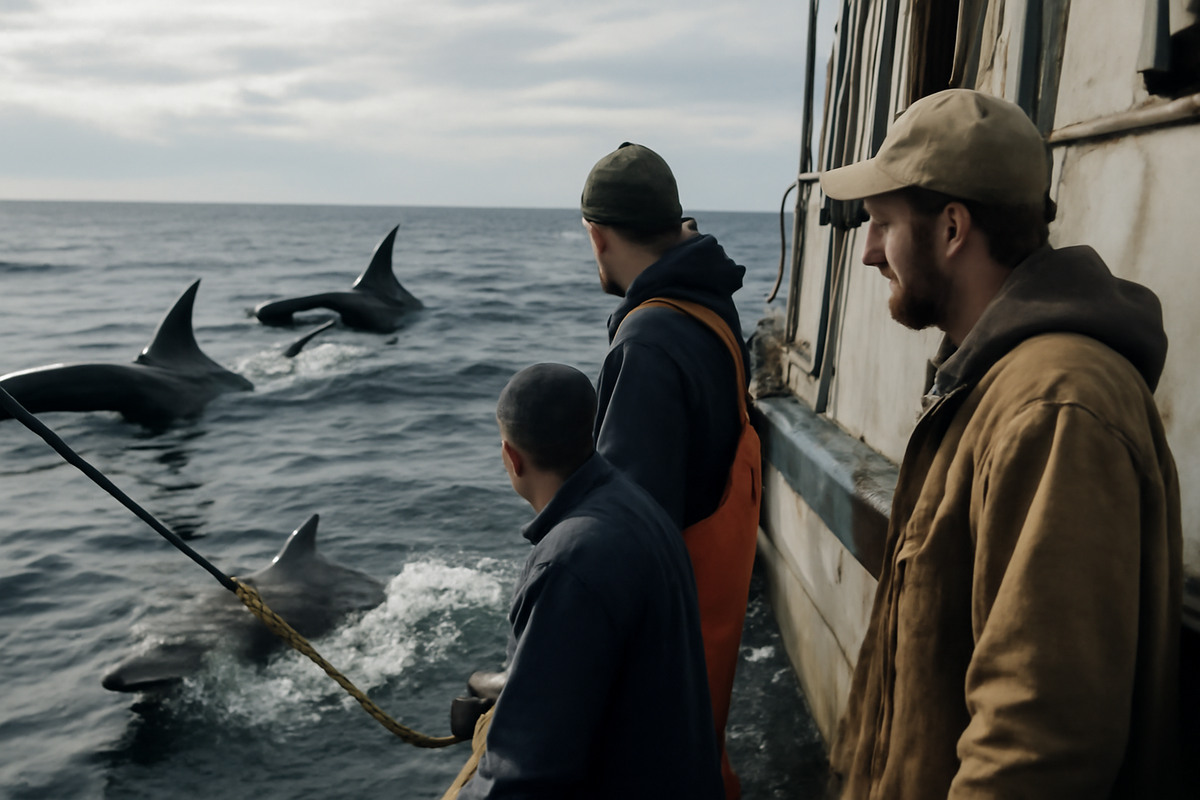
The word carried across the deck with a mix of awe and something sharper—something like dread. There they were, black and white forms just under the surface, moving with that unhurried, predatory purpose. One fin, then two, then five. Within minutes, the boat was surrounded.
The crew fell quiet. You don’t talk over something like that. Orcas draw a hush from people who have seen everything the sea can throw at them. These weren’t the distant silhouettes tourists gasp over from a ferry. These animals were close—so close the fishermen could see the scratches on their skin, the glint of dark eyes tracking the vessel with unsettling focus.
The orcas moved in slow arcs around the boat, slipping under, surfacing on the far side, circling again. The captain could feel the tension rise the way he could feel a change in the weather: not visible, but undeniable. Orcas are smart—everyone knows that. They’ve been known to strip fish from longlines, to learn the sound of certain engines that mean “dinner is ready.” But this felt different. The men were being studied as much as the boat was.
The Sound of Teeth on Steel
For a while, it was only orcas. The fishermen stayed put—engine off, radios quiet, no one quite willing to make the first move to scare them away. Some filmed on their phones; others simply watched, hands resting lightly on the gunwale, every sense sharpened. The ocean, earlier so flat and forgiving, had turned into something more alive and unpredictable.
Then, in that already-strange stillness, came a new sound. A metallic shudder traveled up through the hull, a faint grinding that vibrated through boots and bones.
“You feel that?” one of the deckhands asked, his voice smaller than usual.
The captain didn’t answer. He was staring down at the bow, where the anchor line vanished into the water. The line, thick enough to drag several tons of steel and chain, was trembling like it had snagged on something alive. The sound came again—harder this time. A sharp, rhythmic clatter that echoed up from the deep like the ocean itself was being chewed.
One of the crew instinctively leaned over the side, peering into the green-blue murk. At first he saw nothing. Then a shape detached from the gloom, rising just far enough for the light to catch its pale belly and blunt head.
“Shark,” he whispered.
Another vibration slammed through the hull. This time, they all felt it. Whatever was on the anchor line was biting, not brushing. The rope twitched and pulled, as if something heavy and determined had clamped down and was shaking it in its teeth.
Now there were two predators in the story: the orcas at the surface, carving their patient circles, and the sharks below, invisible but unmistakable. The men were suspended between them, a human island in the middle of a tense, hungry conversation.
Between Orcas Above and Sharks Below
For a few surreal minutes the boat was a kind of floating stage, with danger both overhead and underfoot. The crew could hear the wet burst of orca breaths as they surfaced, exhaling mist that caught in the light like smoke. They could also hear the rough scrape where shark teeth met metal and rope in the green gloom beneath them.
The anchor line stood out in high tension, a taut, wet length shivering with each bite. Every fisherman on board knew what that line represented: their hold on one place, their ability to stay put, their control. To feel something gnawing at it was like feeling the ground under your house beginning to crack.
Though no one admitted it aloud at first, the same thought occurred to several of them—this was no accident. The scent of bait, the vibrations of struggling fish from earlier in the morning, the sudden arrival of orcas known to associate boats with easy meals. And now sharks, drawn in by the same signals, zeroing in on the anchor line as if it were the spine of the operation.
The sea, often framed as empty wilderness, suddenly felt crowded with intent. There was no human drama here that mattered; the predators were busy writing their own script.
One of the younger deckhands swore, eyes scanning the water. “They’re using us like a bell,” he said. “Ringing the dinner call down the line.”
He meant that every vibration from the boat—winches, footsteps, gear—traveled down that rope and chain to the seabed. In a world where sound and movement mean life or death, that anchor line might as well have been a beacon. The sharks hadn’t stumbled onto it. They’d followed a signal.
The orcas tightened their circle, some slipping directly alongside the hull, rolling slightly as they swam. One enormous male passed by close enough that the captain could have reached out and brushed fingers along the base of his towering fin. As the animal rolled, its eye turned toward the boat—a glossy, slow blink of curiosity, or calculation, or both.
Below, the sharks kept working at the line.
Predators Learning New Tricks
These fishermen are not the first to tell stories like this, and they won’t be the last. Along coastlines around the world, similar reports have been trickling in with growing frequency: orcas trailing boats for hours, learning to pluck fish from longlines; sharks appearing at hauled gear like summoned ghosts; animals targeting not just the catch but the mechanics of fishing itself—anchors, propellers, rudders.
On that boat, in that moment, the crew became unwilling participants in a much larger shift. It is one thing to think of marine predators as opportunistic. It is another to watch them actively dismantle the tools humans rely on, as if the animals are learning not just where the food is, but how the entire system operates.
The captain knew of stories—tales traded over radios and dockside coffee—about orcas in other regions coordinating attacks on boats, ramming hulls, tearing off rudders. He’d also heard of sharks biting through anchor lines, even chewing on mooring ropes in harbors, their teeth testing anything that smelled faintly of fish or carried the vibration of life.
That morning, those rumors stopped being stories and became a live broadcast through his own hull.
The men discussed whether to haul the anchor up, but the idea of winching a shark-chewed line toward the surface while orcas circled was its own kind of nightmare. A frayed line under tension is dangerous; add big animals and uncertainty, and the risk multiplies. Instead, the captain ordered everyone to stand by, hands clear, while they tried to read the water the way others might read a room.
Time stretched. The orcas slowed their loops, occasionally vanishing for long moments beneath the hull, reappearing on the opposite side with no hint of where they’d been in between. The sharks continued their unseen labor. Every few minutes another tremor rippled up the anchor line.
In that suspended half-hour, the crew felt the old hierarchy—human above, animal below—subtly tilt. Technology, experience, and steel suddenly seemed flimsy against coordinated hunger and intuition honed over millions of years. Out there, the playing field is never as level as we like to imagine.
The Moment the Sea Let Go
The break, when it came, was almost anticlimactic. There was no dramatic snap, no whipping rope. Just a sudden slackness in the line, a quiet giving way that every person on board felt immediately. The tension holding the boat to the seafloor disappeared like someone had cut a thread.
“We’re free,” the captain said, though the word didn’t bring the relief anyone expected. Free-floating in a ring of orcas with sharks somewhere below did not feel like safety.
He moved fast, starting the engine with a cough of diesel that broke the spell of silence on deck. The orcas reacted—several surfaced at once, their heads rising higher out of the water than before, spy-hopping to get a better look at the suddenly noisy intruder. One slapped its tail, a sharp crack that sent up a fan of white spray.
The captain nudged the throttle gently. This was not a moment for panic-speed. A hasty escape could end in fouled props, damaged rudders, or worse—an accidental strike on one of the animals. No one wanted that. Respect, fear, and a measure of admiration blended in the space between boat and dorsal fin.
Slowly, the vessel inched away, leaving behind the spot where its anchor had once bitten the bottom. The orcas followed for a few hundred yards, then, one by one, peeled off, slipping into the deeper blue like a curtain closing. Whatever had brought them to the boat had played out; their attention drifted back to the vast buffet of the open ocean.
As the boat put distance between itself and the encounter, the men dared to look down into the wake. Now and then, a shadowy shape glided just under the turbulence, a shark pacing them for a short stretch before vanishing again. The idea that those same jaws had been working methodically at their anchor line minutes before made everyone onboard feel both very lucky and very small.
Only once they were certain the predators had lost interest did the crew relax enough to talk. Voices overlapped, retelling the same details again and again—the first orca fin, the tremor up the line, the glimpse of teeth on rope, the moment of slack. Each retelling carried a little more wonder, a little more weight.
When Stories Become Warnings
Back at the dock, the tale spread the way these things always do in fishing communities: quickly, with embellishments, but anchored in shared experience. The broken, frayed end of the anchor line became its own kind of evidence, passed from calloused hand to calloused hand. Fishermen traced the bite marks with fingers, measuring the spaces between teeth, imagining the size of the jaws that had worked so persistently through woven fibers and strain.
Conversations shifted from disbelief to pattern-spotting. Who else had lost anchors lately? Whose gear had come up shredded? How many times had orcas shadowed a boat for hours, taking fish right off the hooks?
In those dockside arguments and late-night radio chats, a bigger picture emerged. The ocean is changing—not only in temperature and chemistry, but in the knowledge of its inhabitants. Animals with long lifespans and complex social structures are passing on hard-won lessons: which engines mean easy food, what shapes on the surface hide baited hooks, where ropes hum with the promise of struggling fish below.
To some, it feels like harassment—a siege laid by whales and sharks on hardworking people trying to make a living. To others, it feels like overdue payback from a wild world that has absorbed centuries of industrial pressure and extraction. Most fishermen, standing in that murky middle ground, carry both truths at once: frustration at lost gear and stolen catch, and a begrudging respect for predators clever enough to bend human technology to their own ends.
Those mixed feelings can be hard to reconcile, especially when livelihoods are on the line. But they all agree on one thing: the stories are no longer just stories. They are warnings lodged in anchors chewed through and hulls rammed, in lines stripped bare and sounders lighting up with the echoes of big bodies too close for comfort.
On that particular boat, the captain began keeping closer records after the encounter. Water temperature, location, time of day, behavior of the orcas and sharks. Not as some formal scientific project, but as a survival tool—clues scratched into weathered notebooks, carried from season to season. Knowledge, after all, is humanity’s favorite adaptation. In that way, we’re not so different from the orcas tracking boat sounds or the sharks homing in on anchor vibrations.
A Thin Line Between Fear and Awe
What lingers most from that day, for the men who were there, is not fear—not exactly. It’s something more layered, closer to awe. They talk about the weight of that orca gaze beside the hull, the deliberate patience in the way the pod moved as one organism. They remember the invisible persistence of the sharks below, biting not in frenzy but with steady purpose until the line gave way.
It is one thing to read about the intelligence of marine predators in a book or see it captured in a documentary. It is another to feel it under your boots, humming up through steel and rope. To know that, for a brief stretch of water and time, your fate was quite literally tethered to the teeth and choices of animals that owed you nothing.
The fishermen still head out, of course. The sea doesn’t stop being a workplace because of encounters like this. But they carry that morning with them—the glassy calm, the sudden black fins, the tremor of sharks chewing on the invisible thread that tied their boat to the bottom. They watch more carefully now. They listen differently. They curse the orcas when a fish comes up half-mauled, then fall into quieter voices when a dorsal fin slices the surface nearby, as if entering a sacred space.
Out there, the relationship between humans and the ocean’s great hunters is being rewritten in real time. Not with treaties or policies, but with circles of whales around small boats, with sharks learning the feel of anchor lines between their teeth. The encounter becomes part of a growing, unspoken agreement: this is not just your ocean, or theirs. It is a shared and contested place, where everyone is learning new tricks, and the cost of underestimating the others is written in broken gear and racing heartbeats.
For the men who felt that line go slack beneath their feet, one thing is clear. The next time the day dawns too calm, too quiet, with the sea lying flat as polished glass, they will look twice at the horizon. Somewhere out there, black fins and shadowy shapes are already listening, already learning, already rewriting the rules of encounter in a world we’re only just beginning to understand.
Key Moments from the Encounter
Here is a brief overview of how the tense encounter unfolded out at sea, as described by the fishermen.
| Timeframe | Event | What the Crew Noticed |
|---|---|---|
| Early morning | Boat anchored at fishing grounds | Calm seas, routine halibut and cod fishing |
| Shortly after | Orcas appear around the boat | Multiple dorsal fins circling, orcas surfacing close to hull |
| Mid-encounter | Unusual vibrations in anchor line | Metallic grinding through hull, line shaking unnaturally |
| Minutes later | Sharks biting anchor line | Shadows below, glimpses of sharks chewing rope and chain |
| Climax | Anchor line snaps or is bitten through | Sudden slackness, boat drifting free amid circling orcas |
| Aftermath | Slow retreat from the area | Orcas follow briefly, sharks seen in wake, crew returns to port |
FAQ
Did the orcas and sharks appear to be working together?
There is no clear evidence that the orcas and sharks were deliberately cooperating, but they were likely responding to the same cues: the presence of bait, struggling fish, and vibrations from the boat and anchor line. To the fishermen, it felt like being caught between two sets of predators both exploiting the same opportunity.
Why would sharks bite an anchor line instead of going after fish directly?
Sharks are highly sensitive to vibration and scent. The anchor line transmits movement and sound from the boat and any gear attached to it. Biting the line may be a way of investigating a potential food source or trying to reach fish activity deeper below. Over time, some sharks may learn that ropes and chains often lead to food.
Are encounters like this becoming more common?
Many fishermen and coastal communities report more frequent interactions with orcas and sharks around fishing vessels. Orcas, in particular, have been observed learning to take fish from lines in several regions, suggesting that these behaviors can spread socially within pods.
Is it dangerous for fishermen when predators target anchor lines?
Yes, it can be. A damaged anchor line under tension can snap and whip back with great force, posing a serious safety risk. Losing an anchor also leaves a vessel drifting, which can be hazardous in rough weather, near other boats, or close to shore or reefs.
What can fishing crews do to reduce these kinds of encounters?
Some crews experiment with changing fishing locations more often, varying engine noise patterns, hauling gear faster, or using deterrent devices. Others keep detailed records to identify patterns in predator behavior. There is no simple solution yet, but awareness and adaptation are key parts of staying safe and reducing conflict with marine wildlife.

Hello, I’m Mathew, and I write articles about useful Home Tricks: simple solutions, saving time and useful for every day.