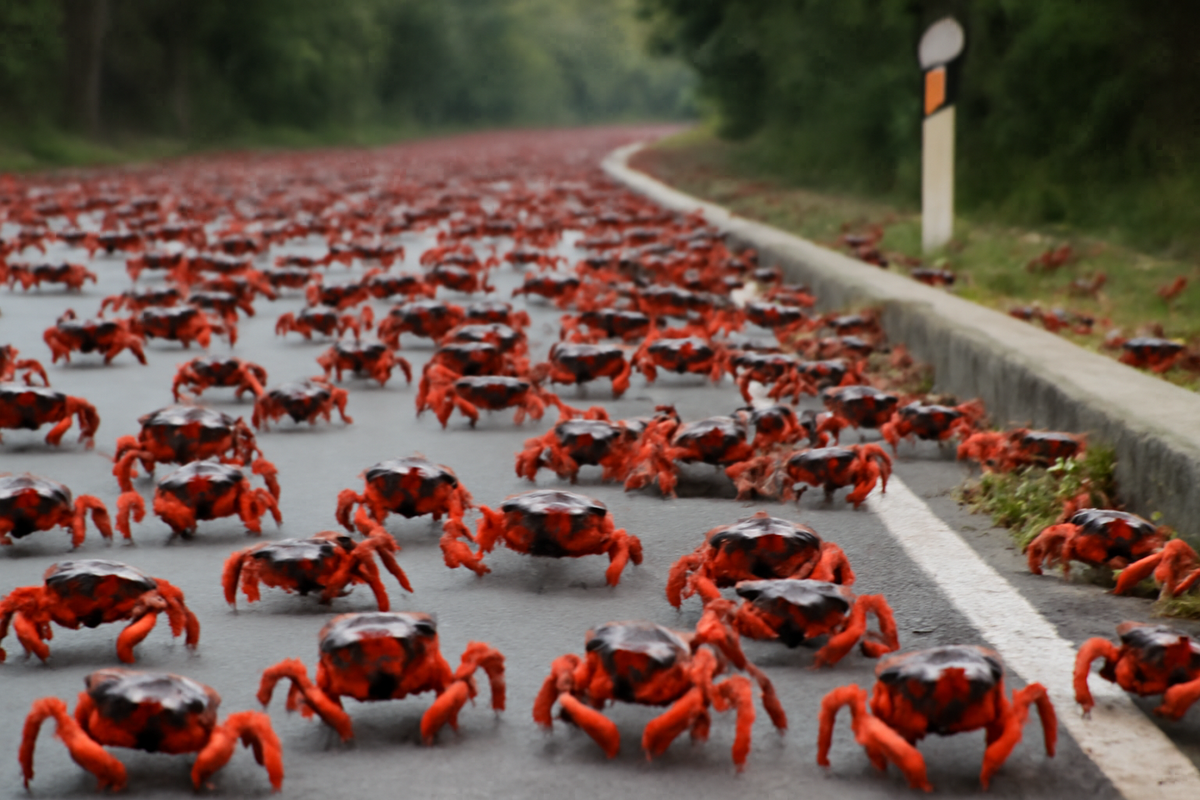
The road is closed. Not for construction, not for a marathon or a visiting politician—but for a tide of living scarlet that swarms across the asphalt like a moving carpet. The first thing you notice is the sound: a dry, restless rustle, like thousands of fingernails tapping on a drum. Then your eyes adjust, and you see them—bright red, dinner-plate-sized crabs clambering over one another, climbing curbs, tumbling into gutters, marching with single-minded purpose toward a shimmering line of blue on the horizon. On Australia’s remote Christmas Island, the human world pauses every year to let the crabs pass.
When the Forest Floor Starts Moving
It begins in the rainforest, days after the first real rains of the wet season. For months, the island’s red crabs have waited in burrows, tree roots, and cool rock crevices, their bodies slowed by the dry. The first heavy downpour is their signal. Humid air thickens, leaves drip steadily, and the forest itself seems to inhale.
Then, almost overnight, the forest floor comes alive.
They emerge by the tens of thousands at first—then by the millions. Each red crab, with its glossy crimson shell and stout claws, looks slightly comical when seen alone. In a mass, they are something else entirely: a biological event, a red river flowing downslope. Their stalked black eyes swivel in endless curiosity. They push aside fallen leaves, scramble over rocks, and, when necessary, over each other.
If you’re standing there among the buttress roots and tangled vines, you feel them before you fully see them: a brushing at your boots, the tap of claws on your soles, a shifting of small bodies around your ankles as they negotiate you as just another obstacle in the forest. You smell rich soil and leaf mold, hear distant surf, and over it all the faint, scratchy chorus of thousands of legs on the move.
For the red crabs, this is not a spectacle. It’s a mission—an ancient, instinctive journey from forest to sea to ensure the next generation lives.
The Call of the Moon and the Sea
The world’s largest crab migration doesn’t just happen whenever the crabs feel like it. Their timing is exquisitely tuned, almost like a ritual choreographed by the sky itself. While the rains trigger the start, the final act—the release of millions of eggs into the ocean—is set to the clockwork of the Moon.
Somewhere in the island’s conservation offices, there is a calendar marked with circles and notes that read less like a scientist’s logbook and more like a tide priest’s script: “Favourable phase,” “Peak migration window,” “Egg release predicted.” Meteorologists and park rangers cross-reference rainfall patterns with tide charts and lunar cycles. On this tiny patch of the Indian Ocean, people watch the Moon not just for romance or tides, but for crabs.
The Moon’s role is everything. Female red crabs must reach the coast in time to match their internal schedule of egg development with a very specific moment: the ebb of the high tide just before dawn, on a receding high tide close to the last quarter of the Moon. Under that waning light, at the precise blend of darkness and moving water, they will stand on the very edges of the reef, brace themselves against surging waves, and release their broods into the sea.
From the forest interior, far from the clamor of waves, millions of crabs somehow keep this schedule. They travel mostly during the coolest times—early morning, late afternoon, and at night. Days are spent in moist shade under logs or in roadside drains. Progress is measured in crab-lengths, but still they march: down from the plateau, across the narrow band of human settlement, to the cliffs, beaches, and rock shelves that ring the island.
For the people of Christmas Island, this means that monitoring the Moon becomes a community affair. Radio bulletins mention not only the weather, but the probable date of the “big move” and the likely night of egg release. Rangers patrol to estimate the advance of the scarlet tide. Off the coast, schooners and fishing boats rock gently beneath the same moonlight, while under the surface, reef fish cruise through columns of moonlit plankton. Everything is waiting for the moment when the shoreline turns red… then black… then suddenly alive with drifting life.
When Crabs Close a Nation’s Roads
On most islands, road closures are a nuisance. On Christmas Island, they’re a promise: this is the crabs’ time. As the migration intensifies, sections of the island’s main roads are shut down, sometimes for weeks. Cars are rerouted. Detours snake deeper into the forest. School buses alter their runs. And, in places, the asphalt disappears entirely beneath a bright, moving crust of animals.
It wasn’t always this way. Before robust protection laws came into force, the annual migration collided head-on with a landscape increasingly shaped by humans—cars, trucks, and the steady crawl of phosphate mining operations. Early in the island’s modern history, millions of red crabs were crushed beneath tires every season. The roadkill wasn’t just tragic; it was heavy enough in places to make the air smell faintly metallic and briny after a hot day.
Today, the island flips that script. Come migration season, bright warning signs flash: “Crab Crossing.” Temporary barriers go up, funneling crabs away from high-traffic areas. Voluntary speed limits drop. Some roads close completely, leaving them—as one local likes to say—“to the rightful owners for a while.”
There are moments that feel almost surreal. Picture a line of cars idling quietly while a ranger in a reflective vest stands, not waving traffic through, but standing back, letting an endless file of crabs move across. Now imagine the same scene, but the “file” is more like a living avalanche. Crabs pour off the forest edge, fill drains, climb median strips, and spill across both lanes. The smell of hot engine metal blends with the tang of damp earth and the faint, seaweedy scent of the crabs themselves. People roll down windows to listen. Children lean out with wide eyes, counting crabs until numbers lose meaning.
To make coexistence easier, the island has built crab bridges—raised mesh walkways that allow crustaceans to cross above vehicle traffic. In other spots, special culverts and underpasses channel them safely beneath roads. Rangers gently sweep stranded individuals off the asphalt, lifting them by the back of the shell while they wave their claws in slow protest. Some residents do the same, pausing on their commute to scoop a few wayward travelers back into the safety of the roadside scrub.
In a world where animals more often adjust to us than we to them, this annual, island-wide shift in behavior is extraordinary. For a few weeks, the traffic report doesn’t just mention accidents and weather. It gives updates on the progress of an ancient migration.
The Island That Surrenders to Crabs
Life on Christmas Island has a way of bending around the red crabs, not just during migration season but all year. They are, in a very real sense, part of the infrastructure. Park offices keep crab rakes next to shovels. Locals check under car tires for sheltering crabs before reversing. Garden fences aren’t just to keep out feral chickens—they’re also crab-proofed.
When the migration reaches its peak, it’s almost impossible to pretend that humans are in charge. Crabs swarm over front steps. They explore the underside of parked vehicles. They clatter into storerooms, materializing unexpectedly behind boxes. Some find their way onto tennis courts and into swimming pools, where rangers or residents must gently rescue them and send them on their way. More than once, a shop has opened its doors in the morning to find several dozen red crabs browsing the aisles as if the place were an especially odd cave.
That’s when you realize something subtle but important: this is not “our” world with animals added. This is their island as much as ours—maybe more. Humans have only been a major presence here for a blink of geological time. The crabs have been marching forest-to-sea-to-forest long before roads were paved or offices built.
So the roads close. The work shifts. The island surrenders, just a little, and in doing so reaffirms a quiet truth: some rhythms are worth honoring, even when they inconvenience us.
The Red River Meets the Blue
First you hear it: the dull, rhythmic thump of waves against rock. Then you smell salt—a sharp, clean scent that cuts through the heavy forest air. As the crabs approach the coast, their pace quickens as if pulled by an invisible rope. The final slope is often steep: leaf litter gives way to loose stones, then to slabs of wave-splashed limestone alive with barnacles, algae, and the constant reach of spray.
Year after year, females gather in crumbling cliff overhangs and rocky crevices just above the high-tide mark. Protected by ledges and boulders, they mate and brood their eggs, holding clusters of orange-red embryos under their abdomens. Each may carry up to 100,000 eggs—a moving, pulsing promise of the future. Here, in cool shade, they wait out days and nights as swells boom below them, the Moon sliding from fullness toward its last quarter.
On the designated night, the island’s clock seems to tick more loudly. Under starlight and waning moon, the air is damp, the rocks slick. Waves surge and crash with that particular sound of a reef edge—a sharp slap followed by a breathy rush. Then, along a stretch of coastline, movement intensifies. Females clamber out of burrows and shadowed ledges and make for the water’s edge, their egg-laden abdomens bulging beneath them.
They time it with astonishing precision. As the receding high tide begins to draw back, females climb to the lip of the rock shelves. In the glow of headlamps and moonshine, rangers and researchers look on, clipboards forgotten for a moment. The crabs stand in the wash, rhythmically dipping their bodies, releasing clouds of tiny eggs into the foaming sea with each surge.
From shore, you mostly see the action of waves and the gleam of shells. But if you could hover just offshore, suspended in the dark water, you’d witness the moment the eggs meet the ocean like a weather event—billions of tiny lives released almost at once, forming a drifting mist that spreads with the current. Within minutes, fish arrive, snatching at the sudden bounty. Many eggs will be eaten. That’s part of the plan. There are simply so many that some will survive.
Over the next weeks, the eggs hatch into free-swimming larvae that join the great invisible highways of ocean plankton. They drift, transform, molt. And then, in a twist that feels almost mythical, they return.
Return of the Tiny Pilgrims
When conditions are right, the sea gives the crabs back.
Sometimes, on a calm morning weeks after egg release, the shoreline at certain bays turns faintly pink. Look closely and you’ll see why: the water’s edge is filled with miniature crabs, scarcely bigger than a fingernail, washing up in pulsating waves. They clamber over one another, scramble up wet sand and stone, and begin a journey in reverse—away from the sea, up toward the forest that their parents once left.
Residents talk about these days with a quiet reverence. People bring children to see the return, kneeling to show them these impossibly small, perfectly formed crabs. The rustle at their feet is a higher-pitched echo of the adult migration, a whisper rather than a roar. And yet the scale is mind-bending: from billions of eggs, only a fraction return, but even that fraction is enough to carpet sections of coast in wriggling life.
Without road closures, without mindful driving, without lunar monitoring that helps protect key windows of vulnerability, far fewer of these tiny pilgrims would make it. The cycle is fragile and strong at once: dependent on rains that might shift with a changing climate, on reefs that must remain healthy, on forests that must stay intact, and on a human community willing to delay convenience for the sake of a species that doesn’t even know we exist.
Sharing an Island With a Million Neighbors
The red crab migration is dramatic, but its impact lasts all year. Even outside the big march, these animals underpin the island’s ecology. They are the forest’s tireless gardeners. As they roam, they devour fallen leaves, seedlings, and fruit, shaping which plants thrive. In places where crab numbers have declined—often due to invasive species—you can see the difference: leaf litter piling up, different plant communities taking hold.
In this way, the crabs are engineers. Their movement, feeding, and burrowing affect how nutrients cycle in the soil, how seeds disperse, how the forest regenerates. Remove them, and the entire character of the ecosystem shifts. Protect them, and you safeguard much more than a single charismatic species.
This is where the story grows larger than a tiny island. Around the world, other species attempt their own grand migrations—wildebeest crossing African rivers, salmon surging upstream, monarch butterflies drifting across continents. Each of these journeys is increasingly squeezed by roads, fences, dams, and changing weather. On Christmas Island, the response is to rework the human footprint—building crab bridges, designing culverts, scheduling road closures, and, critically, paying close attention to the rhythms of tide and Moon.
In a time when so much discussion about nature revolves around loss, the red crab migration offers something different: a case study in coexistence. Not perfection—crabs still die on roads, the island still faces threats—but a living example of what happens when humans decide a wild phenomenon is important enough to bend around.
A Small World, a Big Responsibility
From far away, the phrase “world’s largest crab migration” sounds like a curiosity—a trivia answer, an oddity. Up close, it’s a reminder that our planet is still powered by vast, ancient pulses of life moving from one realm to another: forest to ocean, ocean back to forest; land to river, river to spawning ground; one generation to the next.
There is something quietly hopeful in imagining an island where the nightly news includes lunar phase updates not for romance, but for crabs; where “road closed” can mean “a few million small red neighbors are passing through”; where researchers kneel on wave-splashed rock in the pre-dawn dark to watch a crustacean, unbothered by their presence, perform her part in a global story of reproduction and return.
In the end, the world’s largest crab migration isn’t just about countless little footsteps scraping across asphalt. It’s about the choice to see those footsteps as significant—to treat a moving sea of red, timed to the silent pull of the Moon, as worthy of rearranging our own movements. It’s a story of an island that, once a year, lets the forest flow down to the shore and out into the sea, then patiently waits for the forest’s future to crawl back home.
Quick Snapshot of the Migration
For a concise look at how this event unfolds each year, here’s a simple overview:
| Aspect | Details |
|---|---|
| Location | Christmas Island, Indian Ocean (Australian territory) |
| Species | Christmas Island red crab (Gecarcoidea natalis) |
| Estimated Numbers | Tens of millions of crabs involved in the migration |
| Main Triggers | Onset of wet season rains and specific lunar/tidal cycles |
| Human Measures | Road closures, speed limits, crab bridges, culverts, and ranger patrols |
| Key Moment | Pre-dawn egg release timed to the receding high tide near the last quarter Moon |
Frequently Asked Questions
Why do the red crabs migrate in such huge numbers?
The crabs migrate en masse to reproduce. Adult crabs live in the island’s forests, but their larvae must develop in the ocean. Moving together in vast numbers improves their chances of reaching the shore safely, synchronizes mating and egg release, and overwhelms predators with sheer abundance.
How long does the migration last?
The main migration typically unfolds over several weeks. The initial movement from the forest to the coast may take 5–7 days for an individual crab, but the overall event—from first major movements to the last returning females—can span up to a month or more, depending on rainfall and lunar timing.
Why are road closures necessary?
Road closures dramatically reduce crab deaths from vehicles. During peak migration, roads can be completely covered in moving crabs, making it nearly impossible to drive without crushing them. Closing or re-routing traffic gives the animals safe passage and helps maintain a healthy population.
How does the Moon influence the migration?
The crabs time their breeding so that females can release eggs into the sea during a specific tidal window: usually at the turn of the receding high tide just before dawn, near the last quarter Moon. This timing gives the eggs a better chance of being swept quickly offshore, away from shoreline predators, under low light conditions.
Are tourists allowed to watch the migration?
Yes, visitors can witness the migration, and it’s one of the island’s signature natural experiences. However, they’re expected to follow park guidelines, respect road closures, avoid disturbing the crabs, and be careful where they walk and drive. Rangers often provide advice and information to help people enjoy the spectacle responsibly.
Is the red crab migration under threat?
The migration faces several risks, including habitat disturbance, vehicle traffic, invasive species, and climate-related changes affecting rainfall and ocean conditions. Conservation measures—like road closures, crab-friendly infrastructure, and invasive species control—are crucial to keeping the population robust and the migration intact.
Why is this migration important beyond Christmas Island?
It’s a globally relevant example of how human communities can adapt their infrastructure and routines to support a major wildlife event. In a world where many migrations are declining, Christmas Island’s commitment to road closures and lunar monitoring shows that coexistence is possible—and can even become a defining part of local identity.

Hello, I’m Mathew, and I write articles about useful Home Tricks: simple solutions, saving time and useful for every day.