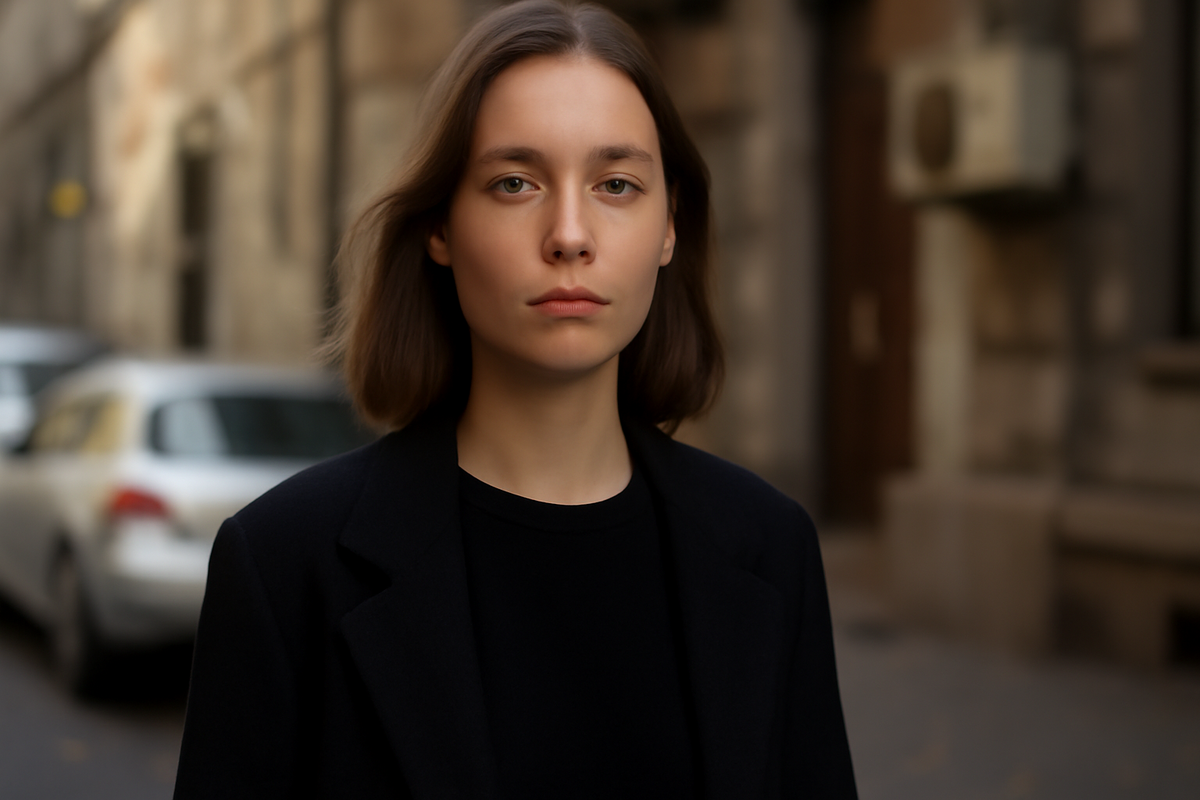
The woman at the café is dressed head to toe in black—coat, turtleneck, slim jeans, boots that make a clean, confident sound on the floor every time she moves. Outside, a river of people flows past the window, and if you watch long enough, you start noticing it: black jackets, black hoodies, black backpacks; sharp black suits, soft black sweaters, inky black dresses that swallow the light in the best possible way. Scan any crowd—airport terminals, subway platforms, concert lines, office lobbies—and it’s as if someone quietly turned down the color saturation of the world. You might wonder, as I did, not with judgment but with curiosity: what is it with black?
The Secret Language of a Black Outfit
Stand on a city street on a cool evening and you can almost hear it: the whisper of coats, the hush of fabric, the soft thud of black boots on pavement. There’s a shared hum underneath, a kind of secret language that doesn’t need words. Because black is never just “I had nothing else to wear.” It’s a message, often a layered one.
Think about the last time you chose black on purpose. Maybe you were nervous about an event and reached for the outfit that made you feel most like yourself. Maybe you didn’t want to think too hard—black goes with everything. Maybe you wanted to look serious, or slimmer, or simply not stand out. In that tiny moment of choice, something in your mind weighed comfort against visibility, confidence against camouflage.
Psychologists often talk about what’s called “enclothed cognition”—the way our clothes quietly shift how we think and feel. A black blazer might make you sit up straighter, a black dress might change the angle of your chin, a black hoodie could let you disappear into the background when you’re not in the mood to be seen. Black acts like an emotional dimmer switch or spotlight, depending on what you need from it that day.
It isn’t just “chic” or “slimming.” Black carries the weight of centuries of symbolism—mystery, power, elegance, rebellion, grief. Each time you wear it, you’re stepping into that history, even if you’re not fully aware of it. You’re speaking a quiet, psychological dialect that most people can read, even if only subconsciously.
Why Our Brains Quiet Down Around Black
Imagine opening your closet on a rushed morning. There’s the floral shirt that feels a bit loud today, the bright sweater you’re not sure you can emotionally match, the patterned dress that demands a good hair day. And then there’s the black t-shirt. You can almost feel your shoulders drop. Relief. Simplicity. Done.
Part of black’s popularity is brutally practical: it reduces decision fatigue. In a world of endless choice—what to look like, how to present, what version of yourself to roll out into public—black is an anchor. It asks fewer questions of you. It doesn’t argue with your mood, or your body, or your other clothes. It just…works.
There’s also the way black behaves in space. On a crowded metro car, black visually recedes, especially against low lighting or dark surroundings. Our eyes are drawn first to the brightest things, so black becomes a sort of visual hush. If you’re feeling overstimulated, socially tired, or just not in the mood to “perform,” black can feel like a soft wall you can stand behind.
At the same time, when you’re in a context that values sharpness and authority—an interview, a presentation, a first meeting with someone important—black pulls focus in a different way. It creates clean lines, a sense of order, and a subtle seriousness. Our brains are wired to pick up on contrast and cohesion; a black outfit often looks more “intentional,” even if it took you five seconds to choose.
There’s a psychological paradox here that many people intuitively love: black lets you feel both shielded and composed. You might be less visually loud, but inside you feel slightly more structured, more held together. It’s the color of the night sky and of ceremonial robes; of backstage curtains and luxury cars; of the unknown and the ultra-controlled. Our nervous systems remember these associations even when we’re just throwing on a black hoodie to run to the store.
The Many Faces of Black: A Quick Look
Even though “black” sounds simple, what it communicates can be surprisingly complex. Here’s a compact overview of some common psychological signals people pick up from black clothing:
| Aspect | What Black Often Signals | How It May Feel to Wear |
|---|---|---|
| Mood & Emotion | Seriousness, depth, sometimes melancholy or introspection | Grounded, thoughtful, emotionally contained |
| Social Message | Professionalism, boundary-setting, subtle distance | Protected, less exposed, more in control |
| Aesthetic Vibe | Minimalism, sophistication, “I thought this through” | Neat, streamlined, put-together with low effort |
| Identity & Culture | Artistic, alternative, rebellious, or fashion-conscious | Belonging to a subculture, expressing taste without words |
| Practical Side | Versatility, stain-hiding, easy matching | Less stress, fewer decisions, reliable backup |
Power, Mystery, and the Armor of the Everyday
There’s a particular feeling that comes with slipping into black: the slight tightening of a belt, the fall of a well-cut coat, the way your reflection changes in a window. Power dressing isn’t just about shoulder pads and suits; it’s about how color pumps quiet voltage through your body.
Black can be psychological armor. In offices where the air hums with unspoken competition, darker clothes often signal competence and authority. Even in more casual settings, a black outfit says: I take myself, and this, seriously. Studies of color perception have repeatedly found that black is associated with strength, formality, and even a bit of intimidation. It’s not aggressive in the way that blazing red might be, but it doesn’t exactly invite casual overstepping either.
Then there’s the mystery factor. The human brain doesn’t love blanks—it loves patterns and explanations. When someone wears all black, especially with clean lines and minimal details, your imagination tends to fill in the gaps. Are they creative? Private? Confident? Hiding something? Intentionally or not, black leaves room for projection. It withholds just enough information to be intriguing.
In a sense, black allows you to choose how much of your inner world you put on display. Bright patterns and loud colors feel like conversation starters. Black feels like a closed book with a beautiful cover. You can decide when to open it, and to whom.
That’s why people often reach for black during big transitions or uncertain chapters of life: a breakup, a career shift, a move to a new city. When the inside is messy, it’s comforting to have the outside feel simple, structured, and strong. Black becomes a boundary line between you and everything you’re still figuring out. It doesn’t shout. It holds.
Grief, Depth, and the Shadow Side of Style
Of course, black’s story isn’t all polish and confidence. Historically and emotionally, it has long been the color of mourning, loss, and solemnity. When you put on black, you’re stepping into that cultural memory too.
There’s a reason people instinctively reach for darker clothes when they feel raw or low—not just because it “matches their mood,” but because black quietly asks less from the world. It doesn’t demand to be admired or complimented. It allows you to move among others without feeling like you’re betraying what’s going on inside by looking too bright, too celebratory.
For some, wearing a lot of black becomes a way to signal depth, even if they’re not always aware of it. It can be an unspoken protest against superficiality, a small refusal to play along with the constant pressure to be cheerful, colorful, and “on.” When your inner life feels complicated, black can feel honest.
That doesn’t mean anyone in black is sad, of course. Not at all. But the emotional range of the color is wide, and our psyches know it. Black says: I contain multitudes. Some of them are not for public display.
Minimalism, Aesthetic Control, and the Joy of Uniforms
There’s another, quieter movement pulling people toward black: the hunger for less. Less clutter. Less visual noise. Less mental static swirling around our choices every morning. In a culture that glorifies options, a growing number of people are discovering the relief of narrowing things down.
Consider the idea of a personal uniform—a small rotation of clothes that reliably express who you are. Black is the backbone of many such wardrobes because it makes everything easier. Black pants, black boots, black sweater: different textures, same base note. You can add a scarf, a watch, a single piece of jewelry, and suddenly you’ve dialed your look up or down without changing its essence.
Psychologically, this kind of consistency can be calming. When your clothes feel like “you” every day, you spill less energy into second-guessing yourself. You’re not reinventing your identity with each outfit; you’re reinforcing it. That repetition, that quiet echo of self, can be deeply anchoring.
Black also has a way of making flawed mornings feel a bit more edited. Even if you slept badly or your thoughts feel scattered, your reflection in a clean black outfit offers a little visual order. You may not feel fully composed inside, but what you see suggests a version of yourself who can handle things. Often, the mind follows the image.
Minimalist aesthetics—think simple lines, limited color palettes, carefully chosen objects—are really about control in an uncontrollable world. Black is the color equivalent of a clean, empty table: it gives your attention somewhere calm to land. In a day filled with notifications, headlines, and emotional crosscurrents, that calm can feel like a small, portable sanctuary you wrap around your body.
Subculture, Rebellion, and Belonging in the Dark
If you’ve ever stood in a concert crowd where the dominant color is black—band t-shirts, jackets, boots—you’ve seen another side of this story: community. Black has long been the unofficial uniform of certain subcultures: punk, goth, metal, beat poets, certain art and fashion circles. It carries that legacy of beautiful defiance.
For people who never felt at home in bright, mainstream styles, black becomes a banner. It says: I see the shadows; I’m not pretending everything is fine; I’m choosing to stand at the edges. That might sound heavy, but for many it’s actually freeing. Wearing black can be rebellion without chaos, a way to push against expectations while still feeling contained.
There’s also the quiet thrill of recognition. You spot someone across a room—black boots, black jeans, black jacket that isn’t quite like the others—and there’s a subtle nod in your mind: one of us. Not necessarily a specific tribe, but a shared sensibility. You may never speak, but for a moment, your color choices are in conversation.
That’s the interesting paradox: while black can signal distance or privacy, it can also signal belonging to a particular way of seeing the world. An all-black outfit might mean “don’t approach,” or it might mean “if you get it, you get it.” Psychologically, those dual signals can feel very satisfying to send. You’re both filtering and inviting, choosing your audience without having to say a word.
What Your Own Black Clothes Might Be Saying
Open your wardrobe in your mind for a moment and scan the black pieces. There’s probably that one item you always feel good in, no matter what. The pair of black jeans that have survived five moves and three jobs. The black dress that holds the memory of a particular evening. The black shirt you wear on days when you’re unsure of yourself—but want to look anything but.
Each of those pieces is doing psychological work for you. Some provide safety. Some provide confidence. Some create distance when you need it. Some tie you to a younger version of yourself you’re not ready to let go of. It’s worth noticing which is which.
On a deeper level, your relationship with black might reflect where you are with visibility itself. Are you craving to be seen more clearly, or to blend in and observe? Do you use black as a shield, a stage, or a canvas? None of these are wrong. But understanding them can offer tiny acts of self-honesty in a world that often pushes us to dress for others’ eyes instead of our own nervous systems.
Maybe, next time you reach automatically for that black sweater, you pause for a breath. Ask quietly: what do I want this color to do for me today? Protect, sharpen, simplify, soften, connect, hide? There’s a strange kind of intimacy in realizing that even your most “neutral” choices are alive with intention.
In the end, the reason so many people wear black is both simple and endlessly nuanced. It’s easy. It’s flattering. It matches everything. Yes. But it also taps into something older and more primal: our relationship with night, with mystery, with the parts of ourselves we only show in low light. It lets us curate our edges in a noisy world. It lets us be both here and slightly elsewhere at the same time.
And perhaps that’s the quiet magic of black: it doesn’t just sit on the surface. It listens, absorbs, reflects back what you need most that day—armor, uniform, statement, or sanctuary—without demanding to be the main character. In a universe bursting with color, black remains a deliberate, powerful whisper.
Frequently Asked Questions
Does wearing a lot of black mean I’m depressed?
Not necessarily. While black is historically linked to mourning and can reflect a serious or introspective mood, many people wear black simply because it feels stylish, practical, or calming. One person’s black outfit might signal grief, while another’s signals confidence or minimalism. Context—and how you feel in it—matters far more than the color alone.
Why does black clothing often feel more “professional”?
Black is strongly associated with formality, authority, and seriousness in many cultures. Suits, uniforms, and formal wear are frequently black, which trains our brains to link the color with competence and control. In a work setting, black can suggest focus and reliability, even when the cut of the clothes is quite simple.
Is it true that black makes you look slimmer?
Black can create a visually slimming effect because it absorbs more light and shows fewer shadows and lines, which can make shapes appear smoother. It also tends to recede visually, drawing less attention to specific areas of the body. However, fit and fabric usually matter more than color alone in how you feel and look.
What does it mean if I feel uncomfortable in bright colors and prefer black?
Preferring black over bright colors can mean many things: you might be more introverted, sensitive to visual stimulation, drawn to minimalism, or simply like how black feels on your body. It could also reflect a desire for emotional privacy or a dislike of attracting attention. None of this is inherently negative; it’s just information about what helps you feel safe and like yourself.
How can I balance loving black with wanting more variety in my wardrobe?
One approach is to keep black as your base and add variation through texture, silhouette, or small touches of color. For example, pair black jeans with a dark forest-green sweater, or a black dress with warm-toned jewelry. You can also experiment with “near blacks” like deep navy, charcoal, or espresso brown, which offer the same grounding effect with a slightly different emotional tone.

Hello, I’m Mathew, and I write articles about useful Home Tricks: simple solutions, saving time and useful for every day.