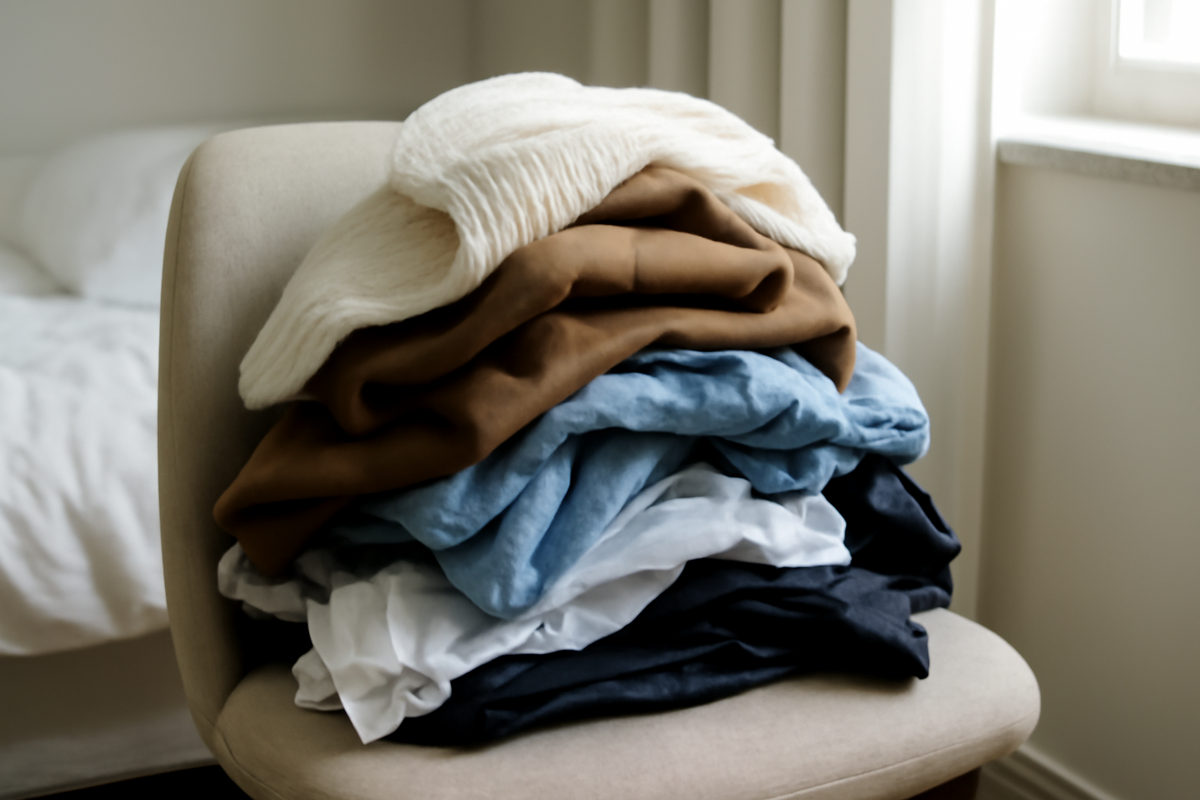
At the end of a long day, you don’t walk straight to your closet. You head, almost unconsciously, to the one spot in your room that has quietly become a second wardrobe: the chair. The jeans you wore for only three hours. The sweater that’s “not dirty, not clean.” The shirt you might wear again tomorrow. One by one, they land there in a soft, slouching pile. The chair accepts it all without protest. In the dim light of late evening, you promise yourself you’ll hang everything up tomorrow. Tomorrow rarely comes.
The quiet landscape of your “clothes chair”
If you pause for a second and really look at it, your clothes chair is like a tiny habitat inside your home. Fabrics layered like fallen leaves. Colors from different seasons overlapping. Textures you can almost feel just by looking: the rough denim, the loose knit of a cardigan, the silk that always slides off the back and puddles to the floor. There might be a belt half-hidden, a bra strap snaking out like a vine, socks in mismatched pairs clinging to the edges.
This pile isn’t chaos by accident. It’s a living snapshot of your in-between moments — the things not ready to be washed yet, but not pristine enough to rejoin the folded, orderly ranks in your closet or drawers. The clothes on your chair are liminal objects, paused mid-journey, caught between “today” and “not yet.”
Walk closer. Run your fingers across the top layer. There’s that hoodie you drag on when you’re too tired to decide what to wear. Under it, the black pants you use for “kind of important but not too formal” events. You may not realize it, but your clothes chair is a map of your real life, not the aspirational one your neatly arranged wardrobe pretends to represent.
The psychology draped over the backrest
The clothes pile is rarely about laziness alone. It often tells a more intimate story about how your brain moves through a day, and what you do with decisions you’re too tired to fully make.
Decision fatigue in fabric form
Every garment in your closet is a choice. What matches? What feels right? What sends the message you want to send? By the end of a long day, your decision-making energy is drained. Your brain wants the simplest possible answer to the question, “Where do I put this?” and the chair offers it: Here. For now. No thinking required.
Putting something back on a hanger has a micro-cost: opening the door, sliding the hangers aside, straightening the sleeves. It’s small, but in a tired brain, even a tiny extra step can feel disproportionate. The chair, meanwhile, is always there. No doors. No friction. Just soft, silent acceptance.
The limbo of “not dirty enough”
The average clothes chair is populated by garments that live in a gray zone. They’ve been worn once or twice. Maybe they smell faintly of your perfume or the café you sat in, or of rain on the walk home. Not bad enough for the laundry basket, not fresh enough for the shelf.
We don’t really have a standard place in most homes for this in-between category. Closets assume binary states: clean or dirty, wearable or done. The chair becomes the unspoken third option: “I’ll deal with it later.” It’s the physical manifestation of ambiguity.
Your relationship with future you
Every time you drop something on the chair, you’re making a tiny bargain with your future self: You’ll handle this, right? Sometimes this is optimistic trust. Sometimes it’s avoidance. But somewhere inside that growing pile is a pattern in how you relate to your own time and energy.
If your chair is regularly overflowing, it may hint that your days are so packed you’re constantly bumping small choices forward. You’re living in a series of deferrals. The promise to “hang it up tomorrow” is less about the shirt and more about the pace of your life: one in which there’s never quite enough room for gentle, unhurried putting-away.
What your clothes pile quietly reveals about you
You might think everyone’s clothes chair looks basically the same, but there are differences, and those differences reveal a lot about temperament, rhythms, and even personal values. Your chair is like a mood board you never meant to create.
The curator: controlled chaos
Some people have a clothes chair that never totally disappears but also never truly collapses into disorder. A few pieces rotate in and out. Yesterday’s jeans draped carefully over the back. One neutral sweater folded on the seat. An outfit for tomorrow laid on top, ready to go.
If this is you, your chair may reveal a mind that prefers visual cues — you like to see what’s in play. Your pile is more of a staging area than a dumping ground. You design your mornings the night before, using the chair as a quiet assistant. You might be busy, but you crave some sense of intention in the way you move from day to day.
The time-traveler: layers of old seasons
Others have a chair that contains not just this week, but faint fossils of last month. A sweater from that cold snap three Fridays ago. The dress you wore to a friend’s birthday that you “still need to steam.” A scarf from early autumn, now half buried beneath workout leggings you meant to use “more regularly.”
Here, the chair becomes an archive, holding onto moments long after you’ve moved on. It might hint at a mind that moves faster than its surroundings, always two steps ahead of itself. Your life keeps shifting, but the objects around you lag, like a shadow not yet caught up.
The dreamer: intention without follow-through
Maybe your chair often hosts outfits that were planned but never worn. That blazer you set out for a networking event you talked yourself out of. The running clothes arranged optimistically for a 6 a.m. workout you slept through. A linen shirt that doesn’t quite feel like “you,” but you keep trying it on anyway.
Your clothes chair, in this case, is a small museum of intended versions of yourself. The runner. The networker. The person who wears crisp white linen and never spills coffee. These clothes aren’t just fabric; they’re costumes for lives you haven’t fully stepped into yet. Your pile holds both your hopes and the quiet weight of hesitation.
The comfort-seeker: soft fabrics, repeated often
For some, the chair is filled with the same rotation of three or four pieces. The softest sweatpants. The one T-shirt that feels just right. The cardigan that’s been washed so many times it’s more memory than structure.
If this sounds familiar, your clothes chair might reflect your deep relationship with comfort and emotional safety. You know which fabrics help you exhale. These aren’t just “casual clothes”; they are your decompression wardrobe. The ones you reach for when you’ve had enough of being “on” for the world.
The subtle ecology of your room
Zoom out. Your clothes chair doesn’t exist in isolation. It’s part of the ecosystem of your space — the way objects migrate, settle, and accumulate in the landscape of your room.
Some people keep the rest of their room almost painfully neat, with the clothes chair as the singular zone of tolerated mess. It’s like a local storm system in an otherwise clear sky. This may be your mind’s way of creating a controlled wildness: a small, safe place where perfection doesn’t matter.
Others have a room where the chair is just one node in a gentle constellation of clutter: books on the nightstand, a half-finished cup of tea on the dresser, chargers blooming from sockets like vines. In this world, the clothes pile is another sign that your space is more organic than engineered. It grows rather than remains fixed.
Consider the path from your door to your bed. Do you pass the chair every time? Does it greet you as you walk in, a fabric monument to the last week of your life? Or is it tucked in a corner, almost out of sight, where your unconscious can ignore it until the pile reaches a tipping point?
A small mirror of how you handle “almost done” things
The clothes on your chair are technically “almost put away.” Just one more step would complete the cycle: onto a hanger, into a drawer, or down into the laundry basket. But they stay, suspended. There’s something familiar about that, isn’t there?
Maybe you have emails drafted but unsent, tabs open with forms half-filled, books bookmarked at the last chapter. The clothes chair can be a fabric echo of that pattern: the tendency to pause just short of finished. Not from failure, but from simple human overwhelm.
Interestingly, the opposite is also revealing. If your chair is almost always empty, your clothes consistently hung or folded at the end of the day, that too says something. Perhaps you draw comfort from closing loops. Maybe you live with a kind of internal agreement: today’s tasks stay in today. Your room becomes an exhale, not a continuation of mental to-do lists.
Neither way is morally better. But both are clues. The way cloth gathers on a chair is a quiet diagram of how you move through cycles: starting, pausing, finishing, or endlessly circling.
From silent pile to intentional ritual
If your clothes chair makes you feel guilty or annoyed every time you see it, that’s your body asking for a new rhythm, not a new personality. You don’t have to become the mythical person who color-codes hangers overnight. But you can turn what feels like a small failure into a small ritual instead.
Make a visible “in-between” zone
Part of the reason the chair becomes overloaded is that it’s doing two jobs badly: storage and staging. Give those clothes a clearer role. A single hook on the wall for “wear again soon” pieces. A slim rail or a single shelf labeled in your mind as “halfway worn.” When your brain knows, “This is where lightly used clothes live,” the chair loses its magnetic pull.
Turn it into a two-minute evening ritual
Rather than promising a full wardrobe reset “someday,” try shrinking the task until it feels almost too easy. Before you get into bed, set a tiny rule: deal with just three items from the chair. Hang one thing. Fold one. Toss one into the laundry. Three pieces a night and the pile never becomes an avalanche. The ritual becomes less about organization and more about telling your mind: I close my day with care.
Pay attention to the repeat offenders
Notice which items appear on the chair over and over. Is it the dress you don’t quite feel confident in? The jeans that only fit on some days? The shirt that requires special care so you keep hesitating to wash it? Those pieces might be quietly asking a question: Do I really belong here?
Sometimes, the clothes chair highlights wardrobe friction. Items that are annoying to wash, uncomfortable to wear, or emotionally loaded will circle endlessly between body and chair without ever settling. Letting them go can lighten both your closet and your mind.
Redesign for the way you actually live
Look at the layers in your pile: what do they tell you about your real routine? If your chair is mainly workout clothes and lounging pieces, maybe you need a more accessible, visible space for those — not tucked in a bottom drawer behind a stack of “should-wear-more” outfits. If work clothes dominate, consider a dedicated “weekly rotation” spot on a rail, so you’re not negotiating their status every day.
When your storage reflects reality instead of fantasy, the chair doesn’t have to carry so much of the load. It can go back to being, well, a chair.
A tiny table of truths: what’s on your chair?
Sometimes seeing it laid out clearly helps. Imagine your chair translated into a little chart of clues:
| What you see on the chair | What it may quietly suggest |
|---|---|
| Neatly folded, small rotating stack | You like visible order and quick access; the chair is a staging area, not a mess. |
| Layers from many weeks, mixed seasons | Life moves quickly; your surroundings struggle to keep up with your pace and decisions. |
| Mostly comfy, worn-soft favorites | You seek emotional comfort in touch and routine; these pieces are your safe zone. |
| Outfits you planned but didn’t wear | You’re actively negotiating different versions of yourself and your future habits. |
| Chair usually empty, clothes quickly put away | You find relief in closing loops and keeping your environment mentally quiet. |
Learning to see the pile with softer eyes
It’s tempting to look at your clothes chair and see only failure: one more thing you’re not “on top of.” But what if, instead, you saw it the way you might see driftwood collected along a shoreline? Evidence of tides. Proof that life is moving.
That sweater thrown over the backrest might still smell faintly of the evening you needed to step outside and breathe cold air alone. The crumpled dress might remember laughter from a night that ended too late. The T-shirt half-slid to the floor might still carry a trace of the paint you got on your hands when you finally started a project you’d been putting off.
Your clothes chair is not just procrastination. It’s a handful of small, honest truths about your days: how tired you were, how you hoped tomorrow would go, how you wanted to feel in your own skin. It holds the gap between how you intend to live and how you actually do. And in that gap, you’ll usually find tenderness more than failure.
You can change the habit if you like. You can add hooks, rituals, rails, and rules. You can proclaim, “No more clothes on this chair.” But even if you do, there will always be some new little pile somewhere — because life is rarely as folded and sorted as closets suggest.
So tonight, when you drop your shirt on the chair, pause for just a breath. Notice the small thud of fabric against wood. Feel the softness under your fingertips. Ask yourself, gently, not “What’s wrong with me?” but “What is this little pile trying to tell me about how I’m really living?” The answer will be quieter than guilt, and much more interesting.
FAQ
Is having a clothes chair a bad habit?
Not inherently. It becomes a problem only if it stresses you out, makes your space harder to use, or hides things you need. For many people, it’s just an improvised system for “in-between” clothes. You can choose to refine that system rather than judge it.
Why do I feel embarrassed about my clothes pile?
Because we’re often taught that a tidy space equals a tidy life. A visible pile feels like proof of failure. In reality, it’s just evidence that your energy and attention are finite. Seeing it as information instead of shame can ease that embarrassment.
How can I reduce the pile without a huge cleanup?
Use micro-rituals: deal with two or three items a night, create a clear spot for “wear again” clothes, and notice which garments keep returning to the chair. Small, repeated actions work better than occasional giant efforts.
What if I actually like having a clothes chair?
Then honor it. Keep the pile intentional and limited. Let the chair be your visible weekly wardrobe: pieces in active use. As long as it doesn’t overflow into stress or chaos, it can be a perfectly functional part of your living system.
Can my clothes chair tell me what to declutter?
Yes. Items that never make it back to the closet, or that sit for weeks without being worn again, are often good candidates to donate or retire. Your pile highlights what you really reach for — and what you only think you should reach for.

Hello, I’m Mathew, and I write articles about useful Home Tricks: simple solutions, saving time and useful for every day.