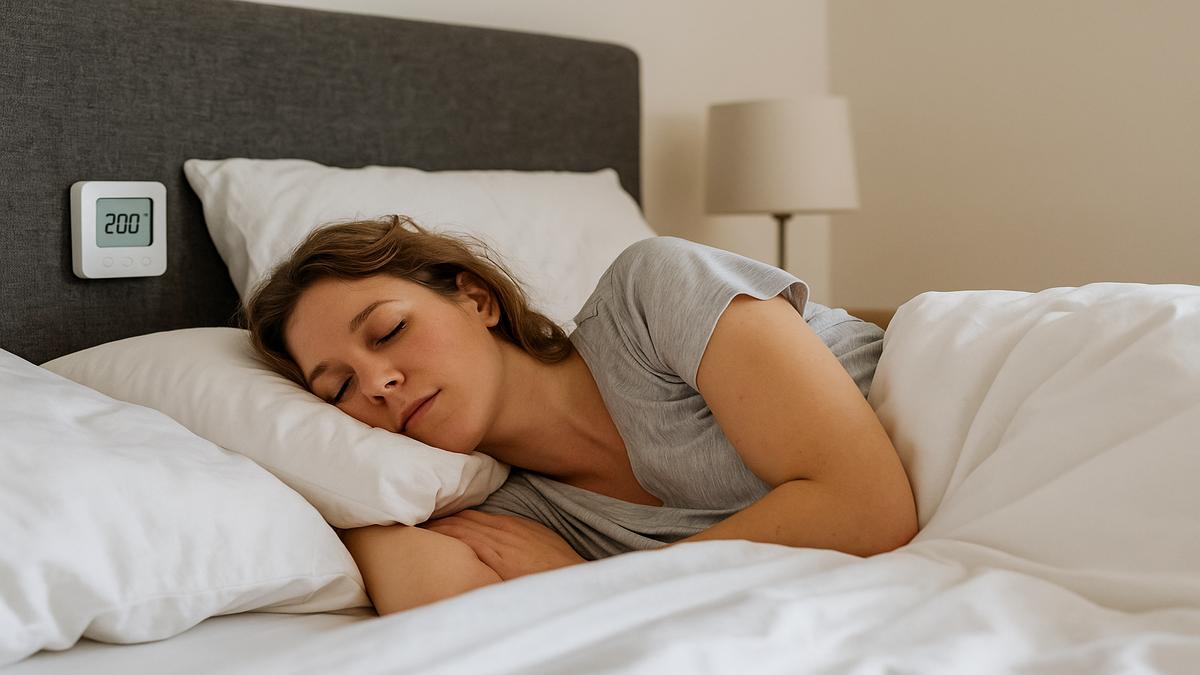
The first thing you notice isn’t the sound, but the feeling. A thin ribbon of cold air is pouring over your shoulders, creeping down the back of your neck, burrowing under the blanket you’ve dutifully pulled to your chin. The thermostat on the wall glows with that familiar, righteous number: 22°C. “The perfect temperature,” everyone says. Except tonight your toes are numb, your nose is icy, and you’re lying wide awake, wondering why the “perfect temperature” feels anything but.
The Myth of the Magic Number
For years, 22°C has hovered over our living rooms and bedrooms like a sacred figure. Office building guidelines, hotel room defaults, polite arguments at dinner parties about whether it’s “too hot” or “too cold”—they all orbit this single, strangely unexamined number. It’s the Goldilocks of indoor life: not too hot, not too cold, just right.
But step into the world of sleep researchers, building scientists, and people who actually pay the electricity bill, and a different story unfolds. The “right” temperature, it turns out, has less to do with a single magic number and far more to do with how your body, your home, and your habits dance together through the night.
Recently, a growing chorus of experts has started to break up with 22°C. They’re nudging thermostats higher—just a little—and discovering something surprising: people aren’t just saving energy; they’re also sleeping better. The cozy setpoint quietly taking over? Somewhere around 24°C.
The Nighttime Body: A Quiet Climate All Its Own
Think of your body at night as a small, soft planet with its own weather system. As evening deepens, your internal temperature begins to drop. This isn’t random; it’s the brain’s way of dimming the lights on your inner world, signaling: it’s time to sleep.
You might assume, then, that colder rooms are always better. We’ve been told this so often that many of us play a kind of cooling Olympics: fans, AC units, chilly sheets, the thermostat heroically pushed down. But your body isn’t just a hunk of meat that prefers “cold.” It wants contrast and comfort: a slightly cooler core, yes, but warm enough extremities and a sense of shelter that tells your ancient nervous system, “You’re safe here. You can let go.”
At 22°C, many people experience what researchers call “cold stress” without even realizing it. Your skin temperature drops, and your body starts quietly working to defend itself, constricting blood vessels in your hands and feet. It’s subtle, but it matters. Sleep, especially deep, slow-wave sleep, thrives when your nervous system is relaxed, not on silent alert, bracing against a draft.
Raise the room just a couple of degrees—to around 24°C—and something interesting happens. You’re still cool enough for your core temperature to drop, but your skin and extremities don’t feel under siege. The bed stops feeling like a refrigerated display case and starts behaving more like a cocoon.
Why “Cozy-Cool” Beats “Hotel-Cold”
We all know that hotel-room chill: you walk in, and the air hits you like a supermarket freezer aisle. It feels luxurious for a few minutes—fresh, crisp, cleansing. But try sleeping deeply in that air, night after night, and the luxury starts to feel like a negotiation. You tug blankets closer. You wake with a dry throat. You hunt for socks in the dark.
In contrast, the new sweet spot that many experts suggest—usually around 24°C, sometimes even nudging toward 25°C in humid climates with good airflow—feels less like a performance and more like permission. It’s the temperature where you don’t have to clutch your covers for dear life. You can stretch out, let your leg escape the duvet, and not instantly regret it.
Your body is incredibly good at fine-tuning its own climate, as long as you give it a reasonably friendly background. A slightly warmer room allows your muscles to truly unwind, your breathing to slow, and your brain to step out of “keep me warm” mode and into the deeper, quieter work of repair.
The Hidden Energy Tax of Chasing 22°C
Then there’s the other piece of the puzzle: energy. Every degree you ask your air conditioner to drop below the outdoor temperature is like adding another weight to a barbell. The lower you go indoors, the harder your system has to work outside.
In many homes, maintaining 22°C all night is less a preference and more an energy habit we’ve inherited—one that made some sense in leaky, poorly insulated buildings where cool meant “not stuffy.” But modern homes, with better insulation and sealed windows, trap that chill with almost stubborn efficiency. You end up cooling an entire air volume more than you need to, hour after hour, watt after watt.
Energy experts often suggest a simple rule of thumb: for every degree Celsius you raise your cooling setpoint in summer, you can shave roughly 5–10% off your cooling energy use, depending on your climate and building. That’s not a tiny rounding error. That’s real money, real grid demand, and, in heat-prone regions, real strain on systems that are already under pressure.
Shifting your nighttime setpoint from 22°C up to 24°C doesn’t sound radical. On paper, it’s barely an adjustment. But across millions of bedrooms, apartments, student dorms, and hotel rooms, that shift adds up to an enormous difference in power demand—especially during sticky summer nights when air conditioners never seem to rest.
A Tiny Change With Outsize Impact
Imagine a city where a million people sleep with the thermostat set to 22°C. Now picture that same city gently sliding the dial to 24°C over a single summer. Air conditioners hum a little less fiercely. Compressors cycle off more often. The grid breathes a bit easier, and some families, quietly, find their electricity bill shrinks by enough to notice.
All without anyone lying awake in sweat-soaked sheets.
The beauty of this change is that it isn’t a sacrifice in the usual sense. Done thoughtfully—with good air circulation, breathable bedding, and sensible shade during the day—it can feel like a genuine upgrade. Less noise from the AC. Fewer midnight shivers. A feeling, subtle but persistent, that your room is holding you instead of refrigerating you.
Your Skin, Your Sheets, Your Air: The Trio That Matters
Here’s where things get delightfully practical. Temperature isn’t experienced by your brain as a number on a thermostat; it’s felt through texture and air movement on your skin.
Two rooms can be identical in temperature but feel profoundly different. One is dry, still, and scratchy; the other has a slow, soft breeze, cotton sheets, and the faintest scent of night air slipping in from a barely cracked window. Same 24°C, dramatically different story.
To make 24°C feel more like “cozy-cool” than “muggy,” three elements work together:
- Airflow: A ceiling fan or a quiet standing fan doesn’t actually lower the room temperature, but it increases evaporation from your skin, which your body reads as cooling. Even a low-speed fan can make 24°C feel as comfortable as 22°C, sometimes more so.
- Bedding: Breathable materials—cotton, linen, bamboo-derived fabrics—let your body create its own microclimate under the covers. Synthetic fibers that trap heat and moisture can make even 22°C feel oppressive.
- Humidity: At high humidity, sweat can’t evaporate well, and even moderate temperatures can feel sticky. A dehumidifier or AC set less aggressively (but allowed to run long enough to dry the air) can make 24°C feel fresh and light.
In other words, 24°C with a light breeze and a cotton sheet beats 22°C in a sealed, stuffy box every time. When people test this combination honestly—giving themselves two or three nights to adapt instead of one hesitant evening—they’re often surprised to realize: “Oh. I actually feel better like this.”
How 24°C Wins the Comfort Game
Consider these two scenarios—both entirely realistic:
| Scenario | Room A | Room B |
|---|---|---|
| Thermostat | 22°C | 24°C |
| Airflow | Minimal, windows closed, AC only | Ceiling fan on low, gentle circulation |
| Bedding | Thick duvet, synthetic blend | Light cotton sheet and thin blanket |
| Body Sensation | Cold spots, occasional shivers, dry throat | Even warmth, cool face, relaxed muscles |
| Energy Use | Higher, AC runs more often | Lower, shorter and fewer cooling cycles |
Room B, at 24°C, is where many people wake up saying, “I slept through the night.” Not in a chilled bunker. Not in a lukewarm stew. Just a gently held, steady comfort zone.
Sleep Quality: What the Research is Quietly Telling Us
Research into sleep and temperature doesn’t always translate neatly into a single “ideal” number, because bodies, homes, and climates vary. But consistent themes keep appearing in labs and field studies.
When the bedroom is too cold, people tend to show more micro-awakenings—those tiny, half-conscious surfacings from deep sleep you barely remember. Their heart rates can bump slightly. They shift around more. Over a week, this can leave you with that cloudy, unrefreshed feeling in the morning, even if you technically clocked seven or eight hours in bed.
When the bedroom is mildly warm but not stuffy, with good ventilation, certain markers of deep sleep and REM sleep often improve. People fall asleep slightly faster. They toss and turn less. They report better subjective rest—even if the thermostat shows a higher number than their old “ideal.”
There’s also the factor of nighttime awakenings for bathroom trips or quick sips of water. In an overly cold room, these awakenings can stretch out. You climb from the warmth of the bed into a chill that nips at your skin, and your body responds with a small jolt of wakefulness. In a warmer room, the transition is gentler; you return to bed without a spike of alertness.
None of this means everyone should rush to set their thermostat to precisely 24°C and carve it into stone. Some people, especially those going through hormonal shifts or dealing with medical conditions, may prefer a slightly cooler night. But as a starting point, as a default we’ve never really tried en masse, 24°C represents a quiet revolution: a more body-friendly, energy-sensible baseline.
The Gentle Experiment: Trying 24°C for Yourself
If 22°C has been your loyal nighttime companion, changing it can feel oddly emotional—like breaking from family tradition. The trick is to treat it like an experiment rather than a verdict.
Try this for one week:
- Set your nighttime thermostat to 24°C.
- Turn on a ceiling or standing fan on its lowest comfortable setting.
- Swap thick, heavy bedding for a lighter sheet and one breathable blanket.
- Block harsh evening sun with curtains to prevent the room from heating up excessively before bedtime.
- Notice, without forcing: how quickly you fall asleep, how often you wake, and how you feel in the morning.
You may find the first night odd, simply because “different” often feels wrong at first. But by the third or fourth night, your body will start to reveal its verdict. Many people discover a subtle but persistent sense of ease: less wrestling with covers, fewer sharp contrasts between “inside the bed” and “out in the room,” more steady comfort.
A New Relationship With Indoor Comfort
Stepping away from 22°C is not just about a new number—it’s about a new way of thinking about comfort. For decades, we’ve treated indoor climate like a fixed setting to be defended. Conversations go, “Is it 22? It needs to be 22.” Windows stay sealed, vents stay blasting, and our bodies are asked to adapt to a rigid standard that never asked how we actually feel.
The emerging wisdom is softer, more responsive. Comfort is becoming something you co-create with your space: a dialogue between air temperature, airflow, humidity, light, and the quiet needs of a body that evolved not in sealed boxes but under night skies, in caves and huts and homes that breathed with the world outside.
At night, this means giving yourself permission to aim for “cozy-cool” instead of “clinic-cold.” It means trusting that your body can help manage its own climate when you provide it with the right background: a room that’s cool enough to sleep, warm enough to relax, and gentle enough on the grid that the planet doesn’t pay for every shiver.
In that small shift from 22°C to around 24°C, there’s a kind of quiet maturity. You’re no longer chasing an abstract ideal. You’re listening. To the way your shoulders unclench, the way your breath softens, the way you wake not with a gasp in the too-cold dawn but with a slow, unhurried return to the world.
One evening soon, you might glance at that glowing thermostat and realize it no longer feels like a scoreboard. It feels like a tool—one you’re finally using with the grain of your own body and the needs of the world outside your window. And as the fan hums gently, and the room settles into its new, warmer, surprisingly cozier setpoint, you may find the cooling conundrum wasn’t a puzzle to be solved by numbers at all, but by noticing how you feel when you finally get out of your own way and let yourself be, simply, comfortably human.
FAQ
Is 24°C really better than 22°C for everyone?
Not for absolutely everyone, but 24°C is a more comfortable and energy-efficient starting point for many people. It often reduces cold stress, improves relaxation, and still allows your body temperature to drop naturally for sleep. You can adjust up or down by a degree based on how you personally feel over a few nights.
Won’t I feel too hot trying to sleep at 24°C?
You might feel warm at first if you’re used to 22°C, but with a light fan and breathable bedding, most people adapt quickly. Air movement and fabric choice matter as much as the temperature number itself. Give your body a few nights to adjust before deciding.
How much energy can I save by raising my thermostat from 22°C to 24°C at night?
Depending on your climate and home, you may save roughly 5–10% of your cooling energy use for each degree Celsius you raise the setpoint. Going from 22°C to 24°C could mean noticeable savings on your bill over a full season.
What if my partner prefers it colder than I do?
Try keeping the room at a slightly warmer shared setpoint (like 24°C) and adjusting individually with bedding: a thicker blanket for the colder sleeper, a lighter sheet for the warmer one. A fan positioned toward the person who likes it cooler can also help without overcooling the entire room.
Does humidity change what temperature feels comfortable?
Absolutely. High humidity can make even 24°C feel sticky, while dry air can make the same temperature feel crisp and pleasant. If your nights feel muggy, focus on reducing humidity with your AC or a dehumidifier and using a fan, rather than pushing the thermostat lower.
Is it better to keep the same temperature all night or let it rise toward morning?
Most people do well with a steady temperature through the night, but allowing a slight increase toward morning—half a degree to a degree—can feel natural, since your body temperature starts to rise as you wake. Smart thermostats can automate this gentle shift.
Can I still sleep well without AC if I aim for 24°C?
If your nighttime outdoor temperatures fall near or below 24°C, you can often sleep well with good cross-ventilation, fans, and light bedding. Shading windows during the day, closing blinds, and ventilating at night can help your room hover around that cozy zone without mechanical cooling.

Hello, I’m Mathew, and I write articles about useful Home Tricks: simple solutions, saving time and useful for every day.