The sonar screen looked like any other—soft blues, grainy green lines, the usual ghostly fuzz of the seafloor—until one of the crew leaned closer and swore under his breath. There, rising against the sediment like a memory refusing to fade, was the clean, unmistakable outline of a wooden hull. Twenty-five meters below the vessel, waves rolled across an ordinary patch of water off Australia’s eastern coast. Above, seabirds rode the thermals like they had for centuries. But beneath them, after more than 250 years, an explorer’s ship that had vanished from the pages of history waited intact, sealed in the cold, dark grip of the sea: a time capsule that nobody expected to find in such extraordinary condition.
A Ghost on the Screen
It started, as these things often do, with a rumor and a hunch. Marine archaeologists had been combing this stretch of coastline for years, following fragments of old logs, incomplete charts, and the stubborn certainty that something important was still out there. A storm had blown through the week before, stirring up sand and shifting the seafloor. When the team went back out with updated sonar passes, they didn’t expect much—just another day of scanning anonymous ridges and trenches.
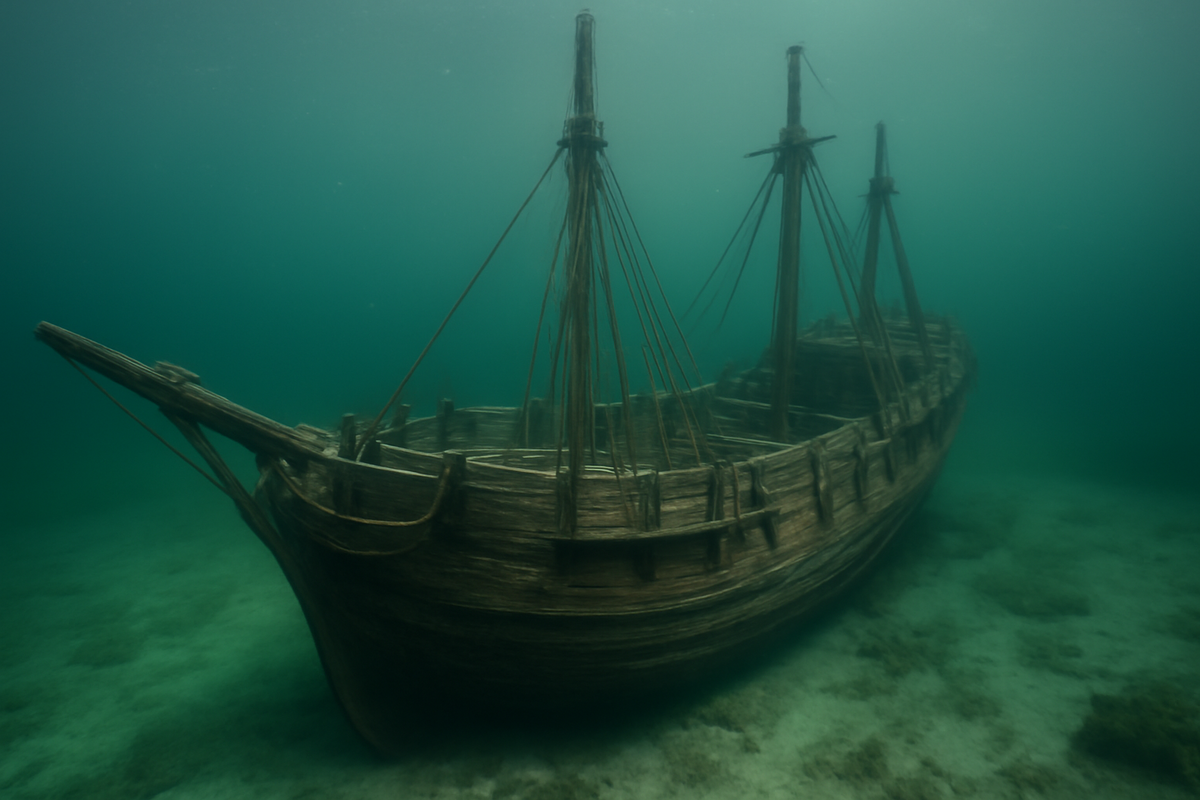
The ship revealed itself slowly. First as a shadow, then a suggestion, and finally, under the scrutiny of high-resolution imaging, a shape too precise to be natural. A sharply defined bow. A flattened stern where a rudder should be. The echo of decks stacked like pages of a closed book. When the first dive drone descended and its cameras flicked on, the control room fell silent.
The wreck balanced on its keel as if it had settled there deliberately. Timber planks, darkened and polished by time, were still locked together with iron fastenings. Seaweed clung like tattered sails. Schools of fish darted through shattered gunports, in and out of the ship’s open wounds. There was no dramatic wreckage field, no chaos of splintered hull and scattered cargo. It lay there almost peacefully, as though it had simply paused for a moment in the middle of a journey and never resumed.
For a few heartbeats, the team just stared. Two and a half centuries had collapsed into the span of a video feed. The questions came later: What ship was this, exactly? How had it gone down? And how on earth had it stayed so astonishingly preserved?
The Explorer Who Never Came Home
The ship’s name, once confirmed by a fragment of brass lettering and cross-referenced logs, seemed to carry its own gust of wind into the research tent: a vessel tied to one of the lesser-known but fiercely ambitious European expeditions to the Pacific in the late 1700s. While the public remembers the big names—the Cook, the Flinders, the Tasman—history quietly swallowed dozens of other captains, surveyors, and naturalists who tried to redraw the world and never came back.
This particular ship had left its home port at a time when the globe still felt mostly imagined. Maps were filled with blank spaces, dotted with sea monsters and hesitant outlines of shores. Australia was more rumor than country, an outline pinned to the edges of empire. The crew, if you sift back through the records, were not heroes when they left. They were carpenters and sailors, a botanist obsessed with cataloguing plants, a young astronomer obsessed with the stars, a surgeon who had learned fast that salt air did not cure infection.
Their journals, what few survived, speak of days that smelled of tar and citrus, of damp hammocks and creaking beams. They describe first landfalls on bare crescent beaches where the sand squeaked under their boots. They also hint at tension—between ambition and fear, between officers and crew, between the empire’s hunger for knowledge and the quiet, standing presence of Aboriginal land and sea lore already millennia old.
Then, the records stop. No triumphant return. No clear report of disaster. Just a line in an official ledger: “Presumed lost at sea.” A bureaucratic full stop written over real human lives.
Finding the ship was like finding the missing sentence after that full stop, the one that had always been there, just written underwater.
Descending Into the Past
The first human eyes to meet the ship’s broken figure in centuries belonged to a diver named Elise. She dropped through the water in slow, steady breaths, the ocean folding around her like thick glass. The light thinned into a dusky green, and the rattle of the boat above faded into a soft, swallowing hush. At ten meters she could see the shadow; at fifteen, details began to emerge: the curve of the bow, the twisted ribs where the deck had partially collapsed.
By the time she reached the seafloor, the ship loomed overhead like a drowned cathedral. Every surface was furred with life. Barnacles and corals tinted the wood in whites, oranges, and bruised purples. Swirls of tiny fish shimmered along the beams. A ray, startled by her bubbles, glided away in a slow, winged motion. What had once been a machine of empire was now an artificial reef, a pulsing node of marine life.
Her gloved hand brushed the hull and came away covered in a fine cloud of sediment and microalgae. She felt, absurdly, like she should apologize. The ship had been alone for a long, long time.
Back on the surface, as the team watched the footage, the scale of the preservation began to sink in. The masts were gone—torn away by storms long ago—but the lower deck structure remained. Parts of the hold were sealed beneath collapsed beams, creating pockets of low-oxygen water that had kept rot and boring organisms at bay. The colder-than-expected local current, passing along this stretch of coast like a slow, protective hand, had also helped.
On their second and third dives, the team mapped every inch. The cameras captured shattered crates fused with calcium, a rusted anchor still cradled in its hawse, a stove firewall half-buried in sand. It was as if time had thickened around the ship, preserving not just its wood and iron, but its final posture, its last chaotic moments.
The Time Capsule Within
A ship’s real story, though, lies inside. As remotely operated vehicles threaded their way through the broken hull, the explorers began to realize how complete this time capsule might be.
In the captain’s cabin, a section of bulkhead had collapsed, pinning furniture in place but shielding it from the worst of the sea’s erosion. A twisted metal frame that had once been a bunk. Hints of wood where a writing desk had stood. Well into the silt, sensors detected the faint reading of a compact metallic object—likely a navigational instrument, maybe even a sextant or quadrant, still nested where it had been stored before the last storm.
In the lower hold, boxes appeared under layers of sediment like ghostly outlines. Some had clearly broken open during the sinking, spilling their contents into the currents. Others remained sealed under the weight of beams and ballast stones. Samples carefully collected and brought to the surface later revealed something astonishing: traces of woven fibers and hardened organic residues, potentially from cloth, rope, or botanical specimens. The ship’s botanist, whose tidy handwriting had filled notebook after notebook, might have his work returned to the surface in physical form after all.
Higher up the hull, near what would have been the crew’s quarters, divers discovered rows of earthenware jugs embedded like teeth in the silt. Their corks and leather seals had long perished, but their shapes remained true. One still held a small pocket of liquid, kept intact in the vacuum left as it drained. Nearby, tin-plated containers hinted at salted meat or hardtack that had once fed men through months at sea.
Somewhere under a tangle of beams and coral-encrusted ropes, metal glinted. Could it be personal items—a spoon with initials, a belt buckle, coins from home? Each new discovery broadened the picture: not just of a ship, but of a floating community paused mid-story.
Between Empire and Ocean
Standing on the pitching deck of the modern research vessel, with tablets and transmitters glowing in the hands of the team, you could feel the strange collision of timelines. Overhead, satellite signals stitched invisible paths through the sky. Below, the Earth held tight to lumber felled in forests long since logged, shaped by tools now displayed behind museum glass, sailed by people whose names had almost been forgotten.
There was, too, the uneasy weight of context. This ship, like so many of its era, was not a neutral wanderer. It moved under flags that divided maps into zones of possession, that treated coastlines as blank until charted in European ink. Every course it plotted across the Pacific intersected with Aboriginal and Torres Strait Islander seaways that had been traveled, understood, and sung about for tens of thousands of years.
Local elders, invited on board once the discovery was confirmed, watched the footage with a quiet that felt different from the scientists’ stunned silence. Where the researchers saw new data points and artifacts, they saw another layer added to a story already impossibly deep. To them, the wreck was one more trace of a sudden, turbulent chapter in an ongoing relationship with sea and land—an artifact of intrusion that the ocean had chosen to keep and transform.
Conversations on deck turned, inevitably, to responsibility. What do you do with a ship like this? Raise it, piece by piece, into climate-controlled rooms and bright museum lights? Or leave it where it is, continuing to host corals and crustaceans, becoming ever more braided into its marine ecosystem?
Sitting between these choices were the stories held in the wreck: the scientific tools that mapped new stars, the botanical specimens that introduced European eyes to new plants, the logbooks that might contain long-lost descriptions of coasts and currents. Stories that could fill gaps, correct errors, and reframe the narrative of Australia’s coastal exploration—not just in textbooks, but in how people understand this stretch of ocean today.
A Ledger of Artifacts
As initial surveys continued, the team began to categorize what they could see without disturbing the site too aggressively. Their preliminary inventory looked something like a ledger written in two languages: that of maritime archaeology and that of the ship’s working life.
| Feature / Item | Location on Wreck | What It Reveals |
|---|---|---|
| Hull and keel structure | Seafloor, full length | Shipbuilding methods; timber sources; repair history |
| Iron fastenings and nails | Throughout hull and decks | Metallurgy of the era; maintenance patterns |
| Earthenware jugs | Crew quarters area | Diet, trade routes, daily life on board |
| Navigation instrument fragments | Captain’s cabin | Voyage precision; scientific priorities of the expedition |
| Crates and botanical remains | Lower hold | Historical ecology; plant exchanges between continents |
Each line is a thread to pull. Wood samples, for instance, can be analyzed to identify the forests the timbers came from; tiny growth rings can even hold climate clues from centuries ago. The jugs and their residues might show not just what the crew drank, but where those supplies were sourced. Fragments of instruments could confirm whether this voyage was at the cutting edge of navigation at the time, or working with older, inaccurate tools.
Put together, these threads form something more than a list. They sketch the outline of a particular moment in human curiosity—curiosity that often arrived with violence and upheaval, but also carried genuine wonder about the unknown edges of the world.
Listening to the Silence
For all the jubilation on the research vessel, there is no ignoring the ship’s other, quieter cargo: absence. No human remains have been clearly identified yet on the site, though it’s far too early to rule them out. Still, even an empty ship speaks of loss. Storm, reef, or miscalculation—whatever brought this vessel to the seafloor would have unfolded in panic and noise, under a sky we can only imagine.
In that silence, the sea kept going. Generations of whales passed over the wreck on their migrations, lanternfish blinked in the dark below, storms raked the surface and shoved the sand a little higher or lower. On shore, an entire continent’s history shifted: more ships arrived, coastal settlements grew, frontiers moved violently inland, revolutions of land, power, and identity unfolded. Above the wreck, flight was invented, radio crackled across oceans, satellites began to look down.
Through it all, this wooden hull remained, slowly softening into its surroundings but refusing to vanish. It feels almost impertinent, now, to shine lights on it and ask it to explain itself. Yet that is what humans do: we seek out the hidden, the buried, the lost, and coax stories back into the open.
Perhaps the most humbling part of the discovery is realizing that the ship wasn’t really waiting for us. It was simply there. It is we who arrived late to the conversation, breathless and exhilarated, wanting to know everything at once.
The Future of a Sunken Past
The months and years ahead will decide the ship’s fate. International guidelines and local laws urge caution: excavation is slow, expensive, and irreversible, and the ocean has its own claim. Marine biologists advocate for minimal disturbance of the thriving reef. Historians and curators argue for the power of tangible artifacts to bring distant centuries into the present, especially for younger generations.
No matter what is ultimately raised—or left in place—the discovery is already changing how people look at this stretch of water. Coastal communities that have long stared out at the same blue horizon now know a fragment of their history lies just beneath the waves. Fishing boats pass over the coordinates with a new, almost superstitious awareness. School classes visit nearby beaches for field trips that, for once, are not abstract: just over there, they learn, a wooden ship from another world lies folded into the sand.
For scientists, the wreck is an extraordinary laboratory. It captures a frozen cross-section of life and technology from the late 18th century, preserved not in a glass case but in saltwater, shadow, and silt. For Aboriginal and Torres Strait Islander communities, it is another piece of the puzzle of how their shores were first approached and mapped by strangers—knowledge that can help rebalance a narrative too often told from only one side.
And for anyone who has ever stood on a headland and wondered what lies beyond the line where sea meets sky, this ship is a reminder that the world’s stories are rarely finished. They just wait, sometimes for centuries, in the dark.
FAQ
Why is this ship considered a “time capsule”?
Because it sank over 250 years ago and remained unusually well preserved, the ship captures a specific moment in history in remarkable detail. Its structure, tools, cargo, and even microscopic traces of food or plants can tell us how people lived, worked, explored, and interacted with new environments in the late 18th century.
How can a wooden ship survive that long underwater?
Several factors helped: relatively low-oxygen pockets inside the wreck, protective layers of sand and sediment, cooler local currents, and the absence of extreme wood-boring organisms in some areas. Together, these conditions slowed decay and allowed key parts of the hull and interior to remain intact.
Will the ship be raised to the surface?
No final decision has been made. Raising a wreck is complex, expensive, and can damage both the site and the ecosystem. Archaeologists, marine biologists, local communities, and heritage authorities will weigh options, which may include partial recovery of artifacts while leaving much of the ship in place.
What can scientists learn from the artifacts on board?
Artifacts can reveal navigation methods, shipbuilding techniques, trade routes, diet, health conditions, and even global climate patterns from the era. Botanical remains, for example, can show which plants were being collected, transported, or studied, offering insights into early scientific exploration and environmental change.
How does this discovery relate to Indigenous histories of the area?
The ship represents one chapter of European exploration but sits within a much older story of Aboriginal and Torres Strait Islander relationships with the sea. Indigenous maritime knowledge long predated these voyages. Studying the wreck alongside oral histories and cultural knowledge can help create a more complete, respectful picture of this coastline’s past.
Is the site protected from looting or disturbance?
Yes. Once identified, such wrecks are typically protected by national heritage laws. The exact coordinates are closely guarded, and unauthorized diving, artifact removal, or disturbance can carry significant legal penalties, as well as cause permanent damage to the site.
Can the public ever see the ship or its artifacts?
While most people will never visit the wreck itself, high-resolution imagery, 3D models, and carefully conserved artifacts may eventually be displayed in museums or online exhibitions. In that way, the ship’s story can travel far beyond the patch of sea that has guarded it for 250 years.

Hello, I’m Mathew, and I write articles about useful Home Tricks: simple solutions, saving time and useful for every day.