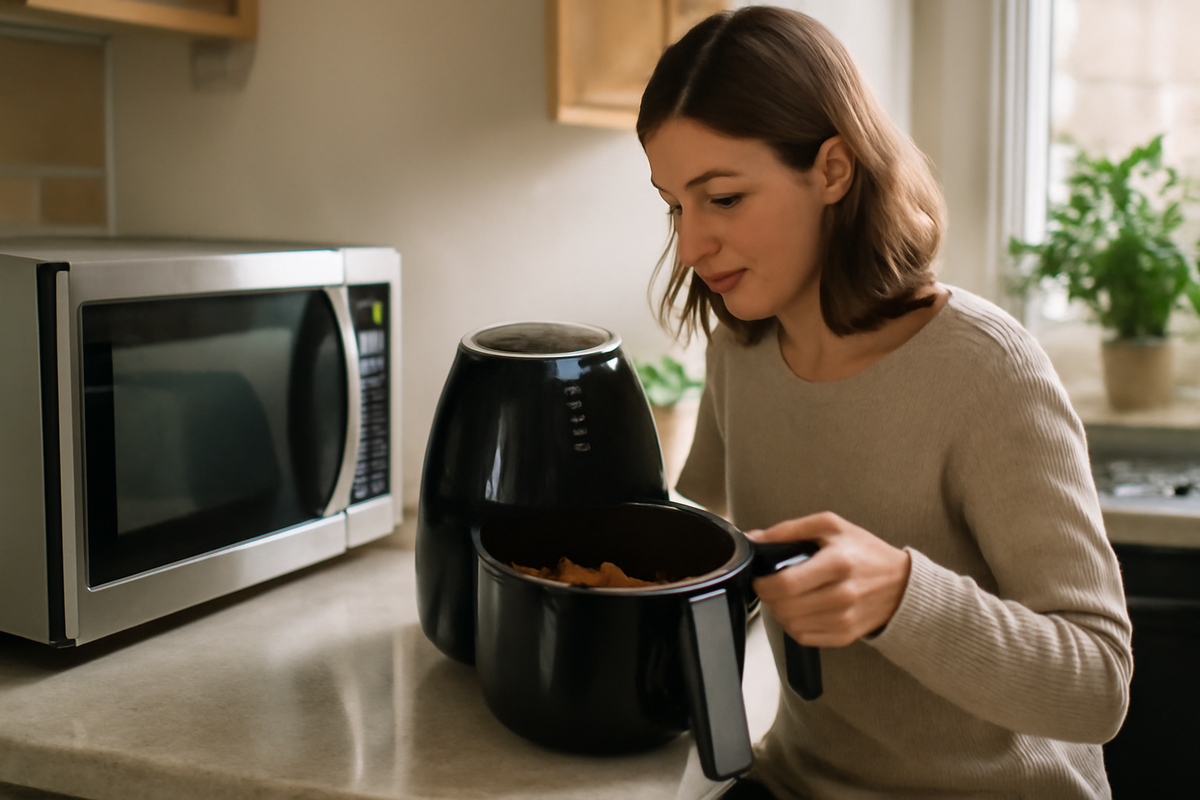
The first thing you notice is the silence. No familiar hum, no revolving glass plate, no impatient beeps urging you to “Remove food.” Just a soft, amber glow under the pan and a quiet, focused hiss as onions meet hot oil. In the time it would take an old microwave to blink awake and slowly spin your leftovers, tonight’s dinner is already halfway to done—seared, fragrant, and somehow… calmer. A decade ago, this kitchen would have been ruled by a bulky microwave parked like a boxy altar on the counter. Today, it sits unplugged in the corner, slowly surrendering its space to something sleeker, faster, and startlingly cleaner.
The Day the Microwave Stopped Being the Hero
For years, the microwave was the unquestioned champion of weeknight survival. It reheated pizza, unfroze chicken in a panic, and made popcorn a three-minute miracle. It was there in college dorms and first apartments, in beige corporate break rooms and tiny studio kitchens. It was convenience, condensed into a humming box.
But look inside modern homes now, and you’ll start to notice a quiet rebellion. The microwave, once front and center, is getting nudged aside. In some kitchens, it’s demoted to a lower cabinet; in others, it’s gone completely. Replacing it is a new kind of device—leaner, smarter, and much more intentional. It doesn’t roar or buzz. It doesn’t leave rubbery edges or suspiciously hot plates with lukewarm centers.
Instead, it radiates a kind of calm competence. A sleek induction cooktop that turns on with a fingertip. An air fryer oven with whisper-quiet fans and barely a crumb in sight. A compact combi-steam oven that turns a frozen fillet into a crisp, juicy supper in less time than a microwave can negotiate with an overworked “Defrost” button.
Somewhere along the way, people stopped wanting food that was merely hot. They started wanting food that tasted alive—flavorful, textured, cooked with intention. And the technology finally caught up with the craving.
The Faster, Cleaner Contender
If you stand at the center of a modern kitchen at dinnertime, it feels different from the hurried bustle of the past. There’s less rushing, less clutter, less scrubbing dried splatters off the microwave ceiling. The new hero device—often an induction cooktop or a high-efficiency countertop oven—quietly goes about its work with a startling sort of precision.
Turn an induction burner on, and the transformation is almost eerie. A cool, glossy surface suddenly wakes up beneath your pan, invisible energy flowing directly into the metal. Water that might have taken ten slow minutes to boil on a traditional stove—and nearly as long to coax into bubbling inside a covered microwave container—rises into a rolling, exuberant boil in just a couple of minutes. No open flame, no wasted heat, no swirling waves of uneven radiation. Just speed, focused and controlled.
Over on the counter, a compact multi-function oven—air fryer, convection, grill, roaster in one—clicks on with a cheerful whir. You slide in a tray of vegetables with a handful of chickpeas and spices. By the time you’ve rinsed the cutting board and wiped the counter, the kitchen smells like roasted garlic and lemon, edges of cauliflower caramelized to an irresistible crisp. And when you open the door, nothing has exploded, splattered, or welded itself onto the interior walls.
The microwave still knows how to melt butter and pop a bag of kernels, but this new device can roast, bake, crisp, steam, and reheat without turning everything into the same vaguely warmed, slightly steamed texture. It doesn’t feel like a shortcut; it feels like an upgrade.
The Allure of Actual Cooking, Quickly
There’s a subtle, almost emotional difference too. Microwaving has always felt like an errand—something you do to get food out of the way so life can continue. You jab the buttons, tap your foot, and stare through the fogged window as your leftovers spin in slow motion, hot on the outside, doubtful in the middle. It’s functional, but not exactly satisfying.
Cooking on a modern induction surface or in a high-efficiency countertop oven is different. It invites you in. You watch onions turn translucent in a pan that responds instantly when you nudge the heat down. You brush a little olive oil on bread and see it emerge five minutes later as golden, shatteringly crisp crostini rather than the infamous microwave result: hot, soft, then strangely hard. You’re not just reheating food; you’re transforming it, even on a Tuesday night with an empty stomach and a long day behind you.
This shift matters. People aren’t just asking, “How fast can I eat?” anymore. They’re asking, “How fast can I make this actually good?” And that small, persistent question is quietly pushing microwaves toward the sidelines.
The Invisible Math of Time, Energy, and Mess
Part of the changing tide is pure, practical math—the kind that hides in utility bills and at the bottom of the sink.
On paper, microwaves were always sold as the kings of efficiency. Plug in, zap for a couple minutes, and you’ve used less electricity than preheating an oven. But cooking is no longer a contest between microwave and old-fashioned oven. It’s a triangle now: microwave, induction cooktop, and compact high-efficiency oven. And in that new triangle, the playing field isn’t so lopsided.
Induction cooking, for instance, sends most of its energy straight into the pan, not into the air around it. When you lift the pot, the surface is often barely warm. That precision means less wasted heat and less time trying to coax water to boil or oil to shimmer. Combine that with small, well-insulated countertop ovens that heat tiny spaces incredibly fast, and you suddenly have devices that rival or even beat the microwave on speed—while producing food that looks and tastes… intentional.
There’s also the quiet war against mess. A microwave can turn pasta sauce into a Pollock painting with one enthusiastic bubble. Steam builds, plastic warps, lids pop. You open the door and are greeted by a constellation of splatters that will harden just enough to make you tell yourself, “I’ll clean this later.” Later rarely comes.
The new devices are different. Trays slide out, racks pop free, surfaces are flat, smooth, and blessedly wipeable. In a world where people are more mindful of both energy and time, that’s a bigger deal than it sounds. Less scrubbing. Less soaking. Less guilt about the fuzzy bowl you just keep reheating in and pretending not to notice.
| Feature | Traditional Microwave | Modern Fast-Cook Device (e.g., Induction + Countertop Oven) |
|---|---|---|
| Speed for Everyday Meals | Fast for reheating, less ideal for full meals | Fast for both cooking and reheating, with better texture |
| Food Texture & Taste | Often uneven, soft or rubbery | Crisp, browned, or delicately cooked as needed |
| Energy Use | Efficient vs. big ovens, but limited scope | Highly efficient, targeted heating and shorter times |
| Cleanup | Interior splatters, awkward corners | Removable trays, flat surfaces, easier wiping |
| Cooking Versatility | Reheat, defrost, basic steaming | Sear, roast, bake, crisp, steam, reheat |
A Cleaner Heat in a Changing World
There’s another layer shaping the story, one that lives outside the kitchen walls. Cities are rethinking gas lines. Builders are reimagining what “modern” means in a world bracing for hotter summers and higher energy demands. People are gaming out which devices will work best in smaller, denser homes, in apartments where every plug, every degree of heat, every minute of noise matters.
Induction cooktops and efficient countertop ovens fit neatly into that future. They don’t emit open flames or combustion fumes. They don’t crank up the room’s temperature on an already-sweltering day. They’re compact, often portable, and surprisingly resilient to changing habits. You can simmer a delicate sauce or blister peppers for tacos on the same surface, then wipe it down with a single swipe.
In that context, microwaves start to feel slightly out of step—not dangerous, not obsolete overnight, but a bit clumsy. They can’t brown, can’t crisp, can’t kiss the edges of food with the sort of heat that creates flavor. In a world trying to do more with less, versatility rises to the top. A single induction burner and a small multi-function oven can stand in for a full stove, a toaster oven, and—without bragging too loudly—the microwave itself.
What Gets Lost When the Beeps Go Quiet?
Of course, there’s a certain nostalgia tangled up in that fading microwave hum. It’s the sound of late-night leftovers after a party, instant noodles in a cramped dorm room, mug cakes that never quite lived up to the photos but felt like small acts of defiance against the clock. It’s the familiar, slightly panicked triple-beep when you’ve walked away and forgotten your food for the third time.
For many households, the microwave was the first device that suggested cooking didn’t have to be a grand production. You could work late, come home, and still have something hot in minutes without dirtying half the kitchen. It democratized speed in an era when speed felt like luxury.
Yet, somewhere along the way, that magic started to fade. We learned its quirks too well, from rock-hard edges on reheated pasta to mysterious cold centers in supposed piping-hot meals. We learned what it couldn’t do: no caramelized crusts, no satisfying sizzle, no fragrant browning. The more people cooked, watched cooking videos, read recipes online, and experimented, the more the limitations showed.
From Reheating to Reimagining
The new wave of devices doesn’t just make food hot; it widens the palette of what’s possible on a Tuesday night. You can drop a handful of cherry tomatoes in a small pan, add a clove of garlic, a little oil, and let the induction burner coax them into a quick sauce. You can toss frozen fries or vegetables into a compact oven and get them back as something you’d be proud to slide onto the table, not just “good enough for hunger.”
For families, it changes the script from “What can we reheat?” to “What can we make quickly?” Kids stand near the counter (safely, because the surface isn’t scorching hot) and watch pancakes bubble or grilled cheese toast to perfection. The kitchen becomes, again, a place of transformation rather than just transaction.
The microwave is still there, often. But it has become the backup singer, the understudy, the device you turn to for the very specific jobs it still does best—melting chocolate in thirty-second bursts under a watchful eye, reheating a mug of coffee gone cold during a phone call, sterilizing a damp sponge for one more day of duty.
Listening to the Quiet Revolution
If you walk into homes that have made the switch, the details are small but telling. Where a bulky microwave once dominated an entire stretch of counter, now there’s a wide, clear expanse with a single, slim burner and a compact, multi-function oven tucked neatly by the wall. A small ceramic bowl of garlic cloves sits where the microwave’s digital clock used to glare 12:00 at everyone.
The air feels different too. Less stale heat, more real cooking smells: toasted spices, quickly blistered vegetables, a last-minute grilled peach for dessert. You can tell, almost instantly, whether a household leans on quick reheating or quick cooking. One smells vaguely of warmed packaging; the other smells of ingredients.
And then there’s the sound—or lack of it. Reheating soup on an induction burner is nearly silent, the only clue a gentle, rising whisper from within the pot. Crisping leftovers in a compact oven creates a soft whoosh of air, a rustle of parchment. Microwaves, by comparison, have become audible relics: the heavy thunk of the door, the whirring turntable, the relentless countdown beeps that feel more like admonishment than assistance.
The Future Sitting Quietly on the Counter
It’s unlikely microwaves will disappear entirely. They’re too entrenched, too affordable, too woven into the muscle memory of “heat and eat.” There will always be offices where people queue to reheat last night’s dinner in plastic containers. There will be dorm rooms where a microwave is still the closest thing to a stove.
But in the evolving heart of the home kitchen, they are losing their claim to the throne. The new devices taking their place are not just faster and cleaner—they’re more humane, more in tune with the way people actually want to eat now: quickly, yes, but also well. They acknowledge that time is precious, but so is taste, texture, and the subtle joy of feeling like you cooked something, even when you started with frozen ingredients or prepped sauces on Sunday.
Stand in that new sort of kitchen at dinnertime, and you’ll feel it. A pan warms with invisible speed, vegetables hit hot metal and hiss happily, a small oven fan purrs in the corner. There’s no impatient beeping, no spinning plate. Just the quiet confidence of tools designed not merely to rush you through a meal, but to help you savor it—without demanding more time than you have to give.
In that quiet, the old microwave hum begins to sound like what it is: the echo of a different era of eating. Not bad, not wrong, just… behind. As households reach for devices that cook faster, clean easier, and honor the food a little more along the way, the future of quick cooking has already arrived—glowing softly beneath the pan, waiting for the next handful of chopped onions.
Frequently Asked Questions
Are microwaves really becoming obsolete?
Not entirely, but they are losing their central role. Many households still use microwaves for specific tasks like reheating drinks or defrosting small portions, yet rely on induction cooktops or compact ovens for most everyday cooking.
What is the “faster, cleaner” device replacing microwaves?
In many homes, it’s a combination of an induction cooktop and a high-efficiency countertop oven or air fryer oven. Together, they handle quick meals, reheating, roasting, and baking with better results than a microwave.
Is induction cooking actually faster than a microwave?
For many tasks, yes. Induction can boil water and heat pans extremely quickly, often rivaling or beating microwave times, especially when you’re cooking rather than simply reheating.
Do these newer devices use more electricity?
They’re often more efficient because they direct heat where it’s needed and work faster. That means less energy wasted and shorter overall run times compared with some traditional appliances.
Will I miss my microwave if I switch?
You might miss it for a few very specific habits—quick coffee reheats, instant oatmeal in a mug—but most people who adopt induction and a small oven report they prefer the taste, texture, and flexibility enough that the microwave quickly becomes an optional extra, not a necessity.

Hello, I’m Mathew, and I write articles about useful Home Tricks: simple solutions, saving time and useful for every day.