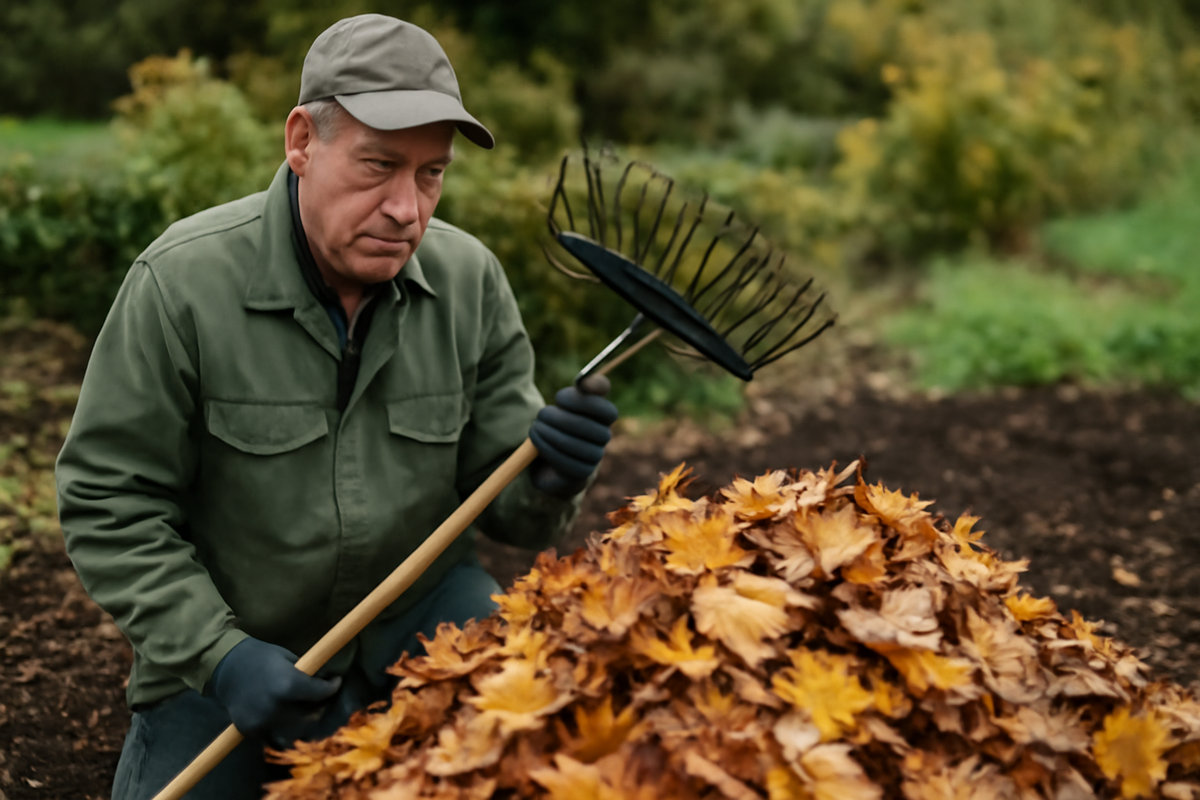
The sound comes first: that brittle whisper of a rake teeth-dragging over dry autumn leaves. For decades, it’s been the soundtrack of fall in suburbia—rhythmic, almost meditative, punctuated by the scrape-scrape-thud of leaves piled high at the curb. In the sharp, smoky air, there’s a ritualistic satisfaction in “cleaning up” the yard, exposing perfect green lawns and neatly edged beds. But across neighborhoods and garden clubs, a quiet confession has been surfacing: we’ve been doing it wrong. The very act that feels like caring for our gardens—bagging leaves, hauling them away—is quietly starving the soil beneath our feet.
The Beautiful Mess We’ve Been Trained to Erase
On a crisp October afternoon, you can stand at the edge of almost any suburban street and watch the same scene unfold. Neatly dressed gardeners, homeowners in old sweatshirts, children conscripted into “helping”—all united by a shared mission: make the yard look “tidy” before winter sets in.
Plastic bags, swollen with leaves, line the curb like oversized pumpkins. In some places, the smell of leaf smoke still hangs in the air as piles are burned into curling ash. The ground is left exposed—bare soil, clipped grass, clean lines. It looks orderly, controlled, finished.
But below the surface, the story is very different. Stripped of its leafy blanket, the soil cools quickly, dries out, and lies vulnerable to winter winds and pounding rains. The thin web of life that makes soil a living, breathing system—fungi, bacteria, insects, earthworms—loses its insulation and its food source. It’s a bit like taking away the pantry and blankets from a household just before the coldest months of the year.
Over the last decade, more and more gardeners have been whispering the same realization at workshops, in online forums, and over back fences: “I think I’ve been too clean.” Or, “Maybe I shouldn’t have bagged all those leaves.” The language is gentle, often tinged with regret. Because the truth is simple and humbling—those autumn leaves we’ve treated like trash are actually one of the most valuable soil-building resources we have.
Leaf Litter: A Soil Feast Disguised as Yard Waste
To understand the mistake, you have to look closely at a single fallen leaf. Hold it up to the light. The veins glow faintly, branching like tiny rivers. That leaf isn’t just dead plant debris; it’s a package of nutrients, carbon, and structure. In a forest, it would fall, soften in the rain, and begin a slow transformation into dark, crumbly humus—the kind of rich, fragrant soil gardeners dream of.
Every autumn, trees send an entire season’s worth of gathered minerals and carbon back down to ground level in the form of leaves. Calcium, magnesium, potassium, trace elements—they’re all there. It’s a nutrient loop perfected over millions of years. The soil feeds the tree, the tree feeds the soil, and nothing is wasted.
In our yards, though, that loop is often abruptly severed. We rake the leaves into bags and let municipal trucks carry them off, or we burn them, or we stuff them into the back corner of the property and forget them. Even the most well-intentioned among us tend to “clean up” far more than nature ever would.
Many gardeners, when they first realize this, look at their leaf piles with new eyes. What once seemed like clutter starts to look suspiciously like free fertilizer. And they begin to ask the simplest question: what happens if I leave them?
The Underworld: How Leaves Feed Invisible Soil Life
When leaves are allowed to break down on the ground—especially if they’re lightly shredded—they don’t just vanish; they’re eaten. Fungi thread their way through the gradually softening tissue, turning parts of it into fungal biomass and glues that help bind soil particles. Bacteria and microscopic creatures break leaf fragments into smaller and smaller bits. Earthworms drag pieces into their burrows, mixing surface litter with deeper soil.
Over time, this decaying leaf layer becomes a sponge, holding moisture, softening heavy clay, and giving sandy soils a better grip on water and nutrients. The soil darkens and deepens. Roots push down more easily. Plants become less dependent on synthetic fertilizers because the soil itself becomes more generous.
Gardeners who shift from “remove all leaves” to “reuse most leaves” often notice subtle, then dramatic changes. Beds stay damper during dry spells. Plants seem less stressed. The spring digging fork slides into the earth with less effort. And perhaps the most telling sign: more life—worms, beetles, pill bugs, millipedes, and the occasional toad hiding under a damp mat of last year’s leaves.
The Big Mistake: Treating Every Leaf Like an Enemy
Ask ten gardeners about their fall routine and you’ll hear a familiar litany: “I bag all the leaves and put them on the curb,” or “I blow everything clean, then mulch the beds with store-bought bark.” It feels efficient, even responsible. But hidden in that routine are several soil-harming habits that many now regret:
- Removing all leaf cover from garden beds and tree bases.
- Raking or blowing leaves off lawns only to send them away as waste.
- Burning leaves, releasing stored carbon and nutrients into the air instead of into the soil.
- Replacing natural leaf mulch with decorative, often sterile, wood chips or colored bark.
Individually, these choices seem small. Collectively, over years, they strip our yards of organic matter. Soil becomes thinner, lighter in color, more prone to crusting and erosion. We then compensate with fertilizers, compost deliveries, and irrigation—trying to buy back what we tossed away for free.
Many gardeners now openly admit: “I didn’t realize how much I was fighting against my own soil.” Once, a tidy, leaf-less bed seemed like the pinnacle of good stewardship. Now, a gentle scattering of leaves under shrubs and trees looks more like wisdom than laziness.
When Leaf Cleanup Goes from Helpful to Harmful
This doesn’t mean every leaf should stay exactly where it falls. Lawns matted under dense, unshredded leaves can suffer. Young, low-growing plants can be smothered. Wet, thick piles pressed against house foundations can cause problems. There is a balance point, and it’s more nuanced than “rake everything” or “leave everything.”
What’s changing is the mindset. The new question is not “How do I get rid of all these leaves?” but “How can I keep as many as possible working for my soil?” That shift alone is enough to transform a garden over a few short seasons.
From Trash to Treasure: Smarter Ways to Use Autumn Leaves
On a breezy November morning, imagine a different kind of fall ritual. Instead of hauling bags to the curb, you stand before a small electric or manual mulcher—or simply run the mower over the leaves. The shredded pieces tumble out, smaller, more flexible, less likely to mat. They smell sharp and woody, like the forest floor after a rain.
Those chopped leaves become your currency of abundance. You start to tuck them under shrubs, spread them in vegetable beds after the last harvest, ring them in wide halos around trees. You rake excess off garden paths, not to the road, but to the feet of berry bushes and perennials. The “waste” loop you once fed now barely gets a scrap.
To make this shift easier, it helps to think of autumn leaves as a set of choices. The table below offers a quick, mobile-friendly comparison of common fall habits and their impact on soil health.
| Fall Leaf Habit | Short-Term Effect | Long-Term Soil Impact |
|---|---|---|
| Bagging all leaves for curb pickup | Yard looks very tidy, bare soil exposed | Loss of organic matter, poorer structure, greater need for fertilizer |
| Burning leaf piles | Fast disposal, smoky air | Nutrients and carbon lost to air, no benefit to soil life |
| Leaving thick, whole leaves on lawn | Can smother grass, patchy growth | Minimal soil improvement, risk of lawn decline |
| Mowing leaves into fine pieces on lawn | Lawn stays green, bits of leaf visible at first | Steady organic matter addition, improved soil and lawn health |
| Using shredded leaves as garden mulch | Soft, natural-looking beds, weed suppression | Enhanced soil life, better moisture retention, richer soil over time |
Once you see the difference laid out this way, it’s hard to unsee it. The very same material—leaves—can either be a slow-release soil elixir or a lost opportunity, depending entirely on what you do in those few weeks of autumn.
Practical Ways to Put Leaves to Work
Gardeners who’ve “come clean” about their old habits are also the ones sharing the most inventive new practices. Some of the simplest changes make the biggest difference:
- Mulch in place: Rake leaves off paths and thick lawn drifts, then spread them 5–8 cm (2–3 inches) deep under shrubs, trees, and in perennial beds.
- Mow, don’t blow: Run a mower over thin layers of leaves on your lawn; the chopped fragments sink between grass blades and quickly break down.
- Leaf mold piles: Create a dedicated leaf-only pile in a back corner. Over a year or two, it turns into beautiful, dark, crumbly leaf mold.
- Protect bare soil: Wherever you see open ground in fall—around new plantings, in resting vegetable beds—cover it with a loose blanket of shredded leaves.
- Mix with compost: Blend dry leaves with greener materials (kitchen scraps, grass clippings) for a more balanced homemade compost.
These approaches don’t require perfection. You might still send a bag or two of leaves away in a heavy year, or sweep some off the driveway. The difference is that your default is now to keep leaves on-site, not treat them as something that must be entirely removed.
Wild Neighbors and the Leafy Underground
There’s another layer to this story, one that moves and rustles when you’re not looking. Stand quietly beside a slightly untidy bed—the kind with leaves tucked under shrubs and perennials—and listen. You might hear the soft scritch of a beetle, the faint movement of a spider, the almost inaudible shifting of a small salamander slipping between damp leaf layers.
Leaves on the ground don’t just feed the soil; they shelter the creatures that help gardens thrive. Many native bees nest in or just under leaf litter. Fireflies spend much of their lives as larvae in moist, leafy layers, emerging in summer as the tiny lanterns people now miss in many suburbs. Butterflies overwinter as chrysalises or adults tucked into dried plant stems and leaf piles.
When we strip our beds bare in the name of tidiness, we’re not just sweeping away organic matter. We are, quite literally, cleaning out homes. The increasing number of gardeners who’ve admitted their “autumn leaves mistake” often speak not only of soil health, but of a slow, creeping quietness in their yards—fewer insects, fewer birds, fewer surprise encounters with small wild neighbors.
Restoring a bit of leaf litter is one of the simplest ways to invite that life back. Birds scratch through leaves to find food in winter. Toads tuck under them to avoid freezing. Beneficial insects find pockets of safety when the rest of the landscape has been reduced to clipped, exposed surfaces.
In a world of vanishing habitats, the choice to leave a soft, leafy ground layer in your own garden is not trivial. It’s an offering, both to the soil and to all the animals that depend on the hidden universe just above it.
Rethinking “Neatness” in the Garden
Old habits are powerful, especially when they’re reinforced by neighborhood expectations. Some gardeners, eager to leave more leaves, still worry: will the neighbors think I’m neglecting my yard? Will this look sloppy?
But there is a quiet cultural shift underway. Neatness is being slowly redefined. A bed mulched with shredded leaves, edges gently maintained, plants clearly tended—that doesn’t read as mess. It reads as intentional, natural, lived-in. Many find that mixing a little structure with a little wildness is all it takes to keep peace with both the soil and the street.
You might still trim the front hedge and sweep the walkway, but leave a crescent of leaves under that maple. You might keep the lawn edges crisp, but allow a soft, leafy underlayer beneath your shrubs. Maybe your vegetable beds, tucked behind the house, wear their winter coats of leaves proudly, out of the main line of sight.
Bit by bit, “good gardening” starts to mean not how bare and controlled your soil looks in November, but how alive and sponge-like and resilient it feels in April.
Listening to the Soil’s Confession—and Our Own
There is a strange sort of intimacy in kneeling down, picking up a handful of damp leaf litter, and crumbling it between your fingers. The colors darken from bright autumn orange to a deep, mottled brown. It smells faintly of mushrooms and rain. In that moment, it’s hard to deny what countless gardeners have finally put into words: “I didn’t realize how much my fall cleanup was costing my soil.”
But confession, in gardening as in life, is less about guilt and more about change. The moment you decide to keep more leaves, to protect your soil instead of exposing it, you begin to rewrite your garden’s future. One autumn’s worth of better choices can make a noticeable difference by spring. Two or three years can transform the way your beds look, feel, and function.
Next time you hear the rasp of a rake or the whine of a leaf blower, you might find yourself listening differently. You might see bagged leaves not as evidence of responsibility, but as a missed opportunity. Maybe you’ll offer to take a neighbor’s extra bags and dump them under your trees. Maybe you’ll skip an afternoon of “perfect” cleanup in favor of a quieter, more deliberate ritual: mowing, mulching, spreading, tucking leaves where the soil can slowly, gratefully, eat them.
In the cool light of late autumn, with geese calling overhead and your breath just visible, you’ll look at the soft, speckled carpet under your shrubs and know you are finally on the soil’s side. The mistake has been named. The remedy is rustling at your feet.
Frequently Asked Questions
Won’t leaving leaves on my garden beds cause diseases?
Most healthy leaves do not spread plant diseases when used as mulch. If you know a tree or plant is heavily diseased (for example, repeated fungal leaf spots or blight), you can avoid using those specific leaves near susceptible plants. Otherwise, a diverse layer of leaves actually supports beneficial microbes that help outcompete many pathogens.
Can I leave leaves on my lawn without harming the grass?
Yes, as long as they are not in thick, smothering layers. Running a mower over a light to moderate covering of leaves chops them into small pieces that fall between the grass blades. This feeds the soil and usually improves lawn health over time. Very dense leaf piles should be thinned, moved, or shredded and used elsewhere.
How thick should a layer of leaf mulch be?
A general guideline is about 5–8 cm (2–3 inches) of shredded leaves around plants. Whole leaves can mat more easily, so use a slightly thinner layer or shred them first. Keep mulch a small distance away from plant stems and tree trunks to prevent excess moisture right against the bark.
Do I still need compost or fertilizer if I use leaves?
Over time, regular use of leaves as mulch and soil cover can reduce or even eliminate the need for many fertilizers, especially if you also recycle grass clippings and organic kitchen scraps. However, heavy-feeding plants (like some vegetables) may still benefit from occasional compost or organic fertilizers, particularly while your soil is in the process of rebuilding.
What about pests hiding in leaf litter?
Leaf layers do shelter some pests, but they also host many predators and beneficial insects that keep those pests in check. A diverse, living soil ecosystem tends to be more balanced than a bare, frequently disturbed one. If you have a specific recurring pest issue, you can selectively thin leaves around those plants while still keeping leaf cover elsewhere in the garden.

Hello, I’m Mathew, and I write articles about useful Home Tricks: simple solutions, saving time and useful for every day.