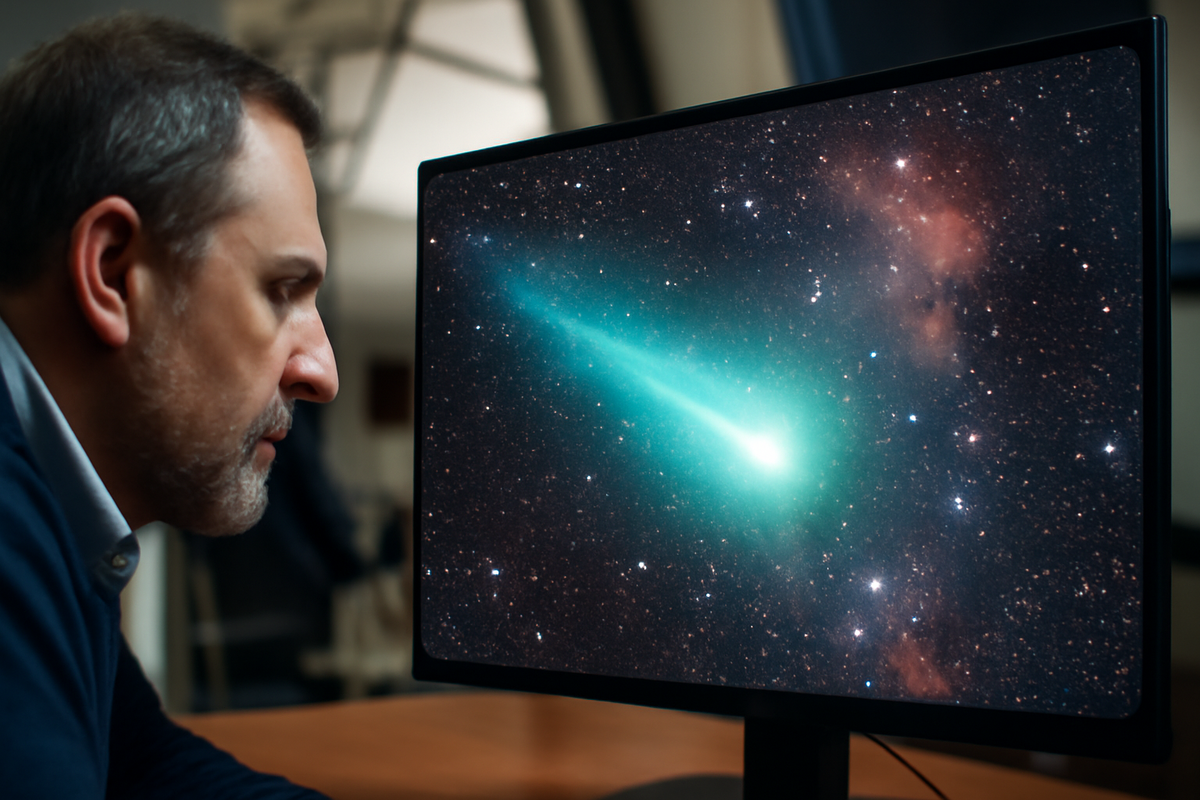
The first time you see it, you don’t quite believe it’s real. A thin, ghostly filament of light stretches across a velvet-black sky, its core a soft electric green, its tail fanning out like smoke from a cosmic campfire. Around it, the prickle of background stars glows in delicate pinpoints, some slightly blurred, as if the universe itself inhaled. The caption is simple enough—“Interstellar comet 3I ATLAS (composite)”—but it doesn’t begin to capture the vertigo of realizing you are looking at something that came from somewhere else. Not “somewhere else” as in another hemisphere or another planet, but another star. Another sun. Another home.
The Night the Data Became a Story
The images arrived not as photographs, but as fragments: ribbons of data from optical telescopes in Hawaii, faint infrared whispers from an orbiting observatory, filtered radio noise from antenna arrays listening for the hiss of cometary gas. For weeks, these numbers lived as lines in spreadsheets, columns in databases, arcane scribbles on whiteboards in quiet observatory offices.
Then, sometime around midnight in a dim control room, an astronomer clicked a final “run” command. Algorithms stitched the data together—aligning, stacking, subtracting the noise of Earth’s own atmosphere. The result slowly resolved on the screen: an impossibly crisp portrait of comet 3I ATLAS, haloed in its own escaping breath, set against the patient, ancient grid of our galaxy.
People who spend their lives staring at noisy plots aren’t usually prone to outbursts. But you can imagine the hush, the soft exhale, the whispered “wow” that slides out before anyone remembers to be professional again. This wasn’t just a comet. This was a once-in-a-lifetime visitor, and now, finally, it had a face.
What Makes 3I ATLAS So Different?
Interstellar comet 3I ATLAS isn’t from our solar system. It’s a drifter, a refugee from another star, flung out long ago from whatever planetary nursery once tugged on its path. It was first picked up by the ATLAS survey—short for Asteroid Terrestrial-impact Last Alert System—in Hawaii, a network that normally watches for dangerous rocks heading our way. Instead, it found a stranger.
By the time astronomers traced its trajectory backward, the verdict was clear: this object was unbound to the Sun. Its speed, its angle, its arc through the sky all whispered the same thing—this comet came in from deep interstellar space, from the dark in-between where star systems end and the next begin.
It’s only the third such interstellar object ever confirmed, after the enigmatic cigar-shaped 1I/ʻOumuamua and the dusty firebrand 2I/Borisov. But 3I ATLAS is different again. It’s brighter. More active. More generous with its secrets. From the moment sunlight struck it, the comet responded like an old match flare: gases boiled off, forming a vivid coma and sweeping tail, a beacon that drew telescopes from every corner of the globe—and above it.
Painting a Portrait with Many Eyes
To the naked eye—even through a backyard telescope—3I ATLAS would appear as a faint blur, a smudge working its way across the constellations night after night. But the new composite images are anything but smudges. They are the result of a visual symphony: multiple observatories, each tuned to a different kind of light, playing together.
In visible light, wide-field telescopes captured the comet’s long tail, a streamer of dust and ionized gas that traced its journey like a vapor trail across the stars. Zoomed-in images from larger instruments revealed intricate twists and knots along that tail, places where solar wind had grabbed and toyed with the comet’s outflow.
Infrared observatories, orbiting above the blur of the atmosphere, saw something else: heat. Not much of it—the comet is a block of ice and rock, after all—but enough to mark where dark, carbon-rich grains were warming and escaping. The infrared data gave the composite its depth, adding a whisper of glow around the nucleus, a sense of volume you can almost feel if you let your eyes linger.
Back on Earth, radio telescopes contributed their own invisible threads. By tuning to specific frequencies emitted by molecules like cyanide and water vapor, astronomers traced the chemistry of 3I ATLAS’s escaping gas, mapping where different compounds were clustering or dispersing in the coma. Those signals, converted into color layers, turned the final image into something like a topographic map of the comet’s breath.
All of it—optical, infrared, radio—was ultimately aligned using the background stars as anchors. In the finished composites, those stars remain sharp, pinning the comet in place like a luminous insect caught in glass. Except this specimen is still moving, still alive, still leaving.
How the Composite Comes Together
If you’ve ever tried to take a long-exposure photo of the night sky with a tripod and a consumer camera, you know the struggle. Stars smear into little lines if your timing is off by even a few seconds. Telescopes fighting atmospheric turbulence face the same basic problem—just at a vastly higher level of precision.
Now imagine you’re not just taking one photo, but hundreds. Some from the Southern Hemisphere. Some from the Northern. Some from space. Some in visible light, some in infrared, some in radio. The hero of this story is not just the glass and metal of the telescopes—it’s the software, and the people who write and tame it.
They start by time-stamping every exposure to the millisecond. Then they correct for distortions: the way air currents stretch and squish starlight, the way instruments introduce subtle biases, the way Earth itself is spinning and moving around the Sun while the comet hurtles inward. It’s a ballet of coordinate transforms and calibration stars, of “seeing” estimates and noise models.
Once the frames are corrected, they’re stacked: layered one atop another to boost signal and scrub out random noise. Faint features suddenly sharpen—the tail grows longer, the coma more structured. Finally, the different wavelengths are assigned colors in a way that both respects the physics and enhances what the human eye can interpret. The greenish glow around 3I ATLAS isn’t entirely artistic license; it reflects real emissions from certain excited molecules. But the balance, the contrast, the interplay of hues—that part is curated, gently, by human hands.
The end result is not exactly what you’d see if your eyes could somehow float a million kilometers from the comet and stare. It’s more than that. It is a translation of the invisible into the visible, a visual essay about what the comet is made of, how it’s changing, how it’s responding to our Sun.
A Visitor Bearing Alien Dust
Every comet in our solar system is a time capsule. They formed when the Sun was young, before planets fully settled into their orbits, and they’ve spent billions of years in cold storage at the outer edges. When one falls inward, it brings with it a sample of that ancient era, frozen chemistry from long before Earth finished becoming Earth.
Now imagine that—but from another star system entirely.
Interstellar comet 3I ATLAS is not just old; it is foreign. The grains streaming off its surface, the ices sublimating into space, the faint whiff of exotic molecules in its wake—all of that tells a story about a different stellar nursery, a different protoplanetary disk, a different experiment in making worlds.
In the new composite images, you can literally see that story unfold. Subtle color gradients across the tail mark where heavier dust grains are lagging behind, where lighter ions are being peeled away by the solar wind. The coma appears textured in certain bands, hinting at jets—localized geysers where volatile ices are erupting more violently, perhaps from fractures or sunlit cliffs on the nucleus.
By comparing these features with those of homegrown comets, astronomers can ask: Is this what our own early solar system looked like, chemically speaking? Or is it stranger? Are the building blocks of planets roughly universal, or does each star system come up with its own recipe?
Some of the answers show up not in the image itself but in the spectra that underlie it. Tiny shifts in the wavelengths of emitted light reveal the fingerprints of elements and molecules: carbon monoxide, water, organics. The composite photographs become a gateway into that deeper data—an attractive doorway into a library of numbers and models and inferences about how worlds are assembled in the dark.
A Quick Look at the Observing Campaign
Behind those breathtaking visuals is a sprawling, collaborative campaign that stretched across months and time zones. Dozens of observatories, from modest one-meter telescopes to flagship facilities, contributed data at different moments in 3I ATLAS’s flyby.
| Observatory | Type of Telescope | Main Role in Composite |
|---|---|---|
| ATLAS Survey (Hawaii) | Wide-field optical | Discovery & large-scale tail structure |
| 8–10 m Class Ground Telescopes | High-resolution optical | Nucleus region, fine detail in coma |
| Space-based IR Observatory | Infrared | Dust temperature, hidden structure in inner coma |
| Radio Telescope Array | Millimeter / radio | Gas composition, molecule distribution |
| Small Amateur Networks | Optical | Continuous monitoring, motion tracking |
For students and amateur astronomers watching from the sidelines, this campaign was a masterclass in modern sky-watching. Slack channels buzzed with coordinates and last-minute updates about weather windows. Observers in Chile would hand off to colleagues in the Canary Islands, who would hand off, hours later, to Japan and then Hawaii. The comet itself never slept; someone, somewhere, was always watching.
Looking Up from Down Here
It is easy, reading about interstellar visitors, to feel detached—as if this is all happening “out there,” in a place that exists only for scientists and their instruments. But 3I ATLAS does something subtle to your sense of home when you let its story sink in.
Here is an object that spent eons—longer than human history by orders of magnitude—wandering between stars. It drifted through a darkness so complete that even the Milky Way would have been a faint mist. It passed the gravitational fringes of who knows how many unseen suns. And then, through a combination of celestial nudges and random chance, it passed close enough for us to notice.
We, tiny primates on a small planet, recognized that this was not one of “ours.” We changed our schedules. We turned our telescopes. We pooled our resources. We watched, measured, composed, and finally, we made these images—these luminous, fragile portraits of a traveler that will never return.
To look at the composite of 3I ATLAS is to feel this act of attention. You can feel the human effort in the way the stars are aligned, the way noise has been tuned away, the way color has been chosen not just to inform, but to invite. It’s as if the astronomers are saying: Come see what we found. Come stand here with us in the dark for a minute.
What These Images Whisper About the Future
3I ATLAS will not stay. Its path curves around the Sun once and then swings outward, back toward the deeps between stars. Scientists have already plotted its exit trajectory; decades from now it will be another faint shard of matter in the dark, anonymous again.
But it leaves us with more than a set of pretty pictures. Each interstellar object we catch refines our sense of how common such wanderers might be. Are star systems constantly shedding these icy nomads? Could they be scattering the raw materials for life—complex organics, water-bearing dust—across the galaxy like pollen?
There are already tentative proposals for “interstellar intercept” missions: spacecraft designed to launch quickly and chase down the next inbound visitor. The composite images of 3I ATLAS serve as both inspiration and blueprint. They show what’s possible when we mobilize our observatories quickly, when we treat the sky not as a static dome but as a living, flowing river of travelers.
And they pose a quiet, thrilling question: If one of these objects once left another star, couldn’t pieces of our own solar system someday drift toward someone else’s sky? Could some distant civilization, circling a sun we cannot see, one day assemble their own breathtaking composite image—this time of a visitor from our neighborhood?
Seeing the Universe as a Shared Ocean
In one of the composite frames of 3I ATLAS, the comet’s tail seems to point straight past a crowded starfield, like an arrow through a map. Of course, that’s an illusion of perspective; the comet is much closer than the stars behind it. Still, the feeling is hard to shake. The image looks like a route, a direction, a road.
You start to imagine the galaxy not as isolated islands of star systems but as an ocean, churned by time, in which tiny, frozen boats occasionally slip from one shore to another. Most will pass unseen. A few will be spotted. Fewer still will be understood. But each is evidence that nothing, not even a star system, is truly closed.
3I ATLAS is just one such boat. Yet through the lens of these composite images, it becomes something larger—a symbol of connectedness, of the way gravity and chance conspire to mix the galaxy’s ingredients. Somewhere, long ago, some long-quiet disk of dust and gas condensed into a star, into planets, into comets. One of those comets was nudged, ejected, set adrift. Ages later, it sailed through our neighborhood, and for a pain-brief moment, we pointed everything we had at it.
We saw it. We learned from it. We turned its fleeting passage into color and form and data. We turned it into story.
And when you look at those new, meticulously crafted images—at the cold green heart of 3I ATLAS and the soft spill of its tail fading into black—you feel not just the comet’s journey, but our own. Our climb from wondering specks under the sky to a species capable of catching an interstellar traveler in a net of photons and mathematics and saying, before it slips away again: We noticed you. We were here.
FAQ: Interstellar Comet 3I ATLAS and Its Composite Images
What is interstellar comet 3I ATLAS?
3I ATLAS is a comet that does not belong to our solar system. Its speed and trajectory show that it came from interstellar space—likely ejected from another star’s planetary system long ago—and is just passing through before heading back out into the galaxy.
Why is it called “3I”?
The “I” stands for “interstellar.” 3I ATLAS is the third confirmed interstellar object discovered, after 1I/ʻOumuamua and 2I/Borisov. “ATLAS” refers to the survey system in Hawaii that first detected it.
What makes the new images so special?
The released images are composites, created by combining data from multiple observatories and wavelengths (optical, infrared, and radio). This approach reveals details about the comet’s structure, dust, and gas that no single instrument could capture alone, turning a faint blur into a richly detailed portrait.
Are the colors in the images real?
The colors are based on real physical information—different wavelengths tied to specific gases, dust temperatures, or emissions—but they are mapped into visible colors so our eyes can interpret them. In that sense, they are both scientifically grounded and artistically enhanced to highlight important features.
Can I see 3I ATLAS with a backyard telescope?
During its closest approach, 3I ATLAS was faintly accessible to skilled amateur astronomers with medium to large telescopes under very dark skies. For most people, though, the best way to experience it is through the professional images and animations created from observatory data.
Will 3I ATLAS ever come back?
No. Its hyperbolic trajectory means it is not gravitationally bound to the Sun. It will swing through our solar system once and then continue outward into interstellar space, never to return.
Could interstellar comets bring life or its building blocks?
Interstellar comets likely carry water, organics, and other complex molecules—similar to comets from our own system. Some scientists speculate that such objects might help spread the ingredients for life between star systems, but this idea is still being explored and is not yet confirmed.
Will we ever visit an interstellar object up close?
There are early mission concepts that aim to chase and study the next interstellar visitor with a spacecraft. It’s technologically challenging, because these objects move fast and appear with little warning, but the new observations of 3I ATLAS are helping engineers and scientists design better strategies for that future encounter.

Hello, I’m Mathew, and I write articles about useful Home Tricks: simple solutions, saving time and useful for every day.