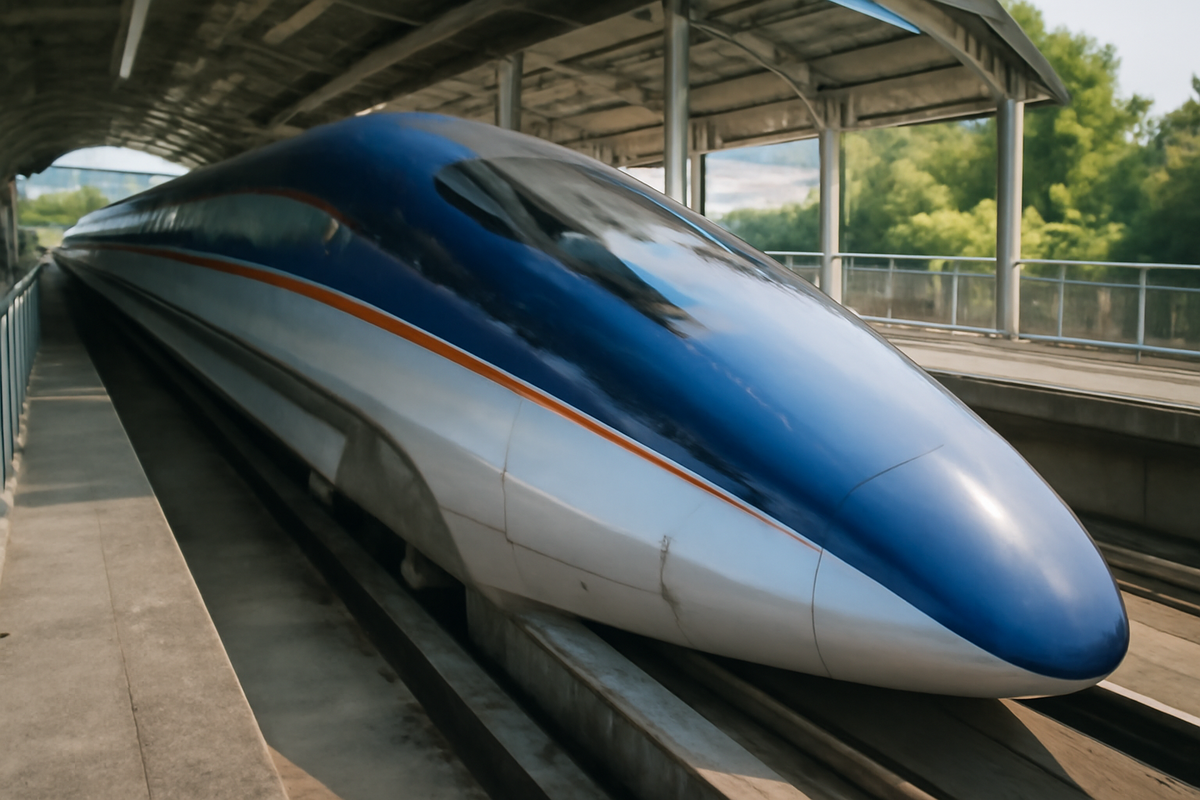
The first thing you notice is the sound—or rather, the near absence of it. A low, steady hum, like distant thunder behind thick glass. The platform speakers crackle, a countdown in clipped Japanese. Air tastes faintly metallic, carrying the coolness of conditioned tunnels and the warm buzz of hundreds of expectant people. Cameras rise like a field of mechanical flowers. Someone next to you mutters, “Six hundred… that can’t be real.” You glance along the sleek silver-blue body of the train, nose tapering like a bird’s beak, hovering almost imperceptibly above the track. The world of steel wheels and clattering rails feels suddenly… antique.
The Day 603 km/h Stopped Feeling Like Science Fiction
It happens so quickly that your brain struggles to keep up. A gentle lurch—more of a whisper than a push—presses you back into your seat. The station slides away, becoming a blur of concrete and color. The carriage is startlingly quiet, with only a soft, rising whir as if the air itself is being parted more cleanly than physics should allow.
At 100 km/h, you expect the familiar clatter of wheels, the sway, the faint metallic groan. Instead, the ride is smoother than driving on a well-paved road. You rest a hand on the folding table: no rattle. The cup of tea in front of you barely trembles. The world outside, though, is changing shape—buildings stretch into streaks of gray and glass; trees become green smears against the hills.
An LED display glows at the front of the car. 187 km/h. 243 km/h. The numbers tick upward with the casual inevitability of an elevator climbing a skyscraper. Passengers murmur, some press their faces to the windows, others simply stare at the screen as if watching a live countdown to the future.
At 400 km/h, your ears pop lightly. The engineer’s voice floats over the speakers, calm, almost proud: “We are now exceeding the maximum speed of most commercial trains.” A ripple of nervous laughter. You glance outside and see the track’s concrete barriers become one continuous ribbon, impossible to distinguish individual segments.
Then, as if reality decides it has been too modest until now, the numbers sprint.
521 km/h. 572 km/h. 598 km/h.
On the display, the digits pause, as though taking a breath. The cabin goes strangely quiet. Even the whisper of conversation fades. Outside, the landscape has stopped being scenery and turned into pure motion.
Then, there it is:
603 km/h.
A cheer breaks out, hesitant at first, then swelling into applause that fills the narrow, futuristic cabin. You feel the moment more in your chest than in your body—the physics of it, the audacity, the knowledge that you are sitting on the fastest train humans have ever built, a slab of human-made lightning hovering above the Earth.
How a Train Floats Its Way to 603 km/h
If you could peel away the sleek body of the train and look beneath, you wouldn’t see wheels, axles, or the greasy moving parts that have defined rail travel for nearly two centuries. You’d see a quiet revolution: magnets, coils, and a track designed less like a railroad and more like a long, horizontal laboratory experiment.
Maglev—short for magnetic levitation—sounds like science fiction, and for a long time, it might as well have been. The principle, however, is almost disarmingly simple: like poles of magnets repel, opposite poles attract. The challenge is not in understanding what happens, but in controlling it with the precise grace needed to float hundreds of tons of machinery and human beings at hundreds of kilometers per hour.
The new record-breaking maglev uses a system where powerful superconducting magnets are cooled to extremely low temperatures, giving them the ability to generate intense magnetic fields with remarkable efficiency. These fields interact with the coils embedded in the guideway—essentially the “rail”—to lift the train several centimeters off its support. Once levitated, the train is free from the tyranny of friction that punishes conventional steel wheels.
Propulsion is no less elegant. Instead of engines turning wheels, the track itself becomes a linear motor. Electric currents race through the coils along the guideway, creating a moving magnetic field that pulls and pushes the train forward. Reverse the pattern, and the train slows. Fine-tune it, and you get a ride that can smoothly accelerate to 603 km/h without jerking your spine or spilling your tea.
The nose of the train isn’t just an aesthetic flourish, either. At those velocities, air behaves more like a dense, invisible wall than a gentle breeze. The extended, sharp beak of the maglev is crafted through painstaking aerodynamic modeling, designed to slice through the atmosphere, reduce drag, and minimize shockwaves as the train hurtles through tunnels and open countryside.
Inside, the engineering is translated into comfort. The seats face large windows that feel just a step shy of a cinema screen, and the lighting is gentle, unobtrusive. It’s striking to realize that the quiet you feel, the gentle weight of acceleration, the subtle hum underfoot, are all byproducts of an invisible negotiation between electromagnets and air pressure at previously unimaginable speeds.
Redrawing the Map of Distance and Time
To understand what 603 km/h means for travel, it helps to think less in numbers and more in sensations: the compressing of time, the shrinking of landscapes, the way borders and boundaries feel smaller when the hours between them disappear.
On an ordinary map, two cities might be separated by a thick line and a handful of carefully printed kilometers. On the lived-in map inside our heads, those cities are often divided by the dead time of travel: airport security, boarding calls, slow trains, traffic-choked highways. The clock becomes part of the distance itself.
The new generation of maglev trains tries to rewrite that mental geography. Imagine stepping into a station in one major city, grabbing a coffee, tapping through a few messages, and stepping off under an hour later in another city hundreds of kilometers away—no turbulence, no runway waits, no shuffle through baggage carousels. The gap between “here” and “there” begins to feel less like a journey and more like a brief intermission.
Consider how this starts to play out in day-to-day life:
- A commuter living in a smaller, quieter town could feasibly work in a distant urban center without sacrificing hours each day to grinding travel.
- Weekend trips could become as casual as an afternoon drive, except that your “drive” spans entire regions.
- Regional economies that once felt disconnected by geography could begin to knit together, as if the land has been folded so that once-distant places now touch.
It’s easy to imagine a world where a business meeting that once required an overnight stay becomes a half-day jaunt. Where families split between cities can choose to live by preference, not by proximity to an airport runway. Where cross-country trips feel less like expeditions and more like extended commutes.
Of course, even at 603 km/h, we’re still talking about surface travel—lines etched across landscapes, not jumps through the sky. The difference is that the sky has had a long head start: air travel has dominated long-distance mobility for decades. But when a train begins to nibble at the lower end of flight times—especially once you remove airport check-in and security delays—the equation starts to tilt.
Maybe not in the way of replacing all flights, but in chipping away at short-haul routes, at those 300–1,000 km journeys where the plane has always been the default. Suddenly, stepping onto a train that departs from the center of a city and glides out with barely a jolt starts to sound less like a nice alternative and more like the obvious choice.
The Numbers Behind the Speed
It’s one thing to feel the future in your bones as you sit on a levitating, whisper-quiet bullet. It’s another to see how starkly it measures up to the technology we’ve relied on for generations. Lined up side by side, the differences become startlingly clear.
| Mode | Typical Max Speed | Sample 500 km Travel Time* | Key Experience |
|---|---|---|---|
| Conventional Train | 160–200 km/h | 3–4 hours | Frequent stops, track noise, moderate sway |
| High-Speed Rail (e.g., Shinkansen) | 300–320 km/h | 1.5–2 hours | Smooth, fast, refined—still wheel-based |
| Short-Haul Flight | 800–900 km/h (cruise) | ~1 hour in air, 2–3+ hours total with airport time | Security lines, boarding, turbulence, out-of-city airports |
| New Maglev (Record Run) | 603 km/h (test) | Planned commercial: ~1–1.5 hours | Ultra-smooth, low noise, city-center to city-center |
*Estimated, simplified figures assuming near-direct routes and typical operations.
On paper, the maglev sits in a curious sweet spot: not quite as fast in raw top speed as jetliners, but dramatically more efficient once you factor in everything that happens between leaving your front door and arriving at your destination. If you’ve ever watched the departure board at an airport flip to “Delayed” under gray skies, the idea of reliable, weather-tolerant ground travel starts to feel less like a luxury and more like a quiet revolution.
The Environmental Echo of a Floating Train
Beneath the exhilaration of 603 km/h, there’s another story humming—quieter, less visible, but arguably more important. It’s written in exhaust trails, in atmospheric chemistry, in the carbon arithmetic of a planet already straining under our appetite for movement.
Airplanes are marvels of engineering, but they are also voracious in their thirst for fuel. Every short-haul flight that leaps into the sky carries not just people and luggage, but a heavy carbon shadow. When we fly the distance between two cities that could be connected by advanced rail, we’re effectively choosing a higher-emission path almost every time.
This is where high-speed electric rail—and especially maglev—starts to look less like a luxury technology and more like a tool for planetary triage. Powered by electricity that can be sourced increasingly from renewables, a maglev line can move thousands of passengers per hour with a fraction of the per-person emissions of jet travel. The absence of rolling friction, the aerodynamic design, and the precise control over acceleration and braking all knit together into a quieter environmental footprint.
There are, of course, caveats etched in concrete and steel. Building a maglev line is not an invisible act. It means pouring foundations, raising viaducts, carving tunnels, and reshaping landscapes. The materials themselves carry an environmental cost. Wildlife corridors must be protected. Communities along the route must be consulted, listened to, and often compensated. A fast train is not just a line on a map; it is a thread through ecosystems and lives.
Yet when you stretch the timeline out beyond the construction phase—when you look at decades of operation, of thousands of journeys that might otherwise have been flown—the calculus begins to favor the levitating steel serpent. Each smooth departure is not just a convenience for the traveler; it’s a small nudge against the growing tide of emissions that define the 21st century.
There is a symbolism here that goes beyond spreadsheets and policy papers. To stand beside a track and watch a train float, whisper, and vanish into the distance at speeds your grandparents would have considered mythic is to feel that progress doesn’t always have to roar through the sky on wings. Sometimes, it can glide just above the earth, almost silently, leaving behind a future that is a little cooler, a little clearer.
The Human Side of Hyper-Speed
For all the drama of numbers and engineering, the reality of any transport system is ultimately human. It lives or dies not on its maximum speed, but on whether people feel safe stepping aboard, whether they can afford the ticket, whether they emerge from the journey feeling more alive instead of drained.
Inside the new maglev, the emphasis is strikingly simple: comfort at impossible speed. The acceleration curve has been carefully shaped so your body never snaps forward or slams back. The seats, shaped to support long journeys, face windows that offer scenery rather than tiny oval glimpses. The cabin pressure is managed to soften the pop in your ears as the train dives into tunnels. Even the color palette—muted, calm, with soft lighting—is a kind of unspoken promise: no matter how fast we go, you are meant to feel at ease.
Talk to the engineers and they’ll tell you about redundant braking systems, real-time monitoring, earthquake detection, and the countless invisible threads of safety woven into the line. Talk to the passengers, and they’ll tell you about how strange it is to move that fast without your body screaming protest, how quickly the novelty gives way to a new normal: check messages, look up, realize half the country has slid by.
There’s something quietly profound about a technology that makes distance feel smaller without making the journey itself vanish into oblivion. Unlike a plane, where the world shrinks to clouds and cabin walls, a maglev ride keeps you connected to landscapes. Mountains still loom and fall away, rivers flash beneath, towns scatter like clusters of tiny models. The world doesn’t disappear; it simply streams past faster than you’ve ever seen it before.
Not Just the Fastest Train, But a New Kind of Promise
When the maglev nudges past 600 km/h, the records and headlines are easy: “Fastest train ever built.” It’s an irresistible label, the sort of clean, triumphant statement we like to attach to human achievement. But trophies are only the surface story.
Underneath that number lies a tangle of deeper questions: How fast should we go? How do we ensure that speed serves people rather than leaving them behind? Where do we draw the line between ambition and responsibility?
The 603 km/h run is, at its core, a proof of possibility. It tells governments that such speeds are no longer fantasy. It tells planners that new kinds of regional networks can be imagined. It tells the next generation of travelers that the familiar calculus of “Is it worth the trip?” might be ready for revision.
But the more important challenge is quieter and slower: bending that record-breaking velocity into an everyday reality where tickets are accessible, lines are reliable, and the benefits of near-flight-speed rail spread beyond the wealthiest corridors. It means asking whether the technology that shrinks distance can also help close social and economic gaps, not widen them.
That’s where the story of this new maglev shifts from being just about speed to being about values. The train itself is a marvel—a smooth, humming arrow of superconducting willpower. Yet it is also a mirror, reflecting back what we choose to prioritize: efficiency or equity, spectacle or sustainability, records or relationships.
As you step off the platform after that first record-shattering ride, the world feels subtly altered. The station is still the same. The sky is still the same soft blue. People still hurry, checking their watches, shouldering bags. But somewhere in the back of your mind, light has bent around a new possibility: that the distances that defined your world yesterday are not quite as fixed as they seemed.
In the echo of that 603 km/h run, you can almost hear the future calling—not in a roar, but in a low, steady hum, like a train floating a few centimeters above the earth, waiting for us to decide what we will do with the speed we have just unlocked.
FAQ
Is the 603 km/h maglev speed used in normal passenger service?
No. The 603 km/h run was a controlled test to explore the technical limits of the system. Planned commercial operations are expected to run at lower, but still extremely high, speeds to balance safety, comfort, and cost.
How does maglev differ from conventional high-speed trains?
Conventional high-speed trains use steel wheels on rails, which generate friction and mechanical wear. Maglev trains float above the guideway using magnetic forces, eliminating wheel-rail contact, reducing noise and vibration, and allowing higher potential speeds.
Is riding a maglev safe at such high speeds?
Maglev systems are designed with multiple layers of safety, including advanced braking, real-time monitoring, and strict operational controls. The absence of wheel-rail contact also removes some traditional derailment risks. As with any major infrastructure, regulatory oversight and rigorous testing are key parts of safety assurance.
Will maglev trains replace airplanes?
Maglev is most competitive on short- to medium-distance routes, typically a few hundred to about a thousand kilometers. It is unlikely to replace long-haul international flights, but it could significantly reduce the need for many short-haul flights, especially where dense corridors exist between major cities.
Why don’t more countries build maglev lines?
Maglev infrastructure is expensive and technically complex to build, requiring specialized tracks and careful route planning. Governments must weigh the high upfront costs against long-term benefits in speed, capacity, and environmental performance. Political will, population density, terrain, and existing rail networks all influence whether maglev becomes a priority.

Hello, I’m Mathew, and I write articles about useful Home Tricks: simple solutions, saving time and useful for every day.