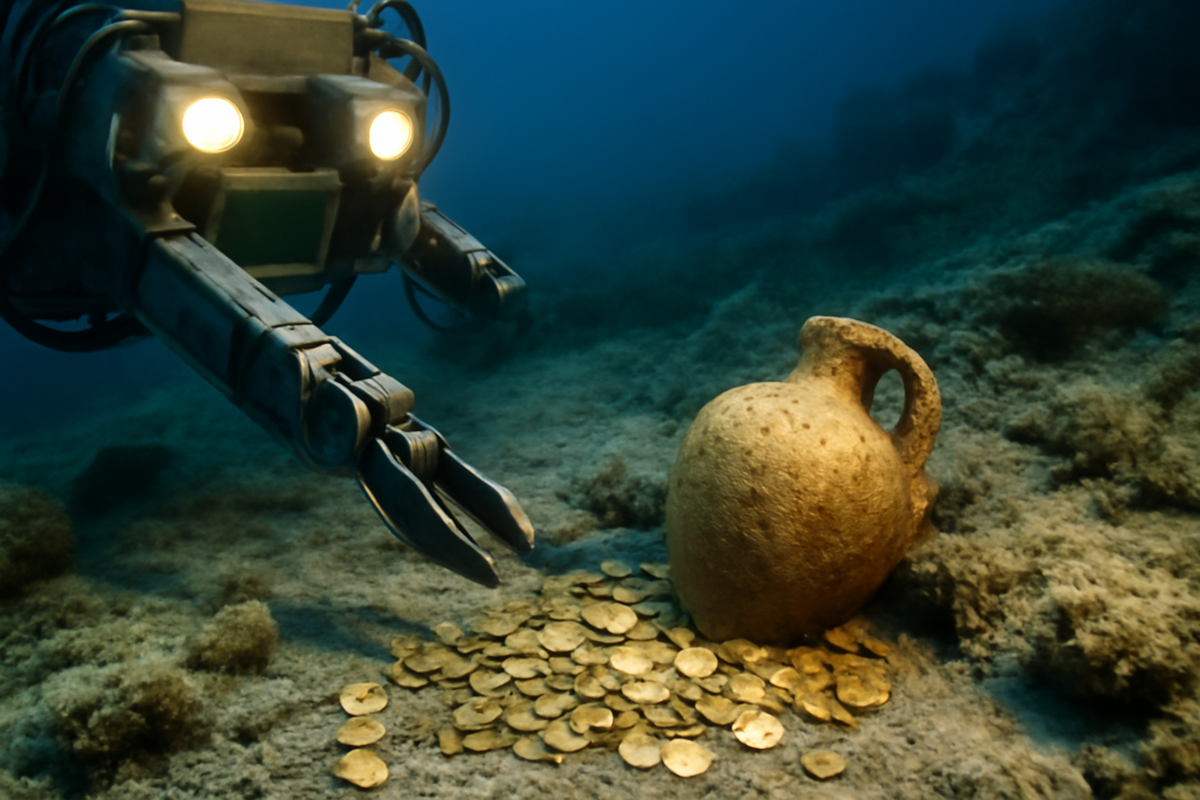
The first thing you notice is the silence. Not the gentle hush of waves against a harbor wall, but a deeper, older silence—the kind that lives 300 meters below the Mediterranean, where light thins into ghost-blue threads and colors surrender to the dark. Into that quiet, a mechanical hum begins to grow. A shape glides out of the mother ship’s shadow and slips downward, its metal frame blinking with cautious eyes of LED light. The ROV—an underwater robot the size of a small car—tilts its camera, adjusts a thruster, and continues descending toward a patch of seafloor that, until a few weeks ago, was nothing more than a bright pixel in a sonar survey.
Tonight, the crew is tense. Coffee cups go cold on control room consoles. Eyes flick between green-lit depth readings and the gray, grainy seafloor inching closer on the main monitor. The Mediterranean, that old storyteller loaded with secrets, is about to crack the spine on a new chapter. Somewhere below, half-buried in silt and seagrass, lies the wreck of a 16th-century merchant ship rumored to have gone down in bad weather and worse luck. For centuries it has been a whisper in archival ledgers and half-remembered sailor tales.
Now, for the first time, a robot is about to see what remains—and what it finds will turn out to be almost unimaginably intact.
The Descent Into History
The ROV’s pilot sits in semi-darkness, hands resting lightly on the twin joysticks, eyes locked on the video feed as if trying to will the machine into grace. On the ship, it smells faintly of diesel, salt, and the metallic tang of electronics warmed by use. Outside, beyond steel bulkheads, the sea rolls—a deceptively calm skin stretched over a jagged underwater world.
On screen, the seabed appears at first like a moonscape: ripples of sand, scattered stones, threads of ghostly white worms. Then, slowly, the texture changes. A lump of something geometric. A line too straight to be natural. The pilot taps a thruster, and the camera swings around.
“There,” someone whispers behind him. No one breathes.
Under the ROV’s lights, the outline of a hull emerges from the dark, like the shadow of a whale lying still. Timbers, blackened by time and salt. Iron fastenings sealed under a film of marine growth. The skeletal frame of a ship that once beat its way across sunlit waters now rests as a fossilized gesture of motion, frozen mid-journey.
“Depth three-two-oh meters. Visibility excellent,” says the systems engineer, voice even but pitched a little higher than normal. The archaeologist leans closer to the screens, heart full of conflicting impulses: to shout with joy, to speak with reverence, to say nothing at all.
They have been searching for months, tracing rumor through archives, weather patterns through old ship logs, and seabed features through stubborn strips of sonar data. The Mediterranean is not generous; it hides as much as it reveals. But here, at last, is proof: a 16th-century merchant vessel, almost fully preserved, lying in a valley of silt like a sleeping giant.
The First Glint of Treasure
The word “treasure” in movies usually shines. It blazes back at the viewer in gold and gleam. In real life, especially at depth, treasure first appears as something dull. Unremarkable. A lump. A shadow. A shape the brain nearly files under “rock” until some instinct halts the judgment.
The ROV drifts along the starboard side of the wreck. Barnacles stipple the wood. A crust of calcification softens hard edges. Then the pilot maneuvers toward what looks like a collapsed section of the cargo hold. The silt there is thicker, swirling into slow-motion clouds as the robot’s thrusters murmur. From inside that blur, something round and faintly reflective catches the light.
“Zoom in,” the archaeologist says.
The camera tightens. More circles emerge, stacked like pancakes gone terribly, beautifully wrong. They are the color of old honey under the algae, their edges softened but not broken. One of them—just one—shows a glint brighter than the rest.
“Those are coins,” someone says, but the sentence stumbles at the end, turning into half-laughter.
Coins, but not scattered. Coins in intact rolls and clusters, in what appear to be leather bags now turned to ghostly impressions in the silt. A cargo that went down quickly and quietly enough that the sea never had the chance to fully tear it apart.
The ROV pulls back, then nudges sideways. More cargo appears—ceramic jars sealed with what looks like the ghost of wax, coils of rope turned into mineral lace, lengths of timber, and then, almost absurdly, an iron cannon still perched on a carriage, mouth pointing at 300 meters of water and centuries of oblivion.
The control room feels airless. A monitor shows the robot’s health; another maps its position relative to the ship. Outside, the sea continues its indifferent rhythm. Inside, twenty or so people are watching a single screen, and on that screen, a 16th-century world is resurfacing in pixels and pale light.
| Discovery Element | Details Observed | Historical Significance |
|---|---|---|
| Coin Hoards | Stacks and clusters, many still grouped as in original bags | Reveals trade routes, currency use, and economic networks of the 16th century |
| Sealed Amphorae | Ceramic jars sealed, some with residue inside | Possible insights into diet, preserved foods, and Mediterranean trade goods |
| Ship’s Hull | Largely intact wooden structure, partly buried in silt | Rare near-complete example of 16th-century shipbuilding techniques |
| Weaponry | Iron cannon, shot, and fragments of arms | Hints at piracy concerns and geopolitical tensions of the era |
| Personal Objects | Buttons, tools, decorative items | Offers a human-scale view of seafaring lives and social status |
How Robots Became Ocean Storytellers
Underwater robots didn’t begin as treasure hunters. Their ancestors were workhorses: industrial ROVs lugging tools for oil rigs, inspecting pipelines, or doing jobs too dangerous for divers. Bulky, tethered, pragmatic. But somewhere along the line, engineers and ocean scientists looked at these obedient machines and saw something else—a way to reach the places where human lungs, bones, and budgets simply could not go.
The Mediterranean wreck sits well beyond the safe depth for divers; 300 meters is not an arena for human exploration, at least not directly. The pressure down there would crush a lung in a second and complicate even the most expert dive plans. But for a modern ROV, built to shrug off that pressure, it is simply another coordinate.
This particular robot, with its array of cameras, sonar, and delicate manipulator arms, represents years of incremental engineering victories. Better thrusters that can hover in place without kicking up too much silt. HD cameras that can see in low light without bleaching fragile surfaces. Fiber-optic tethers that stream live video back to the ship with barely a flicker of delay. Navigation software that keeps the ROV gliding along the wreck’s outline rather than blundering into it.
It is easy to think of the robot as a cold machine, but in the control room, it feels almost like an extension of the crew’s nervous system. The pilot senses drag through subtle vibrations in the joystick. The archaeologist reads history in tiny shifts of silt and color on the screen. The technician watches sonar shadows, ready to nudge the robot away from unseen overhangs or cables. Technology here is not replacing human curiosity; it is amplifying it, stretching it down into the deep where human bodies cannot follow.
In a way, the robot is a translator between two worlds. It takes the language of the sea—pressure, darkness, current—and converts it into something the surface can understand: video, sonar maps, careful measurements of distance and angle. The story of this 16th-century shipwreck would remain unwritten without that translation.
A Treasure Beyond Gold
By the time the team has mapped the wreck, an outline of its last days begins to form. The ship appears to have gone down fast, sink-first, its stern rising and yawning before the sea closed over it. The cargo stayed mostly where it was stowed. The hull cracked but did not entirely shatter. Silt poured in, cushioning, covering, preserving.
Gold is the headline, of course. Reports will later talk about “intact treasure” and “16th-century coins recovered,” and it will be easy to picture chests bursting with doubloons. But in the quiet of the control room, the archaeologists are obsessed with smaller things.
There is a cooking pot still half-filled with what might be charred grain, its contents fossilized by time. A wooden chest, its lid warped but its hinges intact, cradles fabric that may yet yield pattern and dye. There are tools, carefully arranged; navigational instruments; even the ghostly imprint of a book, its pages long dissolved but its metal clasps glowing under the ROV’s lights.
Each of these objects is a sentence in a longer story: who sailed this ship, what they carried, how they lived at sea, which ports they threaded together like beads on a trade route string. The Mediterranean of the 16th century was not just a battlefield of empires; it was a pulsing artery of commerce and culture. Spices, cloth, metals, books, ideas—they all moved across its surface in hulls like this one.
To find a ship so intact is to open a time capsule that was never meant to be opened. Normally, hulls rot. Storms tear them apart. Modern fishing trawlers drag metal teeth across the seafloor, shredding whatever lies in their path. But here, in a pocket of deeper water and calmer currents, the wreck has slept through four centuries relatively undisturbed. The robot’s gentle lights are the first intrusion.
The team plans meticulously before any artifact is moved. Nothing is snatched. Every coin cluster, every ceramic vessel, is photographed from multiple angles, measured, and logged. The ROV’s manipulator arms—precise enough to lift a single shell without cracking it—begin the slow work of retrieval. Baskets are loaded and hoisted up through layers of history before they break the surface into the morning air.
On deck, water streams from the baskets back into the sea. The smell of deep time mingles with diesel. Carefully, gloved hands receive the artifacts from mechanical ones. Each piece travels from the domain of pressure and darkness into air and sunlight, and then into fresh water baths and laboratories where conservators wait like quiet surgeons.
Guardianship in the Age of Machines
Discovering a ship like this raises complicated questions. Who owns a wreck that has slept in international waters for centuries? Is the treasure a windfall to be sold or a shared inheritance to be preserved? How do nations, museums, and local communities fit into a story where the main characters have been seawater and time?
Underwater robotics adds another layer. The very technology that allows a careful, scientific approach also makes deeper, more remote wrecks accessible to anyone with enough money and ambition. The difference between an archaeological mission and a looting operation can sometimes be the difference between patience and greed.
This project leans heavily toward patience. The team has already pledged that the coins and artifacts will be studied before any decisions about display are made. There is talk of a traveling exhibition, of virtual models of the wreck that anyone with a screen can explore, of sharing data with historians and shipbuilding experts around the world. The underwater robot, in this framing, is not a thief but a messenger carrying images and objects out of the dark and into collective understanding.
In the broader world of ocean exploration, this wreck is emblematic of a new era. Underwater robotics has already revealed hydrothermal vents, deep-sea coral forests, and trenches of almost mythic depth. Now it is rewriting maritime history in similar fashion, giving bodies to ships once known only from ink on parchment.
There is power in that, and risk. Each discovery fuels public imagination, but it also fuels competition. Governments and researchers are racing to map their underwater heritage before it is damaged—by trawlers, by illegal salvors, by climate impacts. Robots are the scouts in that race, tireless and uncomplaining, but the decisions about what to protect and why remain profoundly human.
A New Kind of Dive Diary
As the mission continues, the team settles into a rhythm. Days blur into night shifts, the ship rocking gently as screens glow and data fills hard drives. The ROV dives, maps, photographs, retrieves. Back on deck, muddy artifacts become crisp 3D scans. Every move is recorded, every object tagged with coordinates and depth, as if the sea floor itself were being translated into a form we can shelve and study.
Yet the magic of it never quite wears off. Each time the ROV’s lights swing across the wreck, there is a moment of awe—of stepping through a membrane into another century. The timbers creak quietly in the imagination. The coins clink faintly in the mind’s ear. A cup lies on its side near where a crewman might once have slept. You can almost hear a voice calling out above deck, the thud of boots, the crack of sails, a storm gathering where now only water moves.
One evening, as the sun slips toward the horizon, turning the real sea copper and pink, the control room plunges again into the blue-green twilight of the deep. The ROV lingers near the bow this time. There is no figurehead—if there ever was one, the sea has taken it—but the curve of the prow still points forward, stubborn in its direction even in permanent stillness.
The pilot holds the robot there for a moment. No one speaks. On the screen, centuries compress into the present. A 16th-century ship. A 21st-century robot. A human crew poised between them, trying to listen, to read, to understand what it means to retrieve the past from a world that barely remembers it.
When the ROV finally turns away and begins its ascent, a ghost vessel remains behind, its treasure a little lighter now, its story markedly heavier. Above, the waves go on ticking against the ship’s hull. Below, in a pocket of the Mediterranean where light almost never reaches, history settles back into the slow patience of the deep, knowing that this time, at least, it has been seen.
FAQs
Why is this 16th-century shipwreck considered “intact”?
In underwater archaeology, “intact” doesn’t mean spotless perfection; it means the overall structure and cargo remain largely where they were at the moment of sinking. In this case, the hull is mostly preserved, and the treasure—coins, goods, and personal items—still lies in organized clusters rather than being scattered or heavily looted.
How did underwater robots help make this discovery possible?
The wreck lies at a depth unsafe for divers. Remotely operated vehicles (ROVs) equipped with cameras, sonar, and manipulator arms allowed the team to locate, map, and carefully recover artifacts without sending humans down. The robots can withstand extreme pressure, hover without damaging the wreck, and transmit live video for experts to interpret in real time.
What kind of treasure was found on the ship?
The most dramatic finds are hoards of coins, many still grouped as they were stored. But the “treasure” also includes sealed amphorae, tools, weapons, cooking gear, and personal objects. These items are historically priceless because they offer a detailed picture of trade, technology, and daily life in the 16th century.
Who owns the discovered treasure?
Ownership of underwater cultural heritage depends on international law, location, and national agreements. Typically, wrecks of this kind are treated as shared cultural heritage rather than private windfalls. The mission described is framed as a scientific and conservation effort, with plans for museum curation and research rather than commercial sale.
Can the public see the wreck or the artifacts?
Physical access to a deep-sea wreck is extremely limited, but high-resolution imagery and 3D surveys make it possible to create virtual tours and digital models. Once conservation work is complete, selected artifacts are expected to be displayed in museums, potentially as part of exhibitions on underwater robotics, maritime history, and Mediterranean trade.
Are underwater robots harmful to shipwrecks?
They can be, if used carelessly. Poor piloting or heavy thrusters can stir up silt, damage fragile wood, or knock artifacts out of place. However, modern archaeological missions use highly trained operators, low-impact thrusters, and detailed protocols to minimize disturbance. When used responsibly, robots are far less intrusive than many human operations on the seafloor.
What does this discovery change about our understanding of the 16th century?
This shipwreck offers a rare, well-preserved snapshot of Mediterranean trade and seafaring life. Its intact cargo and hull help historians refine trade routes, understand economic networks, study ship construction techniques, and glimpse the lived experience of sailors in an era when empires were expanding and oceans were global highways of culture and commerce.

Hello, I’m Mathew, and I write articles about useful Home Tricks: simple solutions, saving time and useful for every day.




