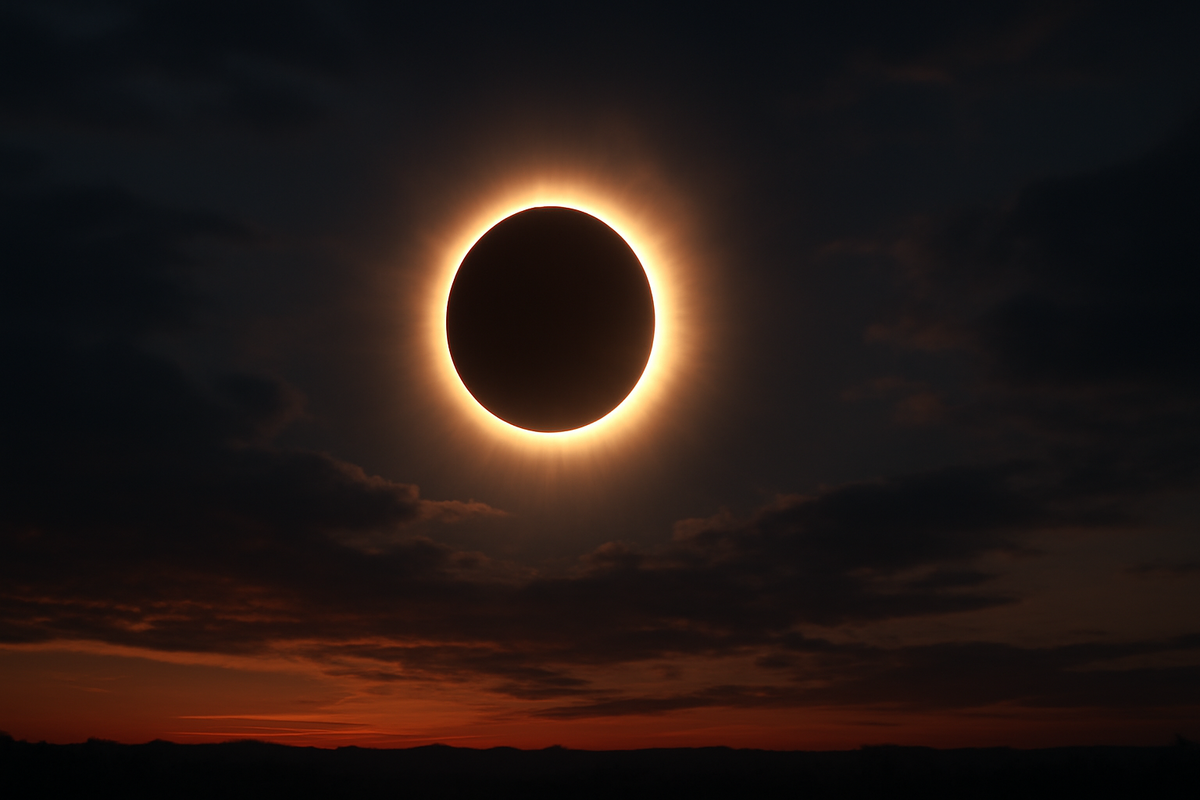
The first thing you’ll notice is the silence. Not all at once, but as if someone is slowly turning down the volume knob on the world. Birds that had been stitching the morning together with song will fall quiet. Shadows will lengthen and sharpen, as if painted in ink. The temperature will slip—subtle at first, then undeniable, a cool breath across the back of your neck. You’ll look up, and the Sun, that unblinking eye that has presided over every day of your life, will no longer be whole.
When Day Decides to Blink
We like to pretend the Sun is dependable. It rises. It sets. It moves, patient and predictable, across our sky. But for a few rare minutes during the longest total solar eclipse of this century, that certainty will fracture. The Moon—small, silent, a stony neighbor that rarely gets our attention—will slide exactly between Earth and Sun and, from your vantage point, erase the star that keeps you alive.
“Erase” isn’t quite the right word, though. The Sun doesn’t vanish so much as transform. Its core light—the blinding disk you know and can’t normally look at—will be swallowed by the Moon’s silhouette. Around that black circle, a ghostly crown of light will appear: the solar corona, the Sun’s outer atmosphere, usually invisible in the glare of daylight. It will shimmer like white fire, delicate and wild all at once, reaching out in tendrils and arcs. You’ll feel like you’re staring at some impossible portal in the sky.
Totality, the moment when the Sun is completely covered, is notoriously brief in most eclipses—a couple of minutes if you’re lucky. But this one, the longest total solar eclipse of the century, will stretch that moment to its very limits. For a few extraordinary minutes, day will give in to night. Streetlights may click on. Stars will prick through the twilight dome above you. Planets, usually shy in daylight, will hang low on the horizon like attentive, glowing sentinels. It will feel wrong and right at the same time, like watching the universe flip a coin and let it hang in the air.
The Geometry of a Miracle
All of this—the strangeness, the beauty, the goosebumps on your arms—is possible because of a cosmic coincidence so unlikely it borders on myth. The Sun is about 400 times wider than the Moon. It is also about 400 times farther away. That ratio means they appear almost exactly the same size in our sky.
From time to time, the orbits of Earth and Moon conspire so that the Moon’s disk lines up perfectly in front of the Sun. Not too high. Not too low. Not too close or too far. If the Moon is a little farther away in its slightly oval orbit, it appears too small and we get an annular eclipse—a “ring of fire” where a bright halo of Sun remains. But when it’s just the right distance, the Moon’s shadow reaches down and fully cloaks the Sun: a total solar eclipse.
In the case of this century’s longest totality, the alignment is almost surgical. The Moon will be near the part of its orbit where it looks largest in our sky. The Earth will be near a point in its own orbit where the Sun appears a little smaller than average. Those tiny differences stretch totality from a fleeting blink of darkness into an extended, luxurious pause—long enough to breathe, look around, notice the world changing, and feel your place in a solar system that suddenly feels very real.
Where you stand on Earth matters, too. The Moon’s shadow doesn’t blanket the whole planet. It traces a narrow path, a slender ribbon called the path of totality. Inside this path, day truly becomes night. Outside it, you’ll see only a partial eclipse: the Sun bitten into, but never fully devoured. For those fortunate (and intentional) enough to stand in that shadow’s path, the experience becomes something you don’t just see—you inhabit it.
The Path Where Day Breaks
Imagine a dark, racing footprint skimming across the planet at thousands of kilometers per hour. That’s the Moon’s umbral shadow: the heart of the eclipse. It will touch down on one edge of Earth, carve a graceful arc over continents and oceans, and lift away on the far side, leaving astonished eyes, backed-up camera rolls, and stunned silence in its wake.
Along this path, small towns will become pilgrimage sites overnight. Farmers will step out into fields that darken at midday, watching their crops bathe in a light that looks more like late dusk than noon. Children will stare with that blend of excitement and worry only kids can manage, gripping eclipse glasses that feel like magical talismans.
Cities will brace for crowds. Hotels along the path will have filled up months or even years in advance. Amateur astronomers will haul telescopes into parks. Photographers will argue over the best vantage point to capture “diamond ring” moments—the split seconds when the first burst of sunlight sneaks past a lunar valley before totality, blowing a jewel-bright star off the edge of a black circle.
For a few minutes, people who might otherwise never speak to each other will look up together, sharing the same involuntary expression: a kind of open-mouthed, unguarded awe. Neighbors who usually meet only over recycling bins or parking disputes will trade eclipse glasses and point out bright planets to one another. The path of totality won’t just be plotted on maps and charts; it will thread through conversations, road trips, and the geography of personal memory.
How the World Feels When the Sun Goes Away
It’s tempting to think of an eclipse as a visual event, something to be captured in photos and videos. But the longest total solar eclipse of the century will be remembered just as much through skin, ears, and instinct.
As the Moon slowly slides across the Sun, the quality of light will change long before totality. Colors on the landscape will desaturate. Your own shadow will look wrong—edges too crisp, outlines too stark. The air will feel thinner, at once cooler and strangely charged. A low unease might move across a crowd like a shared animal memory, something deep and old in us remembering that when the Sun went away, it did not always come back.
Wildlife will respond first. Crickets may begin their evening chorus. Bees will rush back to hives. Birds may swirl and roost as if night has arrived out of schedule. Dogs might pace or bark. Cows will head toward barns. For these creatures, the Sun is not an abstraction or a concept. It is a daily rhythm written into the body, and for a brief time, that rhythm will be scrambled.
Then, as the last sliver of sunlight disappears, the world will tilt. A metallic gray-blue will wash across the landscape. Temperatures may drop by several degrees, enough to raise hairs on your arms. A soft collective gasp might ripple through any gathered crowd. Streetlights and porch lamps—programmed for darkness, not subtle nuance—may expose their confusion by flicking on.
Above you, a sky that was moments ago too bright to stare into will bloom with stars. The brighter ones—Sirius, Betelgeuse, Vega—might burn through the twilight, joined by planets like Venus and Jupiter, suddenly obvious. Overhead, the Moon will be a perfect hole, a dark absence circled by pale, pearly fire. Some people cry when they see their first total eclipse. Others laugh out loud. Many simply stand in stunned silence, as if their vocabulary has been temporarily eclipsed as well.
Why This Eclipse Matters More Than Most
A total solar eclipse is always an event. But this one, with its extraordinary duration of totality, is something rarer still. Those who study the Sun—solar physicists tracking plasma loops and magnetic storms—are already sketching out their observation plans. The longer the Sun’s bright face is blocked, the better they can read the structure of the corona, the shape of its loops, the behavior of its streamers and plumes.
For them, totality is like turning off a stadium’s floodlights to study the faint glow of fireflies hiding in the rafters. For a few minutes, instruments on Earth can see what orbiting spacecraft see without the interference of daylight. They’ll take high-speed photographs, measure polarization of coronal light, and chase down details in those whisper-fine structures that hint at the origins of the solar wind—the constant stream of charged particles that washes over our planet and shapes our magnetic environment.
But the scientific importance is only part of the story. This longest eclipse of the century will also be a kind of global nature festival. It will inspire art and music, poems and essays, new obsessions and lifelong hobbies. It will be the moment a child decides to become an astronomer, or a wildlife biologist, or simply someone who pays closer attention to the sky. It will be the topic around dinner tables and campfires. It will leave behind, in its shadow, a scattered but widening circle of people who know what it feels like when noon becomes midnight and then returns.
And beneath that glow of shared wonder lies a quiet, humbling message: our most fundamental assumptions—that the Sun shines, that days are bright, that the sky is blue—are not guaranteed. They are the result of a particular geometry, a particular distance, a particular moment in cosmic time when the Moon still happens to appear big enough to cover the Sun. Millions of years from now, the Moon will be too far away. Total solar eclipses will end. We are, right now, living in a brief, privileged window of celestial history.
Preparing to Stand in the Shadow
In the months leading up to the eclipse, the world along the path of totality will start quietly rearranging itself. Schedules will shift. Plans will take shape. Eclipse glasses—those simple paper-framed filters that make it safe to look at the partially covered Sun—will become as common as coffee cups in kitchen drawers.
If you’re planning to watch, your preparation won’t just be about where to stand, but how to be present. You might check weather patterns, chase clear skies, and book that slightly out-of-the-way motel that still had a room. You might call an old friend and say, “Meet me in the shadow?” and revive a connection under the most improbable of circumstances.
Technology will whirl around the event. Apps will tick down the seconds to first contact (when the Moon’s edge first nicks the Sun), to second contact (the beginning of totality), and to the moment the first dazzling bead of sunlight breaks free again. Social media will fill with advice on photography, but veteran eclipse chasers will quietly insist: take a few photos, then put the camera down. Look. Listen. Feel the wind. Feel your breath. Notice the way people around you go still.
Your kit might look something like this:
| Item | Why You’ll Want It |
|---|---|
| Eclipse glasses (certified) | To safely watch every partial phase before and after totality. |
| Hat and light layers | To handle both full sun beforehand and the sudden temperature drop. |
| Chair or blanket | So you can settle in and watch the slow transformation of the sky. |
| Notebook or voice recorder | To capture details and feelings that photographs can’t hold. |
| Binoculars with solar filter | For a closer view of the Sun’s edge and, during totality only, the corona. |
One more thing that doesn’t fit in a table: patience. The partial phases take time. The Sun will look like it’s being slowly eaten, its circle turning into a crescent, then a thin arc so delicate it could be drawn with a single brushstroke. This is when you’ll notice strange things—tiny crescent Suns dappling the ground under leafy trees, each gap in the foliage acting as a pinhole projector. This is when the world starts to feel like it’s inhaling, holding its breath.
The Moment You’ll Remember
And then: totality. The longest of the century, but still brutally short in the scale of human desire. You will count down—five, four, three, two—and in that last heartbeat of daylight, something ancient in you may flinch. Our species has watched eclipses with terror and reverence for as long as we’ve had stories. We’ve banged drums to scare away sky monsters, sacrificed and prayed, written myths of wolves and dragons and jaguars devouring the Sun.
But when you stand there in the sudden dark, what you’ll feel is not the fear of a stolen star, but the shock of seeing with your whole self. The Sun, reduced to its halo. The Moon, usually so familiar, now an ink-black disc, its edge razor-sharp. Around the horizon, a 360-degree sunset will glow in bands of orange and pink. You’ll be wrapped in a twilight dome with a bright, uncanny heart.
The minutes of totality will flow strangely. Some will feel frozen. Others will slip through your fingers. You might notice bright red prominences licking off the Sun’s limb, arcs of incandescent gas leaping into space. You might see the corona braided and swept into patterns by magnetic fields too complex to imagine. You might just stare and forget everything you meant to notice.
And then, almost cruelly, it returns. A bead of sunlight explodes from the edge of the Moon, the “diamond ring” that makes crowds cheer instinctively. Eclipse glasses go back on. Birds reconsider their choices. The temperature ticks upward. The ordinary world reasserts itself, embarrassed by how quickly it let go of its routine.
After the Shadow Passes
For days and weeks afterward, you may find yourself replaying those minutes in your mind. They’ll lodge in your memory in ways you couldn’t have predicted: the way the wind shifted, the way your friend’s face looked lit by corona light, the way even strangers around you seemed briefly unmasked.
You may also find your sense of scale subtly altered. The Sun and Moon will never again be just background characters in your mental landscape. The idea that your life unfolds under a sky where such things can happen—where orbits align and shadows fall and day can fold into night and out again—will sit with you like a quiet, steadying weight.
There is a gentle irony in total solar eclipses. To see them, we chase shadows. We plan for absence. We travel to stand in a line where light will go missing. But what we come away with is a feeling of abundance: more wonder, more context, more connection to a planet spinning through space, lit by a star that can, for a heartbeat in cosmic time, be briefly undone by a smaller companion.
When the longest total solar eclipse of the century has come and gone, the Sun will still rise the next day, unchanged and relentless in its brilliance. Life will go on—emails, errands, dishes in the sink. But somewhere inside you, there will be that remembered darkness at noon and the luminous crown of the hidden Sun, a reminder that the universe is not just out there. It is happening, intimately, right over your head.
FAQ: The Longest Total Solar Eclipse of the Century
How long will totality last during this eclipse?
The precise duration depends on where you stand along the path of totality. Near the point of greatest eclipse, totality will last several minutes—longer than any other total solar eclipse this century. Locations closer to the edges of the path will experience a shorter period of total coverage.
Is it safe to look at the eclipse with the naked eye?
It is only safe to look directly at the Sun during the brief period of totality, when it is completely covered by the Moon. At all other times—including partial phases before and after totality—you must use proper eclipse glasses or other certified solar filters. Never look at the uneclipsed or partially eclipsed Sun through regular sunglasses, binoculars, or a camera viewfinder without solar filters.
Do I need to be in the path of totality to enjoy the eclipse?
You can see a partial eclipse from a much wider area outside the path of totality, and that can still be fascinating. However, the full, day-into-night transformation, the visible corona, and the most dramatic environmental changes occur only inside the narrow path of totality. If you can, traveling into that path is worth the effort.
What will animals do during the eclipse?
Many animals respond to the sudden darkness and temperature drop as if night has arrived. Birds may return to roost, insects like crickets might start chirping, and farm animals often move toward evening shelters. Their reactions vary, but watching wildlife behavior during totality is one of the most intriguing parts of the experience.
How often do total solar eclipses happen?
Total solar eclipses occur somewhere on Earth roughly every 18 months, but they are visible from any given location only a few times in many centuries. The path of totality is narrow, so for most people, seeing totality means traveling to meet the Moon’s shadow rather than waiting for it to come to them.
Why is this particular eclipse the longest of the century?
This eclipse combines several favorable conditions: the Moon is near the closer part of its orbit, making it appear slightly larger in the sky, and Earth is near a point where the Sun appears a bit smaller. That geometry allows the Moon’s shadow to linger over certain regions for an unusually long time, stretching the duration of totality beyond that of other eclipses this century.
What’s the best way to experience the eclipse—through a camera or with my eyes?
Photography can be rewarding, but many seasoned eclipse chasers recommend keeping it simple: take a few quick shots, then put the camera aside. The sensory, emotional, and environmental details of totality are best absorbed with your own eyes and attention, not through a screen. Let the sky be your main focus, just for those rare and precious minutes when day becomes night.

Hello, I’m Mathew, and I write articles about useful Home Tricks: simple solutions, saving time and useful for every day.