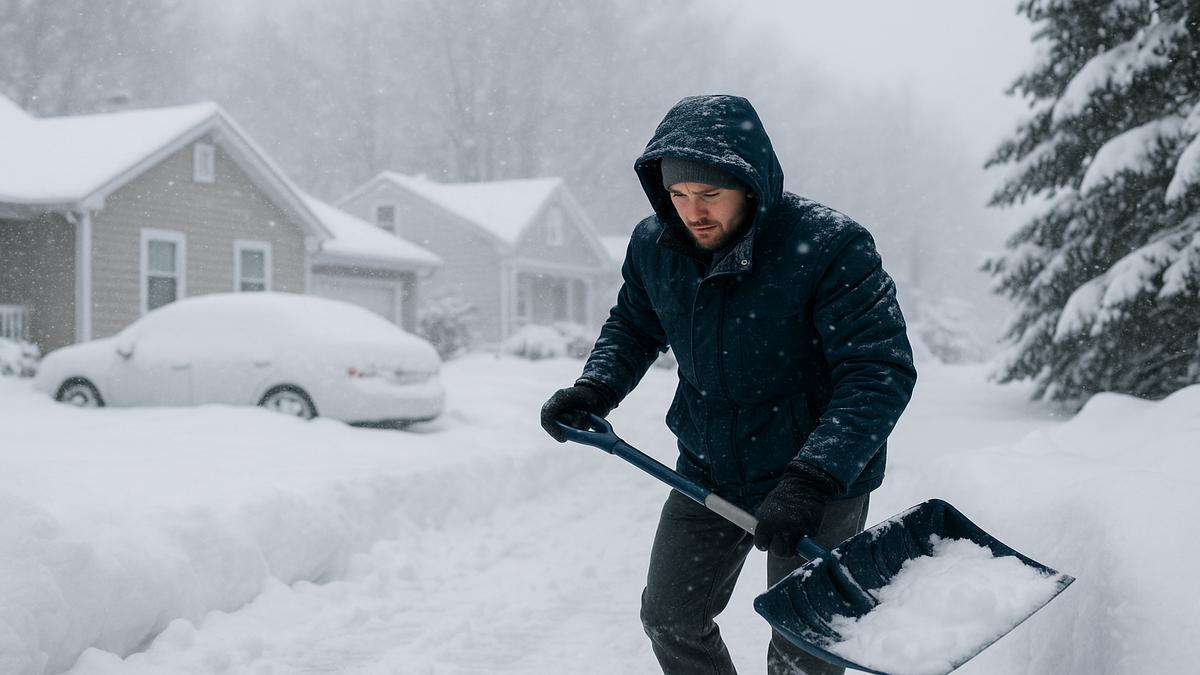
The first snowflake always looks harmless. It drifts past your window like a feather, melts on the glass, and you think, “Pretty.” Then, a few hours later, you realize the sky hasn’t taken a breath since. The world outside has gone soft and quiet, cars are moving like nervous turtles, and the forecast on your screen suddenly reads like an apocalypse movie script: Up to 40 inches of snow. Travel nearly impossible. Power outages likely. Somewhere between your third weather refresh and the low pantry inventory, your heart rate quickens. This isn’t just a snowstorm. This is a snowpocalypse.
When the Sky Opens: What “Up to 40 Inches” Really Means
Forty inches is a number that doesn’t quite land until you picture it. It’s the height of a kitchen counter. It’s a small child vanishing into a drift. It’s your car buried so completely that the only clue it exists is the shape of a rounded white hill in the driveway.
Meteorologists are tracking a sprawling winter storm system that’s poised to stall and dump staggering amounts of snow across several regions. While the exact totals always shift as the system evolves, models are circling around a sobering phrase: multi-day, high-impact snow event. The kind that rewrites landscapes and schedules in one sweep.
Several zones are standing in the bull’s-eye: higher elevations, lake-effect corridors, and broad swaths of interior regions that are about to become the snowy backbone of the storm. Longtime locals may shrug—“We’ve seen big storms before”—but even seasoned snow veterans quietly respect any system threatening three or more feet.
These are the kinds of storms that:
- Shut down major interstates for a day or more
- Turn side streets into trenches and front doors into barricades
- Create whiteout conditions where “visibility” is just a word you used to know
- Test the limits of snowplow fleets, tow trucks, and patience
And yet, from inside a warm house, they can also be oddly magical: a hush that settles, a glow bouncing off the snow at night, kids pressing their faces to the glass, hoping for school cancellations. The key is being ready enough that you can enjoy the wonder without the panic.
Dates You Need to Circle: The Storm’s Life in Three Acts
This kind of storm rarely arrives all at once, like a curtain dropping. It unfolds in acts, like a play directed by the jet stream and fueled by cold air and moisture colliding in exactly the wrong—or right—way, depending on how you feel about snow days.
Act I: The Sneaky Start (Day 1–2)
The first phase often whispers rather than shouts. Light to moderate snow begins creeping in, usually from the west or southwest, depending on your region. The radar looks more smudged than explosive. You might get a dusting in the morning that turns to a couple of inches by nightfall.
This is the deceptive part. Roads are slick but not impassable. People still commute, still run errands, still think, “Is this it?” Meanwhile, the atmosphere is gearing up, stacking layers of energy and moisture above your head like invisible storm scaffolding.
Act II: The Main Punch (Day 2–4)
Then the storm finds its stride. Snowfall rates jump—sometimes to 1–3 inches per hour. That’s when you can shovel your front steps, go inside to make coffee, and come back to find it as if you never touched it.
This is usually the period when:
- Plows fall behind in side neighborhoods
- Visibility drops to near zero in bursts of heavy snow
- Wind gusts turn loose powder into swirling curtains
- Snow bans or travel advisories snap into place
If you’re in one of the high-impact zones, this is the act that could push totals toward that 30–40 inch range, especially if you’re near higher terrain or a lake-enhanced region. The world outside your window will look like it’s being erased and redrawn in white.
Act III: The Lingering and the Lake Effect (Day 4–6)
Just when you think it’s over, the storm leaves a calling card. The main low-pressure system may drift away, but cold air spilling over warmer lakes can ignite intense, narrow snow bands—like conveyor belts of flakes, locked over the same unlucky towns for hours.
This is where isolated spots can quietly tack on another 6–12 inches—on top of what they already have. That’s how a forecast of “up to 40 inches” becomes reality in those bull’s-eye zones, while a town a few miles away ends up with half as much. It’s not unfair. It just feels that way.
Where the Snowpocalypse Hits Hardest
Every big winter storm has its personality, but a few patterns are consistent: elevation, proximity to lakes, and where the storm’s core bands set up. Think of it as the storm’s preferred canvas.
The High Ridges and Mountain Towns
Higher terrain acts like a net for moisture. As air is forced uphill, it cools and wrings out snowfall. That means mountain valleys and ridge-top communities often see totals far above their lowland neighbors.
Residents here know the drill: snow piled high against cabin doors, roofs groaning under the weight, plows pushing walls of white taller than the trucks themselves. They also know that once the road up the mountain closes, you’re living in your own small world for a while.
The Lake-Effect Corridors
If you live downwind of a large, relatively warm lake, your weather app should come with a seatbelt. Cold, dry air sweeping over the warmer water scoops up moisture and dumps it onshore as snow, aligning into bands that can sit stubbornly over a single region for hours or even days.
In these corridors, one neighborhood can be smothered while another, just a short drive away, is merely dusted. These are the places most likely to flirt with that 40-inch mark, especially when a larger storm system sets the stage and the lakes handle the encore.
Interior Snow Belt Communities
Far from the moderating influence of the coast, interior regions can fall into a deep freeze that turns even modest moisture into prolific snowfall. When a strong storm taps Gulf or ocean moisture and then drives it inland into entrenched Arctic air, you get a powder factory.
Here, wide, open fields become unbroken sheets of white, and wind tears across them, carving drifts that swallow fences and lick at second-story windows. Rural residents can find their long driveways transformed into rolling dunes of snow—a full-day project before they even think about reaching the main road.
How to Prep Without Panic: A Calm, Practical Checklist
Preparing for a snowpocalypse isn’t about fear; it’s about giving your future self a high-five. The more you do now, the less you’ll stress when the flakes are flying sideways.
Inside the House: Heat, Light, and Food
First, imagine the power blinking off. Not because it will, but because it might—and that’s the scenario worth planning for.
- Heat backup: If you have a wood stove, pellet stove, or fireplace, stack enough dry wood or pellets for several days. If you rely solely on electric heat, consider portable propane or kerosene heaters rated for indoor use, and follow safety instructions to the letter, including ventilation.
- Light: Gather flashlights, headlamps, lanterns, and a generous stash of batteries. Candles are fine for ambience, but think of them as backup, not your primary plan.
- Food and water: You don’t need a bunker. You need 3–5 days of easy, no-power meals: canned soups, beans, pasta, rice, oatmeal, nut butters, granola, shelf-stable milk. Store at least a few gallons of drinking water, plus extra for pets.
- Fridge strategy: If the power does go, keep the doors closed. Pack perishables into coolers you can stash in a cold garage or on a sheltered porch, protected from animals.
Medicine, Comfort, and Sanity Savers
While you’re thinking like a survivalist, also think like a human who doesn’t want to be miserable.
- Refill prescriptions before the storm window begins.
- Set aside a small “comfort bin”: tea, hot chocolate, your favorite snacks.
- Download books, movies, and playlists in case your internet goes down.
- Charge power banks and devices fully before the storm ramps up.
Fortifying the Outside: Your House, Your Car, Your Muscles
Step outside and picture everything under two or three feet of snow. What becomes a problem?
- Gutters and roofs: Clear leaves and debris now. If you’ve had ice dams in past winters, be proactive with roof rakes and insulation improvements.
- Walkways and driveways: Move what you can—planters, extension cords, small furniture—so they don’t vanish under drifts or block your shoveling paths.
- De-icer and tools: Lay in rock salt or pet-safe ice melt. Check your shovels for cracks. Fire up the snowblower before you need it, and stock extra fuel.
- Car check: Fill the tank, top off washer fluid rated for sub-freezing temps, and make sure your wipers aren’t hanging on by a thread.
Your vehicle should carry a winter kit: blanket, hat and gloves, small shovel, ice scraper, sand or kitty litter for traction, jumper cables, a flashlight, and a small stash of snacks and water. In a snowpocalypse, even a short drive can turn into a long wait.
The Rhythm of a Snowed-In Day
When the storm peaks, time gets strange. The world outside is a blur of white, and the familiar landmarks—trash cans, mailboxes, shrubs—have disappeared beneath sculpted mounds. Windows glow with that distinctive snow-light, a diffuse brightness even at dusk.
Inside, life takes on a different cadence.
You might wake to the muffled hum of a distant plow, to the quiet complaint of wind around the eaves. Coffee steams in your hands as you open the door to check the latest totals and immediately get a boot full of snow. The front steps are gone, swallowed in a drift that now meets the bottom of the railing.
Shoveling becomes an ongoing relationship rather than a single task. You clear a path, and the storm erases it. You dig out the car, even though you have nowhere to go, just because it feels better to see its shape again. Your arms burn, your breath hangs in the air, but there’s a primal satisfaction in carving space out of all that white.
Neighbors appear slowly—bundled figures moving like colorful punctuation in a monochrome world. There are nods across driveways, shouted check-ins: “You good over there?” “Need anything?” Strangers help push stuck cars; someone’s snowblower becomes a neighborhood hero.
Inside, screens compete with windows for your attention. Forecast updates, closings, school alerts, radar loops. But at some point, you surrender to the moment: a pot of soup simmering, kids building a fort in the living room, someone dozing to the sound of wind rattling the windows just enough to remind you that you’re safe and warm—for now.
After the Storm: Digging Out and Looking Ahead
The end of a snowpocalypse doesn’t arrive with a neat finish line. Snow tapers, skies lighten, and the storm drifts off on the maps, but the real work is just getting started.
Snowplows carve canyons along main roads, walls of packed snow rising on either side. Side streets and rural roads may remain rough and narrow for days. Parking lots become labyrinths of plowed piles, cars tucked into odd angles, everyone moving in slow, cautious choreography.
At home, your relationship with the shovel enters its final, determined phase. You widen paths, free buried vehicles, grudgingly clear the extra chunk the plow pushed back across your driveway. Roof rakes slide heavy slabs of snow off overhangs. Icicles grow like crystal daggers along the eaves, and you knock down the biggest ones before they fall on their own.
Then comes the subtle danger: thaw and refreeze. Meltwater refills gutters and trickles over sidewalks, only to harden into glass-slick ice by morning. You learn to scatter salt and watch your footing, to treat every wet-looking patch as suspect.
Yet there is also a strange, deep satisfaction. The landscape has been edited into something new and astonishing: trees wearing heavy cloaks, fields stretched to the horizon in unbroken white, the world quieter, slower, more deliberate. The usual roar of traffic never quite recovers its full volume for a few days. People talk about the storm the way they talk about big life events: “Where were you when it hit hardest? How much did you get? Did you lose power?”
And in the back of your mind, you know: this will be the winter people reference for years. “Remember the one with almost 40 inches?” they’ll say, and you’ll remember the quiet, the work, the beauty—and the preparation that made it all survivable.
Snowpocalypse Prep at a Glance
Use this quick-reference table to double-check your readiness before the heaviest snow arrives.
| Category | What to Check | Goal Before Storm |
|---|---|---|
| Food & Water | Shelf-stable meals, pet food, drinking water | 3–5 days of supplies for all household members |
| Heat & Power | Backup heat, flashlights, batteries, chargers | Enough for a 24–48 hour outage |
| Medications | Prescriptions, basic first aid, pain relievers | At least one week’s supply of essentials |
| Snow Gear | Shovels, snowblower, ice melt, roof rake | Tools tested, fuel ready, paths pre-planned |
| Vehicle Kit | Blanket, shovel, scraper, sand, snacks, water | Car ready for unexpected delays or stalls |
FAQs: Snowpocalypse, Safety, and Staying Sane
How many days should I plan to be stuck at home during a 40-inch snow event?
Plan for 3–5 days of significantly limited travel, especially if you live on side streets or rural roads. Main roads are usually passable sooner, but getting from your home to those roads may be the challenge. In severe cases or remote areas, it can stretch to a week before things feel “normal” again.
Is it safe to drive if I have a four-wheel-drive vehicle?
Four-wheel drive helps with traction, but it doesn’t make you invincible. It won’t shorten your stopping distance on ice, and it can give a false sense of security. If authorities issue strong travel advisories or bans, stay off the roads unless it’s an emergency, regardless of your vehicle type.
How can I protect my pipes during extreme cold and heavy snow?
Keep your home temperature consistent, open cabinets under sinks to let warm air reach pipes, and let faucets drip slightly in extreme cold. Seal drafts around windows and doors. If you have pipes in unheated spaces like garages or crawl spaces, consider insulating them or using safe pipe-heating cables.
What should I do if the power goes out and I have no backup heat?
Close off one or two rooms and live in a smaller space, using blankets and layered clothing to trap body heat. Avoid opening exterior doors frequently. If you use portable heaters or a generator, follow all safety guidelines: proper ventilation, never running generators indoors, and keeping them away from windows and doors to prevent carbon monoxide buildup.
How do I avoid overexertion while shoveling deep snow?
Shovel in short sessions, take frequent breaks, and push snow instead of lifting it whenever possible. Use a smaller shovel to reduce the weight of each load. Listen to your body—chest pain, severe shortness of breath, or dizziness are red flags. For heavy or wet snowfalls, consider sharing the work with neighbors or hiring help if possible.
How can I keep kids and pets safe during and after the storm?
Set clear boundaries: no playing near plow routes, roads, or large snowbanks where visibility is low. Keep pets on leashes or in fenced areas; deep snow and whiteout conditions can disorient them quickly. Make sure everyone has proper clothing—waterproof boots, hats, gloves, and layers—to avoid frostbite and hypothermia.
Why do some places get close to 40 inches while nearby towns get much less?
Local snowfall totals are shaped by elevation, storm track, and narrow, intense snow bands—especially in lake-effect regions. A town under a persistent band can be buried, while another just a few miles away sits under lighter, intermittent snow. That’s why forecasts often include ranges and phrases like “locally higher amounts.”
In the end, a snowpocalypse is a test, but also an invitation—into a slower rhythm, a heightened awareness of neighbors, a front-row seat to the atmosphere showing off. With a little foresight, you’re not just bracing for impact. You’re preparing to watch, to weather, and, when the sky finally clears, to step out into a world remade in white.

Hello, I’m Mathew, and I write articles about useful Home Tricks: simple solutions, saving time and useful for every day.




