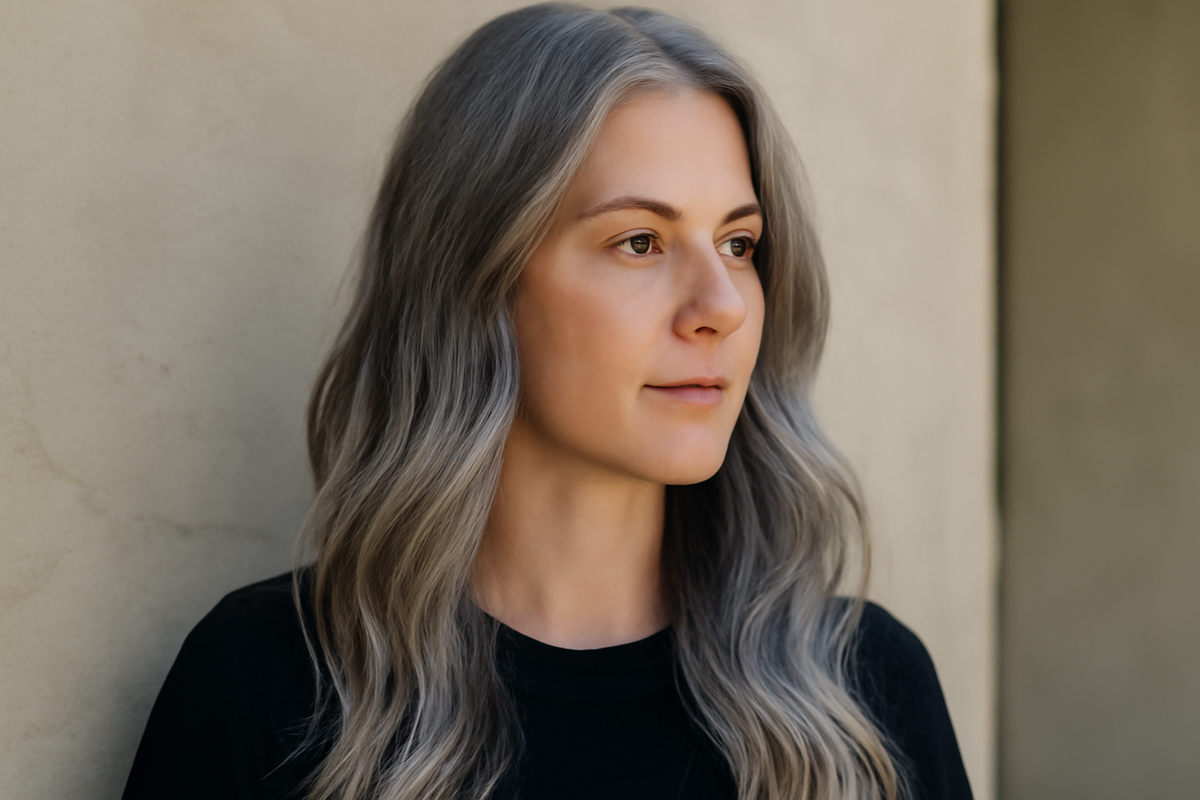
The first thing you notice is the silver—soft, shimmery, like moonlight caught in strands. Not a harsh line, not a stripe of blonde, not that telltale “I’ve-been-to-the-salon” banding that announces itself before you do. Just a quiet glimmer at the temples, disappearing seamlessly into deeper roots and sun-faded ends. It looks like hair that’s lived, not hair that’s labored over. The stylist calls it “melting.” You remember balayage—the hand-painted streaks, the lifted ends, the whole sunkissed, beach‑girl myth—and realize that this feels different. Subtler. Kinder. Like a way of saying: I’m changing, and my hair gets to come along for the ride.
Goodbye Balayage, Hello Gray-Melting
For years, balayage reigned as the easy-going queen of low‑maintenance color. Hand‑painted highlights gave us that “I woke up like this” illusion, all soft ribbons of light drifting through the lengths. It was a rebellion against stripy foils and one‑note box dye—an art form more than a formula.
But something interesting started happening in salon chairs everywhere: people didn’t just want brightness; they wanted belonging. They weren’t chasing a summer‑vacation blonde as much as they were searching for a way to coexist with the new silver threads showing up along their part line.
Balayage, for all its magic, wasn’t really designed with gray in mind. Sure, it could distract from a few sparkles here and there, but once the grays came in with more confidence, many people were left with a familiar dilemma: keep fighting them with constant root touch‑ups, or go cold turkey and grow them out.
Enter gray-melting—sometimes called color melt, root melt, or gray-blending melt—a technique that doesn’t pick a side in the “dye it or ditch it” debate. Instead, it proposes a third path: what if your natural grays weren’t the enemy to be concealed, but the main character to be styled around?
What Exactly Is “Melting” — And Why Does It Feel So Different?
Imagine three colors on your head: your natural root shade (grays and all), a transition tone that lives in the mid‑lengths, and a softer, lighter tone on the ends. Now imagine that, instead of sharp lines or obvious streaks, those colors blend into each other like watercolor bleeding on paper. No hard starts, no sudden stops—just a gentle gradient from one hue to the next.
That’s melting. Technically, it’s a way of applying color so that one shade “melts” into another without visible demarcation lines. With gray-blending melts, the stylist builds a custom bridge between your silver and your existing color—so your hair looks cohesive, not patched together.
Where balayage often centers on brightness, melting centers on harmony:
- Balayage: Hand-painted brightness, often with strong contrast between roots and ends.
- Melting: Layered tones with minimal contrast, aimed at invisible grow‑out and soft transitions.
The result is hair that doesn’t scream “colored,” but whispers “intentional.” Think ash‑taupe ribbons that cradle silver strands, smoky beige mid‑tones, pearly ends that echo the shimmer of gray without trying to override it. It’s less “highlighted mane,” more “forest at dusk”—a shifting interplay of shadows and light.
The Emotional Shift Behind the Technique
There’s a quiet revolution underneath this move from balayage to melting. It’s not just about aesthetics; it’s about relationship—specifically, your relationship with time. Balayage was about extending summer, freezing the sun in your hair. Gray-melting is about learning to stand in the afternoon light and say: yes, I’m still here, and I’m changing.
In the salon, that shift can feel almost ceremonial. You sit down with roots that make you feel behind—behind schedule, behind maintenance, behind the version of yourself that felt safely “young enough.” Instead of hearing, “Let’s cover those,” you might hear, “Let’s frame them.” The stylist swirls bowls of soft taupes and muted mushroom tones, formulating not to erase but to accompany.
When the color rinses out, your grays are still visible—only now they look like part of the story, not an interruption. The harsh root line is gone, replaced by a gradient so soft you almost can’t tell where nature ends and artistry begins. For many, that first look in the mirror isn’t fireworks—it’s a deep exhale.
How Gray-Melting Actually Works in the Chair
From the outside, melting can look like any other color service: cape, bowls, brushes, foils (sometimes), a symphony of salon chatter. But behind the scenes, it’s a little more like landscape painting than highlight work. Your hair becomes a terrain the colorist studies carefully—mapping altitude (where your grays live), weather patterns (your undertones), and the paths sunlight naturally takes through your strands.
The Basic Steps of a Gray-Melt
- Consultation: The stylist assesses how much gray you have, where it’s concentrated, your natural level and undertone, your previous color history, and how bold or subtle you want to go.
- Root Strategy: Instead of full opaque coverage, they might use:
- Soft demi‑permanent shades close to your natural color.
- Translucent tints that blur, not block, your silver.
- Sometimes no color at the root at all, depending on your starting point.
- Transition Zone: Mid‑lengths get a slightly lighter or cooler tone, often in smoky beige, mushroom brown, or muted ash, to echo the coolness of gray hair.
- End Lights: The ends may be gently lightened or toned to match the silvery reflect of your grays—think soft pearl, sand, or ice-mocha, not screaming platinum.
- Melt Application: With brushes, fingers, or a comb, the stylist smudges and blends where each shade meets, ensuring there’s no stark line between sections.
- Toning & Finishing: A gloss or toner calms brassiness, refines the palette, and adds a healthy sheen.
The magic isn’t in a single product; it’s in the way the colors meet. Just as a river fades into estuary, then sea, your root, mid-lengths, and ends become a single continuous story.
A Quick Comparison: Balayage vs. Gray-Melting
| Aspect | Traditional Balayage | Gray-Melting / Gray-Blending |
|---|---|---|
| Main Goal | Sun‑kissed brightness and contrast | Soft transition between gray and colored hair |
| Root Area | Often left darker; can show strong contrast as it grows | Blurred or tinted to blend with grays and minimize root lines |
| Best For | Adding light and dimension to non‑gray hair | Anyone transitioning to or living with visible grays |
| Maintenance | Low to medium, but obvious once too much root shows | Medium, but grow‑out is softer and more forgiving |
| Visual Vibe | Sunlit, high‑contrast, fashion‑forward | Lived‑in, natural, almost undetectable color work |
Who Is Gray-Melting Really For?
You don’t have to be “ready to go gray” to fall in love with melting. In fact, it might be most powerful for people who aren’t ready—at least, not all at once. It offers room for ambivalence, for changing your mind, for evolving in real time.
If You’re Just Starting to See Grays
Maybe it’s a shimmer at your temples, a constellation of silver at your part. You don’t necessarily want to overhaul your entire color, but you are tired of those first few strands glaring back under office lighting or in your selfies.
Melting can soften the contrast between those early grays and your base color. By cooling or slightly lightening the mid‑lengths, your new silver friends look less isolated and more like subtle highlights you meant to have.
If You’re Tired of Root Touch-Ups
Monthly appointments. Standing in the drugstore shade aisle, wondering if “Medium Cool Brown 5.1” is the same as last time. Those telltale weeks when the helmet of fresh color floats above half an inch of new growth like a mismatched cap.
Gray-melting won’t eliminate maintenance, but it stretches the timeline. Because your root is intentionally blurred and closer to your natural (grays included), there’s less of a jarring jump between salon day and six weeks later. You can go longer without feeling “undone.”
If You Want to Eventually Go Fully Gray
For some, the destination is a full head of natural silver. But the flight there can be bumpy—months (or years) of obvious demarcation lines if you simply stop coloring cold turkey. Melting offers a softer route.
Your stylist can gradually use lighter, more translucent tones and strategically place lowlights or highlights that mimic your growing gray pattern. Over time, there’s less artificial color in the mix, until one day you notice: most of what you’re seeing is actually you.
Living With Melted Hair: The Daily Experience
Hair is one of the first places we feel our own seasons changing. With melted gray-blending, day‑to‑day life can feel a little gentler. There’s less panic at the mirror, less sudden need to hide under a headband or hat when you catch a glimpse of your part under harsh light.
Movement, Light, and Texture
Melting is particularly beautiful in motion. When you tuck your hair behind your ear, silver peeks out between cooler mid‑tones instead of cutting through a block of dark dye. In the sun, the lighter ends pick up warmth while the grays flash like tiny pieces of foil. In the evening, under softer lamps, your hair reads as one unified color story.
Texture plays a role, too:
- Wavy or curly hair makes the melt look especially organic; each curl becomes its own little ombré.
- Straight hair shows off the gradient with sleek clarity—most people won’t know whether it’s color work or just fabulous genes.
- Coarse or wiry gray strands benefit from the conditioning and glossing often built into melt services, which can add shine and softness.
Maintenance Without the Drama
Most gray-melting clients find themselves returning to the salon every 8–16 weeks—timing that can shift with your growth rate, tolerance for visible gray, and how much opaque color is still in the mix.
Home care is more about preserving tone than chasing coverage. A few habits go a long way:
- Using sulfate‑free shampoo to help color last.
- Occasional purple or blue shampoo if your melt leans cool and you want to knock out brass.
- Hydrating masks to keep lightened ends from feeling dry compared to your natural gray at the root.
- Heat protection when styling, because shine is the secret weapon of any gray-blend.
The goal isn’t perfection; it’s coherence. Even on “I just air‑dried and ran out the door” days, your hair should still look intentional.
Talking to Your Stylist: How to Ask for a Gray-Melt
Salon language can feel like another alphabet, especially with trends changing faster than your hair grows. “Melting,” “smudging,” “blending,” “shadow root”—it’s easy to wonder whether you’re asking for the same thing everyone else is talking about.
Words That Help, and Pictures That Help Even More
Instead of leading with the trend name, describe the feeling you’re after:
- “I want my grays to blend in, not be completely covered.”
- “I’m okay seeing some silver; I just don’t want a harsh root line.”
- “I’d like a very soft gradient from my natural root into my existing color.”
Then you can add: “I’ve been seeing gray-blending melts and color melting for gray on social—something like that.” Bringing photos is invaluable, but choose references that show similar hair to yours in texture, length, and starting gray level.
Questions Worth Asking
- “How much gray coverage versus gray blending do you recommend for my hair?”
- “Will you be using demi‑permanent or permanent color at my root?”
- “How often should I expect to come back to maintain this?”
- “What will the grow‑out look like in three months? Six months?”
- “If I eventually want to go fully gray, can this melt transition with me?”
A good colorist will talk you through the roadmap, not just today’s appointment. Melting is a journey strategy as much as it is a single visit.
The Quiet Power of Letting Hair Tell the Truth Softly
In the end, gray-melting isn’t just a passing trend stealing the spotlight from balayage. It’s a reflection of something happening culturally: a widening of what we consider beautiful, desirable, and worth showing up with in the world. Where balayage gave us an eternally‑sunny version of ourselves, melting offers something perhaps more radical—an honest version, rendered kindly.
There’s something almost wild about it, in the best way. Like moss slowly creeping over a fallen log, like frost edging the corners of autumn leaves, gray-melting allows time to write its patterns softly instead of drawing them in thick marker. Your hair doesn’t have to stay frozen at twenty-five. It can tell the story of thirty, forty, fifty, sixty, and beyond—with every shade between chestnut and silver invited to the same conversation.
So yes, the age of balayage isn’t over; it’s simply evolving. The bright, painted ribbons will always have their place. But for those standing at the edge of a new decade, watching silver appear like early stars, there’s a new language available. One that doesn’t shout, but murmurs. One that doesn’t deny the gray, but melts right into it.
When you finally step outside after your first gray-melt, the air will feel the same. The sky will be doing whatever the sky does that day. But the reflection in every passing window might feel easier to meet. Not because you’ve hidden anything—but because, strand by strand, you’ve found a way to let your hair and your life be on the same page.
FAQ: Gray-Melting and Subtle Gray-Blending
Is gray-melting damaging to my hair?
It can involve lightening and toning, which always carry some risk of dryness, but a skilled colorist will choose gentle formulas, avoid unnecessary lifting, and pair the service with treatments. Compared to frequent all‑over permanent dye, gray-melting often leads to less cumulative damage because you’re coloring less often and more strategically.
How long does a gray-melt typically last?
You’ll usually enjoy your melt for 8–16 weeks before feeling the need for a refresh. The beauty is in the soft grow‑out: even as your natural gray increases, the transition remains gentle, so you’re not rushed back to the salon by harsh lines.
Can I get a gray-melt if I already have box dye on my hair?
Yes, but your stylist may need to correct or lift some of that existing color first, especially if it’s very dark or uneven. Be honest about your full color history so they can create a safe plan; sometimes a multi‑step approach is better than forcing a big change in one day.
Will my grays still show after gray-blending?
Usually, yes—by design. Gray-melting doesn’t aim to erase your grays; it reframes them. They’ll still be visible, but surrounded by tones that echo their coolness and brightness, so they look intentional instead of isolated.
Is gray-melting only for people with a lot of gray?
Not at all. It works beautifully for early sprinkles, medium pepper‑and‑salt, and higher percentages of gray. The formula and placement just change depending on how much silver you have and how prominently you want it to appear.
Can men try gray-blending melts too?
Absolutely. On shorter hair, gray-blending is often more subtle and faster to apply, using soft toners or lowlights to diffuse harsh contrast. The mindset is the same: keep the dignity of the gray while smoothing the transition between shades.
What should I ask for if my stylist isn’t familiar with the term “melting”?
Describe what you want to see: “a soft gradient from my natural gray roots into my colored hair, with no harsh line and partial, not full, gray coverage.” Share a few reference photos of gray-blending or soft color transitions and focus on the outcome rather than the buzzword. A good colorist will understand the technique, even if they call it something else.

Hello, I’m Mathew, and I write articles about useful Home Tricks: simple solutions, saving time and useful for every day.




