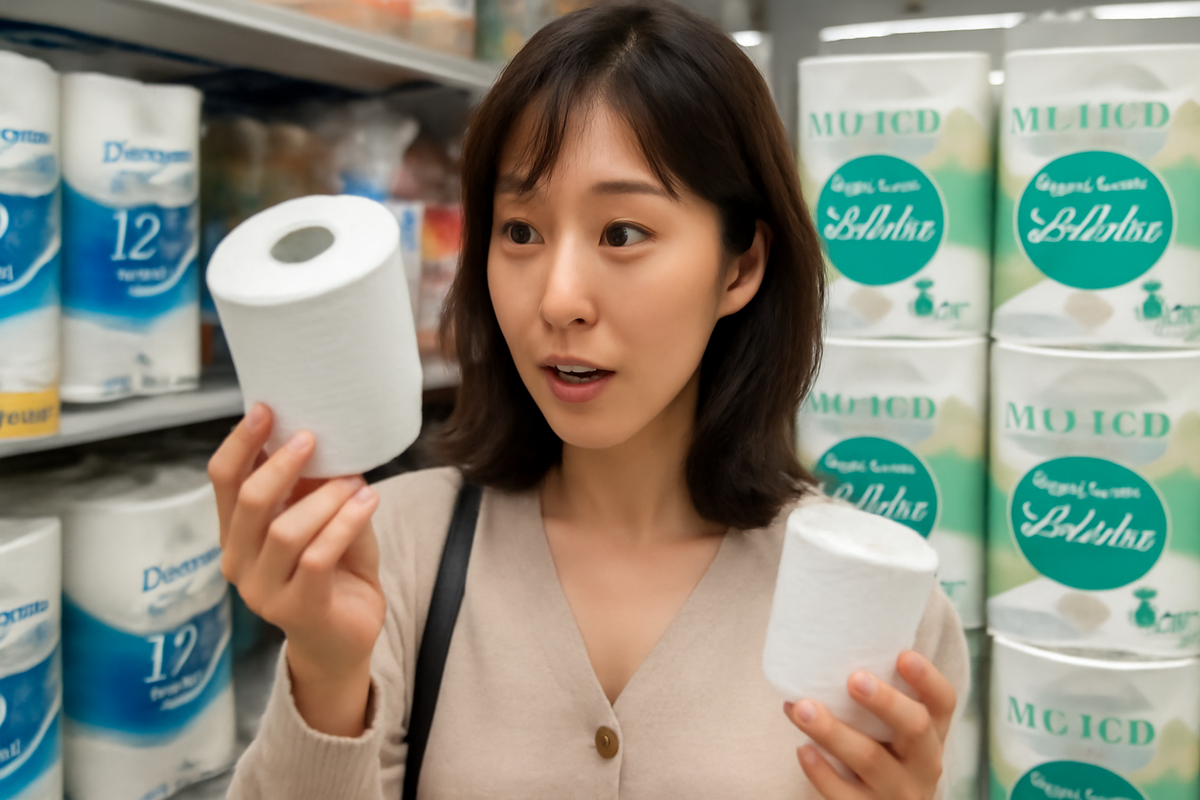
The first sign that something is different is the sound. A faint, papery whisper as the roll turns, softer than you expect, like the turning of a page in a beloved book. You notice the color too—off-white, a shade closer to rice straw than bleach. The packaging is unassuming, printed in muted greens and browns, a tiny illustration of a tree ring where a cute mascot might normally go. At first glance, it doesn’t look like the future. But in supermarkets and drugstores across Japan, shoppers are pausing in the aisle, picking it up, and realizing: this is not the same old toilet paper story. It’s quieter, humbler, and maybe—finally—overdue.
A country famous for toilets, finally rethinking the paper
Japan has spent decades perfecting what happens around the toilet. Heated seats, deodorizing fans, built-in bidets with pressure settings that would impress a precision engineer, even sound-masking features to preserve delicate bathroom privacy. For travelers, it’s a revelation: the toilet becomes a tiny spaceship of comfort.
But for all that tech, one part of the ritual barely changed: the roll hanging at your side. Soft, white, disposable, and—like most of the world’s toilet paper—heavier on the planet than it looks. It’s an odd contradiction in a country that reveres forests, seasons, subtlety, and waste-not philosophy. The bathroom became smart and space age, but the paper remained a relic of a more careless time.
That quiet contradiction is what Japan’s new toilet paper innovation is finally starting to resolve. This isn’t just a change in texture or fragrance. It’s a rethink of material, packaging, and habit—mixed with that distinctly Japanese sense of design that makes even the most ordinary objects feel thoughtful. Shoppers are surprised; environmentalists are relieved; and the rest of us are left wondering why it took this long.
A softer sheet with a rougher truth behind it
Stand in a Tokyo supermarket and watch people discover it. A woman in her thirties presses a roll gently between her fingers. A grandparent tilts their head, reading the small print. A student smells the paper, expecting perfume, and instead finds almost nothing—just the faint scent of fiber, like sun-dried laundry.
The story starts in the forests, but not the ones you might picture. For decades, much of Japan’s toilet paper relied on imported pulp. Trucks, ships, chemical processing, bleaching—softness built on a long, energy-hungry itinerary. At the same time, Japan has overgrown cedar and cypress plantations, aging and underused. In rural towns, foresters watch trees grow taller and denser, shading out wild plants, contributing to pollen problems, and quietly waiting for someone to remember them.
The new-generation rolls reaching store shelves weave those two worlds together. Some brands are blending domestic timber—thinned from those crowded forests—with recycled paper. Others are pushing further, using agricultural byproducts: rice straw that once was burned, bamboo culms that sprout faster than anyone can cut, even pruned branches from orchards. It’s not crude or rough; it’s refined, tested, over-designed in the best way. Still soft, but honest about where it comes from.
The surprise isn’t just that the paper feels good. It’s that it feels good enough to make people pause and think about what “softness” really costs.
Why “overdue” feels like an understatement
In Japan, the bathroom has long been more than a purely functional space. Traditional homes separated the toilet from the bath, physically and spiritually, with bathing seen as cleansing and restorative, and the toilet space as something to be managed with care and ritual. Old wooden farmhouses often placed the toilet near the fields, tied symbolically to fertility and return to the soil.
Fast-forward to the present, and the culture has kept many of those sensibilities, but the materials tell a different story: huge amounts of single-use paper, packaged in layers of glossy plastic, stacked high in convenience stores and urban apartments. If you live in a tiny Tokyo flat, your toilet paper probably travels farther than you do.
So when Japan—a country where the word mottainai carries the weight of “what a waste” and “respect what you have”—starts selling toilet paper that looks less like a bleached cloud and more like a crafted object, it doesn’t just feel new. It feels like a cultural realignment that should have happened years ago.
What’s actually different about the new rolls?
On the surface, toilet paper is deceptively simple: a roll, a sheet, a perforation. But the new Japanese designs are quietly re-engineering everything from material to core. Look closely and the innovations stack up.
| Feature | Traditional Toilet Paper | New Japanese Innovation |
|---|---|---|
| Material Source | Mostly imported virgin wood pulp | Domestic thinned wood, recycled paper, bamboo, agricultural fibers |
| Color & Treatment | Bright white, heavily bleached | Natural off-white or light beige, low-bleach or unbleached |
| Core & Roll Size | Standard core, shorter roll length | Slim or coreless rolls, extra-long sheets to reduce change frequency |
| Packaging | Multi-layer plastic, flashy colors | Reduced plastic, paper wrap, subtle designs, information on sourcing |
| Environmental Focus | Comfort and cost prioritized | Forest management, waste reduction, and lifecycle impact prioritized |
Some supermarkets now stock rolls that look slightly taller and more solid, a kind of “compressed” version. The idea is simple: more paper per roll means fewer cardboard cores, fewer plastic wraps, and fewer transport trips. For apartment dwellers, it also means fewer bulky multi-packs to lug up narrow staircases.
Then there are the coreless rolls: a dense cylinder of paper wound so tightly there’s no hollow center. They fit on existing holders with a small adapter or simply rest on a peg. Less air, more function. It’s the sort of small engineering adjustment Japan excels at—careful, almost invisible, yet quietly transformative.
Even the texture is shifting. Instead of being bleached and scented into anonymity, some of the new rolls retain a faint, natural tone and a grain you can almost see. Not rough, but present. Like the difference between polished stone and plastic.
Listening to the forest in your bathroom
Out in a mountain town in Akita or Gifu, the change feels different than it does in the neon aisles of Tokyo. Under tall stands of cedar, foresters walk between trunks that were once part of huge post-war planting projects. For decades, these plantations were left to grow with minimal thinning; it was too costly, and demand dropped. The result: dense stands that block out light, weaken biodiversity, and contribute to the pollen that fills the air each spring, causing widespread allergies across Japan.
Now, some of that “excess” wood is being redirected. Carefully selected trees are thinned, hauled to small regional mills, and broken down not into beams or planks, but into pulp. This is not the glamorous side of sustainable design, but it’s the connective tissue between land and daily life.
When that fiber becomes part of a toilet roll, the story is almost absurdly humble. You stand in your bathroom, bare feet on tile or wood, and tear off a few sheets without thinking. And yet those few sheets might carry the imprint of hillside snowmelt, of chainsaws and sweat, of a long truck ride, of machines that hummed all night while the town slept. That’s the paradox of modern sustainability work: its success is measured by the things you no longer notice are wrong.
The emotional shift: from shame object to design object
There’s something quietly radical about making toilet paper interesting. It’s the product you stash under the sink or behind a curtain, not the one you brag about. But in some Japanese homes, that’s starting to change. Minimalist bathrooms now feature neatly stacked rolls of natural-colored paper in woven baskets. Small, legible labels explain how they were made. The utility object steps forward, no longer something to hide.
This design shift matters because it humanizes an invisible problem. Environmental impact is often talked about in terms of distant ice sheets or abstract emissions data. A roll of paper, on the other hand, lives in your hands. You see it shrink. You throw away the wrap. You feel its texture every single day.
When those sensations align with a story—this roll came from trees that needed thinning, this packaging breaks down easily, this fibers’ journey is shorter and cleaner—it does something quite powerful. It makes responsibility feel less like a lecture and more like participation. You’re not saving the planet with a shopping choice, but you are, in a small way, choosing a story you can live with.
Overdue, because the bathroom was always part of the ecosystem
For most of history, what happened in the toilet stayed part of a cycle. Human waste returned to fields as fertilizer; water filtered through soil; materials came from nearby. Modern sanitation brought extraordinary advances in hygiene and health—but it also allowed us to exile the bathroom from our mental map of the natural world. Pipes whisk everything away, and we rarely ask where it goes.
Japan’s toilet paper rethink doesn’t solve wastewater issues, but it nudges the bathroom back into the realm of cause and effect. When your paper is tied to local forests, you start thinking about watersheds. When your roll is longer and your packaging lighter, you start noticing how much you used to throw away without thinking.
And once you notice in one corner of your life, it becomes easier to notice in others: the plastic around your vegetables, the fast fashion in your wardrobe, the packaging around your deliveries. A single everyday object, redesigned, becomes a gateway drug to broader awareness.
How shoppers are reacting in the aisle
Ask store staff in suburban Japan and they’ll tell you: people are curious, but cautious. The first question is always about feeling. Is it soft? Will my kids complain? Will my parents notice? The second question is price. Can I afford my principles this month?
Manufacturers know this, and they’ve aimed for a balance. Many of the new lines are priced slightly above standard rolls, but not by a shocking amount. Discount chains are beginning to carry eco-conscious options, not just boutique stores. Campaigns show animated forests, smiling trees, and simple graphics explaining the idea in a glance. It’s not preachy; it’s almost cute.
Some shoppers buy a single pack just to test. They go home, load the roll, and wait for someone in the family to comment. Often, no one does. The biggest compliment in this category is probably silence: it works, it feels fine, life goes on. And then, maybe, the next time they shop, they reach for the same roll again, not out of habit yet, but out of a new, forming preference.
There’s a flicker of pride too. Using Japanese-sourced materials in a daily staple speaks to a national fondness for the local, the seasonal, the homegrown. It fits comfortably alongside rice from a nearby prefecture or miso made with domestic soy. It feels like closing a small loop.
Could this change ripple beyond Japan?
Japan has a way of turning its quiet design experiments into global trends. The modern bidet toilet once seemed like an eccentric domestic quirk; now, high-end bathrooms around the world are installing them. Minimalist Japanese stationery and kitchen tools have influenced international brands. Even the humble convenience store rice ball has inspired copycats abroad.
The new wave of toilet paper might follow a similar path, not because it is flashy, but because it answers a question many countries are asking at once: how do we make the invisible parts of our lives less harmful? If Japan can prove that people will accept, even love, toilet paper that isn’t gleaming white, that lasts longer per roll, that tells a transparent resource story—other markets may start to expect the same from their own brands.
In a world grappling with deforestation, climate change, and waste mountains, the idea that something as unglamorous as tissue paper could be redesigned at scale is strangely comforting. It suggests that no object is too small to reimagine, and no habit is too automatic to be made a little kinder.
From small sheet to larger shift
In the end, the innovation now lining Japanese shelves isn’t a miracle product. It doesn’t erase the environmental cost of manufacturing or transport. It doesn’t solve inequality, or overconsumption, or the millions of tons of waste still produced every day. It is, in the most literal sense, just toilet paper.
But that’s precisely why it matters. The ecological crises we face are built from uncountable small actions, repeated by billions of people. Long flights and massive factories play their part, but so do the daily, unremarked rituals: flicking a switch, tossing a wrapper, pulling a sheet from a roll. Changing the texture of those rituals—slightly, thoughtfully—can rewire how we feel about what we use and what we discard.
Japan’s new toilet paper is surprising shoppers not because it’s spectacular, but because it’s gentle and quietly logical. Natural-toned, thoughtfully sourced, longer-lasting, less flashy. Less about excess, more about enough.
You pull a length from the roll. It feels familiar, but the story behind it is different. Somewhere, a crowded cedar stand is a little more open to sunlight. A mill is running with a slightly cleaner process. A truck is making fewer trips. A plastic wrapper was never made at all.
And in the stillest, most private room of your home, a subtle shift has taken place. The bathroom—long exiled from our picture of the living world—edges back into view. The forest, the factory, the store shelf, your hand: all linked by a small, quiet innovation that took too long to arrive, but finally did.
Frequently Asked Questions
What exactly is new about Japan’s toilet paper innovation?
The innovation isn’t just about softness or scent. It involves new material sourcing (like domestic thinned wood, bamboo, and recycled paper), longer rolls with less packaging, coreless or slim-core designs to cut waste, and reduced bleaching for a more natural look. It’s a systems change rather than a cosmetic tweak.
Is the new toilet paper really better for the environment?
It improves several key areas: shorter supply chains, better use of overgrown forests and agricultural byproducts, less plastic packaging, and more paper per roll. It doesn’t make toilet paper impact-free, but it reduces the overall footprint and ties production more closely to sustainable forest management.
Does the natural, off-white color mean it’s lower quality?
No. The off-white or beige tone usually indicates less aggressive bleaching, not lower quality. Manufacturers still refine and soften the fibers; they simply avoid pushing them to a bright, artificial white. The feel on the skin is designed to be as comfortable as conventional paper.
Will this eco-friendly toilet paper work with Japanese bidet toilets?
Yes. The products are tested to dissolve properly and function with high-tech bidet toilets just like conventional toilet paper. The main changes are in materials, roll design, and packaging—not in how the paper behaves in everyday use.
Could other countries adopt similar toilet paper designs?
They already can. The principles—using local fibers, extending roll length, reducing packaging, and cutting back on bleaching—are transferable to many regions. Japan’s experiment may simply provide a model and social proof that consumers will accept, and even prefer, a more honest and sustainable version of a very ordinary product.

Hello, I’m Mathew, and I write articles about useful Home Tricks: simple solutions, saving time and useful for every day.