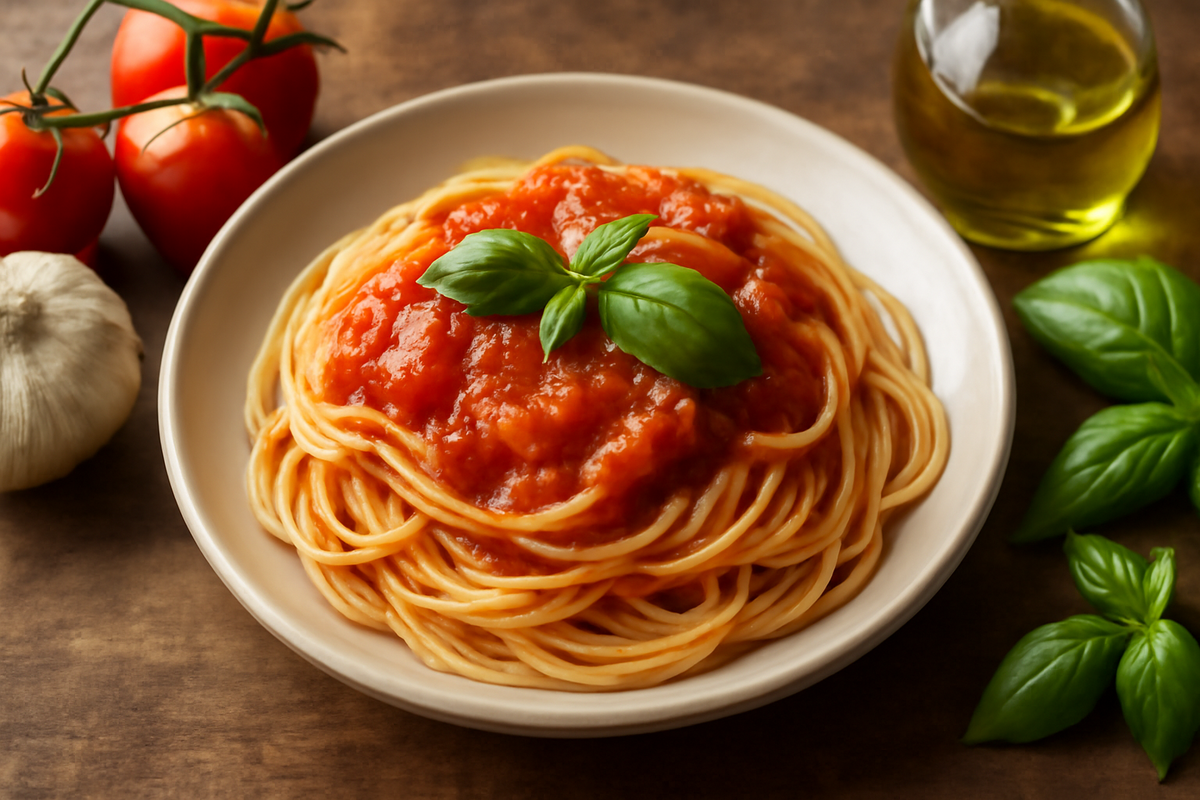
The tomatoes didn’t look like much at first—just a small pile tumbling lazily across the farmer’s stall, still dusted with the faint bloom of the field. One of them wore a sun‑split scar, another sat lopsided and soft at the shoulder. But lean in a little closer, and you’d swear you could hear them humming with late-summer sweetness. The air smelled of warm earth and basil, the kind of scent that makes you stop mid‑stride and imagine dinner. Not the rushed weeknight kind, but the slow, quiet ritual of standing over a saucepan, coaxing out flavor the way one might coax fire from a damp matchstick. Four ingredients, you tell yourself. Just four. Yet somehow, they promise the kind of sauce you’d pay too much for at a restaurant, the kind that arrives at your table in a shallow bowl, gleaming and fragrant, making you momentarily forget everyone else around you.
The Quiet Magic of Less: Why Four Ingredients Are Enough
There’s a certain bravado in a crowded ingredient list: twelve herbs, three cheeses, assorted cured meats, a splash of this, a handful of that. It suggests confidence, maybe even luxury. But in the kitchen, as in the wild, richness often grows from restraint. Think of a bare winter tree against a pale sky, or the way a single birdcall cuts across an empty valley—what’s missing creates space for what’s present to truly be heard.
A four‑ingredient pasta sauce obeys this same quiet logic. Nothing is there to hide behind. Each component must pull its weight, must be as fresh and honest as possible. When you make a sauce from just ripe tomatoes, good olive oil, garlic, and fresh basil, you’re not constructing a complicated symphony. You’re standing in a clearing, listening to four clear voices, each one distinct and necessary. The restaurant quality you’re after doesn’t come from complexity; it comes from attention—attention to heat, to timing, to texture, to the way your kitchen begins to smell like some small trattoria tucked into an alley in a city you love.
This is cooking as conversation, not lecture. The pan hisses a little when the garlic hits the oil, and you adjust the flame. The tomatoes slump and sweeten; you season, then taste, then season again. You don’t need a culinary degree. You just need to be there, fully—nose, eyes, fingertips, and the quiet curiosity that asks, “What happens if I wait just one more minute?”
Meet the Four: Choosing Ingredients Like a Chef
Before any chopping, before the first clatter of a pan, there is the small ritual of choosing. This is where the sauce’s fate is decided, long before the water for the pasta ever thinks about boiling.
1. Tomatoes: The Heartbeat
Imagine you’re holding summer in your palm. A good tomato feels heavy for its size, as if it’s hiding a small reservoir of sunshine under its thin, warm skin. When you press gently near the stem, it yields just enough to suggest ripeness, not so much that it slumps or bruises. It should smell like a memory of August—a little sweet, a little green, deeply alive.
You can make an excellent sauce with different kinds of tomatoes, but the best are ripe, flavorful, and not too watery. Plum or Roma tomatoes are classic: meaty, with fewer seeds and a dense, rich flesh that cooks down beautifully. Heirlooms will give you a more complex, sometimes almost wine‑like flavor, though they may need a bit more simmering to thicken. In winter, when fresh tomatoes taste like regret, high-quality canned whole tomatoes can step in—but let’s stay with fresh for now, because this story is about capturing immediacy, the taste of right now.
2. Olive Oil: The Quiet Luxurious Thread
A good extra‑virgin olive oil smells like crushed grass and fruit and something faintly peppery. It has depth, a gentle richness that coats your tongue, not a flat, oily slickness. When you lift the bottle, you’re not looking for the fanciest label in the store; you’re looking for freshness and flavor. Think of the oil as the thread that stitches everything together. It carries the scent of garlic, softens the acidic edges of the tomatoes, and gives the sauce that restaurant‑style silken feel that clings to each noodle in a quiet embrace.
3. Garlic: The Flame in the Background
Garlic should be firm, tight, and papery, not shriveled or sprouting. When you break a clove from the bulb, it should snap with a little sigh, not crumble. Garlic is the voice that whispers from the background of the sauce, never shouting. Two to four cloves, sliced thin or gently smashed, are enough to fill the oil with a low, humming warmth. Burn it and the entire mood shifts from inviting to bitter. Treat it like you would a match in a dry forest—lovingly, but with attention.
4. Basil: The Green Finish Line
Fresh basil leaves are tender and almost velvety, dark green with no black spots or yellowing edges. When you rub a leaf gently between your fingers, the scent rushes up: peppery, floral, faintly anise‑like. Basil isn’t cooked into the sauce for long; it’s more like the final word in a sentence—the one that lingers in your memory after the conversation has ended. Add it too early and it dulls, turning dark and tired. Add it at the right moment, and it blooms in the heat, filling the kitchen with something that feels both wild and homey.
The Slow Build: From Empty Pan to Glossy, Rich Sauce
The first move is silence. A pan set on the stove, empty as an untouched field at dawn. You drizzle in the olive oil, just enough to coat the bottom in a golden sheen. As the metal gently warms, the oil loosens and moves, turning from thick and still to fluid, almost eager.
Garlic steps in first—not minced to oblivion, but sliced or lightly crushed to release its aromatic spirit without risking a fast burn. When it hits the warm oil, there is a small, hopeful sizzle, like the first whisper of rain. You keep the flame low to medium-low. This part is not a sprint; it’s a slow awakening. The garlic edges turn blonde, then a light, gentle gold. You tilt the pan, watching them slide through the oil like leaves in a shallow stream. If they darken too quickly, you nudge the heat back, patient as someone tending a fragile candle.
Then comes the moment the kitchen changes. Chopped tomatoes tumble into the pan, and the oil hisses in welcome. Some drops spatter, a few bright red seeds escaping like startled birds. You stir, folding the garlic into the fruit, and the mixture looks rough, a bit chaotic—a mess of chunks and juice and skins. It’s not pretty yet. That’s alright. Good things rarely are at the beginning.
Within a few minutes, the tomatoes begin to collapse. Their juices leak out, pooling in glistening puddles. You add a pinch of salt, maybe two, and stir again. Salt doesn’t just season; it draws out liquid, encourages the tomatoes to surrender more of themselves. The sauce simmers, bubbles thick and irregular, like hot springs breaking through stone. You stand nearby with a spoon, not hovering anxiously, but attentive, like a friend keeping someone company through a difficult confession.
As the minutes pass—fifteen, twenty, maybe more if your tomatoes are especially juicy—the sauce thickens. The raw, sharp acidity softens; the bright edges turn round and deep. If you drag your spoon across the bottom of the pan, the sauce briefly parts before slowly closing in behind it. The color deepens to a richer red-orange, a visual hint of its growing intensity. Taste it. It should be sweet, a little tangy, the garlic present but not shouting. If it tastes flat, it may just need a bit more time, or another small pinch of salt. Patience, again, is your finest tool.
Restaurant Texture at Home: The Details Chefs Don’t Skip
In restaurants, what separates “pretty good” from “how is this so good?” is often not a secret ingredient, but a few small decisions repeated every day with near‑ritual care. You can do exactly the same in your kitchen.
Letting the Sauce Marry with the Pasta
One quiet truth: the sauce isn’t finished in the pan. It’s finished on the pasta. When your noodles are just shy of done—still with a firm, honest bite—pull them from the boiling water and drop them directly into the simmering sauce. The first contact is almost ceremonial: hot pasta meeting warm sauce, the steam rising like a brief offering.
Add a splash of the starchy pasta water—just a spoonful or two. It looks like nothing, a cloudy trickle, but it’s a tiny miracle worker. The starch helps the sauce cling, turning from something that sits on the pasta into something that wraps around it. You toss everything together over gentle heat, watching the sauce tighten and gloss, each strand or shape of pasta now fully dressed, not merely garnished.
The Final Olive Oil and Basil Moment
Right at the end, with the heat turned low or even off, you finish the dish in a way that restaurants rely on constantly: a final drizzle of fresh extra‑virgin olive oil. This isn’t the cooking oil from earlier; this is the perfume, the top note. It adds shine and a fresh, grassy aroma that floats above the deeper cooked tomato flavors.
Then, and only then, you tear the basil leaves with your hands—never metal knives if you can help it, which can bruise and blacken them more quickly—and scatter them into the pan. The leaves wilt just slightly in the residual warmth, releasing their scent in a wave that rolls across the kitchen. Stir gently. Taste once more. Adjust salt if needed. At this point, you’re not just cooking; you’re tuning.
| Element | What to Notice | Why It Matters |
|---|---|---|
| Tomatoes | Heavy, fragrant, deeply colored, just‑ripe | Gives natural sweetness and depth without sugar |
| Olive Oil | Fresh, fruity, peppery extra‑virgin | Creates luxurious mouthfeel and carries flavor |
| Garlic | Slowly cooked to pale gold, never brown | Builds complexity without bitterness |
| Basil | Added at the end, torn by hand | Keeps flavor bright, herbal, and fresh |
| Pasta Water | A ladle of starchy cooking water | Helps sauce cling and become silky |
A Simple Ritual, Night After Night
Once you’ve done this a few times, the process becomes less like following a recipe and more like settling into a familiar evening walk. The steps are the same, but the details change: the tomatoes a little sweeter this week, the basil a touch more peppery, the garlic bulbs smaller or sharper. You start learning to cook not from strict instructions, but from the language of smell and sight and sound.
On a chilly weeknight, you might come home tired, drop your keys in a small clatter on the counter, and think you have nothing in the house. But then you remember the bag of tomatoes softening slightly on the windowsill, the half‑bulb of garlic, the stubborn basil plant still clinging to life in a pot by the sink, and that faithful bottle of olive oil. You fill a pot with water, set it to boil, and the evening begins to feel less like something to survive and more like something to inhabit.
You stand at the stove, stirring the sauce as it thickens, tasting the way a musician might tune an instrument before a small performance. The room fills with the smell of garlic and tomato, and suddenly the day’s small frustrations seem to melt as easily as the tomatoes in the pan. You toss in the pasta, add the starchy water, finish with the basil and oil, and carry the pan to the table. There is nothing elaborate here, no twelve‑step plating, no sculpted foam or fragile garnish. Just a bowl, hot and honest, red and fragrant, and the soft sound of a fork scraping against ceramic.
This four‑ingredient sauce isn’t impressive because it’s flashy. It’s impressive because it feels like something you can come back to, over and over, the way you return to a favorite trail or a beloved paragraph in a book. It’s a reminder that richness in food, as in life, doesn’t require excess. It requires presence.
Making It Your Own Without Losing the Heart of It
Sooner or later, you’ll be tempted to improvise. That’s part of the pleasure. Maybe you toss in a pinch of chili flakes with the garlic, a quiet heat that creeps in at the back of each bite. Maybe you finish with a grating of hard cheese, letting it melt just slightly into silky strands. Perhaps you experiment with different tomato varieties, chasing the one that tastes most like the memory you’re trying to recreate.
The key is to remember the soul of this sauce: four fresh pillars—tomato, olive oil, garlic, basil—doing most of the work. You can adorn them, but you don’t need to bury them. Let the tomatoes stay the star, the basil the bright echo, the garlic the subtle engine under the hood, the olive oil the quiet luxury tying it all together. From there, every plate of pasta you serve can feel a little like a restaurant moment slipped into your everyday life: not fussy, not distant, but deeply, satisfyingly close.
FAQ: Four‑Ingredient Restaurant‑Style Pasta Sauce
Can I use canned tomatoes instead of fresh?
Yes. When good fresh tomatoes aren’t available, choose whole peeled canned tomatoes with no added sugar or excessive seasoning. Drain a bit of the liquid if they’re very watery, then crush them with your hands before adding to the pan. Simmer until thick and sweet.
How long should I cook the sauce?
Usually 20–30 minutes for fresh tomatoes. You’re watching for the sauce to thicken, lose its raw acidity, and develop a softer, sweeter flavor. If it still tastes sharp or watery, give it more time over a gentle simmer.
Do I need to peel or deseed the tomatoes?
No, not necessarily. For a more rustic, homey sauce, you can leave skins and seeds in. For a smoother, more “restaurant‑style” texture, you can score, briefly blanch, and peel the tomatoes before chopping, or pass the finished sauce through a food mill.
What kind of pasta works best with this sauce?
Almost any shape works, but simple, classic shapes like spaghetti, linguine, bucatini, penne, or rigatoni are excellent. Long shapes feel elegant; short, ridged shapes catch more sauce in their grooves.
Why is my sauce too acidic?
It may need more time to cook, a tiny bit more salt, or simply better tomatoes. Extended simmering often mellows acidity. If it’s still very sharp at the end, a small splash of pasta water and a little extra olive oil can help round out the flavor.
When should I add basil?
Right at the end of cooking, after you turn down or turn off the heat. Add torn basil leaves and stir gently so they wilt in the residual warmth without turning dark or losing their bright aroma.
Can I make the sauce ahead of time?
Yes. The sauce keeps well in the fridge for 3–4 days. Reheat gently and freshen it up with a drizzle of olive oil and a handful of newly torn basil when serving. Toss with freshly cooked pasta and a bit of pasta water to restore that silky restaurant texture.

Hello, I’m Mathew, and I write articles about useful Home Tricks: simple solutions, saving time and useful for every day.