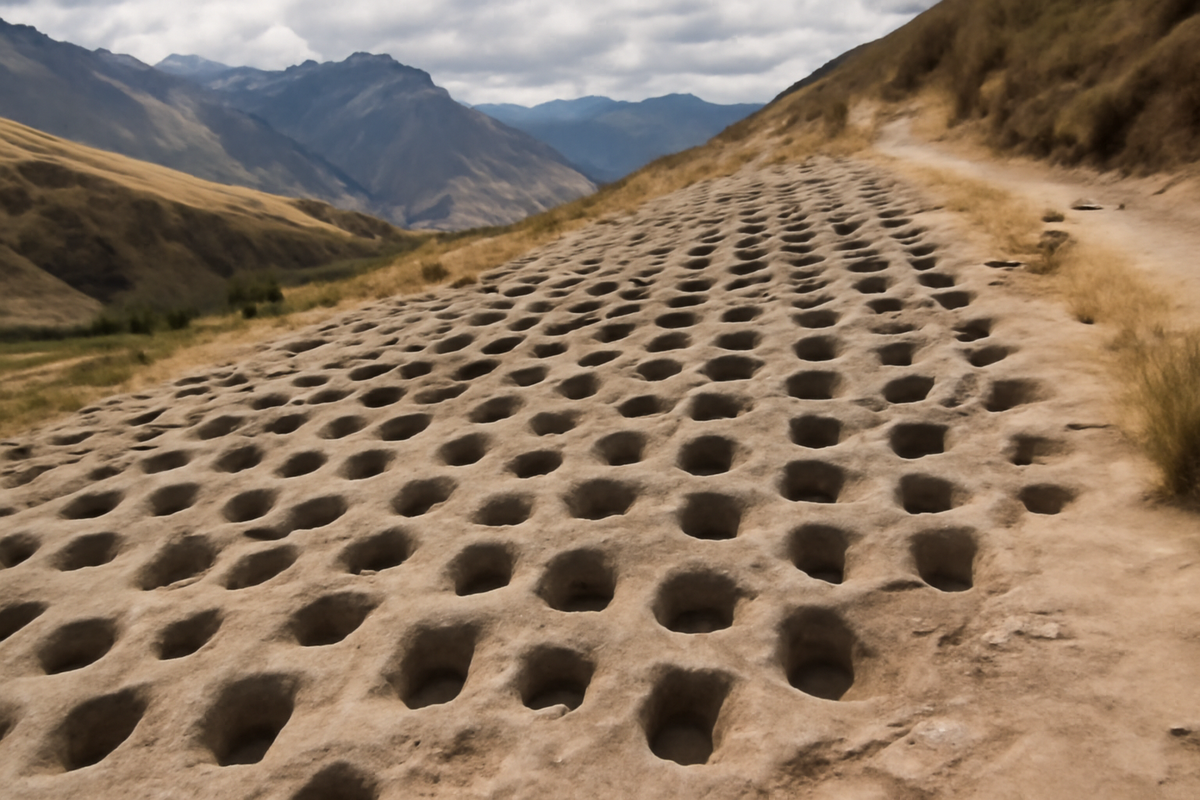
The wind comes first. It snakes through the narrow valley near the town of Nazca, lifting dust and the faint scent of dry earth. You stand on a rocky slope, squinting against the sun, and there it is: a vast honeycomb of shallow pits gouged into the bluff, marching in wavering lines along the hillside. Five thousand two hundred rock holes, each only a few steps apart, each looking stubbornly alike. From above, they ripple across the land like the skin of some ancient stone creature. For centuries, these pits—called the Band of Holes or Paredones de Cantalloc—have confused everyone who’s laid eyes on them. A forgotten fortress? A burial field? A celestial calendar? Now, a new idea is taking shape in Peru, and it is at once more ordinary and more astonishing: this might have been a giant open-air ledger, a pre-Inca accounting system chiseled straight into the earth.
The first time someone tried to count the uncountable
The first written descriptions of these holes came from Spanish chroniclers who stumbled onto them in the sixteenth century. They listed the strangest things they found in this fierce, dry country—mummies, geoglyphs, terraced hills—and tucked among them a passing reference to “rows of pits cut in stone.” No one seemed to know what they were. Over the centuries, travelers and explorers visited, measured, speculated, and left with more questions than answers.
Up close, each hole is big enough to crouch in—roughly a meter across and about as deep. They’re carved into a sloping terrace, in uneven but clearly intentional rows, falling away down the hillside like dominoes. When the light is low, the shadows sharpen, and each pit becomes a dark punctuation mark on the skin of the hill. Count a row and you lose your place. Try to grasp the pattern and it dissolves in the shifting stones and uneven ground.
Early researchers labeled them everything they could think of: grain silos, burial niches, defensive fortifications. Some locals whispered about treasure caches. Others said they were simply ancient quarries, scars left behind from stone extraction. The problem was always the same—the holes were too numerous, too shallow for serious storage, and too uniform for burials. They held almost nothing, not even the everyday debris that usually clings to archaeological sites: broken pottery, bones, ash.
Still, they refused to be ignored. Every few decades, a new attempt at explanation surfaced, followed by another shrug. The Band of Holes slipped quietly into the category of “unsolved ancient mysteries”: great for postcards and documentaries, unsatisfying for archaeologists who prefer evidence to wonder.
A pattern hiding in plain sight
Then technology caught up with curiosity. In the early twenty-first century, high-resolution satellite imagery and drone photography began to reveal something the human eye struggled to see from ground level: the holes were not random at all. They were grouped in irregular, interrupted lines, some marching straight, others bending like question marks. The overall layout, when seen from above, suggested not defense or burial, but something more like…notation.
Peruvian researchers started looking at the Band of Holes the way you might look at a page of handwritten numbers whose language you don’t yet understand. They measured hole clusters, tracked where patterns repeated, and noted that the rows seemed to form distinct segments. Some sequences were tightly packed; others were spaced apart in odd gaps, like commas between numbers. This wasn’t neat, modern order, but it had its own internal logic.
What if, they asked, this entire hillside was never meant to hold objects, but information?
The question landed in a country already famous for another enigmatic information system: the quipu, the knotted-string records used by the Inca. Quipus could store complex numerical data for censuses, taxes, crop yields, and more. They were, in a sense, portable spreadsheets carried on a messenger’s back. But the Band of Holes predates the Inca. It belonged to people who had no known writing system and left no surviving codices. To imagine that they might have carved their bookkeeping directly into stone was both bold and oddly plausible.
The pre-Inca ledger on the hillside
The new hypothesis grew slowly, fed by comparison and fieldwork rather than spectacle. Researchers considered what kind of society would need a ledger at this scale. This region, at the edge of the Nazca valley, sat on an ancient network of trade routes that once stitched the Andes, deserts, and coast together. Long before the Inca, camelid caravans carried dried fish inland and highland potatoes downward, passing through valleys like this one. Goods had to be counted. Tribute had to be tallied. Labor had to be recorded.
Imagine it not as a mystery site, but as an accounting office without walls. Each shallow pit could represent a unit: a load of maize, a portion of cloth, a group of laborers. Lines of holes might be columns of categories. Segmented rows could mark different communities or seasons. A leader or official—using a wooden staff, pebbles, or simply memory—could read the hillside the way an accountant reads a ledger sheet.
Slowly, the pieces began to fit. The sheer number of holes—about 5,200—makes sense if you’re tracking large volumes or long spans of time. The lack of artifacts starts to look less like absence and more like design; you wouldn’t leave valuables in a public tally board. The uneven patterns, instead of discrediting the idea of order, suggest a flexible coding system: some stretches heavily “used,” others left intentionally blank for future entries.
The more the team thought like scribes instead of soldiers or priests, the less the Band of Holes looked like a fortress or cemetery, and the more it resembled a permanent, enduring memory device.
The texture of stone memory
There is something viscerally moving about the thought that accounting—a practice so often dismissed as dry, bureaucratic—could carve such beauty and mystery into a landscape. Walk along the Band today and your boots crunch on loose gravel. The sun presses hard on your shoulders; the rock radiates heat into your hands as you steady yourself on the slope. Each hole traps its own pocket of cooler air, a tiny shade where a lizard might rest. If you step inside one, you feel briefly cradled, held in the shallow palm of the hill.
It is not difficult to imagine a procession of people here, long ago: traders arriving from the highlands, dust on their sandals, llamas shifting and snorting as bales of goods are unloaded. A local official points with a staff toward certain clusters of holes, conferring with another keeper of numbers. They talk in low, practical voices as they “move” tallies—not with ink, but by assigning meaning to sequences of shallow cups chiselled in stone. Somewhere, a child perches on a rock, watching the strange, silent counting unfold.
If this was indeed a ledger, it turns the hillside into a book written in relief. The language is lost. The grammar of pits and patterns is broken. But the scale of it—its sweeping, deliberate reach across the slope—argues for a society that took memory seriously, that understood that numbers themselves are a form of power.
From mystery to model: a new way to see the site
To move from poetic imagining to credible theory, archaeologists needed more than inspiration. They began charting the Band of Holes with the same precision used to document monumental architecture. Every cavity’s position, depth, and diameter went into digital models. They compared segments of the hillside as if comparing pages of a ledger: where do the “entries” cluster? Where do patterns repeat or break?
One of the most intriguing findings was the variation in grouping. In some areas, holes are arranged in near-rectangular blocks, almost like rows and columns of a table. In others, they twist into gentle arcs or split into parallel tracks. Rather than chaos, this suggests different categories or phases of use. Not all information is recorded the same way; think of how modern spreadsheets mix numbers, labels, and notes.
To visualize this, you might imagine a simplified “snapshot” of what such a stone ledger could conceptually represent:
| Segment (Hypothetical) | Possible Meaning | Type of Data |
|---|---|---|
| Upper rows | Tribute from highland communities | Quantities of potatoes, wool |
| Central dense clusters | Seasonal production record | Harvest totals, labor days |
| Lower curved sections | Trade route tallies | Caravan loads, visiting groups |
| Gapped intervals | Reserved or reset markers | New cycles, administrative changes |
None of this is confirmed as literal truth; it’s a working model, a way of testing whether the “ledger” lens fits better than other interpretations. But when archaeologists compare this landscape of pits to known economic systems in the Andes and to the later Inca quipus, the fit grows tighter.
Echoes of the quipu, without the strings
The Inca knotted cords to record numbers in a base-10 system: the placement and type of knots indicated tens, hundreds, thousands. Color and arrangement signaled categories like corn, labor, or textiles. Quipus were portable and could be updated, untied, or expanded as needed. The Band of Holes, by contrast, is immovable. You can’t take it on the road. But both systems share an underlying idea: that space and repetition can encode meaning without alphabetic writing.
Some researchers now see the Band of Holes as a conceptual ancestor to the quipu—a kind of monumental, communal “training ground” or early experiment in layout and aggregation. The pits themselves, once numbered and modeled, show clusters that behave like tallied amounts. The hillside becomes a fixed “board,” and human bodies moving through it enact the updates.
It’s tempting to think of this as a pre-digital spreadsheet: rows and “cells” of capacity, each waiting to be assigned value. If the Inca quipu is akin to a pocket calculator, the Band of Holes is closer to a chalkboard permanently etched in stone, where the marks have long since been erased but the grid remains.
The land that remembers, even when people forget
Stand at the upper edge of the Band of Holes and look out. Below you, the valley opens like a shallow bowl, its floor striped with modern fields and roads. Cars flash on asphalt where caravans once trod slowly. The Nazca lines—those vast, enigmatic geoglyphs of animals and shapes—lie not terribly far away, carved into the desert plain. This is a landscape obsessed with mark-making, where ancient hands drew, cut, stacked, and rearranged the earth to make meaning visible from the ground and the sky.
In that context, the idea of a stone ledger feels less bizarre. Why wouldn’t a culture that traced lines across whole valleys also carve tallies into hills? Why wouldn’t they extend their memory beyond the fragile human body into the enduring skin of rock?
We know that Andean societies relied on complex systems of reciprocal labor and redistribution. Farmers worked on state and community projects in exchange for security in lean years. Grain and textiles flowed into central storehouses and then out again in carefully measured quantities. These systems demand meticulous record-keeping. Without columns of ink on paper, people turned to knots, to architecture, to alignments—and perhaps, in this case, to a hillside full of pits.
In our world of glowing screens and cloud backups, it’s easy to think of data as ephemeral, weightless. But here, in the Nazca valley, information may once have been measured in the ache of shoulders hauling stone and the time it took to carve yet another hole into the slope. Knowledge had mass. Accounting left blisters.
A slow, careful solution—not a headline miracle
It’s important to be honest: archaeology rarely offers movie-style resolutions. No crumbling tablet has surfaced with an inscription reading, “Here lies the Great Ledger of Our People.” The interpretation of the Band of Holes as a pre-Inca economic recording system is not a sudden revelation, but a careful accumulation of clues—context, pattern, comparison, and plausibility.
What is changing now in Peru is not just a single explanation, but a mindset. Instead of treating the Band of Holes as an isolated oddity, researchers are folding it into a larger story of Andean information systems. They’re asking: how did people here think with stone? How did they model obligation, debt, and abundance in a world before paper?
This perspective allows for nuance. The site might have changed functions over time. Perhaps it began as a ritual counting place, later adapted for more strictly economic purposes. Maybe different authorities reshaped its “code” as political power shifted. The beauty of the ledger theory is that it can accommodate such complexity, just as a modern account book can track taxes, gifts, wages, and offerings all at once.
Why this matters beyond one Peruvian hillside
It’s easy to see ancient puzzles as entertainment, something to spice up a travel documentary or a sensational headline. But the meaning we assign to sites like the Band of Holes spills into deeper questions: who do we think ancient people were? How sophisticated were their minds? What do we assume about “civilization” and what it requires?
If the Band of Holes was a ledger, then people here were not merely artists making giant geoglyphs or farmers coaxing maize from stingy soil. They were also administrators, economists, logisticians. They grappled with the same abstract problems we do: how to track obligation, how to plan for scarcity, how to measure trust. Their solution just happened to involve carving numbers into the bones of a hill.
This reframing chips away at the old hierarchy that puts writing at the pinnacle of cognitive achievement. The absence of alphabetic texts in pre-Inca Peru once made some outsiders assume a lack of sophistication. But when you step back and see quipus, storage complexes, astronomical alignments, and now perhaps a stone ledger spread across the ground, you begin to ask: what if we’ve just been looking for intelligence in the wrong format?
The Band of Holes may never quite surrender all its secrets. Yet even in partial understanding, it invites us to widen our definition of record-keeping, to recognize that data can live in knots, shadows, terraces, and pits. It suggests that the human urge to account—to mark “this many, from these people, at this time”—is ancient and deeply rooted, as fundamental as art or story.
And so you stand once more at the edge of those 5,200 cavities, the wind threading through them like breath through a flute. The hillside looks different now. Not a riddle begging for a single clever answer, but a vast, silent page where a society once wrote its obligations and its abundance into stone. The ledgers are empty. The numbers are gone. But the grid remains, waiting for us to read, to guess, and to remember that long before we built servers and satellites, we tried to make memory permanent with the simplest tools of all: stone, repetition, and time.
Frequently Asked Questions
Where are the 5,200 rock holes located?
The Band of Holes is located near Nazca in southern Peru, along a rocky hillside above a valley that has served as a trade and travel corridor for centuries. The site stretches for hundreds of meters across the slope.
Who created the Band of Holes?
The pits are generally considered pre-Inca, likely made by a regional culture that inhabited the area before the rise of the Inca Empire. The exact group is still debated, but the work predates Spanish arrival by many centuries.
How do we know the holes were used as an economic ledger?
We don’t have absolute proof, but multiple lines of evidence point in that direction: the large number of holes, their patterned arrangement, the absence of burial or storage remains, and parallels with known Andean accounting systems like quipus and state storehouses. Together, these clues make the ledger interpretation one of the most convincing current explanations.
Could the holes have had a religious or ceremonial purpose instead?
It’s possible they had overlapping roles. In Andean societies, economic, political, and ritual activities often intertwined. A place where tribute and labor were counted could also hold ceremonial significance. The ledger hypothesis doesn’t rule out ritual use; it simply emphasizes the practical, information-keeping function.
Are the Band of Holes related to the Nazca lines?
The two are geographically close and belong to a broader tradition of monumental landscape modification, but they likely served different purposes. Nazca lines appear primarily symbolic and ceremonial, while the Band of Holes may have been administrative and economic in nature. Both, however, show how ancient Andean cultures used the land itself as a canvas for meaning.
Can visitors see the Band of Holes today?
Yes, but access can be limited and usually requires going with local guides or tours that understand the terrain and regulations. The site is fragile, so visitors are encouraged to observe respectfully and avoid damaging the rock surface.
What does this discovery change about our view of pre-Inca societies?
Seeing the Band of Holes as a ledger emphasizes the administrative and intellectual complexity of pre-Inca cultures. It reinforces the idea that sophisticated information systems existed in the Andes without alphabetic writing, expanding our understanding of how humans can store and manage knowledge through landscape, architecture, and non-written codes.

Hello, I’m Mathew, and I write articles about useful Home Tricks: simple solutions, saving time and useful for every day.