The egg hits the pan with a soft hiss, and for a split second everything is still. No sputtering oil. No angry pops of butter. Just the faint aroma of warm egg and metal. Then, with a small flick of the wrist, the egg glides across the surface as if the pan were made of glass. No sticking, no tearing, no crust welded to the bottom in defeat. It simply…slides. If you cook eggs often, it’s the sort of moment that makes you forget to breathe.
The Morning That Changed My Eggs
I was in a small Tokyo apartment kitchen the first time I saw it happen. The chef—who insisted I call him Sato, not “Chef”—moved like someone who had made peace with mornings long ago. Tiny kettle humming. Rice cooker ticking. A modest black pan warming on a single gas burner. No bottle of oil on the counter. No butter dish in sight.
“You like tamago?” he asked, already knowing the answer. In Japan, tamago—egg—can mean anything from the delicate, layered omelet of tamagoyaki to the soft, molten yolk tucked inside a bowl of ramen. I nodded, still busy pretending I wasn’t analyzing every move he made.
Sato cracked two eggs with a single-handed rhythm that made it sound like percussion. The pan had been heating quietly on low, no visible smoke, no shimmering fat. When he poured the beaten eggs in, they flowed out like sun-yellow silk.
Then he did something that upended everything I thought I knew about eggs.
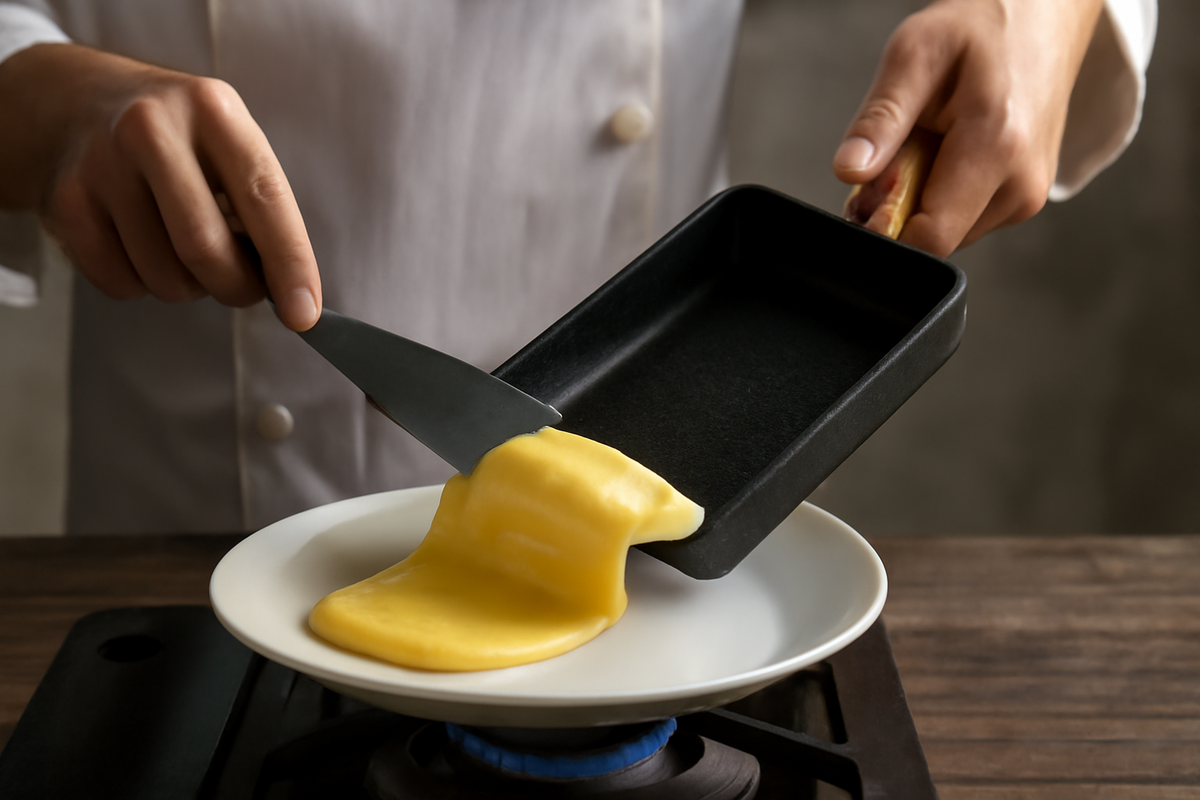
He lifted the pan by the handle and gave it the smallest, gentlest shake. The eggs, instead of gripping or bunching or instantly forming those dry, rubbery curds that haunt bad hotel buffets, seemed to float. As they set, they detached from the surface naturally—no scraping, no forcing. With one deliberate tilt, the entire sheet of egg slid effortlessly, gathering itself into a soft roll as he nudged it with a set of chopsticks.
“No oil?” I finally blurted out.
He laughed—softly, kindly, the way people do when they remember their own first surprise. “You don’t need much,” he said. “Sometimes, you need none at all. You just need to prepare the pan, not the egg.”
The Japanese Chef’s Quiet Trick
What Sato was doing wasn’t magic, though it felt that way. It was a quiet trick born from repetition, attention, and a slightly different way of thinking about the relationship between egg and pan.
In Western home kitchens, we tend to solve most sticking problems by adding more oil, more butter, more spray. The pan is an afterthought, a mere stage for the performance. But in many Japanese kitchens, the pan itself is an instrument you learn to tune, season, coax, and respect.
“The pan remembers,” Sato said that morning, placing the empty skillet back over the soft flame. “If you rush it, it punishes you. If you treat it well, it will help you.”
He wiped the pan gently with a folded paper towel, almost like he was polishing a lens. I watched him in silence, hearing only the low whisper of the gas flame and the city beginning to stir outside the window—bike bells, distant trains, crows gossiping from the rooftops.
Then he explained the core of his trick, in a way that felt less like a recipe and more like an understanding:
- The pan must be evenly heated before the egg ever touches it.
- You use the smallest possible amount of fat—or sometimes none at all—but you spread it with intention.
- The egg goes in only when the pan is ready, not when you’re impatient.
- And once the egg is in, you move the pan, not the egg.
That last part stuck with me: the pan is the dancer; the egg just follows.
The Heat Test You Can Feel, Not Just See
To show me, he cleaned the pan completely, as if resetting a stage. This was a carbon steel pan, shiny from years of use but darkened from heat and seasoning. It was not nonstick in the modern, coated sense, but it behaved like one in his hands.
He set it on the burner over medium-low heat and walked away. Not far, just enough to show that patience was part of the ritual. No oil in the pan, no egg yet. Just metal and flame getting acquainted.
After about a minute, he flicked a few drops of water from his fingers into the center. Instead of sizzling out immediately, the droplets gathered into little silver beads that skated across the surface like mercury.
“Listen,” he said. The droplets made a faint whispering sound as they moved, like rain on a hot sidewalk. “Now it is ready to talk to the egg.”
Then he wiped the water out with a cloth, added the tiniest smear of oil—truly, almost ceremonial—and used folded paper to spread it until the pan looked basically dry. “Too much oil makes you think you don’t need skill,” he said. “Too little makes you angry. This,” he lifted the pan and tilted it, “is enough to teach you.”
When the next egg went in, it behaved like it had been waiting for this moment all its life. The edges set, then gently lifted. A careful shake, barely visible from where I stood, made the whole round of egg slide as one piece. He didn’t chase it with a spatula. He guided it with gravity.
Learning to Let the Egg Slide
Back home, I ruined a lot of eggs before I understood what he meant. My first attempts were either underheated or overheated. I was either impatient, or distracted, or simply trying to rush the part you’re not supposed to rush: the warming of the pan.
Maybe you know this cycle: spray the pan, crack the egg, watch it weld itself to the bottom, curse gently, scrape angrily, resign yourself to a scrambled mess. It feels like a daily fight between you and breakfast.
The Japanese chef’s trick doesn’t remove all risk. It just changes the terms of the relationship. Instead of relying on a shield of oil, it makes you pay attention—to heat, to timing, to texture.
Over weeks of trying, I started to recognize signs I’d never noticed before:
- The way a properly heated pan radiates a steady, gentle warmth when you hover your hand above it—not searing, just firm.
- The soft whisper of beaten eggs pouring into a ready pan, versus the aggressive hiss of a pan that’s too hot.
- The moment when the edges of the egg set cleanly and begin to release, like a tiny curtain pulling away from the stage.
It felt less like memorizing instructions and more like learning to listen to something that had been trying to talk to me for years.
A Simple Ritual You Can Steal
Here’s what the ritual became in my own kitchen, adapted from Sato’s method and tempered by many imperfect breakfasts:
- Place a clean, dry pan on medium-low heat. Walk away for a minute. Don’t rush.
- Test the heat with a few drops of water. If they skate and bead, the pan is ready. If they explode violently, it’s too hot—let it cool slightly.
- Wipe out any water. Add the smallest dab of oil or butter you can bring yourself to use—truly, just a touch—and spread it evenly until the surface looks almost dry.
- Pour in your beaten egg or crack in your whole egg gently.
- Let it sit for a moment, then gently nudge the pan’s handle. If you’ve honored the heat and the preparation, the egg will begin to loosen and slide on its own.
Some days it feels perfect—effortless, elegant, worthy of a quiet bow. Other days, the egg rebelliously clings to the surface just to remind you that cooking is a living negotiation, not a fixed contract. But even then, the eggs stick less and slide more. The oil bottle stays mostly untouched.
Goodbye Excess Frying Oils, Hello Gentle Control
There’s something strangely liberating about not reaching automatically for a pool of oil every time you cook an egg. It’s not just about health, though that’s part of the story. It’s about trust: trusting your pan, your patience, your ability to notice small changes.
In many Japanese kitchens, oil is treated almost like a seasoning rather than a crutch—used sparingly, thoughtfully, only as much as the food truly needs. When you learn to rely less on oil and more on technique, the egg’s own character comes forward: its sweetness, its softness, the way the texture can be tender instead of greasy.
You start to notice how the kitchen smells different, too. Instead of the heavy perfume of hot oil, you get the mild scent of warm egg and metal and whatever gentle ingredients you decide to add—chopped scallions, a hint of dashi, a whiff of soy sauce or a sprinkle of sea salt.
Over time, I realized this “goodbye frying oils” moment was less about rejecting oil and more about reclaiming intention. I still use butter in an omelet when I want that deep, rich, almost nutty flavor. I still drizzle olive oil into a pan of vegetables without apology. But I don’t use fat to hide my fear of sticking anymore.
A Tiny Breakfast Revolution on Your Stove
There’s a quiet thrill the first time your egg slides across a nearly dry pan as if it’s on ice. It doesn’t announce itself with fanfare; it just happens. You tilt the pan, gently, curiously, and the egg moves. Not reluctantly. Not tearing. Just gliding.
It changes how you think about breakfast. Suddenly, your pan is not a battlefield; it’s more like a stage polished by habit and care. Your movements become smaller, calmer. There’s less scraping, less banging, fewer muttered negotiations over stubborn stuck bits.
And if you’re someone who’s been wanting to cut back on oils—not out of guilt, but out of curiosity about what food tastes like without them—this small shift feels like an invitation. Eggs become lighter, cleaner-tasting. You might find you need less salt, less cheese, fewer extras to compensate. The egg itself is finally allowed to be the main character.
Choosing the Right Pan: The Unsung Partner
When I asked Sato what mattered most besides heat control, he tapped the pan with his chopsticks. “This,” he said. “Your partner.”
Not all pans behave the same way. Some are forgiving; others are fussy. But almost any pan can be coaxed into better behavior if you understand what it needs.
| Pan Type | How It Behaves with Eggs | Best Use for the Sliding Trick |
|---|---|---|
| Carbon Steel | Seasons over time, becomes naturally slick, responds quickly to heat. | Excellent, especially when well-seasoned. |
| Cast Iron | Holds heat well, can be very nonstick when seasoned, heavier to maneuver. | Very good, though heavier for delicate flips. |
| Nonstick (Modern Coating) | Slides easily with minimal fat, sensitive to high heat and scratches. | Good for beginners; use gentle heat. |
| Stainless Steel | Can stick if overheated or underheated, rewards precise control. | Possible, but demands more practice and patience. |
Sato’s pan was carbon steel, a common choice in Japanese home kitchens and restaurants. Light, responsive, and slowly transformed into a natural nonstick surface by layers of microscopic oil baked into the metal over time.
But the sliding trick—the true heart of it—is not locked to one material. Whatever pan you have, you can start with two commitments: never rush the preheating, and learn the water droplet test like a conversation starter.
Seasoning: The Memory of Meals Past
“The pan remembers,” he said, and I only truly understood months later, when my own carbon steel pan began to change. It darkened from silver to a soft, cloudy gray, then to a deeper, almost blue-black. With each meal, the surface grew more relaxed, less anxious to cling, more willing to let food go.
Seasoning isn’t just a technical layer; it’s almost like a history. Every lightly oiled stir-fry, every careful wipe, every gently cooked egg adds to an invisible archive that makes tomorrow’s eggs friendlier.
If you treat the pan roughly—scouring it aggressively with harsh detergents, overheating it until it smokes, neglecting to dry it properly—it forgets. It reverts. If you treat it kindly, it remembers, and that memory shows itself when the egg slides instead of sticks.
From Technique to Quiet Daily Joy
The Japanese chef’s trick isn’t about performing a stunt to impress guests. It’s about transforming a tiny, everyday task into something quietly satisfying. The kind of moment you look forward to, not because it’s dramatic, but because it’s steady and kind.
Maybe your morning looks like this: half-awake, kettle whistling, phone buzzing with notifications you’re not ready to face. The pan sits on the stove like an invitation. You warm it gently. You listen to the faint tick of metal expanding. A few droplets of water dance across the surface, and for a handful of seconds, you’re not thinking about anything except heat, sound, and the feel of the handle in your hand.
You swipe the thinnest glaze of oil or butter across the surface, more out of respect than fear. The egg pours in with a soft, contented sigh. You wait. You breathe. You nudge the pan, curious. The egg slides.
For a moment, there is no struggle—no scraping, no frustration, no apology to the sink as you soak a pan in defeat. Just you, the pan, and an egg that finally knows how to leave gracefully.
That’s the real gift of Sato’s little trick. Yes, it lets you say goodbye to heavy frying oils if you want to. Yes, it makes your breakfasts lighter and your pans cleaner. But more than that, it teaches you to approach a simple act—cooking an egg—with the same calm, attentive respect usually reserved for bigger things.
In a world that begs us to hurry, an egg that slides from the pan without resistance feels like a small, hard-won miracle. One you can practice every single morning.
FAQ
Do I really need zero oil to make eggs slide?
Not always. Many Japanese chefs use a tiny amount of oil or butter—just enough to lightly coat the pan, not enough to pool. The key is minimizing oil and maximizing technique. With a well-seasoned carbon steel or cast iron pan, you can sometimes skip oil entirely, but using a trace amount makes the process more forgiving.
Can I do this with a regular stainless steel pan?
Yes, but it takes more precision. Preheat the pan thoroughly on medium-low, use the water droplet test, and spread a very thin layer of oil. If the egg still sticks, your pan may be a bit too hot or too cool. Stainless steel isn’t as naturally slick as seasoned steel or nonstick, so expect more practice and patience.
What if my eggs keep sticking no matter what?
Check three things: heat, cleanliness, and fat distribution. If the pan is too hot, the egg seizes and bonds. Too cool, and it seeps into imperfections and sticks. Any residue from previous cooking can cause gripping, so start with a truly clean surface. Finally, even a tiny amount of poorly spread oil can leave dry spots where eggs latch on.
Is this method healthier than using lots of oil or butter?
Generally, yes. Using less frying fat means fewer added calories and less heaviness, especially if you eat eggs often. But the main advantage is control: you choose when to add rich fats for flavor, rather than relying on them because you’re afraid of sticking.
Will this trick work for scrambled eggs as well as fried or omelets?
It will help with all types of eggs. For scrambled eggs, a well-heated, lightly coated pan allows you to form soft, tender curds that move freely instead of clumping and burning on the bottom. For omelets and Japanese-style rolled eggs, it’s especially powerful—those dishes rely heavily on the egg sliding smoothly as you fold and roll.

Hello, I’m Mathew, and I write articles about useful Home Tricks: simple solutions, saving time and useful for every day.