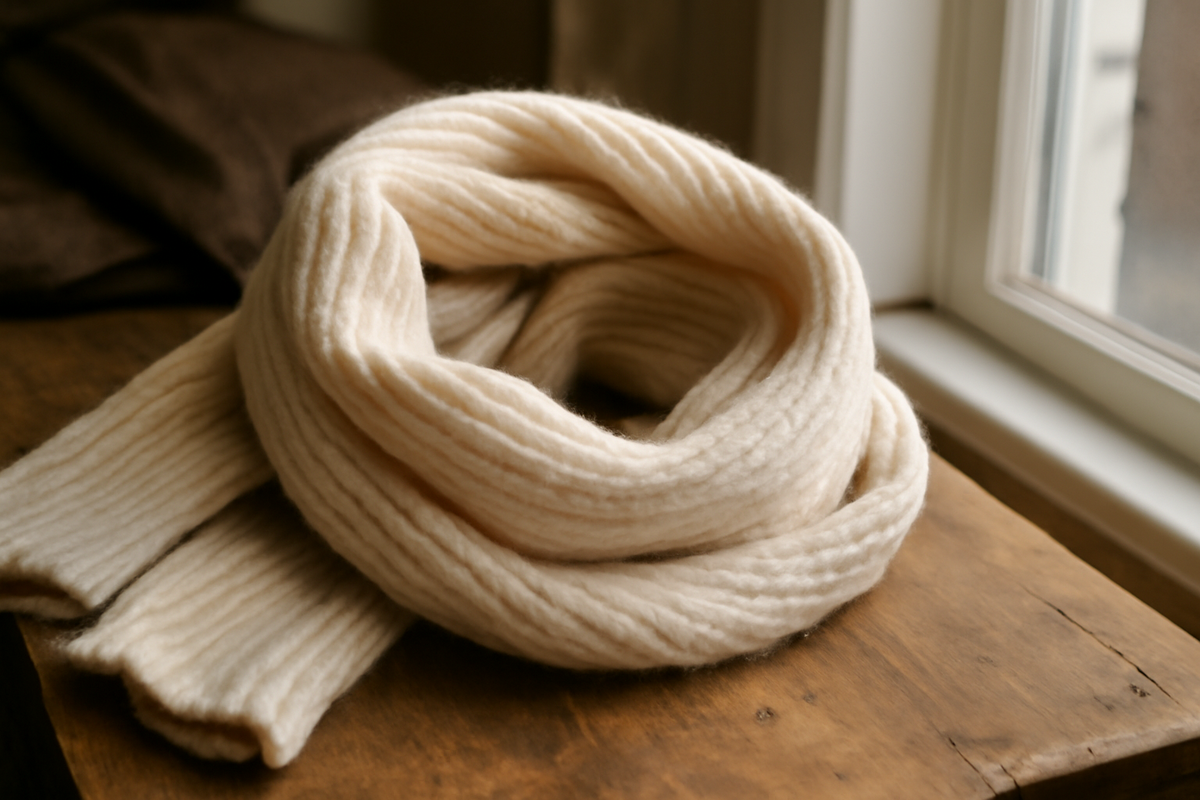
The scarf had been hanging on the hook by the door for so long it had started to feel like part of the architecture. It was there in August, a soft blur of wool behind the sun hats and canvas totes. It was there in October when the air sharpened and the leaves turned. And it was there, inevitably, on the first morning the wind cut straight through your sweater and into your bones — waiting, as it always did, to be wrapped around your neck, carried out into the world, and then returned to its post, still unwashed, still slightly perfumed with last winter’s life.
The Winter Thing We Love, Wear Constantly… And Almost Never Wash
Think of the things you dutifully launder. Sheets? A weekly ritual. Towels? Tossed into the wash the moment they’re more damp than fluffy. Coats might visit the dry cleaner once or twice a season. Hats and gloves occasionally survive a spin cycle. But the quiet champion of our winter wardrobe — the one that presses against our mouths, cradles our hair, rubs against our chin, and collects the faintest trace of every place we go — is usually exempt from all that swirling, soapy redemption.
The accessory, almost embarrassingly overlooked when it comes to cleanliness, is the humble scarf.
It’s ironic, really. The scarf is the winter object most likely to kiss the world and then come back home with souvenirs. It drapes over the subway pole you grab as the train lurches. It brushes the table at the café as you lean in to talk. It gets stuffed into the corner of your bag, brushes against the floor, absorbs that fleeting whiff of cigarette smoke from the stranger who brushed past you on the street.
Yet ask a dozen people when they last washed their scarf and you’ll get the same sheepish pause, the same half-smile, the same answer hidden behind a joke: “Uh… I don’t remember. Does February of… last year count?”
The Secret Life of a Scarf
A scarf is more than a strip of fabric that keeps your neck warm. It’s a traveling diary no one reads, a soft, silent witness to the season. It holds your breath on freezing mornings, hoarding the little clouds of condensation that leave your lips. It frames your face in photos you will forget you took. It carries the faint ghost of your perfume or your shampoo or that peculiar mixture of coffee and city air that always clings to winter coats and crowded trains.
On the coldest mornings, when the world feels distant behind your fogged-up breath, you pull the scarf higher, over your nose, over your mouth. Your words come out muffled, warmed by wool or fleece or cashmere, and the scarf takes it all in — the rhythm of your speech, the warmth of your exhale, the sweetness of the pastry you grabbed on your way out the door. That small ring of fabric becomes the border between your body and the world, touching both sides at once, absorbing traces of each and telling neither.
There’s a kind of intimacy to that, a quiet closeness that few other objects share. We change our shirts, swap out sweaters, tuck a hat in our bag “just in case.” But the scarf stays. It waits on the hook, in the front hall basket, coiled on the back of a chair. All season long, it’s the last thing you reach for before you step outside, the soft buffer between your vulnerable skin and the sharpness of the air.
And still, it almost never sees water.
The Soft Weight of Habit
Part of the reason is simple habit. Scarves don’t look dirty the way a shirt does after a day of errands, or socks after a long walk. They don’t sit close enough to sweat-heavy places to broadcast their use. They age gracefully — at least on the surface — holding their color and shape even as the world clings invisibly to every fiber.
There’s also a kind of superstition about them. You find one that feels right — the perfect length, the exact weight, a color that makes your skin look alive in the gray wash of late January — and it becomes lucky. A small, personal talisman of warmth. Washing it feels slightly risky, as though the spin of a machine might rinse away not just the grime but the comfort, the memory, the particular way it falls around your shoulders.
But nature, as always, is patient. Fibers are small landscapes; they collect what the season offers. Skin cells, city dust, the faint residue of lipstick, damp air turned to frost and melted again — every day, a little more layered into the weave. Most of it is harmless. But it’s there, all the same, waiting.
What Your Scarf Quietly Collects
If you could shrink yourself down and walk along a single strand of your scarf’s yarn, the scene might surprise you. From a distance, that fiber looks smooth. Up close, under magnification, it’s a rugged mountain road of loops and ridges, tiny caves and hanging ledges. This is where the winter world sticks.
There’s a bit of romance to that idea. Your scarf might carry the smoky hint of a campfire from last December’s cabin trip. A trace of pine needles from the tree lot where you picked out a slightly lopsided spruce. The salted air of a coastal town you visited on a cold, bright day. Winter, in fragments, caught and remembered.
But right alongside those charming relics live the less poetic passengers: oils from your skin, microscopic food particles, airborne germs, the invisible fog of the bus ride you took at rush hour when everyone was sniffling.
Unlike a T‑shirt, your scarf hugs the places you breathe and speak. That means it gets front-row access to the full, rich theater of your mouth and nose — including all the bacteria that normally mind their own business but are more than happy to settle into a soft, warm fabric and wait it out. Most of the time, this isn’t dangerous. But it is, in a quietly tangible way, a little gross.
How Often People Actually Wash Their Scarves
Ask around, and you’ll quickly find that scarf-washing is less a habit and more an emergency response: reserved for spills, mysterious odors, or the moment you realize the fringe now has the texture of overused shoelaces.
To put this into perspective, here’s a simple snapshot of how often many people tend to wash different cold-weather items during winter:
| Item | Typical Wash Frequency | How Often It’s Used |
|---|---|---|
| T‑shirts | Every 1 wear | Daily |
| Sweaters | Every 3–5 wears | Several times a week |
| Coats | 1–2 times per season | Almost daily |
| Hats & Gloves | A few times per season | Often |
| Scarves | Rarely, if ever | All winter long |
However scientific or informal your survey, the pattern is clear: scarves are the quiet outliers, woven into our daily lives and almost completely exempt from the rituals of care we give everything else.
Learning the Language of Fabric
If the idea of your unwashed scarf now has you eyeing the hook by your door with faint suspicion, there’s some good news: caring for it doesn’t have to mean sacrificing softness or inviting disaster. The key is to listen to the fabric itself — to recognize that fibers, like landscapes, have personalities and limits.
The Nature of Wool, Cashmere, and Friends
Most winter scarves are born from animals and plants that know a thing or two about weather. Wool and cashmere come from creatures built to stand in wind and snow. Cotton grows under wide skies and unpredictable rain. Even synthetic blends are engineered with seasons in mind.
But once those fibers are twisted into yarn and woven into something that hangs in a shop window, we forget their origins. We treat them like ornaments instead of companions. Washing, done right, is less like punishment and more like a small act of restoration — like brushing mud from a hiking boot or rinsing salt from your skin after a swim.
Cool water, a little patience, and the gentlest possible motion are usually enough. Think of it as giving your scarf a slow swim rather than throwing it into rapids. The goal isn’t to scrub away every molecule of memory, just to relieve it of the excess — the layer of the world that no longer needs to be carried.
A Quiet Ritual of Care
There’s something unexpectedly calming about hand-washing a scarf. It’s a tactile, sensory pause in a season that often rushes past in a blur of obligations and deadlines. The sink fills with lukewarm water. A small swirl of soap clouds the surface. You lower the fabric in and watch as whether from months of wear or only a few outings, the water gradually turns the color of city dust.
Your hands move slowly, pressing and releasing, never twisting or wringing. You feel where the fibers are still plush and where they’ve been flattened by the constant pressure of a coat collar or a shoulder strap. You notice small details you’ve overlooked all season: a tiny pulled thread, the way the fringe knots at the end, the spot near one edge that still smells faintly of cedar from the drawer where it spent the summer.
Rinsing is its own small ceremony, the water running clear, the fabric a little heavier, like a field after rain. You roll the scarf gently in a towel, pressing out what you can, then lay it flat — never hanging, never stretching — to dry on a clean surface. For a little while, it becomes a landscape again: a soft hill of wool on the dining table, a river of cashmere along the back of the couch.
By the next day, it’s itself again. Only cleaner, lighter, somehow more truly yours.
Why This Tiny Habit Matters More Than You Think
In the vast catalog of things the world asks you to worry about, “washing your scarf more often” ranks low. It won’t save the planet on its own, won’t solve a single global crisis. But sometimes, small, tangible acts of attention change the way you move through a season.
Washing a scarf is one of those acts. It’s a reminder that the objects we depend on — the ones we reach for on cold mornings without a second thought — are part of an ecosystem of care. They do their job quietly, day after day, until we take a moment to return the favor.
And cleanliness, in this case, isn’t just about hygiene. It’s about presence. The next time you wrap a freshly washed scarf around your neck, you’ll feel the difference. The fibers sit differently against your skin, a little more alive, a little more responsive. The faint, clean scent rises as you pull it closer to your face, a subtle promise whispered in the chill air: You are taken care of. You have taken care.
In a winter that can so easily blur into gray sameness — commutes in the dark, the same old boots stomping the same damp sidewalks — these tiny points of sensory clarity matter. A clean scarf smells like a reset button. It’s a small, portable reminder that you still have agency over your environment, over what touches your skin, over the rituals that shape your days.
From Afterthought to Companion
Perhaps the greatest shift comes not in the scarf itself but in how you see it. No longer just an accessory that lives on a hook, it becomes a companion in the truest sense: something you walk alongside, care for, and occasionally give a day of rest.
You start to notice how it changes with the weather. How it stiffens slightly in dry, cold air and loosens again indoors. How it carries the faint mineral tang of snow after a walk through falling flakes. How, on some days, you choose a different one — lighter, heavier, brighter — in response to a mood you didn’t even realize you were having.
These are the details that modern life is very good at blurring out. Yet they’re also the details that tether us to the seasons, to our own bodies, to the quiet physicality of simply being alive in a place with changing weather. Your scarf is an invitation back into that noticing.
A Small Challenge for This Winter
This season, before the cold fully settles in, you might give yourself a small experiment: treat your scarf not as a permanent fixture, but as something alive with use. Notice how often you wear it. Notice where it goes. Notice, without judgment, how long it’s been since you last let it see water.
Then pick a day — a slow Sunday afternoon, a quiet weekday evening — and give it a wash. Hand-wash if you can, gently, without haste. Let it dry overnight. And when you loop it around your neck the next morning, feel the difference. Let that moment be a reminder of all the invisible care that underpins even the most ordinary winter days.
Because in the end, this story isn’t really about laundry. It’s about attention. It’s about the way a small, overlooked object can become a mirror of our habits, our thresholds, our willingness to tend to the things that tend to us.
The scarf on your hook has been there through so many cold mornings, so many hurried exits, so many returns home with numb fingers and red cheeks. It has carried your breath and your warmth through seasons you barely remember clearly now. Maybe this is the winter it finally gets its own kind of weather — a storm of water and soap, a gentle drying wind of indoor air — and emerges lighter, ready to begin again.
And maybe, in taking a little better care of that almost-never-washed accessory, you’ll find yourself taking a little better care of the person who wears it, too.
Frequently Asked Questions
How often should I wash my scarf in winter?
For most people, washing a frequently worn winter scarf every 2–4 weeks is a good balance, unless it becomes visibly dirty or starts to smell sooner. If you wear it daily and often cover your mouth and nose with it, closer to every 2 weeks is ideal.
Is it safe to machine-wash a wool or cashmere scarf?
Usually, hand-washing is safer for wool and cashmere. If the care label allows machine-washing, use a delicate or wool cycle, cold water, and a mesh bag, and never use high heat to dry. When in doubt, wash by hand.
Can I just air out my scarf instead of washing it?
Airing it out — hanging it in a well-ventilated space, away from direct sun — can help freshen it between washes, but it won’t remove oils, skin cells, or all germs. It’s a useful practice, but not a full substitute for occasional washing.
What’s the best way to dry a scarf so it doesn’t stretch?
After gently pressing out extra water (never wringing), lay the scarf flat on a dry towel, reshape it, and let it air dry. Avoid hanging it while wet, as the weight of the water can stretch the fibers.
My scarf smells but looks clean. Do I really need to wash it?
Yes. Odor is usually a sign of accumulated oils, breath, and environmental particles in the fibers. A gentle wash will refresh it and make it more pleasant and hygienic to wear, especially so close to your face.

Hello, I’m Mathew, and I write articles about useful Home Tricks: simple solutions, saving time and useful for every day.