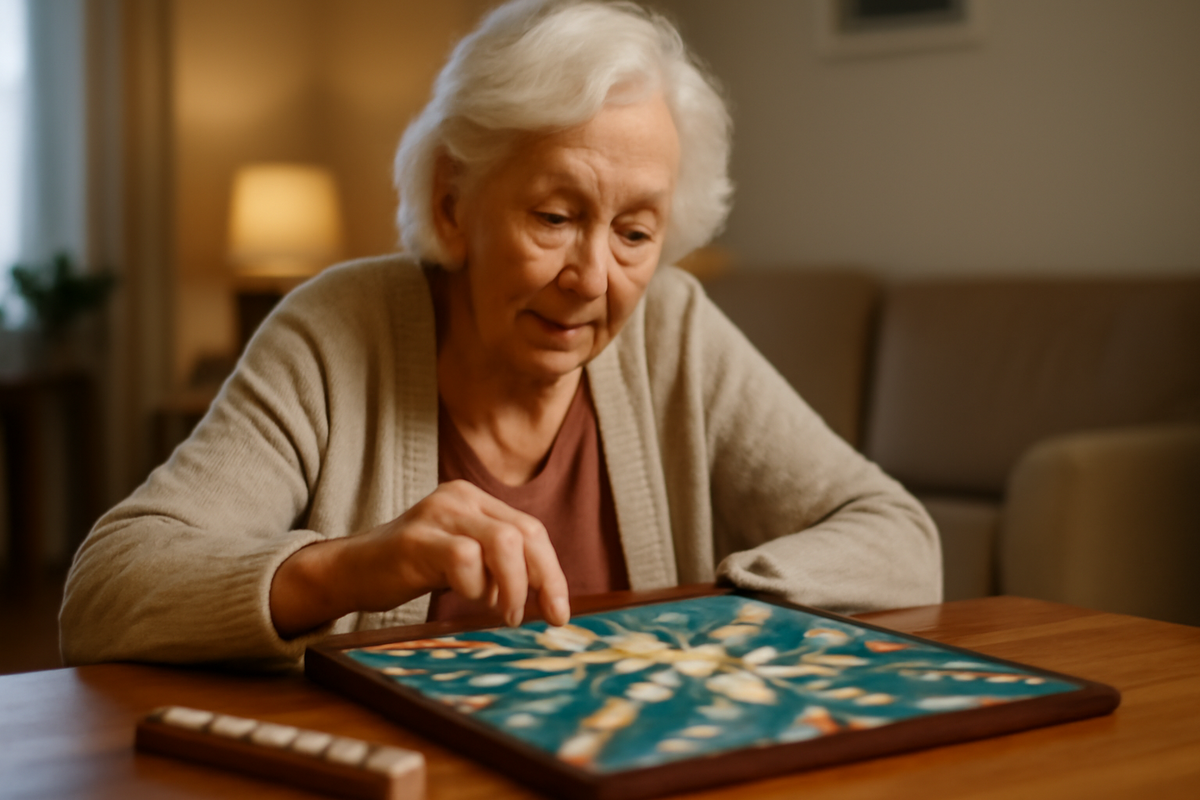
The tiles click softly against the wooden table, a delicate percussion that sounds almost like rain on a cabin roof. The afternoon light slants in through the window, catching the soft curve of Eleanor’s hands as she gently turns a piece over, lips pursed in concentration. She’s 72, with a silver bob and a sweater the color of moss. Across from her, James—76, lanky, perpetually wearing socks with sandals—leans forward and narrows his eyes at the board.
“You’re not putting that there,” he says, but his voice is more amused than stern.
Eleanor’s eyes flash with mischief as she lays the tile down anyway. A neat line of colored circles now snakes across the board, threading through their afternoon like a quiet, secret story.
No television blares in the background. No phone sits between them. The only glow in the room is the warm brightness of two people utterly present, utterly engaged—and, though neither of them says it out loud, subtly training their minds to stay nimble, curious, and awake.
The board game between them is one your doctor might be more excited about than your grandchildren: a tile-laying, pattern-making puzzle that does something crosswords and sudoku often can’t. It doesn’t just ask you to remember words or numbers. It invites your whole brain to the table—vision, memory, planning, attention, even emotion. And for people over 65, that might be exactly what memory needs to keep shimmering instead of fading.
The Quiet Revolution of a Tile and a Table
Walk into almost any retirement community lounge and you’ll find the familiar grid of black and white squares on someone’s lap. Crosswords are the unofficial national pastime of aging minds. They’re comforting. They’re portable. They feel productive.
But under the warm glow of lamp light and over the shallow rattle of pencil tips on newsprint, something else is happening: a kind of quiet monotony. The same part of the brain, doing the same type of task, again and again. Language. Spelling. Word recall. All vital—but not the full symphony of cognition your brain still wants to play.
Now picture a different scene: a square wooden board, a small cloth bag of colorful tiles, a pot of tea cooling on a cork coaster, and two or three people of different ages bent over in thought. No one is filling in blanks. They are building something: lines of colors and shapes, patterns that must follow rules but also allow creativity.
This is the world of modern abstract strategy games—think Qwirkle, Azul, Rummikub, or any tile-based pattern game that asks you to match, remember, and plan several turns ahead. Let’s call this family of games “pattern-tile board games.” They’re simple enough to learn in ten minutes, but intricate enough to keep your brain dancing for years.
Instead of asking, “What’s a six-letter word for ‘sea bird’?” these games whisper something else: “Where will this move leave you in three turns? What did your opponent just reveal about their plan? How can you remember the pieces that are already on the board—and the ones still hidden in that bag?”
In that difference lies something important: a shift from narrow, repetitive challenge to rich, multisensory thinking.
Why Your Brain Loves Patterns More Than Puzzles
Doctors and neuroscientists have been circling around a simple truth for years: the brain doesn’t stay sharp by doing one kind of exercise over and over. It thrives on variety—especially tasks that combine memory, decision-making, and social interaction.
Pattern-tile board games quietly pack all of that into one humble cloth bag:
- Visual processing: You scan colors, shapes, positions, and alignments in a constantly changing landscape.
- Working memory: You remember what’s already on the board, what you just played, and what you hope to draw next.
- Planning and strategy: You think a couple of moves ahead and weigh different options.
- Cognitive flexibility: The game changes. Your plans change. You adapt.
- Social and emotional engagement: There’s conversation, joking, tiny bursts of triumph and disappointment.
All of this matters more after 65 than most of us realize. Cognitive decline doesn’t usually arrive as a dramatic cliff; it’s more like a slow, quiet erosion. A lost name here, a missed appointment there. The brain becomes less quick to adapt, less eager to build new connections.
Pattern-tile games push back on that erosion the way a tide pushes sand back up onto the shore. Each session becomes a small act of resistance: a chance for your neurons to stretch, talk to each other, and lay down fresh pathways.
The magic isn’t in trivia, facts, or vocabulary. It’s in relationships—between tiles, between players, between decisions and consequences. And relationships are what memory is made of.
The Subtle Workout Hiding in Plain Sight
Imagine you’re playing a game where you’re rewarded for creating rows of matching shapes, but all the shapes in a row must be different colors. On your turn, you’re holding a red square, a blue circle, and a yellow clover. The board is a patchwork of half-finished patterns. You have to choose: Do you add to the line your partner clearly wants, helping them but setting yourself up for a bigger move later? Or do you block them and open a new pattern?
In that moment, your brain is quietly juggling at least five things:
- What tiles you’re holding (short-term memory)
- What’s already on the board (visual memory)
- What you think others will do next (prediction)
- How you want the board to look two turns from now (planning)
- How risky you feel like being (emotional decision-making)
No crossword clue has ever asked quite this much of you in ten seconds.
The Aroma of Tea, The Clack of Tiles: Memory Loves the Senses
One of the quiet strengths of board games is that they are tangible. You aren’t staring into the bright, flattening glow of a screen. You’re touching cool ceramic or smooth wood. You’re listening to the click of pieces, the rhythm of voices, the creak of a chair. The room smells like tea, furniture polish, someone’s floral hand cream.
Memory thrives on this sensory richness. When you sit down with a crossword, your experience narrows: paper, pen, maybe a cup of coffee. But when you sit at a table with a physical game, your recall becomes layered. The strategy you used last time isn’t just a line of letters on a page; it’s bound up with who you were playing with, what song was on the radio, how sunlight fell across the board.
That’s how the brain likes to store things: as tapestries, not threads. The richer the tapestry, the easier it is, later, to pull on a single, shimmering strand.
Storytelling in Silence
Watch an older adult lean over a board game and you’ll often see something familiar flicker across their face: that look of story-making. They’re not just placing pieces; they’re reading the game the way you might read a river—where it bends, where it narrows, where it could overflow.
This kind of narrative thinking is closely tied to episodic memory, the part of your brain that holds the story of your life. When you craft little stories about what you’re doing now (“If I put this here, she’ll finally get to complete that line she’s been waiting for”), you flex the same muscles that help you remember what happened last Tuesday.
Pattern-tile games invite this gentle story-building without any pressure to be “creative.” The unfolding pattern is the story. The shared laughter when someone makes a surprising move is a chapter break. The final score is just the epilogue.
Small Table, Big Benefits: Why Social Play Matters After 65
There’s another reason to trade at least some of your solo puzzles for a shared board: loneliness. We don’t like to talk about it, but it curls around the edges of retirement communities, suburban homes, and quiet apartments like fog.
Loneliness isn’t just sad. It’s dangerous for memory. Studies repeatedly show that isolation increases the risk of cognitive decline, dementia, and depression. The brain is a social organ, and it begins to dim when it’s left alone too long.
Board games are one of the few activities that can feel both cozy and purposeful, especially for people who might be wary of “joining a club” or “signing up” for anything. Nothing about opening a box of tiles feels like therapy, but in a small, stubborn way, that’s what it becomes: therapy for the mind that arrives disguised as an invitation to play.
Conversation Without Pressure
For those who feel awkward making conversation, a board game is a gift. You don’t have to think of topics. The game is the topic. It gives you something to point to, to laugh about, to comment on.
“You’re not really going to put that there, are you?”
“I can’t believe you blocked me again.”
“Look at this pattern—doesn’t it look like your old tile floor?”
These are small phrases, but they are also openings—tiny doors out of silence. Through them, people share memories, complaints, jokes, advice. Without ever naming it, they are doing what humans have always done around a shared object of attention: bonding.
That kind of light, effortless connection is the opposite of cognitive decline. It doesn’t just keep memory functioning; it gives it a reason to bother.
Finding the Right Game: Gentle on the Hands, Challenging for the Mind
Not every game is ideal for older adults, especially if there are issues like arthritis, vision changes, or hearing loss. The trick is to find games that are simple to learn, tactile, and visually clear, while still offering a surprising amount of strategic depth.
Here’s a quick comparison of common “brain games” compared with modern pattern-tile board games for people over 65:
| Activity Type | Mental Benefits | Social Interaction | Sensory Involvement |
|---|---|---|---|
| Crosswords / Sudoku | Language or number skills, limited flexibility | Mostly solitary | Low (paper, pen) |
| Digital Brain-Training Apps | Targeted exercises, quick feedback | Minimal, often solo | Mostly visual, on-screen only |
| Classic Card Games | Memory, counting, attention | Moderate to high | Tactile and visual |
| Pattern-Tile Board Games | Memory, planning, flexibility, pattern recognition | High, encourages conversation | Rich: touch, sight, sound |
When choosing a game for yourself or a loved one, keep these guidelines in mind:
- Big, easy-to-grip pieces: Chunky tiles are kinder to arthritic fingers than tiny cards or pegs.
- High-contrast colors: Clear reds, blues, yellows and distinct shapes help those with weaker eyesight.
- Short rules, long engagement: If it takes forty minutes to explain, it’s probably not worth it. Look for games you can teach in under ten minutes.
- Turn-based, not frantic: Fast reaction games can be stressful. Pattern-tile games usually let you sit, think, and take your time.
- Scales well from two to four players: So it works on a quiet Tuesday and at a bustling family gathering.
Once the right game finds its way to your table, something interesting often happens: people who “don’t like games” discover they don’t actually dislike play—they’ve just been playing the wrong things.
From Reluctant to Regular
In one small town community center, a volunteer started bringing a simple tile game every Thursday. At first, only two people joined her: a widower who said he was “just bored enough to try it,” and a retired teacher who swore she was terrible at games.
They started slow. No pressure to keep score. No time limits. Just the gentle ritual of drawing tiles, building patterns, and sipping coffee. Within a month, a second table had to be added. Within three, Thursdays were “game days,” and the crosswords on coffee tables went mostly untouched until people got home.
That’s the secret power of these games: they don’t demand that you be clever. They simply assume that you already are.
Making Game Night a Habit: A New Ritual for Aging Well
The brain, like any old house, needs regular care. You don’t wait until the roof caves in to see if it’s still strong. You check the shingles, oil the hinges, open the windows.
Bringing a pattern-tile game into your weekly routine is one way to do that quietly, kindly—without turning your life into a training program. It becomes a ritual. Friday afternoons. Sunday after brunch. Tuesday evenings with tea instead of television.
To make it stick, keep it simple:
- Leave the game visible: A box on a shelf is easy to forget. A board leaned against the wall near the dining table is an invitation.
- Keep the group small and reliable: Two or three regulars are better than a big, inconsistent crowd.
- Allow for house rules: Adjust scoring, skip rules that confuse, add gentle variants to lower the pressure.
- Celebrate the ritual, not the winner: The point isn’t victory; it’s engagement. A pot of tea and some biscuits go a long way.
Over time, you may notice tiny shifts: a name recalled faster, a joke remembered from last week, a strategy improved without quite knowing why. Memory doesn’t announce its victories with fanfare. It just quietly keeps showing up, a little stronger, a little clearer.
The tiles keep clicking on the table. The light keeps slanting in. Another afternoon passes—not lost in a vague haze, but anchored, patterned, remembered.
FAQ: Board Games and Memory After 65
Are board games really better than crosswords for memory?
They’re not necessarily “better,” but they often exercise more areas of the brain at once. Crosswords mainly challenge language and word recall. Pattern-tile and strategy board games combine memory, visual processing, planning, flexibility, and social interaction—which can be especially valuable after 65.
What if I’ve never been a “game person”?
Many older adults who say they don’t like games actually dislike complicated rules or high-pressure competition. Simple, tactile pattern games with clear goals often feel very different—more like a relaxing puzzle shared with friends than a contest you can “lose.”
Can board games prevent dementia?
No game can guarantee prevention of dementia. However, mentally stimulating, socially engaging activities are linked with a lower risk of cognitive decline and may help slow its progression. Board games can be one part of a broader healthy lifestyle that includes physical activity, good sleep, and social connection.
How often should I play to see benefits?
There’s no strict formula, but playing once or twice a week is a realistic and helpful goal. The key is regular engagement over time rather than occasional marathons. Even 30–45 minutes of focused play can be valuable.
What if I have arthritis or poor eyesight?
Look for games with large, easy-to-grip tiles and high-contrast colors. Many modern board games use big, clear shapes and minimal text, making them easier for people with mobility or vision challenges. You can also adjust the setup—good lighting, a stable table, and plenty of space—to reduce strain.
Can I play these games with my grandchildren?
Absolutely. Many pattern-tile games are “age-flexible”—a 9-year-old and a 79-year-old can enjoy them together, each at their own level. That cross-generational play adds another layer of meaning and memory to the experience.
Do I need to keep score for the game to help my memory?
No. The mental workout comes from making choices, tracking patterns, and remembering what’s on the board, not from the final tally. If scorekeeping feels stressful, you can simplify it or skip it entirely and still get the benefits.
So the next time you reach for a crossword, consider reaching for a cloth bag of tiles instead. The clues won’t be printed in black and white—but the memories you make around that table might stay vivid and bright long after the puzzle page has yellowed and faded.

Hello, I’m Mathew, and I write articles about useful Home Tricks: simple solutions, saving time and useful for every day.