The romaine in my fridge used to tell the same sad story: bought in a hopeful burst of health, washed with good intentions, then slowly collapsing into a limp, translucent heap within days. Maybe you know that story too. You pull out the bag, already braced for disappointment, and there it is—another mushy pile of what was supposed to be a week’s worth of crunchy, life-affirming salads. And every time, there’s that familiar whisper of guilt: food waste, plastic waste, and the quiet feeling that fresh never lasts as long as you want it to.
The Day I Stopped Using Plastic Bags for Lettuce
It started with a sound. Not the shuffling of plastic or the crinkling of foil, but the soft, papery sigh of cotton. I was staying with a friend who lives on the edge of a small coastal town, the kind of place where the grocery store feels more like a conversation than a transaction. She opened her fridge, reached past the jam jars and leftover soup, and pulled out a loosely folded bundle that looked, at first, like a napkin.
“Salad?” she asked, as if offering a secret.
She unfolded the cloth, and I watched, genuinely startled, as a wave of cool, green fragrance spilled into the kitchen. Inside the cloth, leaves of butter lettuce glowed a gentle, vibrant green. They weren’t wilted or faintly slimy at the edges. They were perky. They were crisp. They snapped when she tore them by hand, scattering tiny droplets of moisture across the cutting board.
“How long has that been in there?” I asked, suspicious. This was not how lettuce behaves after a few days in a fridge. This was lettuce on Day One energy.
“Four days,” she said, rinsing the leaves under a quick stream of water. Then she shrugged. “Sometimes five. I just wrap it in a damp cotton cloth and toss it in the crisper. No bags. No foil. Just that.”
It sounded too simple. I’d tried the careful plastic bagging. I’d used the clamshells they come in from the store. I’d lined containers with paper towels. I’d even, once, tried one of those specialty salad boxes with vents and mystery filters. None of them had delivered this kind of casual, quiet magic. No plastic. No foil. Just a damp cloth.
The Easy Trick Nature Has Been Hinting At All Along
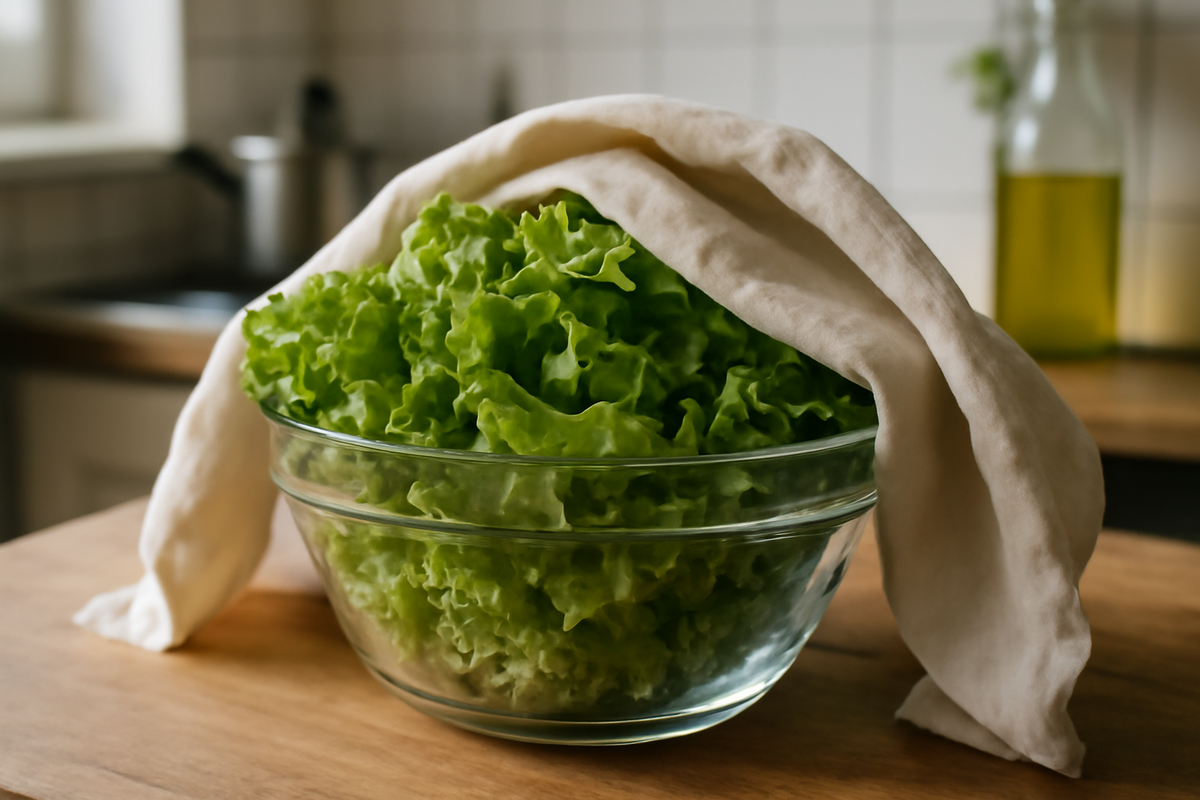
Here’s the secret in its barest form: wash or rinse your greens, dry them gently so they’re not dripping, then wrap them in a clean, slightly damp cotton or linen cloth—like a tea towel—and store that bundle in your fridge, ideally in the crisper drawer. That’s it.
If it sounds like something your great-grandparent might have done, that’s because it is. Long before plastic film slid itself between us and our food, people relied on porous, breathable materials to keep produce alive for as long as possible. The trick isn’t new. We just forgot it somewhere along the way, buried under an avalanche of zip-top bags and cling wrap.
Plants are still quietly doing what they’ve always done: breathing, moving water, exchanging gases—even after we’ve harvested them. A lettuce leaf in your fridge isn’t dead; it’s just living more slowly. Wrap it in plastic and it’s like giving it a tiny, airtight coffin. Moisture condenses, clings, and suffocates the leaf. It gets slimy because it’s trapped with its own exhalations and excess water.
A damp cloth, on the other hand, is a kind of gentle, breathable cocoon. It keeps the leaves cool and moist—but not drenched—and lets them exhale. It’s the difference between wearing a light, airy shirt on a warm day and wrapping yourself in a plastic poncho. The first breathes with you; the second just traps the sweat.
When I tried it at home, I started small. A head of romaine, washed and spun until only a few droplets clung to the ribs. I laid the leaves on a freshly washed cotton towel, folded the corners in like I was wrapping a present, and nested the parcel in the crisper drawer. I closed the fridge door with the faint suspicion that I was about to prove my friend wrong. But three days later, I unfolded the bundle and heard that familiar, crisp snap. The leaves were still fresh. Five days in, they were still strong enough to anchor a salad that actually felt like food, not obligation.
Why This Works Better Than Plastic (And Feels Better Too)
There’s a quiet, almost graceful logic to it. Lettuce—and most salad greens—like a stable, cool, slightly humid environment. Too dry and they wilt. Too wet and they rot. Plastic, for all its glossy convenience, tends to veer straight into “too wet.” It traps the beads of condensation that form when you open the fridge or stack containers too close together. Those beads collect at the bottom of bags, at the corners of boxes, forming little pockets of decay.
A cloth doesn’t do that. It holds just enough moisture in its fibers to keep the air next to the leaves humid, almost like a cloud of cool mist hovering close, but not settling in puddles. When the cloth starts to feel dry, you lightly dampen it again. The cycle continues—moisture shared, not suffocated.
There’s another subtle thing happening too: when you handle your greens with a bit more care—rinsing them, patting them dry, wrapping them—you start to treat them less like a commodity and more like living food. They become less disposable in your mind. That shift alone can change how quickly they disappear from your fridge—not because they’re spoiling, but because you’re actually using them.
And then there’s the physical sensation: the soft weight of the cloth in your hands, the smell of clean cotton and cool leaves when you open it. You’re not wrestling with sticky plastic or crinkly bags. You’re touching fabric that will wash and return to service, over and over again. There’s something quietly respectful about it.
How to Wrap Your Salad So It Stays Crisp for Days
This isn’t a complicated ritual. It fits into a normal, slightly rushed, wildly imperfect life. You can do it in the few minutes after you get back from the market, or on a Sunday afternoon when you’re washing fruit and resetting the fridge for the week.
Here’s a simple way to start:
- Rinse or soak your greens. Fill a bowl or the sink with cool water. Swish the leaves gently so dirt falls to the bottom. This is especially helpful for lettuces with sandy roots or garden soil clinging to them.
- Dry them—thoroughly but gently. A salad spinner works well, but if you don’t have one, spread the leaves on a dry towel and pat them. They should feel cool and slightly moist, not wet.
- Choose a clean cotton or linen cloth. A tea towel, a thin dish towel, or a piece of old, soft cotton works best. Avoid anything fuzzy that might shed fibers.
- Lightly dampen the cloth. If your leaves are still a bit wet, the cloth can be dry. If they’re very dry, run a corner of the cloth briefly under the tap, then wring it out. You want “forest-air moist,” not “just came out of the washing machine.”
- Wrap like a loose bundle. Lay the leaves in a single or double layer across the center of the cloth, fold the sides inward, then fold the bottom up and the top down. The bundle should feel snug, but not tight.
- Store in the fridge. Tuck the cloth parcel into the crisper drawer or on a cool shelf away from the light. That’s it. You’ve built a tiny, breathable greenhouse.
Over the next few days, you can unwrap and rewrap as often as you like, taking what you need. If the cloth feels dry, flick it lightly with water. If you notice any damaged leaves, remove them so they don’t spread decay to the rest. You’ll start to learn the rhythm of your own fridge and your own greens.
A Quick Comparison: Old Habits vs. The Cloth Method
If you’re curious how this stacks up against the usual storage methods, here’s a simple side-by-side look at what tends to happen over a handful of ordinary, busy days.
| Method | Day 1–2 | Day 3–4 | Day 5–6 |
|---|---|---|---|
| Plastic bag / clamshell | Crisp, but condensation starts forming | Edges soften, some leaves slimy, soggy patches | Noticeable smell, slimy clusters, often tossed |
| Open bowl / plate | Crisp but begins to dry at edges | Leaves wilt, look tired and floppy | Most leaves limp and dehydrated |
| Damp cotton cloth | Fresh, cool, crisp like just washed | Still crisp, minor softening at ribs only | Often still salad-ready; some varieties last a full week |
The numbers aren’t scientific; they’re kitchen-real. Fridges differ. Lettuce varieties behave differently. But over time, the pattern becomes unmistakable: the cloth method leans into slow, steady freshness instead of the boom-and-bust cycle of plastic.
Small Ritual, Big Ripple: Less Waste, More Pleasure
What stays with you, once you’ve done this a few times, isn’t just the extended life of your greens. It’s the feeling that this tiny, almost old-fashioned act sits at the intersection of so many things that quietly matter.
There’s the obvious: less plastic. One simple shift means no more wrestling with cloudy, slick bags that feel slightly guilty every time they hit the trash. You start using what you already own—cloth you can wash, reuse, wear thin with good purpose. Over weeks and months, that absence of plastic becomes its own kind of relief. Your fridge starts to look softer, less like a museum of containers and more like a pantry of actual food.
Then there’s food waste. The numbers we hear about global food waste can feel crushingly abstract—tons, percentages, climate consequences. But it becomes real when you stand at your own trash can and drop in a head of lettuce you meant to eat and didn’t. When your greens last five or six days instead of two or three, you start finishing what you bring home. You buy a bit more confidently, knowing it won’t turn against you quite so quickly.
But there’s also something more subtle: the way this small practice nudges you toward eating more of what you intended to eat. If you open your fridge and see a soft bundle of promise—crisp leaves ready for a quick salad, a piled sandwich, a handful tossed into soup—you’re more likely to reach for it. The barrier between “I should eat better” and “I’m eating something green right now” gets thinner. It stops feeling like discipline and starts feeling like ease.
And underneath all of it is that sensory reward. The cool whisper of the cloth when you unfold it. The crisp snap of healthy leaves. The quiet pride of a fridge that works with you instead of against you. No drama. No tight plastic suffocating your food. Just the steady, daily pleasure of something simple that works.
Beyond Lettuce: Other Greens That Love the Cloth Trick
Once you see what this does to lettuce, curiosity takes over. You start to wonder what else might respond to the same gentle treatment. A lot of greens, it turns out, are happy to live in a cloth cocoon.
Herbs. Soft herbs like parsley, cilantro, dill, and mint thrive when loosely wrapped in a slightly damp towel, then slipped into the crisper. Their stems stay plump, their leaves fragrant. The wilting slows, the blackening edges retreat. You stop losing half a bunch to the tragic slime at the bottom of a plastic bag.
Hearty greens. Kale, chard, collard greens, beet tops—these are sturdier leaves, built for weather and time. When wrapped in cloth, they stay flexible and hydrated instead of drying into brittle flags. You can wash them once, store them wrapped, and strip leaves into pans all week.
Prepped salad mixes. If you like to build your own salad mixes—shaved cabbage with tender greens, arugula with herbs—you can layer them in a cloth bundle and gently combine varieties. The cloth holds them together without compressing them, and you reach for a single, ready-to-go mix instead of a cluster of individual containers.
Not everything belongs in a damp cloth, of course. Mushrooms, for instance, prefer a dry one. They’ll mold if you introduce moisture, but in a dry cloth bag or wrapped in a dry towel, they stay firm, velvety, and earthy for days. The underlying principle is the same: breathability, not suffocation.
Letting Your Kitchen Breathe Again
There’s a quiet revolution that happens when you let go of foil and plastic for something as basic as salad greens. It’s not a manifesto. It’s not a grand gesture or a social media-ready transformation. It’s a simple realignment with how food actually behaves and what it actually needs.
Your kitchen becomes a bit more like a conversation with the ingredients and a bit less like a negotiation with packaging. A damp cloth stands in for dozens of throwaway wraps. A drawer of soft bundles replaces a tangle of bags. You pull out a towel, unfold it, and there’s your salad: crisp, waiting, alive enough to crunch between your teeth.
Over time, you start to notice other places where breath matters more than barriers: carrots resting in a shallow bowl of water, celery revived by a quick soak, radishes wrapped in a dry cloth to keep their skins from shriveling. You remember that food isn’t an object to be sealed; it’s a living thing finding a slower pace in your fridge.
The trick that keeps salad crisp for days is almost disarmingly easy: no foil, no plastic, just a damp cloth and a bit of attention. But in that simplicity lies a quiet invitation—to waste less, to touch your food more, to listen to the small physical truths that have been there all along.
Next time you bring home a head of lettuce, don’t reach for the roll of plastic wrap. Reach for a clean, soft towel. Rinse the leaves, pat them, wrap them up. Tuck them into the fridge and forget them for a day or two. Then open the cloth and listen for it: that delicate, satisfying crackle of a leaf that’s still very much alive, waiting patiently to become your next salad.
Frequently Asked Questions
How damp should the cloth be?
Just slightly damp. If your greens are well-rinsed and still hold a bit of moisture, you can use a dry cloth. If they feel very dry, run a corner of the towel under cool water and wring it out thoroughly before wrapping. The cloth should feel cool and barely moist, never wet or dripping.
How long will my salad stay fresh using this method?
Most lettuces and tender greens stay crisp for about 4–6 days, sometimes up to a week depending on your fridge temperature and the variety. Hearty greens like kale can last even longer.
Do I have to wash the lettuce before wrapping it?
It works best if you rinse or soak and then dry the leaves before wrapping. This removes dirt and bacteria and lets the cloth hold a consistent level of moisture. If you prefer to wash as you go, you can still store whole heads in a slightly damp cloth, but washing first usually gives better results.
Can I use paper towels instead of cloth?
You can, but cloth is more sustainable and often more effective. Paper towels tend to dry out faster and tear easily. A cotton or linen cloth can be washed and reused endlessly, making it better for both your wallet and the environment.
What kind of cloth is best?
Thin, tightly woven cotton or linen works best—tea towels, dish towels, or old cotton napkins. Avoid microfiber (it doesn’t breathe the same way) and anything very fuzzy, as fibers can cling to the leaves.
Do I still need to use containers or bags with the cloth?
No plastic is needed, but you can place the wrapped bundle inside a shallow container or bowl if you like. The cloth itself provides the main protection and humidity control; the container is optional and mainly for organization.
What if my cloth dries out after a couple of days?
Simply unwrap the bundle, lightly dampen a corner of the cloth under cool water, wring it well, and rewrap the greens. This refreshes the microclimate around the leaves and helps extend their crispness.

Hello, I’m Mathew, and I write articles about useful Home Tricks: simple solutions, saving time and useful for every day.