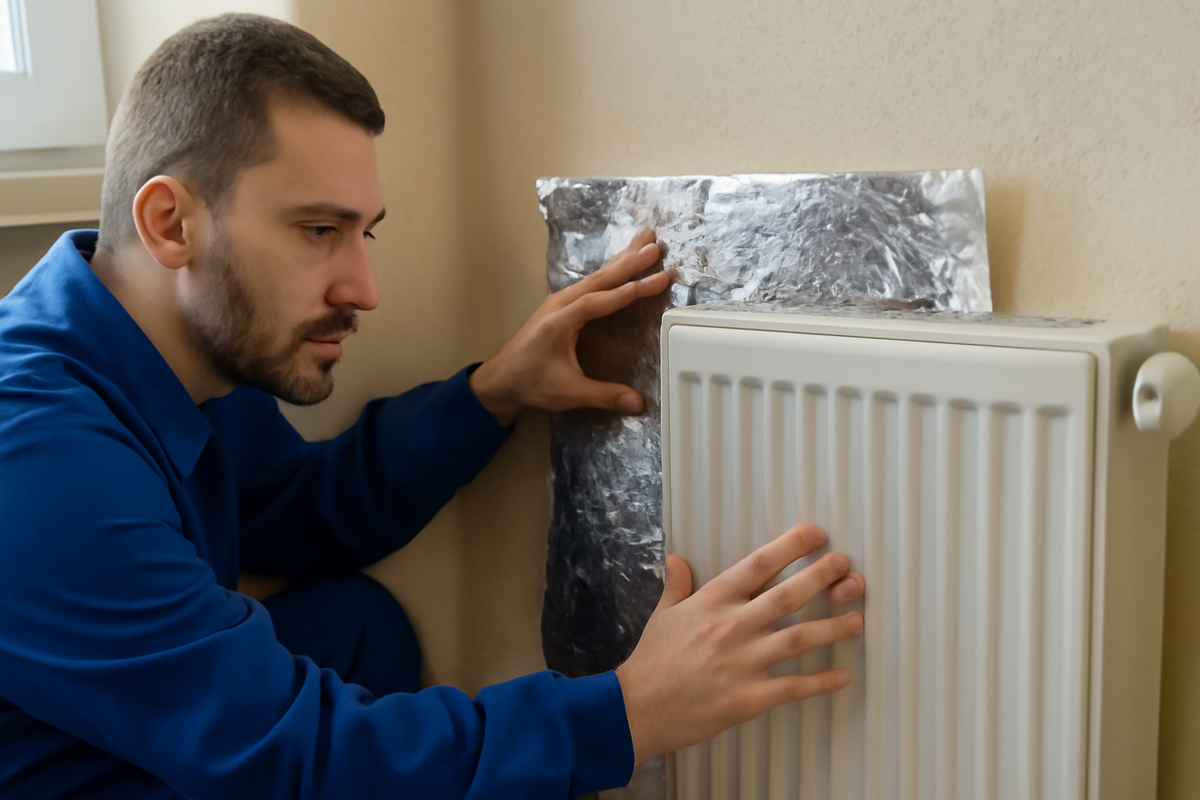
The first time I saw it, I almost laughed. A tired, nineteenth‑century terraced house, a whistling draft under the door, radiators ticking and hissing … and there, quietly taped to the wall, a sheet of crinkled foil glinting behind the living‑room heater. It looked like a school science experiment that someone forgot to tidy away. Yet as the evening drew in and the outside temperature slumped, something subtle happened: the room stayed warm, long after the boiler had cycled off. The old house wasn’t fighting so hard to keep the chill at bay. The foil, as flimsy as a chocolate wrapper, was doing something surprisingly powerful.
The Quiet War Between Your Radiator and the Wall
Engineers will tell you that every winter, in almost every home with hot‑water radiators, a quiet and fairly wasteful war is taking place right where you can’t see it—inside your walls. Put your palm on the outside wall behind a radiator on a cold night and you may feel it: a faint, stubborn coolness seeping inward. That coolness is where a portion of your hard‑paid heating is going to die.
Radiators aren’t actually named very accurately. They don’t just radiate heat; they also warm the air by convection, setting up a slow, looping current that carries warmth around the room. But a big chunk of the energy they release heads straight backward into the wall. If that wall faces the street or the garden, it becomes a kind of unwitting partner in theft, smuggling heat to the outdoors.
“Think of the wall as a sponge,” one building‑physics engineer explained to me over a cup of coffee, tracing heat flows on a napkin with a pen. “If you let the radiator look directly at that wall, it will pour radiant energy into it. The wall warms up, then bleeds that warmth outside. You feel like the radiator is underperforming, but really, a lot of its energy is just leaving the party early.”
He pointed to a simple sketch: radiator on one side, outside air on the other, and arrows marching dutifully through brick and plaster. The solution, he suggested, doesn’t require a new boiler, fancy thermostats, or ripping out walls. It can be as simple as slipping a reflective shield between the two and asking the heat to try again—into the room this time.
The Foil Trick: Childishly Simple, Quietly Clever
When you hear “foil behind the radiator,” it might sound like something your thrifty grandparent would suggest, somewhere between knitting your own socks and saving jam jars. But underneath the home‑hacked feel is solid physics that engineers have leaned on for decades.
A radiator sends out heat in all directions. Part of that energy is radiant heat—infrared waves that travel in straight lines until they hit something. The wall behind the radiator soaks up a good share of this radiation. If the wall is poorly insulated, it’s like trying to heat your living room with one side permanently open to the night.
A reflective foil panel changes that geometry. Instead of allowing the infrared waves to plunge into the wall, the shiny surface bounces a portion of them back into the room. That’s all. No moving parts, no electricity, no software updates. Just redirecting the invisible light of heat.
Engineers love this kind of solution: low‑tech, low‑cost, and entirely governed by the unglamorous but dependable laws of thermodynamics. When carefully installed, the foil shield reduces the “view” your radiator has of that cold external wall. In the language of building scientists, it lowers the radiant exchange between them. You can think of it as turning the wall from a heat sink into a mirror that politely refuses the gift.
In many older homes, where insulation is spotty and walls are solid brick or stone, this simple change adds up. The radiator, relieved of its job of heating the great outdoors, has more to offer the humans in the room. People often describe it less in numbers and more in sensations: the room feels quicker to warm, less drafty, somehow “fuller” with heat.
What the Numbers Quietly Reveal
Strip away the romance of foil and radiators, and the story becomes a set of numbers. Building‑energy researchers have run controlled tests—some in labs, some in real houses—measuring how different wall setups behave. While the exact figures vary by house type and installation quality, the pattern is consistent: a reflective shield, correctly placed, improves the useful heat you get in the room from the same radiator output.
One engineer showed me a set of simplified example figures they use when explaining this to homeowners, based on typical older masonry houses with external walls and standard panel radiators. It’s not universal, but it’s instructive.
| Setup | Heat Lost Through Wall | Heat Delivered to Room | Notes |
|---|---|---|---|
| No foil, uninsulated external wall | High (up to 35–40% of radiator output can be lost in worst cases) | Lower; room warms slowly, cools quickly | Common in older solid‑wall homes |
| Foil shield behind radiator | Reduced (losses can drop by 5–15% or more) | Higher; more heat retained in usable space | Impact higher where walls are coldest |
| Foil + insulated external wall | Very low | Most of radiator output benefits occupants | Best‑case scenario for efficiency |
These are ballpark figures, not universal guarantees, but they echo a consistent real‑world experience. In energy‑poor households where every degree of warmth matters, even single‑digit percentage gains turn into hours of extra comfort each week and tangible savings over a winter.
“Is it magic?” the engineer shrugged. “No. It’s just reducing one path of escape. Heat is always looking for a way out. We’re just shutting a door you didn’t know was open.”
How a Sliver of Foil Changes the Feel of a Room
Numbers are persuasive, but the human body experiences heat in more nuanced ways than a thermometer. Engineers think about temperature, but they also think about comfort—the way air moves over your skin, the difference between warm air and cold surfaces, the odd chill you get even when the thermostat insists you’re fine.
Radiators work partly by warming the air, but your body is also keenly aware of radiant temperature. Stand next to a cold wall, and you can feel heat leaking from you toward it, like standing beside a block of ice that never melts. In a room where the external wall behind the radiator is cold and unprotected, you get a subtle contradiction: the air might be reasonably warm, but one entire surface is quietly sucking radiant heat out of your body.
Add a reflective shield, and the game shifts. The wall at that point no longer behaves as such a powerful cold sink. The radiator’s backside energy, instead of vanishing into masonry, is redirected. Some of it returns to the radiator itself, which raises its surface temperature slightly and strengthens the convection currents; some spills back into the room, raising the mean radiant temperature around you.
People describe the difference in telling ways: “The room feels more even” or “I don’t get that cold patch by the window anymore.” It’s not just about raw degrees; it’s about the invisible conversation between your skin, the air, and the surfaces surrounding you. The foil takes a wall that was working against you and quietly drafts it onto your side.
In older city apartments, where radiators often sit under leaky windows on solid external walls, the effect can feel surprisingly pronounced. You may still feel drafts from ill‑fitting frames, but the deep, bone‑soaking chill from the wall itself softens. With the heating running no harder than before, the space starts to feel less like a battlefield and more like a refuge.
What Engineers Actually Recommend (Beyond the Myths)
Because the idea is so simple, it’s easy to turn it into myth on both ends of the spectrum. Some people assume that foil shields are a miracle fix that will halve their heating bills. Others scoff and insist it’s “basically useless.” The engineers I spoke to are allergic to both exaggerations.
They start with some clear, grounded points:
- Foil helps most when the wall is external and poorly insulated. If your radiator backs onto a solid brick or stone wall with nothing but plaster in between, that wall is probably cold in winter and stealing a noticeable share of the radiator’s output. A reflective shield has room to make a difference there.
- The closer the foil sits to the radiator, the better. A slim air gap is fine—and in fact often necessary—but big voids of cold air behind the foil blunt its effect. The goal is to “see” as much of the radiator’s backside as possible with the reflective surface.
- Proper materials matter. Not all shiny surfaces are equal. Engineers favor foil products specifically designed for radiant reflection in building applications, often with a bit of insulating backing. Plain kitchen foil can work in a pinch but tears easily and doesn’t age well.
- It doesn’t fix everything. If your windows leak, floorboards gape, or your loft is uninsulated, a radiator foil shield is a supporting actor, not the star. It optimizes what the radiator is already doing; it doesn’t rewrite your home’s entire energy story.
In lab test rigs, under carefully controlled conditions, reflective panels behind radiators routinely show measurable improvements in heat retention and room warming times. The savings might be modest on paper—often in the range of a few percent of total space‑heating energy—but in tight energy budgets and chilly climates, “a few percent” can mean the difference between comfort and constant shivering.
The engineers’ real enthusiasm comes not from the size of the gain but from the ratio of effect to effort: a small, one‑time bit of work, using inexpensive materials, that keeps paying back quietly, winter after winter. It’s the same affection they have for draught‑proofing strips and thick curtains: not glamorous, not headline‑grabbing, but deeply honest tools in the craft of staying warm efficiently.
Seeing Your Home as a Heat Landscape
Spend enough time with building‑energy people and you notice they develop a certain kind of vision. They don’t just see rooms; they see gradients, flows, and invisible exchanges. They’ll sit on your sofa, look around, and quietly map the journey of warmth through plaster, glass, fabric, and flesh.
In that vision, your radiator is not a lonely device bolted to a wall. It’s one node in a small and intricate climate system, full of negotiations. The hot water arriving from the boiler argues with the cold air descending from the window. The radiator’s cheerful glow debates with the wall’s stubborn chill. Your body listens in, not just with the skin on your arms but with the fine‑tuned receptors on your face and neck that sense even tiny shifts in heat radiation.
Slip a foil shield into that picture and you’ve changed the conversation. A little more of the radiator’s story now reaches your skin, your chair, the side of your desk where your fingers rest. A little less vanishes unseen into the masonry, never to be felt by anyone. You might nudge the thermostat down half a degree without noticing, or you might simply feel that, this year, winter is slightly less biting indoors than you remember.
In an age obsessed with high‑tech solutions—smart thermostats, app‑controlled valves, heat pumps and learning algorithms—it can be oddly comforting that something so simple still has a place. A strip of foil behind a radiator won’t solve the climate crisis. It won’t cancel out poor building standards or skyrocketing energy prices. But at the scale of one household, one chilly bedroom, one drafty sitting room, it’s a quiet act of reclaiming power over where your heat goes.
Outside, the wind still claws at the bricks, and the night still presses its cold palms to the glass. Inside, though, your warmth is a little more loyal, a little more reluctant to leave. Somewhere behind the radiator, out of sight and out of mind, a thin reflective shield does its unglamorous work, bending the flow of invisible light back toward the people who paid for it in the first place.
Frequently Asked Questions
Does foil behind radiators really make a noticeable difference?
In many homes with radiators on external, poorly insulated walls, yes. The difference may not feel dramatic like installing full wall insulation, but it often makes rooms warm faster and stay comfortable longer between boiler cycles. People frequently describe the improvement as a “more even warmth” rather than a huge temperature jump.
Can I just use regular kitchen aluminum foil?
You can use kitchen foil as a temporary or low‑budget option, but it’s not ideal. It tears easily, can crease and lose reflectivity, and is awkward to mount securely. Purpose‑made radiator reflector panels or foil‑backed insulation boards are more durable, easier to handle, and designed to maintain high reflectivity over time.
Where is a foil shield most effective?
It’s most effective behind radiators that sit on external walls, especially solid brick or stone walls without cavity or internal insulation. If your radiator is on an internal wall between two rooms, the benefit of a reflective panel is generally much smaller, because the heat that “escapes” is still warming another part of the house.
Will foil behind my radiator reduce condensation or damp?
It may help slightly by keeping the inner surface of the wall a little warmer, which can reduce the risk of condensation forming right behind the radiator. However, foil alone will not solve serious condensation or damp problems. Ventilation, insulation, and addressing moisture sources are still essential.
Is this still useful if I already have good wall insulation?
If your external walls are well insulated, the potential gain from adding foil is smaller, but not necessarily zero. Some radiant heat will still be redirected back into the room. In highly insulated homes, however, other upgrades—like fine‑tuning controls or improving window performance—may offer more noticeable returns than radiator foil.

Hello, I’m Mathew, and I write articles about useful Home Tricks: simple solutions, saving time and useful for every day.