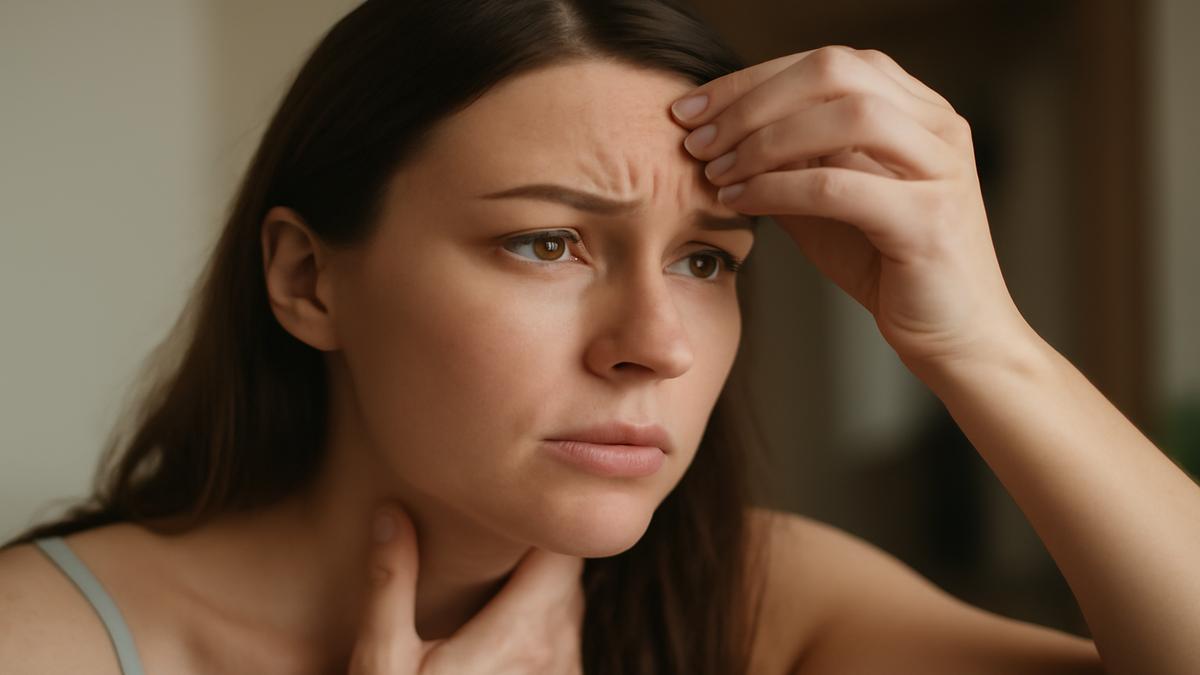
The woman sitting across from me in the small mountain clinic kept brushing her fingertips over the outer edges of her eyebrows as if trying to find something that had gone missing. Outside, pines hissed softly in the wind and a kettle whistled on a distant stove, but in that room everything narrowed to her quiet worry. “It’s the strangest thing,” she said. “My eyebrows are just… vanishing.” There was no drama in her voice, only a bewildered curiosity. Yet that simple observation would turn out to be a more powerful clue than any of us realized—an ancient, almost folkloric “test” hiding in plain sight on her own face, whispering that her thyroid might be in trouble long before a lab slip ever would.
The quiet story written in your eyebrows
Most of us pay attention to our eyebrows only when we’re plucking, trimming, or trying to coax them into some Instagram-worthy arch. They’re decoration, we think—expressive punctuation marks perched above our eyes. But biologically, eyebrows are more like living barometers. They are made of hair follicles that respond, often dramatically, to shifts in hormones, nutrients, and systemic stress. When something big is going on inside your body, those tiny follicles may be among the first to file a quiet report.
For the thyroid—a small, butterfly-shaped gland tucked in your neck—eyebrows can be surprisingly talkative. The outer third of each eyebrow, the part that tails off toward your temples, has long been watched by observant clinicians and traditional healers. Long before we had TSH, T3, and T4 on lab printouts, doctors were taught to notice: are the outer ends thinning? Are they shortened or strangely sparse, while the inner portions still look fairly normal? That subtle change can be an early sign of hypothyroidism, a condition where the thyroid slows down and your metabolism, like a campfire left unattended, begins to smolder instead of blaze.
In the clinic that day, the woman’s brows told a story her bloodwork—still annoyingly “within normal range”—had not yet written in numbers. Her outer edges were pale, patchy, almost ghosted, while the inner halves stood thick and loyal. It was like reading a line of text where the last few words had simply faded from the page. Once you see it, you can’t unsee it. The eyebrow hair test is not a lab test, not a gadget test. It’s a noticing test. A test of paying attention.
The “eyebrow hair” test: a mirror-sized check-in
Unlike most tests we think of in medicine, this one doesn’t involve needles, waiting rooms, or an insurance card. It requires only a mirror, some decent light, and the willingness to look more closely at your own face than you perhaps have in years.
Here’s where the story gets oddly intimate. Imagine standing at your bathroom sink one quiet morning. Steam from a recent shower still beads along the edge of the mirror. You lean in, push your hair back. Your fingertips trace the line of your brows from the bridge of your nose outward. You’re not looking at shape or symmetry this time. You’re looking for density—how many tiny hairs line up along that outer third before they taper into skin.
You might notice:
- The inner two-thirds of the brow (closest to your nose) are full, dark, and fairly even.
- The outer third looks noticeably thinner, patchier, or shorter—as if someone gently erased the last part with a soft eraser.
- On one side, the tail may almost disappear entirely.
This pattern—sparse outer thirds with relatively preserved inner brows—is a time-honored visual clue for low thyroid function. It’s called “lateral eyebrow thinning,” and though it isn’t a diagnosis, it’s a red flag that says, “Look deeper.” Many people notice this long before they’re ever given a thyroid label. They see old photos and think: Wait, when did my eyebrows shrink?
Of course, eyebrows can thin for many reasons: over-plucking, aging, stress, nutrient deficiencies, skin conditions, and more. But the specific pattern of “outer third vanishing” has earned a quiet reputation as the thyroid’s early ghostwriter, especially when it appears alongside other murmurs of hypothyroidism: persistent fatigue, feeling cold when others are fine, dry skin, hair shedding, weight gain that doesn’t match your habits, or that strange sense that your energy has been turned down one notch too low.
Why your thyroid talks to your brows before your blood tests do
To understand why eyebrows sometimes tell the truth before lab tests, you have to imagine the thyroid as a subtle regulator rather than an on/off switch. This tiny gland makes hormones (mainly T4 and T3) that act almost like messages broadcast to each cell in your body: “Here’s how fast to burn energy, repair, grow, stay warm, shed hair, build hair.” Every hair follicle is like a little radio tuned to that signal.
When that signal starts to weaken—not enough to break completely, but enough to go from crisp to fuzzy—some tissues react earlier than others. Hair follicles, especially in delicate, hormone-sensitive areas like the outer eyebrow, are among the first responders. They rely on an energetically expensive process of growth, rest, and shedding. If the body senses a subtle slowdown, it quietly decides to conserve. Resources are pulled from “nonessential” luxuries: glossy hair, strong nails, full brows. Survival first; adornment later.
Meanwhile, the blood tests most commonly used to screen the thyroid, especially TSH (thyroid-stimulating hormone), operate within broad “normal” ranges that may not match what your body considers optimal. You can feel off—colder, slower, foggier—yet still sit comfortably inside that reference interval. To your cells, the volume is already low. To the lab, the dial hasn’t moved enough to raise a flag.
This gap between subjective experience and objective lab printout is where the eyebrow hair test quietly steps in. It says: watch the small changes. Don’t wait until everything is numerically “abnormal” to honor the whispers. In early or “subclinical” hypothyroidism, the eyebrows may thin, the skin may roughen, the outer edges of your body’s story dimming before the central paragraphs are touched.
In that mountain clinic, the woman’s first set of blood tests were stamped as “normal.” The doctor might have shrugged and sent her home with a vague reassurance if her eyebrows hadn’t insisted otherwise. Instead, they looked again, checked antibodies, reviewed her symptoms and history. Months later, as her labs finally drifted out of range, it felt less like a surprise and more like a confirmation of what her hair had quietly been trying to say.
The early whispers your body sends
By the time a textbook hypothyroid pattern announces itself on paper, the body has usually been negotiating in the background for a long time. Eyebrow thinning can be one of the first of these negotiations. But it rarely speaks alone. Often, it appears folded into a chorus of small, easy-to-dismiss changes:
- A perennial chill in your hands and feet, even in rooms everyone else finds comfortable.
- A soft, stubborn weight gain that doesn’t entirely match your intake or movement.
- Dry, papery skin around the shins, elbows, or face, no matter how much lotion you use.
- Scalp hair that feels rougher or sheds more than usual in the shower drain.
- Constipation that quietly becomes your new “normal.”
None of these signs scream. They accumulate like leaves at the edge of a path, enough to make you pause but not enough, perhaps, to send you racing to a doctor. Which is why the eyebrow hair test, as informal as it is, can act as a tiny, personal alarm clock: something you can see, clearly, in the mirror, no specialist required.
Looking closer without jumping to conclusions
There’s a delicate balance here: the art of noticing without panicking. Losing eyebrow hair does not automatically mean you have a thyroid problem. It simply means something has changed, and it deserves curiosity rather than fear.
Several other factors can thin your brows:
- Over-grooming or waxing that damages the follicles over time.
- Normal aging, as hair cycles slow.
- Nutrient gaps, especially low iron, zinc, biotin, or protein intake.
- Skin conditions like eczema, psoriasis, or seborrheic dermatitis.
- Chronic stress or major illness that jolts the hair cycle.
- Autoimmune conditions like alopecia areata.
That’s why the eyebrow hair test is best seen as a starting point, not a diagnosis. It is a question mark, not a period. The key is to place it in context: What else is your body saying? Are you tired beyond what your life reasonably explains? Is your mood dimming, your digestion slowing, your cycle shifting? Have your nails grown more brittle, your voice a touch hoarser, your energy flatter than the story you once told yourself about your own vitality?
When those threads weave together with eyebrow thinning, thyroid function becomes a strong suspect—even if your first round of lab numbers looks deceptively unbothered.
A small table for a subtle mystery
Sometimes it helps to see these patterns side by side—what’s likely thyroid, what might be something else, and how the eyebrow hair test fits into the picture. Think of this as a compact field guide for that quiet moment in front of the mirror.
| Observation | What it may suggest | What to pay attention to |
|---|---|---|
| Outer third of eyebrows thinning, inner part relatively normal | Possible early hypothyroid change or other hormone/nutrient issue | Check for cold intolerance, fatigue, dry skin, weight changes; consider thyroid evaluation |
| General thinning of entire eyebrow from front to tail | Aging, over-plucking, nutrient deficiency, stress, or skin conditions | Review grooming habits, diet quality, stress, and skin health |
| Patchy bald spots in eyebrows | Possible autoimmune hair loss (e.g., alopecia areata) or local skin disease | Look for similar patches on scalp/body; seek medical or dermatology review |
| Eyebrow loss plus very dry, coarse hair and chronic tiredness | Stronger suspicion of low thyroid function | Ask for comprehensive thyroid testing and discuss symptoms in detail |
| Eyebrow loss with intense shedding after a major stress or illness | Stress-related shedding (telogen effluvium) | Reflect on recent life events, infections, surgeries, dieting; support recovery |
Bringing the eyebrow story into the exam room
In many clinics, there is still a quiet art of observation that lives beneath the hum of technology. A good clinician will watch how you walk into the room, listen to the cadence of your voice, notice your skin, your hair, your affect. Yet in the rush of modern practice, the simple act of studying someone’s eyebrows can be lost to the glow of the computer screen.
This is where you become your own best narrator. If you’ve noticed the outer edges of your brows fading, it’s worth bringing that observation into the room with you—clearly, confidently. You might say something as plain as: “The outer third of my eyebrows has thinned a lot over the past year, and I’ve also been more tired and cold than usual. Could we look more closely at my thyroid?” It sounds small, almost quaint, but that sentence can change the direction of your care.
If initial tests come back “normal” while your body still says otherwise, you can gently push for nuance: asking about a full thyroid panel, not just TSH; exploring thyroid antibodies that might reveal early autoimmune shifts; or discussing a period of watchful waiting with repeat testing instead of filing everything under “it’s just stress.” Your eyebrows, after all, have volunteered as witnesses. You’re simply giving them a voice.
In the mountain clinic, that’s precisely what happened. The woman’s thinned brows weren’t dismissed as vanity or over-plucking; they were folded into a deeper investigation. When her antibodies eventually came back positive and her TSH began its slow climb, it didn’t feel like a failure of the earlier tests. It felt like the body had been heard early enough that the story could be shaped with care rather than crisis.
Listening to early signs as an act of respect
There is a cultural habit of waiting for things to become bad enough. Bad enough to see a doctor. Bad enough to take seriously. Bad enough to earn a diagnosis. The eyebrow hair test suggests something quieter: that you are allowed to pay attention before things become emergencies. That the first hints of change in your body—especially in something as minimally invasive as hair—are worthy of contemplation and, when needed, gentle investigation.
This doesn’t mean pathologizing every loose strand. It means approaching your body like a constantly shifting landscape that you live inside of, not a silent machine that only matters when it breaks. The outer third of your eyebrows, those small arcs reaching out toward your temples, are part of that landscape—subtle shorelines where internal tides sometimes show themselves first.
The subtle power of waking up to your own face
In a world of sophisticated scans and multi-page lab reports, it is oddly grounding to realize that your bathroom mirror still holds some of the most sensitive diagnostic tools you’ll ever own: your eyes, your attention, your patience. The eyebrow hair test is not magic, not foolproof, not a replacement for medical care. It is, in many ways, an invitation.
An invitation to look at yourself not just to fix, tweak, or judge, but to notice. To see when the outer edges of things—the brows, the energy levels, the resilience you once took for granted—begin to fray or thin. To hear your body’s whispers before they condense into shouts. And to carry those observations into conversations with people who can help interpret them in context.
If you stand in front of the mirror tonight and run your finger along the tail of your eyebrow, you might find everything perfectly unchanged, full and firm. Wonderful. Consider that a small moment of gratitude for a gland in your neck doing its intricate work well. If, on the other hand, you see an unexpected sparseness where there used to be solidity, let it be a nudge—not toward fear, but toward curiosity.
Ask what else has shifted. Recall how long you’ve felt a half-step behind your days. Notice whether you’re piling on sweaters when everyone else is in shirtsleeves. And if the story adds up to more than simple vanity or aging, let those quiet eyebrow hairs be the reason you ask one more question, request one more test, or seek one more opinion.
In the end, the “eyebrow hair” test is less about hair and more about relationship: the one between your noticing and your body’s early attempts at communication. It is a reminder that long before numbers appear on lab slips, your own reflection may already be trying to tell you something. All it asks is that you look.
Frequently Asked Questions
Does thinning of the outer eyebrows always mean a thyroid problem?
No. Outer eyebrow thinning is a classic sign associated with hypothyroidism, but it is not specific to it. Aging, over-plucking, nutrient deficiencies, chronic stress, and certain skin or autoimmune conditions can also cause this pattern. It becomes more suggestive of thyroid issues when it appears along with symptoms like fatigue, feeling cold, dry skin, weight changes, or hair loss elsewhere.
Can eyebrow changes appear before thyroid blood tests are abnormal?
Yes, they can. Hair follicles are sensitive to subtle shifts in hormone availability and metabolic rate. Some people notice eyebrow thinning and other mild symptoms while their TSH and thyroid hormone levels still sit within the broad “normal” range. This doesn’t replace lab testing but can encourage earlier, more careful evaluation and follow-up.
What should I ask my doctor if I notice my outer eyebrows thinning?
Share what you’ve observed and any other symptoms you’ve noticed. You might say you’d like a thorough thyroid evaluation, and ask about checking TSH, free T4, free T3, and possibly thyroid antibodies. Also discuss other possible causes, like nutrition, stress, skin conditions, or grooming habits, so your doctor can look at the full picture.
Can eyebrow hair grow back if the thyroid problem is treated?
Often, yes—if the hair follicles are still alive and the underlying issue is addressed early enough. Once thyroid function is better supported and the body is no longer conserving resources so strictly, hair growth cycles can gradually recover. This process can take several months, and regrowth may be partial, especially if there has been long-term damage from plucking or scarring.
Is there anything I can do at home to support healthy eyebrows while I investigate my thyroid?
You can be gentle with grooming (avoid over-plucking or harsh waxing), support overall nutrition with adequate protein, iron, zinc, and other micronutrients from a varied diet, and manage stress as best you can with rest, movement, and calming routines. These steps won’t treat a thyroid disorder if one is present, but they can help your hair follicles stay as resilient as possible while you and your clinician explore the deeper causes.
Hello, I’m Mathew, and I write articles about useful Home Tricks: simple solutions, saving time and useful for every day.