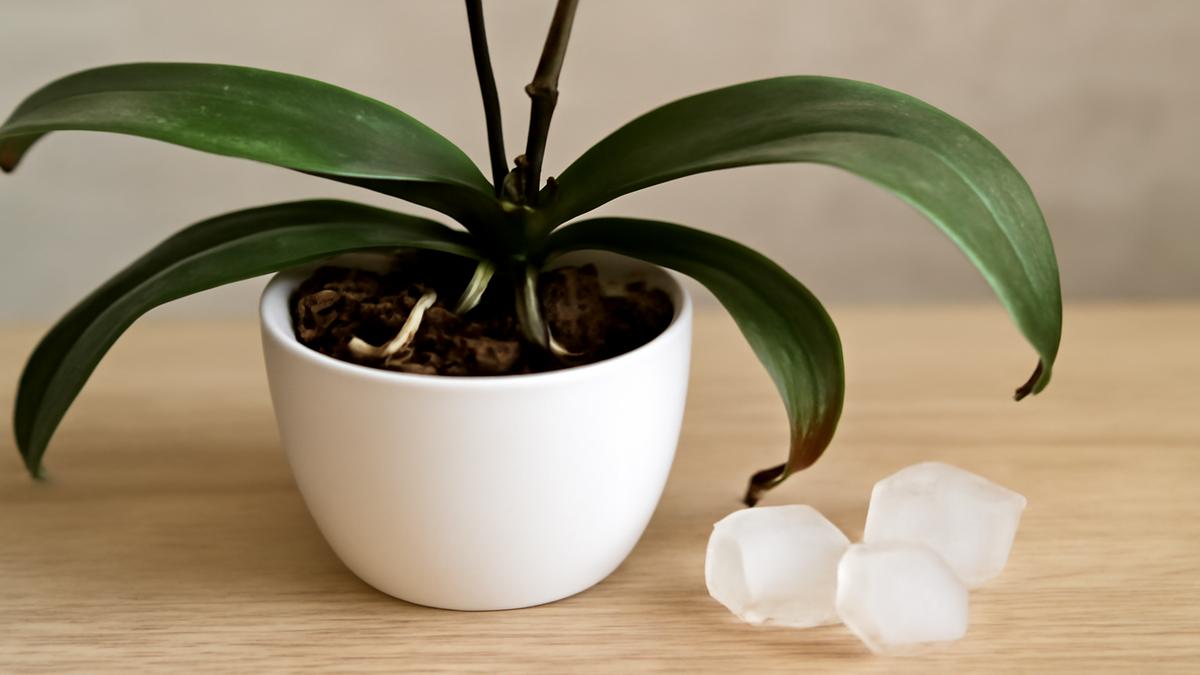
The first time you pressed that glossy orchid leaf between your fingers, you probably felt a quiet thrill: this is a plant that looks like it belongs in a tropical greenhouse, not on the corner of your kitchen counter. Fat, waxy leaves. Roots that curl like pale green snakes over the surface of the pot. And–if you were lucky–a swoop of delicately painted flowers that seemed too perfect to be real. You brought it home, set it by a bright window, and did what so many care tags and social media posts told you to do: you started watering it with ice cubes.
At first, it felt clever. Neat. Measured. Three ice cubes on a Sunday. The moss darkened, the cubes glistened and shrank, and you walked away thinking you’d done right by your new plant. Weeks passed. Months. The flowers dropped, one by one, leaving a bare green spike. Then nothing. Just leaves. No hint of new buds, no promise of another cascade of blooms. Somewhere between the second and third bag of ice you emptied into your freezer tray, your orchid quietly decided to survive instead of thrive. And it has been refusing to flower ever since.
The Slow, Quiet Suffering of a Tropical Diva
It’s easy to forget that the plant on your windowsill is descended from orchids that spend their lives in warm, misty forests, clinging to tree trunks and branches. They grow where the air hums with moisture and rumbles with distant thunder. Their roots are bathed in soft, warm rain that never lingers long enough to drown them, and never once arrives as a chunk of frozen water from somebody’s freezer.
Imagine for a moment that you are that orchid. Your roots are not like the roots of a pothos in a pot of dirt; they’re more like living sponges, wrapped in a silver-green jacket called velamen that soaks up water and air in delicate balance. In the canopy, water comes in gentle spurts–a burst of rain, a heavy mist, droplets caught in moss. The temperature barely wavers.
Now picture the shock of an ice cube pressed against that velvet skin. As it melts across the roots and crown, tiny cells shiver, contract, and in some cases quite literally die back. It’s not dramatic enough to see in a day, but over months, this small repeated trauma adds up. Damaged tissue invites rot, and stressed plants, like stressed animals, go into survival mode. Your orchid stops thinking about romance and flowers and turns all its energy inward: repair, preserve, endure.
This is the quiet crisis happening in so many living rooms. We think we’re being cautious because the instructions say “Just three ice cubes once a week!” But for the plant, it’s like standing barefoot in cold water, again and again, in a body built for warm rain.
The Ice Cube Myth: How a Marketing Trick Became Houseplant Gospel
The ice cube method didn’t arrive from botanists walking through cloud forests with notebooks and gentle hands. It came from marketing–from the desire to make orchids less intimidating and more “set-and-forget” for big-box shoppers who might be scared of overwatering. “Three ice cubes” sounds harmless, tidy, precise. You don’t need to think about it. The ice limits the amount of water, so you’re less likely to drown the roots. Problem solved, right?
In a way, that’s the saddest part: the whole thing is built on a partial truth. Overwatering is a major orchid killer. Roots left standing in wet, compacted media rot. The plant collapses from the bottom up. So someone somewhere thought, Why not slow down watering by freezing it? Less water, fewer dead plants. Win-win.
But plants are not spreadsheets. Orchids are especially not. Phalaenopsis, the moth orchids most of us grow, are native to warm regions where the idea of ice is about as likely as snow in a sauna. Their roots don’t just dislike the cold; they are physiologically unprepared for it. When we substitute real watering with ice cubes, we trade one problem (potential overwatering) for another, more subtle one (chronic stress).
Over time, many ice-watered orchids keep surviving–they don’t immediately crumple up and die–so we think, “Well, mine seems fine.” But if you look closely, the signs are there: weak new leaves, shorter flower spikes, fewer buds, blooms that don’t last as long. The plant is alive, but not really living. This is what it looks like when a tropical diva is trapped in a long, lukewarm compromise.
What Your Orchid Actually Wants (And Why It’s Not Complicated)
The real needs of a typical moth orchid are surprisingly simple once you step away from the gimmicks and imagine its life in the wild. A healthy, happy orchid needs four main things to bloom: the right kind of light, proper watering, a breathable potting mix, and a gentle temperature shift between day and night. None of these are as precise or fussy as those ice cube rules suggest.
Think of it as learning how your orchid “talks.” It doesn’t need apps or schedules–just your attention.
| Need | What Ice Cubes Do | What Your Orchid Prefers |
|---|---|---|
| Watering | Small, cold doses sitting on roots and crown | Room-temperature soak, then full drainage |
| Temperature | Sudden cold spots on warm roots | Steady warmth; mild night-time cooling |
| Root Health | Tissue stress, risk of rot in damaged areas | Plump, silver-green roots with strong velamen |
| Flowering | Chronic stress, fewer or no new spikes | Energy to form buds and sustain long blooms |
Real orchid watering looks something like this: you carry the plant to a sink or tub, pour lukewarm water through the pot until it runs freely from the drainage holes, and then you let it sit and drip. Ten, fifteen minutes. The bark or moss drinks, the roots swell from silvery to bright green, and then the excess escapes. No wet feet. No icy shock.
The difference inside the plant is enormous. Where ice cubes send a chilling jolt, warm water signals safety. Roots relax and expand. They don’t have to wall off damaged tissue or go into emergency mode. Instead, they can partner with the leaves, photosynthesizing steadily, storing energy. And energy, for an orchid, is the difference between “just getting by” and sending out a flower spike that feels extravagant.
Reading the Orchid’s Body Language: Why It Still Won’t Bloom
When your orchid refuses to flower, it’s issuing a gentle but firm statement: I don’t have enough reserves to risk it. Flowering is a high-stakes gamble in the plant world. Blooms cost energy, and for orchids, they are a big investment–large, complex, often long-lasting blossoms that demand resources to create and maintain.
If your plant has been on the ice cube diet for months or years, it’s likely been running at a deficit, surviving on the botanical equivalent of coffee and crackers. Here’s what that “I can’t bloom” message often looks like:
- Leaves that are thin or leathery rather than plump and glossy.
- Roots that look brown, hollow, or shriveled when you peek through the clear pot or gently slide the plant out.
- No new leaf growth for many months, or new leaves that emerge but stay small and limp.
- No new flower spikes even after a full year.
These signs can be subtle. You might not notice them unless you’re deliberately looking. But the orchid knows. Cold watering, poor light, exhausted potting media, or a combination of all three create a kind of low-level emergency. The plant conserves itself. It may even drop leaves or roots to stay alive. And flowering? That becomes a luxury it can no longer afford.
The good news is that orchids are more resilient than their delicate faces suggest. Give them what they actually need, and they often respond with an almost startling determination. A stubby node on an old spike begins to swell. A new leaf unfurls, deeper green, broader than the last. Roots stretch out, bright and hopeful, like fingers reaching toward the future.
How to Break Up with Ice Cubes (Without Drowning Your Orchid)
Leaving the ice cube habit behind can feel strangely risky. It was a rule, after all. A simple one. Three cubes. Done. Letting that go means trusting yourself instead of a slogan on a tag. The trick is to replace it not with another rigid formula, but with a relationship–a back-and-forth between you and the plant.
Here’s a quiet ritual you can begin, one that fits into a weekend morning or the soft edge of an evening:
- Check the potting mix. Gently press a finger into the bark or moss near the center. If it still feels cool and faintly damp, wait a few days. If it’s dry and light, your orchid is ready.
- Use room-temperature water. Not cold from the tap, not hot–just the comfortable warmth you’d offer to your own hands.
- Water deeply. Take the whole pot to the sink and pour water slowly over the surface, letting it flow through and out the bottom. Keep going for a good 10–20 seconds, or set the pot in a bowl of water for about 10 minutes before letting it drain fully.
- Let it breathe. Make sure no water pools in the decorative outer pot. Empty saucers and cachepots. The roots should be moist, not submerged.
- Return it to its bright perch. A spot with bright, indirect light–like an east window or slightly shaded south window–keeps the plant energized.
Over time, you’ll notice your orchid’s rhythm. In a warm, bright room, it may need water every 5–7 days. In a cooler, dim space, maybe every 10–14 days. The plant will tell you: light pot, dry bark, silvery roots? Time to water. Heavier pot, dark, cool bark, green roots? Not yet.
Breaking up with ice cubes also means accepting a slower kind of satisfaction. You won’t see instant flowers. But you might notice, after a month or two, that the leaves feel firmer. A new root tip appears, almost glowing at the edge of the pot–a bright, tender green. That, right there, is your orchid’s thank you note.
Creating Blooming Conditions: Light, Seasons, and a Little Bit of Drama
Once your orchid is no longer battling cold shocks, it can start to think about the future again. For many Phalaenopsis, the cue to initiate a new flower spike is a combination of maturity, good health, and a slight change in environment–especially temperature.
In their native habitats, these orchids often respond to subtle seasonal differences. You can mimic this at home with a bit of gentle theater. In early autumn, when the nights naturally begin to cool, place your orchid near a window where it experiences a small, consistent drop in temperature after dark–about 5–10 degrees Fahrenheit cooler than daytime, but not below roughly 60°F (15–16°C). This shift whispers to the plant: Now. It’s time to send up a floral flag.
Of course, light plays its part too. While ice cubes have been distracting us with their convenient simplicity, many orchids have been languishing in dim corners, never receiving the brightness they need to build the sugars that power blooms. If leaves are dark, almost forest green, that’s often a sign the plant is underlit. A well-lit orchid usually wears leaves of a lighter, fresher green.
Move your plant closer to a bright window, but not into harsh midday sun that can scorch the leaves. Sheer curtains, blinds, or a spot set back a little from a south or southwest window can be perfect. Watch how the light shifts across its leaves throughout the day–a slow, silent dance that you might have never noticed before.
When you begin to see the first hint of a spike emerging between two leaves–a narrow, pointed growth that curves upward–you’ll know you’ve moved beyond survival. You and the plant have entered into a kind of collaboration. The blooms that appear weeks later aren’t just decorations; they’re the visible proof that you’ve learned to listen.
Letting Orchids Be Orchids, Not Ice Sculptures
There is something quietly radical about choosing to care for a plant on its own terms instead of bending it toward our shortcuts, trends, and tidy rules. When you stop treating your orchid like a delicate ornament and start recognizing it as a tough, adaptable survivor from the canopy of some faraway forest, your whole relationship shifts.
You may still make mistakes. Everyone does. You might underwater a bit at first, or give it a spot that’s too bright or too dim. A leaf may wrinkle, a bud may drop. But those mistakes are different from the slow, numbing harm of the ice cube routine. They’re part of a conversation. You’ll see the plant respond, adjust, recover. And slowly, you’ll become the kind of person who doesn’t need a watering gimmick because you can read a leaf the way you read a familiar face.
In the end, your orchid’s refusal to flower is not a failure, or a judgment. It’s an invitation–a quiet one–to pay closer attention. To remember that the world on your windowsill is connected, thinly but truly, to forests where air roots dangle like pale ropes in the mist and no one has ever seen an ice cube.
When you finally stand at your sink one morning, watching water pour gently through the pot instead of watching ice cubes shrink, you may notice something else as well: the small, satisfying feeling of having chosen care over convenience. Of having allowed a tropical diva to be what it has always been, long before store tags and freezer trays: a living story of warmth, patience, and bloom.
Frequently Asked Questions
Is using ice cubes to water orchids always bad?
While some orchids survive for a while with ice cubes, it’s generally not healthy long-term. The cold water can damage roots and crown tissue, leading to stress that prevents flowering. Room-temperature water and thorough, occasional soaking are far better for long-term health and reblooming.
How often should I water my orchid without ice cubes?
Most Phalaenopsis orchids do well with watering every 7–10 days, but it depends on light, temperature, and potting mix. Check the media: if it feels dry and the roots look silvery rather than green, it’s time to water. In brighter, warmer rooms, you may water more often; in cooler, dimmer spaces, less often.
My orchid is healthy but still won’t bloom. What else could be wrong?
If leaves and roots look good but there are no flowers, the plant may not be getting enough light or a slight temperature drop at night. Try moving it to a brighter spot with indirect light and, in autumn, provide a 5–10°F cooler temperature at night for several weeks. This often triggers spike formation.
Can I save an orchid that’s been watered with ice cubes for years?
Often, yes. Switch to proper watering with room-temperature water, ensure the potting mix is fresh and well-draining, and improve light if needed. Trim dead roots when you repot. With patience over several months, many orchids recover and eventually bloom again.
Do orchids need special fertilizer to flower?
They don’t need anything exotic, but they do benefit from a balanced orchid fertilizer used lightly. During active growth, feed about once a month at a diluted strength on already moist media. Fertilizer supports overall health and energy reserves, which in turn help fuel flowering.

Hello, I’m Mathew, and I write articles about useful Home Tricks: simple solutions, saving time and useful for every day.