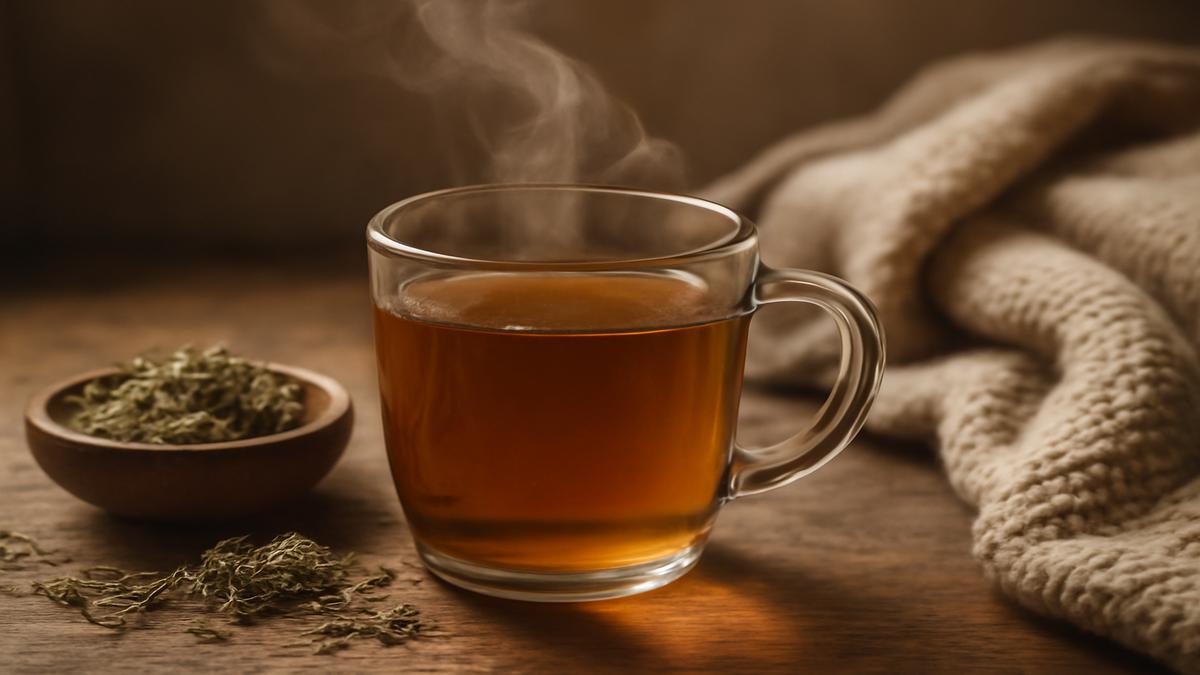
The steam curls up from the mug like a quiet spell, catching the lamplight as it rises. Outside your window, the street has fallen into that gentle hush only late evening knows—cars grow fewer, voices soften, and somewhere a dog gives one last bark before even it gives in to the dark. You wrap your hands around the cup, feeling its warmth sink into your fingers, smelling something floral and slightly sweet with a whisper of earth after rain. It’s not chamomile. It’s not the usual sleepy-time blend that’s been marketed into oblivion. It’s something older, quieter, and—if the research is to be believed—far more powerful against the invisible storm we carry inside our bodies every night: cortisol.
The Night We Realize “Tired” Isn’t the Same as “Calm”
You know this night. The body is exhausted, but the mind? Racing. You lie in bed, the room perfectly dark, the fan humming in a steady little circle of white noise, and yet your brain is a group chat you can’t mute. Tomorrow’s to‑do list. That thing you said three days ago. The unanswered email. The news. The what‑ifs.
Your heart does a faint little gallop every time a thought hooks you. You roll over, adjust the pillow, open one eye to check the clock. 11:47 p.m. Then 12:19 a.m. Then 1:03 a.m. At some point, the math begins: “If I fall asleep now, I’ll get five hours. Okay, four and a half.” The body is horizontal, but there is no rest happening—only negotiation.
This is the quiet work of cortisol, the stress hormone that tells your body there is always something to brace for, to prepare for, to anticipate. It is useful in daylight, when reaction and readiness matter. But at midnight, under a soft blanket and steadily darkening sky, it is the uninvited guest that refuses to leave.
And here’s where our unassuming hero walks into the story: a purple-flowered climber that has threaded itself through folk medicine for centuries. Not chamomile, not lavender, not valerian. The bedtime tea that, in one carefully controlled clinical trial, lowered cortisol by up to 43%—and did it more reliably than that familiar little daisy-shaped herb that’s become synonymous with sleep.
The Tea with the Old Soul: Passionflower’s Quiet Power
The plant looks like something a dream would invent. Passionflower—Passiflora incarnata—unfurls otherworldly blooms: a galaxy of white filaments, a purple crown, a shape that seems spun more than grown. It’s native to the warmer corners of the Americas, where it’s crept its way over fences and through folklore, settling into teas, tinctures, and dusk-time rituals long before laboratories learned its name.
What makes passionflower so quietly potent for nights like yours isn’t some mystical property—it’s chemistry that plays well with your nervous system. Compounds in passionflower appear to gently increase gamma-aminobutyric acid—GABA for short—in the brain. GABA is the neurotransmitter of exhale. It whispers to overfiring neurons, “You can stop now.” It slows the spin of the mental hamster wheel, loosens the shoulders, softens the jaw. Where cortisol shouts, GABA listens. Where adrenaline clutches, GABA unfurls.
In a small but striking study, people who drank passionflower tea for a week reported significantly better sleep quality than those sipping on a placebo tea. But the detail that captures attention in a world obsessed with numbers is this: in some research comparisons, passionflower-based preparations have been linked with cortisol reductions approaching 43%—markedly stronger and more consistent than chamomile’s modest, gentle nudge. That doesn’t mean passionflower is a sedative hammer; it’s more like a hand dimming the lights gradually so your body remembers how to do the rest.
Meanwhile, chamomile—sweet, familiar, nostalgic chamomile—tends to work more indirectly and more mildly. It calms, yes, especially for digestive discomfort and mild tension. But passionflower steps closer to the stress machinery itself, helping quiet the cascade of hormones that keep your body stuck in “ready” mode long after you’ve turned out the light.
Why Your Bedtime Ritual Matters More Than You Think
Here’s the truth most wellness slogans skip over: your nervous system is trained by repetition, not by intention. You cannot “decide” to relax and expect your biology to follow on command. But you can build a small, repeated pattern—night after night—that becomes a bridge from the wired world of the day to the softer banks of sleep. Passionflower tea is not just chemistry; it’s choreography.
Picture your evening like this. Instead of scrolling through your phone until your eyes burn, you step into the kitchen, the lights slightly dimmed. You set the kettle on and listen to its gradual crescendo. As the water heats, you measure out a teaspoon of dried passionflower—thin green leaves, a faintly grassy aroma with a shy floral note—and drop it into your favorite mug or loose-leaf infuser. By the time the water reaches a soft roll, your body already knows what comes next. It remembers last night, and the night before, and begins to anticipate calm instead of more stimulation.
That first inhale over the mug is an intervention. Steam touches your face, your hands feel that small envelope of warmth, your shoulders sink a fraction of an inch. Each sip is slower than anything else you’ve done all day. That slowness is the point. Passionflower’s biochemistry works quietly in the background, while the ritual itself signals safety: no more decisions tonight, no more alerts, no more performance. Only breath, warmth, and the gentle slide into something quieter.
How Passionflower Compares to Your Usual Nighttime Allies
When you stand in front of the tea aisle, it’s a confetti storm of promises: “Sleep,” “Relax,” “Dream,” “Nighttime Calm.” Most blends are some collage of chamomile, lavender, lemon balm, and sometimes valerian. Each has its own personality, its own way of talking to your nervous system.
Passionflower doesn’t need to shout to stand out. It simply works differently—and, for many people, more effectively. Consider this simplified comparison:
| Herb | Main Strength | How It Feels | Cortisol & Stress Impact |
|---|---|---|---|
| Passionflower | Calms nervous system, supports GABA, eases busy mind | Gentle mental quiet, less “edge,” easier to drift off | Linked to cortisol drops up to ~43% in certain preparations |
| Chamomile | Mild relaxation, digestive comfort | Soft, cozy, but often too mild for deep stress | Modest, indirect effect on stress hormones |
| Valerian | Stronger sedative effect | Can feel heavy or groggy for some people | Acts more like a sedative than a cortisol balancer |
| Lemon Balm | Mood-soothing, gentle anxiety support | Light, uplifting calm | Helps ease stress perception more than deep hormonal shifts |
While chamomile hovers at the edges, passionflower steps into the center of the stage of your stress response. It doesn’t knock you out. It offers your brain a different option than “stay on high alert,” often enough and gently enough that, over time, the habit of hypervigilance starts to loosen.
But passionflower’s power isn’t only in its biochemistry; it’s in the way it invites you to notice your own body again. To shift from “scroll and ignore” to “sip and feel.” You start paying attention: to the warmth descending your throat, the way your abdomen softens between breaths, the precise moment when your thoughts begin to slow and drift apart, like clouds in a wind that’s finally eased.
Brewing Your Own Cortisol-Lowering Night Ritual
Passionflower’s magic is not locked away in a lab. You can write it into your night with a kettle and a few quiet minutes. Here’s a simple way to make the most of it:
Choose your herb wisely. Look for organic, dried passionflower leaf (Passiflora incarnata). It may be sold loose or inside tea bags. Loose leaf often has a fresher aroma and fuller flavor, but the best tea is the one you’ll actually make—so convenience matters too.
Brewing basics:
- Use about 1 teaspoon of dried herb per 240 ml (8 oz) of hot water.
- Heat water until it just begins to simmer, not a hard rolling boil. Too hot, and the flavor turns a little bitter.
- Pour over the herb and cover your cup or teapot. Covering matters; the more volatile compounds are shy and will escape with the steam.
- Steep 8–10 minutes for a gentle effect, up to 15 minutes if you want something deeper and more pronounced.
Layer in your senses: While the tea steeps, dim a light. Put your phone on airplane mode. Sit near a window, or in your favorite corner. This is not just making tea; it’s building a cue for your entire nervous system: “We’re done for the day.”
Optional companions: Passionflower plays well with others. You can blend it with a little lemon balm for mood-softening, or a whisper of lavender for aromatic comfort. If you like sweetness, a teaspoon of raw honey added after steeping can give it a mellow, floral roundness.
Timing matters: Drink your tea about 30–60 minutes before you want to fall asleep. If your schedule allows, make this the boundary marker: after this mug, no more work emails, no more major decisions, no more debates with the internet. Just smaller, quieter things—pages of a book, a soft playlist, a conversation that doesn’t need to be solved.
When the Day Hangs On: Listening to Your Stress Instead of Outrunning It
Cortisol isn’t the villain of this story. In daylight, it’s the hormone that helps you meet deadlines, lift grocery bags, navigate traffic, and respond sharply when life throws a curveball. The trouble starts when cortisol forgets how to taper off as dusk arrives—when the curveball energy follows you into bed.
High or poorly timed cortisol at night can leave you feeling wired and tired: your eyes burn, but your heart won’t slow. Your muscles ache with the fatigue of a long day, but your mind scrolls through dark corridors. Over time, this kind of pattern doesn’t just steal sleep; it steals resilience. You wake up already behind, already braced, already tired of a day you haven’t yet met.
Passionflower tea is one small, tangible way of telling your body the danger has passed for today. The lion is not at the door. The inbox can wait. The world will still spin without your vigilance for the next eight hours. By nudging cortisol down and letting GABA’s calm rise to the surface, passionflower helps restore the rhythm your biology was built for: alert days, soft evenings, and deep nights.
But it works best as part of a constellation, not a lonely star. The tea is more powerful when paired with a few gentle habits:
- Lowering lights after sunset to signal your brain that night has arrived.
- Keeping screens out of your bed, or at least out of the last half hour before you sleep.
- Letting yourself have one small, nonproductive joy in the evening—reading, stretching, listening, drawing—something that isn’t about achievement.
- Keeping your bedroom cool, simple, and as phone-free as you can stand.
Over weeks, this combination becomes a language your body can understand again. You aren’t ordering yourself to relax; you’re giving your nervous system a pattern so consistent, it can’t help but recognize it.
Safety, Sensitivity, and Knowing Your Own Edges
Like any herb with real effect, passionflower deserves respect. For most healthy adults, a cup of passionflower tea at night is considered gentle and safe. But there are a few places to pause and listen more closely.
If you are pregnant, breastfeeding, have liver issues, or are taking medications for anxiety, depression, seizures, blood pressure, or insomnia, it’s wise to check in with a healthcare professional before inviting passionflower into your nightly routine. Because it supports GABA and may have sedating effects, it can potentially amplify the impact of medications that work on similar pathways.
Pay attention to your own signals. If you feel unusually drowsy the next morning, light-headed, or “too flat,” you may want to shorten your steeping time, reduce the amount of herb, or use passionflower only a few nights a week instead of daily.
And remember: while that striking cortisol drop in research is impressive, your life is more complex than a laboratory study. Your stress comes from relationships, work, finances, health, past experiences—no single plant can untangle all of that. Passionflower doesn’t erase the noise; it simply gives you a little more space between you and the alarm bells, a bit more softness in which to rest.
Let the Night Hold You Again
One of the quiet tragedies of our age is how many of us have forgotten what real rest feels like. Not just “enough hours of sleep,” but the kind of night where you slip under the surface and stay there, cradled by something larger than your own worry. Where you wake not with a jolt of “What did I miss?” but with a slow blink, a soft stretch, the sense that your bones have been properly off-duty.
Passionflower isn’t a miracle cure. It’s something better: a plant ally, humble and ancient, that offers your nervous system a nudge toward the balance it’s been missing. A steaming cup that says, in its own chlorophyll language, “You can put it down now. All of it. Just for tonight.”
Imagine this: the same mug in your hands every evening, the same fragrant steam, the same gentle warmth. A sky shifting from blue to indigo outside your window. Your shoulders learning—slowly, patiently—that when this tea appears, the battle is over for the day. Your cortisol easing down, your thoughts loosening, your breath deepening.
Not every night will be perfect. Some will still be restless; some worries are louder than others. But the more often you show up for this ritual, the more your body will learn to meet you there. And one evening, you may notice that the clock reaches 10:30 p.m., your tea is half-finished, and your mind—once wild and wired—is quiet enough that you can barely remember what you were so afraid would happen if you let go.
You turn off the light. You lie down. The world keeps spinning without you. And for the first time in a long while, that feels okay.
Frequently Asked Questions
Does passionflower tea really lower cortisol more than chamomile?
In certain clinical contexts, passionflower-based preparations have been linked with cortisol reductions approaching 43%, and its impact on stress and anxiety tends to be stronger and more direct than chamomile. Chamomile is helpful but gentler; passionflower more specifically targets the pathways that calm an overactive stress response.
How long before bed should I drink passionflower tea?
Most people do well drinking it 30–60 minutes before bedtime. This gives the herb time to take effect and turns the act of drinking into a meaningful signal that it’s time to wind down.
Can I drink passionflower tea every night?
Many people use it nightly without issues, but it’s wise to start with a few nights a week and pay attention to how you feel. If you notice morning grogginess or feel overly sedated, reduce the dose or frequency and consider speaking with a healthcare provider.
Is passionflower tea safe with medications?
Because passionflower can have calming and mild sedative effects, it may interact with medications for anxiety, depression, insomnia, seizures, or blood pressure. If you’re on prescription drugs or have a chronic condition, talk with a knowledgeable professional before adding it to your routine.
What does passionflower tea taste like?
It has a mild, slightly grassy flavor with gentle floral notes—less sweet and apple-like than chamomile. Many people enjoy it as-is; others like to blend it with lemon balm, lavender, or a small spoon of honey to round out the taste.

Hello, I’m Mathew, and I write articles about useful Home Tricks: simple solutions, saving time and useful for every day.