The first time I watched a bunch of bananas ripen in slow motion, it was in the kind of countryside kitchen that smells faintly of woodsmoke and dish soap. A pale autumn light fell through the small window, striping the wooden counter in gold. There, beside a chipped blue enamel sink, lay the bananas: green on Monday, joyful yellow on Wednesday, freckled by Friday, and almost defeated by Sunday, slumping into the kind of spotty brown that whispers, “banana bread or bin.”
It always felt a bit tragic. So much promise, so little time. We buy a bunch with the optimism of the week ahead – packed lunches, quick breakfasts, smoothies – and then life happens. Meetings spill over, alarms are snoozed, kids change their minds, and suddenly half the fruit bowl looks like it missed its cue. That’s when I first heard about the oddest little hack – something that sounded less like kitchen wisdom and more like a prank: “All you need,” my friend said, “is the inside of a kitchen roll tube.”
The Curious Case of the Too-Fast Banana
Bananas are impatient things. Unlike apples that seem to wait politely, or oranges that bide their time behind their thick rind, bananas ripen like they’re racing a finish line you never agreed to. You set them down on the counter, they glow quietly for a day or two, and then – as if one of them fires an invisible starting pistol – they all begin aging at once, ripening shoulder to shoulder until the whole bunch teeters on the edge of overdone.
If you’ve ever wondered why this happens, picture each banana as a tiny, fragrant factory. Inside, they’re producing a plant hormone called ethylene – an invisible gas that acts like a signal. “Time to ripen,” it declares. The more ethylene, the faster the fruit softens, sweetens, and shifts from green to golden, then from golden to mottled, then from mottled to mush.
Now multiply that signal by five or six bananas all pressed together at the stem like conspirators. Ethylene moves from one banana to the next, bouncing between thin peels, turning the bunch into a little miniature greenhouse of ripening. It’s communal enthusiasm at its ripest…and its most wasteful.
This is where that humble cardboard tube – the one you usually throw away without a second thought – steps into the story like an unlikely hero.
The Kitchen Roll Tube Trick: How a Cardboard Scrap Becomes a Banana Tool
The trick is almost embarrassingly simple. So simple, in fact, that when you first hear it, you might raise an eyebrow and reach for your phone to double-check. But it’s also strangely satisfying, like turning a forgotten object into a small act of quiet rebellion against food waste.
Here’s how it works, step by step:
- Finish a roll of kitchen paper. You’re left with that cardboard tube: light, hollow, a little soft at the edges.
- Cut the tube open lengthways. One clean slice down the side with scissors or a kitchen knife turns the tube into a flexible cuff.
- Gently open the cuff. It will spring apart slightly, like a split bracelet, waiting to close around something.
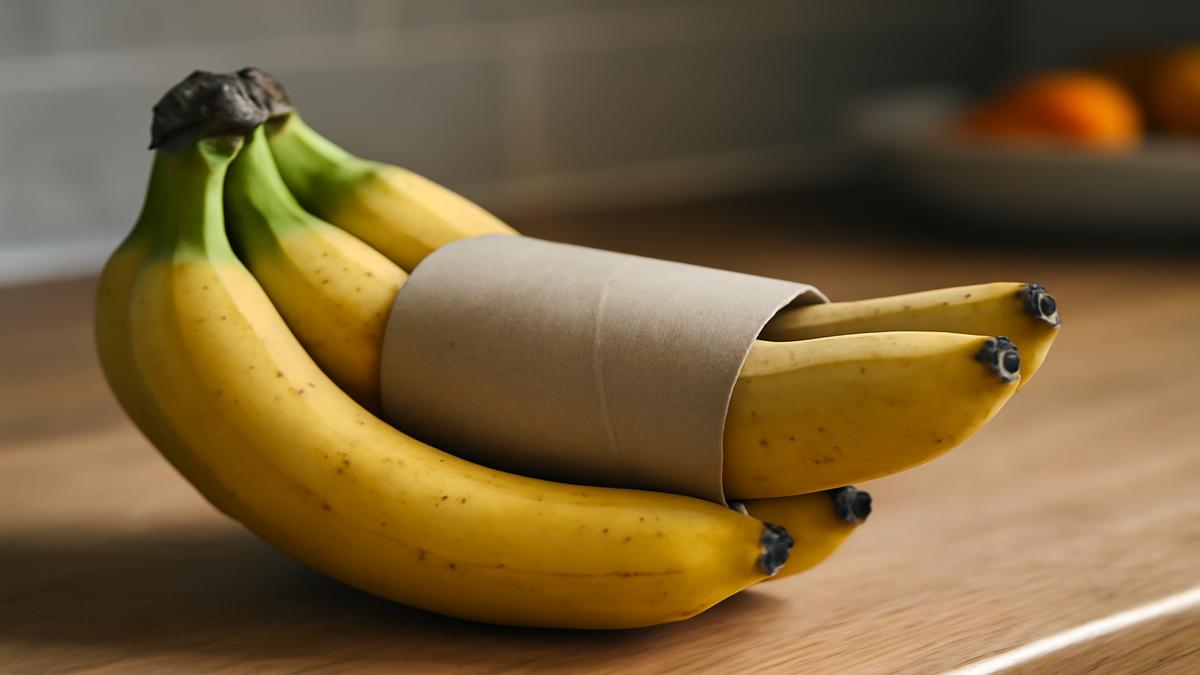
- Slip it over the banana stems. Gather your bananas together by the crown – that thicker, clustered part where all the stems meet – and wrap the tube around this section, closing it so it hugs the tops securely.
- Place the bananas away from other fruit. Set them on the counter or in a bowl, but give them some breathing room from apples, pears, or avocados, which also emit ethylene.
And that’s it. No gadgets, no clips, no cling film; just one piece of cardboard wrapped around the stems of your bananas like a little collar against time.
What you’ve done, in that small moment, is interrupt the way ethylene travels. The stems are the prime communication hub – the place where ripening signals circulate the most. By wrapping the crown, you’re gently interfering with that conversation, slowing down the constant exchange of ethylene between the bananas.
Does it stop ripening altogether? No. Bananas will still grow sweeter and softer over days. But you may find they stay in that golden, just-right stage for longer, spreading their journey out rather than tumbling all at once into overripe chaos.
The Secret Life of Ethylene (And Why the Tube Helps)
Imagine ethylene as a whisper that turns into a chorus. Each banana emits a tiny signal, which encourages nearby fruit to ripen more quickly. In a crowded bunch, the chorus grows louder, and the fruit races ahead. This is brilliant from a plant’s point of view – all the fruit ripening at once means more chance for some animal to eat it and scatter its seeds. But from your perspective as the shopper who just wants bananas for the week, it can be a bit of a disaster.
By wrapping the crown in that kitchen roll tube, you’ve added a light, simple barrier. You’re not sealing the bananas in a vacuum or blocking every puff of ethylene, but you are disrupting the hotspot where it builds up. It’s like cracking a window in a steamy bathroom – you don’t stop the shower from being hot, but you stop the mirror from fogging quite so fast.
The magic isn’t just in the physical material, either. It’s in the combination of contact, coverage, and a little bit of insulation. Cardboard has enough structure to stay in place and enough breathability not to trap unwanted moisture. It’s the low-tech, roll-of-the-dice type of innovation that lives in old kitchens where people quietly keep trying things until something works.
Trying It at Home: A Tiny Banana Experiment
There’s something strangely fun about turning your fruit bowl into a small laboratory. One quiet Sunday, you can line your bananas up like a science project in progress. Half of them get the cardboard crown. The others are left loose, stems bare to the air. You put them in the same room, lit by the same soft window light, and then you wait.
Over days, you start to notice the difference. Maybe the unwrapped bunch picks up freckles faster, the peel turning from smooth yellow to spotted in a blink. The others – the crowned ones – still yellow, still sweet, but not quite as hurried. They are ripening, yes, but more like they’re walking instead of sprinting.
Here’s a simple visual comparison you might notice over time:
| Day | Without Tube | With Tube on Stems |
|---|---|---|
| Day 1 | Greenish-yellow, firm | Greenish-yellow, firm |
| Day 3 | Bright yellow, a few spots | Mostly yellow, fewer or no spots |
| Day 5 | Speckled, softening fast | Yellow, just starting to freckle |
| Day 7 | Very spotty, great for baking only | Freckled, still good for eating fresh |
Your results will depend on the starting ripeness, your room temperature, and the mood of that particular bunch, but the pattern is often similar: the tube doesn’t freeze time, but it gives you a buffer. A few more mornings to slice a banana over porridge. An extra afternoon to pack one into a lunchbox. One more evening for a late-night snack that isn’t already mush.
There’s a quiet thrill in this – not because it’s high science, but because it feels like a tiny rebellion against waste. You’ve turned something throwaway into something quietly useful. Zero extra cost. Almost no extra effort. Just a bit more breathing room in your week.
Banana Wisdom: Small Habits That Make the Trick Even Better
The kitchen roll tube trick works best when it’s part of a small rhythm of banana care – nothing dramatic, just a few gentle habits layered together. If you already live with a fruit bowl as busy as a small marketplace, these details help your cardboard crown shine.
Some easy companions to the tube trick:
- Keep bananas away from other ethylene-heavy fruit. Apples, pears, kiwis, avocados – all of them give off ethylene too. The more they mingle in a bowl, the faster they’ll all rush to ripen. Give your bananas their own little corner on the counter.
- Choose where they sit. A cool, shaded spot will always slow them more than a pool of direct sunlight near a warm oven. Think “comfortably cool” rather than “chilled.”
- Hang them if you can. Using a banana hook or a simple string in an old-fashioned kitchen helps avoid bruising from hard surfaces, which can speed up soft spots and spoilage.
- Separate when they’re just right. Once a few bananas are at your favorite stage – yellow with only a whisper of speckles – you can gently pull them away from the main bunch. The more distance, the less they keep urging each other along.
- Chill them only at the end. If you must, pop already-ripe bananas into the fridge. The peels will darken, but the inside stays firm and sweet a bit longer.
All of these small rituals sit comfortably beside that one thin cylinder of cardboard. Together, they don’t just slow ripening; they slow the feeling of rush. They extend the life of your groceries, sure, but they also stretch the time between buying something bright and throwing away something spoiled. And in a world that too easily shrugs off waste, that matters.
Why This Silly-Sounding Trick Feels So Satisfying
There’s something charming about the fact that this doesn’t require a special product. No branded banana-saving clip, no silicone gadget, no extra plastic lurking in a drawer. The tool is already in your home, disguised as trash. It’s the kind of solution that feels more like a story than a purchase.
In many kitchens, especially in older houses or countryside corners, this sort of thinking is a quiet tradition. People have always looked at the scraps of daily life and wondered, “What else could this be?” Jars become vases, old shirts become cleaning rags, and a cardboard tube becomes a little harness for fruit stems.
There’s a pleasure in using what’s at hand – in knowing that your small act of curiosity can nudge nature’s timing just enough to work better with your own. It’s a reminder that sustainability isn’t always grand gestures; sometimes it’s just paying attention, noticing that if you cover this, separate that, hang something here, everything lasts a little longer.
Beyond the Fruit Bowl: What Bananas Teach About Time
Bananas are such ordinary things that it’s easy to forget how quietly dramatic they are. They travel thousands of miles, ripen in crates and on cargo ships, cross borders and supermarket shelves to finally land in your hand. By the time you’re deciding whether to slice one over cereal or throw a brown-spotted one into the freezer for “future smoothies,” there’s already been a long invisible journey behind it.
So the kitchen roll tube trick isn’t just a cute hack for staying a step ahead of speckles. In a small way, it honors that journey. It says: if this fruit has come all this distance, perhaps I can meet it halfway. Perhaps I can keep it fresh for long enough to actually eat it, instead of letting it slip too quickly into the vague guilt of food waste.
There’s a kind of quiet gratitude in that. In treating your bananas with the same care you might give to something more obviously precious. In wrapping the stems gently and giving them a little space so they last.
And in a funny way, that small act can shift how you see other parts of your kitchen. If covering a bunch of stems can make this much difference, what else might be possible with the things we normally ignore? How many other scraps and seconds can we reclaim with curiosity rather than convenience?
Making It Your Own
Once you’ve tried the kitchen roll tube, you might start to invent small variations. Maybe you cut the tube into shorter cuffs if you often buy just three or four bananas at a time. Maybe you decorate it with a child’s doodles or label it “Banana Crown” just because it makes you smile every time you see it on the counter.
You might find yourself keeping a small stash of empty tubes in a drawer, ready for each new bunch. Or you might become the person who passes the trick along at work or in the family chat, with a quick photo of your bananas lined up beneath their cardboard collar, staying golden just a little longer than they used to.
In that sense, it’s more than a hack – it’s a kind of gentle, domestic folklore. A tiny piece of passed-on wisdom that lives in kitchens, travels by word of mouth, and settles into your own routine like it’s always been there.
Frequently Asked Questions
Does the kitchen roll tube trick really work, or is it just a myth?
It doesn’t stop ripening completely, but it can noticeably slow it down. By wrapping the stems – the main area where ethylene builds up and circulates – you reduce how quickly the bananas push each other to ripen. Many people see an extra couple of days of good, eatable ripeness compared to untreated bananas.
Is cardboard better than plastic wrap for banana stems?
Plastic wrap can also slow ripening by covering the crown, but cardboard has the advantage of being reusable, breathable, and usually already on hand. It doesn’t cling as tightly, which helps avoid trapping excess moisture around the stems.
Should I separate the bananas before using the tube?
You can, but you don’t have to. The trick is most often used on the whole bunch, wrapped around the joined crown. If you prefer to pick off bananas as you go, you can still keep the tube on the remaining cluster to help them last.
Can I use a toilet roll tube instead of a kitchen roll tube?
Yes, a toilet roll tube works in exactly the same way. It’s just a bit shorter, so it may be a tighter fit on a large bunch. Cut it lengthways, open it gently, and wrap it around the stems.
Where is the best place to store bananas with the tube on?
Keep them at room temperature in a cool, shaded spot away from direct sunlight and away from other ethylene-heavy fruits like apples and avocados. You don’t need to refrigerate them while they’re still firm and yellow.
What if my bananas are already very ripe?
If they’re already heavily speckled and very soft, the tube won’t turn back the clock. At that stage, peel and freeze them for smoothies or baking, or use them in banana bread, pancakes, or muffins. The tube works best when the bananas are still greenish-yellow or just turning fully yellow.
Can I reuse the same cardboard tube for multiple bunches?
Yes. As long as the tube is dry and intact, you can reuse it again and again. If it becomes damp, stained, or starts to break apart, simply compost or recycle it and replace it with a new one from your next empty roll.

Hello, I’m Mathew, and I write articles about useful Home Tricks: simple solutions, saving time and useful for every day.