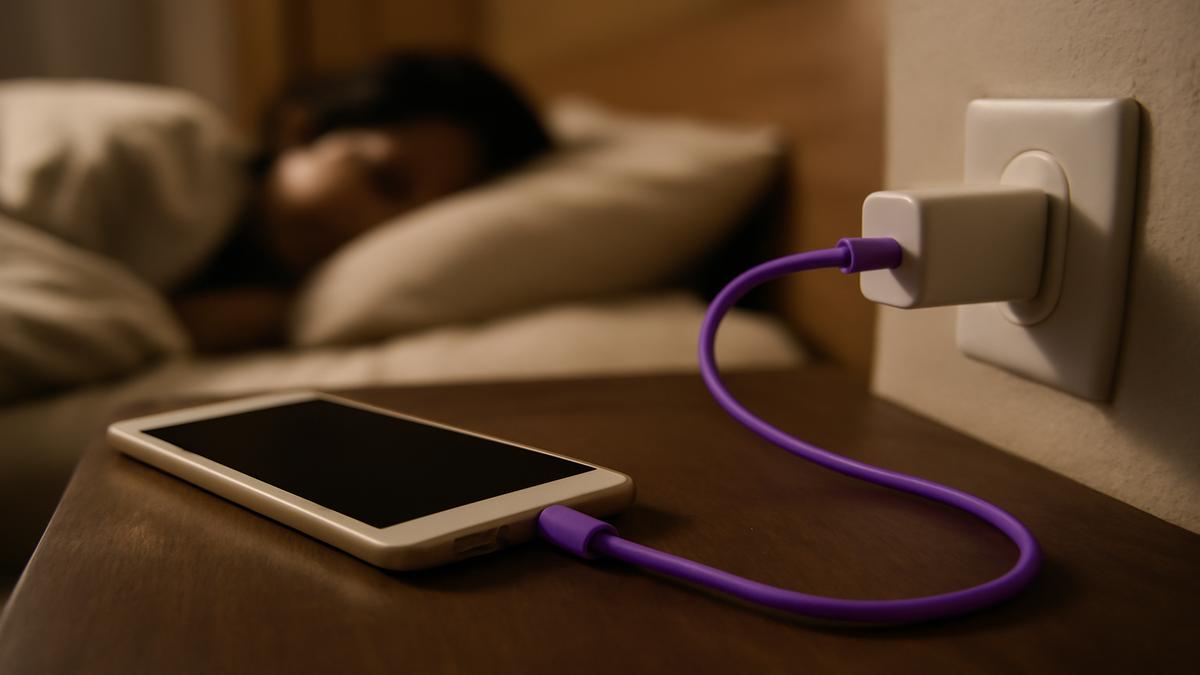
You don’t notice it at first. Just a soft, ghostly glow at the edge of your vision when you turn out the lights. The hum of your day has finally gone quiet, blankets pulled up, your body heavy with the promise of sleep. Then your eyes flick open again, pulled by something small and strangely insistent: a pinprick of light near the bedside table, steady and unblinking.
Your phone charger is awake.
The blue or white LED on the cable looks innocent enough — helpful, even. It tells you the cable’s working, your phone’s charging, all is well. But that tiny, sharp glow is doing something else too. It’s piercing through the darkness your brain needs, whispering to your body, “It’s not really night yet.”
And your body, loyal and literal, believes it.
The Quiet Saboteur by Your Bed
Imagine your bedroom in the middle of the night as a forest at dusk. Everything is softening, slowing down. The sounds are gentler, the colours fading to shadow. You are, biologically speaking, a creature tuned to this fading light. Your hormones shift with it; melatonin rises as darkness deepens, guiding you softly into the deep woods of sleep.
Now picture, in that quiet forest, a sudden bright-blue spark in the undergrowth. Harsh, electric, unnatural. Your instincts would flare. You’d turn your head. You’d wake up a little more.
That’s what that glowing phone charger is doing on your nightstand, every single night. Not in a dramatic, alarm-bell way — but in a slow, chronic nudge. A fraction less melatonin here, a slightly shallower sleep cycle there, a few more minutes to fall asleep, one more 3 a.m. wake-up you can’t quite explain.
We talk so much about screens, doomscrolling, blue light from phones and laptops — and yes, those matter. But the strangest saboteurs of all are the tiny artificial stars we willingly plant in our bedrooms: the little LEDs on chargers, power strips, speakers, Wi‑Fi routers. The worst offenders? Often those cool-toned, icy blue charger cables that burn like miniature moons in the dark.
The Colour Your Brain Thinks Is Morning
Here’s the part our bodies still remember, even if we don’t think about it much: for millions of years, the only light at night was fire and the moon. Night meant darkness, warmth, maybe the red-orange flicker of a flame. Morning meant cool, rising light — the sun lifting over the horizon, the sky shifting through grey and blue.
Your brain evolved under that rhythm. It still uses light color as a cheat-sheet for time of day.
Cool blue light = “It’s morning. Wake up. Stay alert.”
Deep darkness or warm, low light = “It’s night. Power down. Release melatonin.”
Now place a bright blue or icy white LED right beside your face for eight hours. Your eyelids aren’t blackout curtains. Even closed, they let in about 5–10% of light. That doesn’t sound like much, but in the quiet language of hormones, it’s like whispering “not yet, not yet” to your sleep all night long.
Many modern charging cables and adapters now come with bold, bright indicator lights — especially blue and white ones. They stand out in the shop display. They feel futuristic and “techy.” But your brain doesn’t care about aesthetics. It cares about wavelength. And blue sits right in the spot that screams “daylight”.
You don’t need to feel jolted or “blinded” for it to matter. Tiny amounts of the wrong-coloured light at night can nudge your circadian rhythm just enough to dull the edge of your sleep. Not broken, just… blunted. You wake up feeling strangely unrefreshed, even if you were technically “in bed” for seven, eight, nine hours.
The Night Your Bedroom Turned Into a Cockpit
Think of the last time you walked into your bedroom in full darkness with all the tech powered but screens off. What did you see?
Maybe the tiny green eye of the speaker in the corner. The blue-teeth of a Bluetooth device. The blinking router down the hall, leaking light under the door. And by your bed, the cold LED of your phone charger cable — a little island of sky-coloured light that never sleeps.
Your bedroom, meant to be a cave, has quietly become a cockpit.
Now, in a cockpit, those lights have a purpose: to keep pilots awake, to keep minds switched on, to keep systems alive. In a bedroom, they do almost the same thing, but that’s the last thing you actually want at 2:37 a.m.
Some people try to fight back with folded T‑shirts draped over chargers, socks thrown over routers, bits of masking tape hastily slapped over LEDs. Quick hacks, all of them. But there’s a simpler, more beautiful solution for at least one of the biggest culprits:
Change your cable. Not just the design. The colour of its glow.
The Case for a Softer, Warmer Cable
Not all light at night is the enemy. Candlelight doesn’t jolt your brain the way a cold blue LED does. A campfire doesn’t make you think of a glaring midday highway. Our bodies are far, far more forgiving of warmer, redder, softer hues in the dark.
That’s where your choice of charging cable can quietly change the entire feeling of your nights.
Picture this: instead of that piercing, neon-blue indicator, your cable has a soft amber or very dim red light — or better yet, no light at all. Nothing burns a hole into the room. Your nightstand goes back to silhouette and shadow. Your phone still charges; it’s still there within reach. But the visual noise is gone. Your cave is a cave again.
Changing just this one small object on your bedside table can create a chain reaction that doesn’t feel dramatic, just… kinder. The room darkens. Your eyes soften faster. You toss and turn less. The space where you sleep feels less like a charging station and more like a nest.
If total darkness feels unsettling to you, a cable or lamp that uses a deep amber or low red light can be a gentle compromise — enough to navigate the room without kicking the bedframe, not so strong that it shouts “wake up” at your hormones.
What to Look for When You Swap Cables
When you’re choosing a new cable or charger to bring into your bedroom, you’re not just buying a tool. You’re inviting light into your sleep space. So it’s worth being deliberate. Here are some simple ways to think about it:
| Feature | Better for Daytime | Better for Night / Bedroom |
|---|---|---|
| Indicator Light Colour | Bright blue, cool white | Soft amber, dim red, or no light |
| Brightness Level | Strong, easily visible across a room | Very dim, only visible up close |
| Cable Placement | Anywhere on your desk or office | Below bed level or turned away from eyes |
| Ideal Use | Quick status check, busy room | Long hours of sleep, sensitive eyes |
You don’t have to become a lighting engineer. Just a few basic questions will do:
- Does this cable glow in the dark? If yes, how bright is it?
- Is the light cool (blue/white) or warm (amber/red)?
- Will it be at eye level while I sleep?
From there, your choices get simple. Choose warmer, dimmer, or no-light cables for the bedroom. Keep the bright blue indicators for the office or kitchen — spaces where your brain isn’t trying to fall into dreamland.
Designing a Darker, Kinder Nightstand
There’s something strangely intimate about your nightstand. It’s the last landscape you see before surrendering to sleep and the first you blink at in the grey of morning. A glass of water, a book, maybe a lamp, the tangle of a charging cable. A quiet still life of your most private hours.
Shifting that still life toward darkness doesn’t mean turning your room into a bunker. It means aligning it more closely with what your animal body understands as night.
Start by standing at the bedroom door with the lights off and your eyes adjusted. Really look. Every point of light you see — the glaring charger, the little green dot on the speaker, the router flicker under the door — is a question:
Do I need this here, at night, in this room where I sleep?
You might decide to move the router to another space entirely. You might put the speaker in the living room. You might angle a power strip so its lights face the wall instead of your bed. And that charger? That can be your easiest win. Swap it for one that doesn’t feel like a shard of daylight held inches from your face.
Layer by layer, LED by LED, your nightstand shifts back from cockpit to campfire. The darkness thickens. Your body exhales.
A One-Night Experiment You Can Feel
Try this tonight, if you can:
- Remove or cover every blue or white indicator light in your bedroom — especially the one on your phone charger.
- Use a cable with either no light or a very soft warm glow, and keep it below eye level (like on a low shelf or the floor).
- Turn off ceiling lights early and use a warm lamp or dim light in the hour before bed.
- When you finally switch everything off, pause. Notice how dark the room actually is. Let your eyes adjust.
You may find that you fall asleep a little quicker. Or you might notice something subtler: your mind feels less “buzzed,” more like it’s strolling into sleep instead of sprinting.
One night won’t rewrite years of habits, but it can give you a taste of what’s possible when your bedroom starts working with your biology instead of against it.
When Your Charger Becomes a Ritual
For many of us, plugging in the phone at night has become as much a ritual as brushing our teeth. It’s the moment we finally admit: the day is done. There’s no more to check, no one left to answer.
What if that ritual could also gently signal to your body that night has truly begun?
Picture this scene:
You walk into a bedroom that’s already dim, lit only by a warm pool of light from a bedside lamp. You set your phone down. The cable you reach for is a soft braided cord that doesn’t glow like an emergency beacon. If it has an indicator, it’s a tiny ember of amber, barely visible unless you look for it.
You plug in the phone like you’re hanging up the day. The lamp clicks off. The room collapses into a soothing, almost velvety dark. No glaring blue points hovering in the corner of your vision. Just the slow outline of furniture, the faint suggestion of curtains, the quiet hum of your own breathing.
This is not a sterile tech moment. This is a small, tactile, human ritual. The colour and quality of that tiny piece of technology supports the mood you’re trying to create — instead of running crosswise to it.
And over time, your body learns: this colour of light, this level of darkness, this nightly gesture — these are the cues that say, “It’s safe to let go now.”
It’s Not About Perfection — It’s About Permission
Your life is probably not arranged like a retreat in a remote forest. There will be nights when you doomscroll under the covers, mornings when your alarm drags you up far too early, evenings lit by bright kitchen LEDs while you do dishes at 11 p.m. That’s real life.
But there’s a quiet power in making even one small change that points in the direction of deeper rest.
Swapping a harsh blue charging cable for a softer, warmer one doesn’t solve everything. But it is a tangible step — something you can hold in your hand and say: “I’m choosing sleep, here. I’m choosing my nervous system. I’m choosing to give myself a little more darkness.”
In a world where so many of our habits nibble away at rest, this is one habit that gives a bit back.
Tonight, Let the Night Be Night Again
Stand in your bedroom with the lights off and really look at how many tiny suns you’ve invited into your midnight. Notice the way that blue charger LED cuts through the dark like a shard of ice. Ask yourself how it feels, in your body, to fall asleep under that constant, low-intensity glare.
Then imagine the room after you’ve swapped it.
The same bed. The same blankets. The same phone, quietly filling with charge. But the colour of the technology in your hand has changed. The night no longer feels perforated by little points of artificial dawn. It feels, finally, like night.
Your phone will still be fully charged by morning. But you might be a little more charged too — in the way that actually matters. Not the frantic alertness of too much blue light, but the steady clarity of a body that knows it was allowed to truly, deeply rest.
So yes, your phone charger might be frying your sleep. Not dramatically. Not loudly. Just a slow, nightly sizzle at the edges of your rest. Swap the colour of that cable — or its light — tonight, and see what happens when your bedroom remembers how to be dark again.
FAQ
Is a tiny LED really enough to affect my sleep?
It can be. Your circadian system is remarkably sensitive to light, especially in the blue range. Even a small, cool-toned LED at night can slightly suppress melatonin and nudge your sleep rhythm later, especially when it’s near your face for hours.
What colour light is best in the bedroom at night?
Deep red or very warm amber light is generally the least disruptive, and total darkness is ideal for most people. Blue and cool white should be avoided as much as possible while you sleep.
Do I need to stop charging my phone in the bedroom?
Not necessarily. The key is how and where you charge it: use a cable or charger with no bright blue/white LEDs, keep it slightly away from your pillow, and try not to use the screen in the last stretch before sleep.
If I cover the LED with tape, is that enough?
Covering or dimming the LED helps a lot, especially if you use opaque or thick tape. But if you’re buying something new, choosing a cable with no light or a warm, very dim indicator is an even cleaner solution.
How long does it take to notice a difference after changing my setup?
Some people feel a change in just a night or two — falling asleep faster or waking less often. For others, it may take a week or more as their circadian rhythm gently realigns to a darker, calmer sleep environment.
Is screen time worse than a glowing charger?
Staring at a bright screen close to your face before bed is usually more disruptive than a single LED. But the LED works against you all night, even after you’ve put the phone down. Reducing both evening screen time and stray blue lights gives the best results.
What if I actually like a bit of light at night?
Then aim for the friendliest version of it: a very low-intensity red or amber source, placed away from direct eye contact. A gentle, warm glow is much easier on your sleep system than blue or white light from chargers and devices.

Hello, I’m Mathew, and I write articles about useful Home Tricks: simple solutions, saving time and useful for every day.