The first time I poured banana peel water into a tired-looking orchid, I’ll be honest—I didn’t expect anything. The plant had been sulking on my windowsill for months, leaves like dull green leather, flowering spike long gone and snipped back. Its original bloom, the one that had seduced me at the garden center with impossible purple wings, felt like a lie. Orchids are “hard,” everyone says. They’re fussy. They need special food in tiny, expensive bottles with mysterious labels and charts. And yet, a bowl of brownish, slightly sweet-smelling liquid made from the scrap of my morning fruit did what those fancy fertilizers never quite managed: it woke the orchid up.
How a Sad Orchid and a Banana Peel Changed Everything
It started on a quiet Sunday morning. Sunlight was barely spilling over the kitchen counter, catching the thin glass vase where my orchid sat, looking more like a prop than a living thing. I was making breakfast—coffee, toast, a banana sliced over yogurt—when the peel slipped from my hand toward the compost bowl.
On impulse, I stopped. I’d seen a stray comment somewhere online: “Don’t throw banana peels away—plants love them.” It had sounded like the sort of vague advice that belongs next to “talk to your plants” and “play classical music for your ferns.” But something about it snagged my attention again. Maybe it was the price tag still stuck in my mind from the last bottle of orchid food I’d reluctantly bought, or the sinking feeling each time another flower fell.
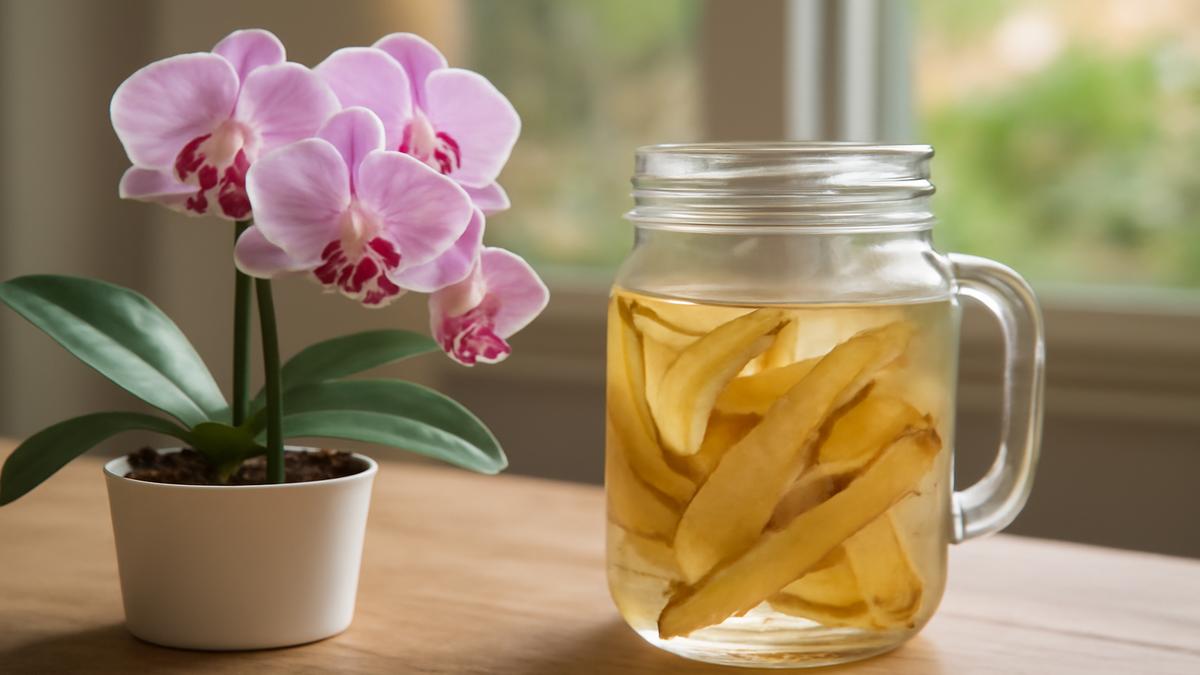
Curiosity won. I rinsed the peel, sliced it into strips, dropped it into a jar, and poured in water from the kettle that had cooled a bit. The water clouded to a pale tea color, then deepened as I left it on the counter. By the next day, I had banana peel water: a simple, homely-looking concoction that smelled faintly like fruit and earth.
It didn’t feel like a “hack,” or some viral gardening trick. It felt almost embarrassingly old-fashioned, the sort of thing someone’s grandmother might have quietly done for decades. Still, I diluted it, carried it over to my orchid, and gave the plant a long, slow drink.
Nothing happened in that moment, of course. But nature usually works on a slower clock than we do. A week later, something changed—or rather, something dared to begin.
The Slow Magic: What Banana Peel Water Actually Does
Before we get swept away by miracles, let’s talk about what’s really in that banana peel water, and why your orchid might treat it like a gourmet meal rather than kitchen trash. Think of banana peel water as a gentle, homemade tonic—soft on the plant, strong in quiet ways.
Banana peels are rich in a handful of nutrients that orchids quietly crave:
- Potassium – the star player, helping your orchid manage water balance, strengthen stems, and build resilient, long-lasting blooms.
- Phosphorus – supports root growth and helps the plant channel energy into developing buds and flowers.
- Calcium and Magnesium (in small amounts) – help keep leaf tissue strong and chlorophyll production smooth and steady.
When you soak the peels in water, some of these minerals dissolve slowly into the liquid. The result isn’t a harsh chemical blast like some synthetic fertilizers—it’s more like a soft infusion, a plant-friendly tea. For orchids, which can be easily burned or overwhelmed by strong feeds, this gentleness is everything.
My once-limp orchid didn’t explode overnight into blossom. But the leaves brightened from a flat, matte green to a deeper, glossier shade. A new root tip pushed out, smooth and silver-green, and then another. And then, as if the plant had finally remembered what it was made to do, a slender spike emerged from the base of a leaf, curving toward the light like a question mark.
That spike was only the beginning. And through trial, error, and an embarrassing number of bananas, I learned how to turn this simple peel water into a rhythm that coaxed not just one rebloom, but a near-monthly cycle of flowers.
The Simple Ritual: Making Banana Peel Water for Orchids
You don’t need a lab, a greenhouse, or a shelf of specialized products. If you have a kitchen, some bananas, and a jar, you have almost everything you need. The key is consistency and subtlety—orchids thrive on a soft, regular nudge rather than an occasional shove.
Step-by-step banana peel water
- Choose your bananas wisely. Use ripe, yellow bananas without mold or rot. A few freckles are fine, but avoid black, collapsing peels.
- Rinse the peel. Quickly rinse under running water to remove any dust or residues.
- Cut into pieces. Slice the peel into small strips or squares to increase the surface area.
- Soak in clean water. Place peels in a glass jar and cover with room-temperature water. A good ratio is 1 medium peel to about 2–3 cups (500–700 ml) of water.
- Steep, don’t stew. Cover the jar loosely and let it sit for 24 hours at room temperature. This allows nutrients to leach into the water without going funky.
- Strain carefully. Remove the peels and any floating bits. You want a clear, light golden liquid.
- Dilute before use. For orchids, mix about 1 part banana peel water with 2–3 parts fresh water. This keeps the feed gentle and safe.
Resist the urge to push the process longer “for extra strength.” After 24–36 hours, decomposition speeds up and you slide from nutritious to sour and potentially harmful. Your nose will warn you—if it smells off, compost it and start fresh.
How often to use it
Imagine your orchid as a slow-breathing forest epiphyte (which many of them are), living on tree branches, sipping nutrients from passing rainwater. Constant, heavy feeding wouldn’t exist in that world. Light, rhythmic nourishment would.
- During active growth or budding: Use diluted banana peel water about once every 7–10 days.
- During blooming: Every 10–14 days is plenty to support flowers without stressing the plant.
- During resting periods: Once a month, or switch back mostly to plain water.
Always make sure your orchid’s potting mix is appropriate (bark, sphagnum, or a specialized orchid mix), and that there’s good drainage. Banana peel water is a boost, not a cure for soggy roots or the wrong soil.
From One Bloom a Year to Flowers Almost Every Month
The real transformation didn’t happen the first time my orchid bloomed again. It happened the third time. And the fourth.
That first new flower spike crawled upward for weeks, developing fat, green buds that looked too heavy for the thin stem. When the first bloom unfurled, it was bigger than the original store-bought flowers, the petals slightly thicker, more luminous in the low afternoon light. I remember standing there with my mug of coffee, stunned. This wasn’t a fluke, I thought. This plant is better than when I bought it.
So I kept going. Once a week, the banana peel water ritual. Always diluted. Always fresh. In between, plain water, a gentle mist in the morning, and a rotation on the windowsill so every leaf got its share of light.
After the first flush of blooms faded, I did what many people are afraid to do: I cut the spent spike back just above a small node, a tiny bump along the stem. I kept feeding. A few weeks later, that node began to swell and push out a side branch. By then, new roots were reaching down like white-green fingers, grabbing into the bark, and a fresh leaf was unfurling, thick and glossy.
The plant seemed to understand the rhythm: grow, rest briefly, then bloom again. Some months it produced a full new spike. Other times, it offered a side branch bursting with smaller but equally vivid flowers. The cycle tightened until I was seeing some kind of bloom or bud nearly every month.
Every orchid is different, of course. Light, temperature, variety, and overall health matter. But that steady, gentle stream of potassium- and phosphorus-rich water appeared to tell the plant, confidently and repeatedly: “You can afford to bloom. You have what you need.”
Comparing the Costs and the Payoff
There’s another quiet magic to banana peel water: the way it rearranges your relationship with both plants and waste. Instead of buying more products and throwing away more peels, you’re closing a loop, turning leftovers into life.
| Aspect | Banana Peel Water | Commercial Orchid Food |
|---|---|---|
| Cost | Essentially free (from kitchen scraps) | Ongoing purchase, often expensive |
| Nutrient Strength | Gentle, low and slow release | Concentrated; easy to overdo |
| Environmental Impact | Reduces food waste; no plastic bottles | Packaging, manufacturing, and transport footprint |
| Ease of Use | Simple to make; no formulas | Requires measuring and dilution charts |
| Risk of Burn | Very low when diluted | Higher if mismeasured or overused |
There’s nothing inherently evil about store-bought orchid fertilizers. They work, and sometimes they’re useful, especially if you’re rehabbing a very weak plant. But if what you want is steady, long-term health and frequent reblooming, you can get surprisingly far with something you already have in your fruit bowl.
Listening to Your Orchid: Signs It Loves Banana Peel Water
Orchids don’t wag their tails or purr when they’re happy, but they do speak. Slowly, in the subtle language of leaves, roots, and buds. When you begin feeding banana peel water regularly, here are the quiet signals to look for:
- Plumper, firmer leaves – They feel less like thin paper and more like sturdy fabric when you touch them.
- Healthy green root tips – New roots with bright, green tips show that the plant feels safe enough to expand.
- Glossy sheen on foliage – Not artificial shine, but a natural glow that catches the light.
- Steady new growth – Leaves emerging every few months, not just once in a blue moon.
- Buds that don’t abort – Instead of drying up and dropping off, they swell and open fully.
If you notice leaves yellowing from the base or roots staying mushy, the issue is rarely the banana peel water. It’s more likely overwatering, poor drainage, too little light, or an exhausted potting medium. The peel water is a support act, not the main stage.
Watch the plant the way you’d listen to a friend’s tone of voice. If it seems “off”—drooping, dull, or shriveling—pause, simplify, and return to basics: good light, proper watering, and fresh air around the roots. Then slowly reintroduce the banana water once it stabilizes.
A Few Gentle Rules to Keep in Mind
- Never leave peels in the pot. They don’t belong on top of the orchid bark; they’ll rot, attract gnats, and suffocate roots.
- Don’t drench constantly. Alternate banana peel water feedings with plain water to avoid buildup.
- Mind your tap water. If your tap water is very hard or heavily chlorinated, consider using filtered or rainwater for both soaking peels and watering orchids.
- Watch the smell. If your banana peel water smells fermented or sour, discard it. Fresh, light, and slightly sweet is your target.
Orchid Care Beyond the Bottle
The deeper gift of banana peel water isn’t just practical or economical. It nudges you into a different way of seeing your plants, your kitchen, and even your daily habits. You begin to notice how much of what we throw away is only half-finished usefulness. You notice how patient growth is. How transformation rarely arrives in a single, dramatic moment, but in a series of small, faithful gestures.
You stop thinking of orchids as high-maintenance divas demanding boutique treatments, and start seeing them as what they are in the wild: air plants clinging to tree limbs, surviving on filtered sunlight and whatever the rain washes down to them. They don’t need you to be a chemist. They need you to be consistent, observant, and gentle.
A jar on the counter with a banana peel in it becomes something almost ceremonial. You slice fruit for breakfast, toss the peel in, fill with water, and 24 hours later, you’re pouring that quiet infusion into a pot where pale roots curl like calligraphy. Weeks pass. Spikes rise, buds form, petals unfurl like soft flags. And you watch, a little stunned, realizing the most ordinary parts of your day have turned into a collaboration with something wild and delicate and alive.
Every new flush of flowers starts to feel like a conversation between your habits and the plant’s trust. The fact that you didn’t need to buy a single expensive bottle to make that happen—that you turned scraps into blossoms—only makes it sweeter.
FAQs About Banana Peel Water and Orchids
Can banana peel water replace orchid fertilizer entirely?
For many healthy household orchids, especially common varieties like Phalaenopsis, banana peel water can provide enough gentle nutrition on its own when used regularly and paired with good light and watering. If you’re growing rare or very demanding species, or trying to rescue a severely weakened plant, you may still choose to supplement occasionally with a balanced orchid fertilizer at low strength.
How long can I store banana peel water?
It’s best used fresh. Aim to use it within 24–36 hours of soaking the peels. Beyond that, it can start to ferment or develop bacteria. If it smells sour or unpleasant, discard it and make a fresh batch.
Will banana peel water attract pests or mold?
The water itself, when properly strained and used promptly, usually doesn’t cause problems. Issues arise if you leave peels or fruit pieces in the potting mix, or store the water too long. Always strain thoroughly, avoid getting it on leaves and crown, and never bury peels in the pot.
Can I spray banana peel water on the leaves?
It’s better to water the roots instead. Misting or spraying leaves with banana peel water can leave a sticky residue that attracts dust or pests and may encourage fungal spots. Keep leaf misting to plain water if you do it at all, and always let leaves dry quickly in good air circulation.
Is banana peel water safe for all types of orchids?
Most commonly grown orchids—like Phalaenopsis, Dendrobium, Cattleya, and Oncidium—respond well to gentle, diluted banana peel water. More sensitive or unusual species may prefer even lighter feeding. When in doubt, start with a very weak solution, watch the plant for a few weeks, and adjust slowly.
How soon will I see results after starting banana peel water?
Orchids move at their own pace. You may notice subtle improvements in leaf color and root activity within a few weeks. New spikes or reblooming can take one to several months, depending on the plant’s cycle, light, and overall health. Think in seasons, not days.
Can I use banana peel water on my other houseplants too?
Yes. Many houseplants, especially flowering and fruiting types, enjoy the gentle potassium boost. Just remember to dilute it, avoid overuse, and adjust frequency based on each plant’s needs. What your orchid loves, your tomatoes, roses, and even some leafy greens may quietly appreciate too.

Hello, I’m Mathew, and I write articles about useful Home Tricks: simple solutions, saving time and useful for every day.