The cabin lights dimmed to a soft amber, and the plane settled into that strange, suspended stillness you only feel at 36,000 feet—part sleepover, part spaceship, part waiting room in the sky. Around you, screen glow flickered over half-closed eyes, ice clinked in tiny cups, and somewhere nearby a baby began to cry again, thin and insistent. You watched yet another movie you wouldn’t remember tomorrow. Sleep felt about as likely as stepping outside onto the wing for a walk.
The Secret in the Galley
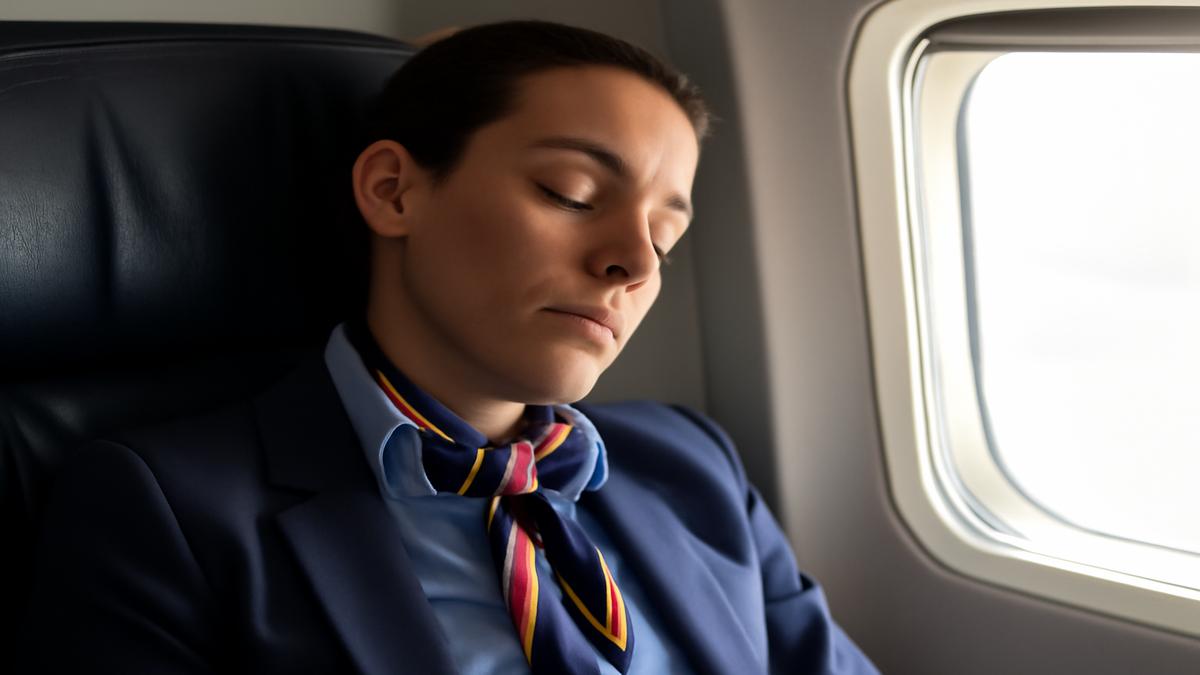
It was sometime after the second round of drinks and before the third apology from the pilot about turbulence that you noticed her—the flight attendant leaning against the galley wall. Her shoulders were relaxed, eyes half-lidded, breathing so slow you almost wondered if she had drifted off standing up.
Minutes earlier she had been moving like quicksilver: serving meals, lifting bags, checking seatbelts with that calm efficiency people develop only after years of juggling strangers and gravity. Now, in a brief lull, she’d slipped into a quiet stillness, her body language soft, almost serene.
You watched, curious. Her chest barely moved. Instead, there was the faintest rise and fall in her belly, like the surface of a lake on a windless morning. In. Out. In. Out. Not the shallow, tense breathing of everyone else cramped in their economy cocoons. Something slower. Deeper. Different.
“How do you do it?” you finally asked when she passed by again, voice low so as not to disturb the row of restless almost-sleepers beside you. “Sleep on planes, I mean. I can barely shut my brain off.”
She smiled, the kind of smile you see from someone who lives inside jet lag and has learned how to outsmart it. “We have a trick,” she said. “Reverse breathing. Learned it in training. I can fall asleep almost anywhere now.”
Reverse breathing. The phrase lodged in your mind. It sounded like something a yoga teacher might whisper in a candlelit studio or a mountain guide might mutter while watching storm clouds roll over a ridge. But here it was, whispered over the hum of engines and the rattle of the drinks cart: a hack, passed hand to hand among people who make a life out of sleep in impossible places.
What Reverse Breathing Actually Is (and What It Is Not)
Imagine, for a moment, the way most of us breathe when we’re stressed or traveling. The air stays high and shallow in the chest, ribs barely widening, shoulders lifting with each quick inhale as if we’re perpetually bracing for impact. It’s survival breathing—enough to keep us going, not enough to make us feel safe.
Reverse breathing flips that script, not by forcing you to take more air, but by changing the way you move it.
Instead of expanding your belly when you inhale and letting it fall as you exhale—the classic “belly breathing” you’ve probably heard about—reverse breathing pairs the movement of the abdomen with the opposite phase of the breath. You gently draw your belly in on the inhale, then let it soften and expand again on the exhale.
Sounds wrong, doesn’t it? Everything you’ve been told about “proper breathing” runs the other way. And yet, that tiny rearrangement changes how your nervous system reads the moment. It offers your brain a new rhythm: one that slides you away from the jangling alarm bells of wakefulness and closer to the slow, deep drumbeat of sleep.
Where traditional belly breathing is like sinking into a warm bath, reverse breathing—at least the way seasoned flight attendants use it—is more like slipping into a heavy blanket on a cold night. It creates a subtle internal pressure, a feeling of containment and groundedness that says: you are held, you are safe enough to let go.
The Body’s Quiet Switchboard
Inside your ribcage, each breath is a conversation between your lungs, your diaphragm, and a dense web of nerves. Change the pattern of that conversation, and signals begin to shift. Heart rate slows. Muscles soften their grip. Thoughts lose their hard edges.
Reverse breathing works partly by massaging the area around your solar plexus—where many of us carry worry like a tight knot. Drawing the belly gently inward on the inhale slightly engages the deep core muscles, bringing your attention away from the noise in your head and down into the center of your body. Then, when you exhale and allow the belly to ease outward, the release signals your system: now we rest.
For people who sleep in metal tubes slicing through the sky at hundreds of miles an hour, that signal matters.
How Flight Attendants Actually Use It (Even Standing Up)
On long-haul flights, rest doesn’t always mean a cozy bunk behind a curtain. Often, it means twenty stolen minutes in a jump seat, or a quiet pause in the galley, or leaning against the bulkhead where the lights are dimmest, trying to coax the body into something that at least resembles rest.
Ask a few flight attendants about how they manage to sleep between time zones, and themes emerge. Noise-canceling headphones help. So do eye masks, thick socks, and a battle-hardened sense of detachment from crying babies and seat-kickers. But over and over, you’ll hear some version of the same thing: control the breath, and the rest might follow.
Reverse breathing is one of those tools—simple, portable, invisible. No app, no gadget, no special position required. You can do it with a seatbelt on, tray table up, window shade open to a sunrise you’re not even sure belongs to your day.
The Basic Reverse Breathing Sequence
It goes something like this, though every attendant has their own small variations:
- Get as comfortable as the circumstances allow. Head against the window. Hands loosely on your lap. Feet flat if possible, or folded in a way that doesn’t pinch.
- Close your eyes or soften your gaze. Let your focus blur. Pretend you’re watching your thoughts from the aisle instead of sitting in your own seat.
- Exhale gently through your nose. Don’t force the air out; just let it leave, like a sigh you didn’t know you were holding.
- Inhale slowly through your nose, drawing your belly in very slightly. Not a hard clench—not sucking it in for a photo—just a subtle inward motion, as if you were tightening a soft drawstring.
- Pause for a beat. Not a hold, not a struggle—just a brief moment of stillness.
- Exhale longer than you inhaled, letting your belly soften and expand. Feel it almost spill outward, like the body melting into bed at the end of a long day.
- Repeat. Inhale: belly gently in. Exhale: belly soft and out. Slow, steady, unhurried.
Some attendants count silently in their heads: four counts in, six or seven out. Some sync the rhythm to the engines. Some pair it with a simple phrase—in, gathering; out, releasing—like a quiet mantra carried below the level of thought.
How It Feels From the Inside
At first, it can feel almost backwards, like trying to write with your non-dominant hand. The mind might protest: this is wrong, this is weird, this is not how breathing works. But if you stay with it for a few minutes, something begins to loosen.
The tight band around your chest—so familiar you might not have even noticed it until now—starts to ease. Your shoulders sink a few millimeters deeper into the seatback. Sounds drift a little farther away, like waves receding from shore.
You might even notice the plane swaying beneath you in a softer, slower way, as if its movements have synced to your breathing instead of the other way around.
The Strange Comfort of Breathing Against Instinct
There’s something almost subversive about reverse breathing. You are, in a small and harmless way, going against the grain of your automatic habits. In a world that constantly nudges you toward urgency, toward faster, higher, more, you are quietly choosing slower, deeper, less.
High above the clouds, where everything feels dislocated—time zones stacked like books, day and night folded over each other—this is its own kind of orientation. You can’t feel the ground beneath your feet, but you can feel the air moving through your own ribs. You can’t see the horizon, but you can follow the arc of your own breath.
For flight attendants, this becomes a kind of anchor. The plane may be hurtling from one continent to another, but reverse breathing writes a small, steady line of continuity through each journey, a private ritual hidden inside the choreography of safety demos and service runs.
A Pocket-Sized Sleep Ritual
What makes this hack powerful is not that it’s flashy, but that it’s repeatable. You can use it:
- On a red-eye, with a stranger’s elbow drifting steadily across the armrest.
- In a hotel room that smells faintly of other people’s stories and industrial detergent.
- On a train with fluorescent lights that refuse to dim.
- In your own bed, when the day won’t let go of your shoulders.
Over time, the pattern itself becomes a cue. The moment you start pairing that inward-then-outward belly motion with slow nasal breathing, your body recognizes the script: we’ve done this before; usually this ends in sleep. The nervous system, like any good listener, responds to repetition.
The Science Beneath the Softness
Strip away the lore and the sky-high anecdotes, and what remains is a very grounded, physiological effect. Reverse breathing taps into the same wiring that underlies many classic relaxation techniques: the communication loops between breath, heart, and brain.
When you lengthen your exhale—especially when you combine it with a gentle abdominal expansion—you subtly activate the parasympathetic nervous system, the part of you often called “rest and digest.” This isn’t mystical; it’s mechanical. Nerves running through your diaphragm and gut send signals upward: things are slowing down here, you can stand down your guard.
The twist with reverse breathing is that it introduces mild, focused tension on the inhale, then full release on the exhale. That contrast—the gentle gathering followed by letting go—can feel more tangible than just “take a deep breath.” Your body experiences a clear before and after with each cycle.
For restless minds, that contrast can be everything. It gives you something to track, a small sensation to follow, a tactile story your body can tell itself. Instead of wrestling your thoughts into silence, you are simply offering them somewhere quieter to sit.
Reverse Breathing vs. Regular Deep Breathing
Think of these two as cousins, not competitors. Many people find standard diaphragmatic breathing wonderfully calming: inhale, belly softens outward; exhale, belly gently returns. It’s oceanic, expansive, open.
Reverse breathing feels denser, more rooted. It’s the difference between floating on your back and curling into a nest. For those who feel “too open” when trying to relax in public—or who struggle to let their guard down in crowded spaces like planes and trains—the subtle inward motion on the inhale can create a sense of containment and safety.
Some flight attendants move between the two, starting with traditional deep breathing to unwind the day, then shifting into reverse breathing when they’re trying to tip from simple calm into actual sleep.
Trying the Flight Attendant Hack Yourself
Picture this: It’s late. You’re in seat 32A on a red-eye, somewhere over an invisible ocean. Your neck pillow isn’t working, the armrest feels like a rock, and the person in front of you has chosen violence and fully reclined. You could fight it—or you could practice being a little more like the people who live in this sky-borne limbo every week.
Here’s how to give reverse breathing an honest try:
- Step 1: Soften what you can control. Adjust your seatback, loosen your jaw, let your hands rest palm-down. They don’t need to hold anything right now.
- Step 2: Start smaller than you think. Your first reverse breaths should be barely noticeable from the outside. Tiny belly draw on the inhale, small softening on the exhale. Quiet. No drama.
- Step 3: Set a time boundary. Tell yourself you’ll do this for five minutes. Not “I must fall asleep,” just “I’ll practice reverse breathing for five minutes and see what happens.” Removing the demand for sleep is, ironically, one of the fastest ways to invite it.
- Step 4: Follow the feeling, not the thought. Each time your mind wanders to work, or worries, or the mysterious elbow in your ribcage, bring it back to the simple choreography: belly in as air comes in, belly out as air leaves. That’s the whole job.
- Step 5: Let drowsiness be messy. You might not notice the precise moment you cross from wakefulness into that in-between haze. You don’t need to. Reverse breathing isn’t about forcing a clean cut; it’s about gently eroding the edges of your alertness until they blur.
A Simple Comparison Table
To make it even clearer how this method differs from more familiar breathing tricks, here’s a compact comparison you can glance at whenever you want to remember which is which:
| Technique | Belly on Inhale | Belly on Exhale | Best For |
|---|---|---|---|
| Regular Diaphragmatic Breathing | Expands outward, soft | Gently moves inward | General relaxation, easing anxiety |
| Reverse Breathing (Flight Attendant Style) | Draws inward, lightly engaged | Softens and expands outward | Settling in noisy or public spaces, drifting toward sleep |
Carrying the Sky Home
Somewhere near the end of your flight, as the cabin lights came back up and the aisle came alive with the rustle of bags and the quiet clatter of plastic cups, you saw the same flight attendant again. There were faint creases at the corners of her eyes, the kind that come from years of watching sunrises from above the clouds.
“Did you try it?” she asked, as you handed her your empty cup.
You realized, with a small, startled gratitude, that you had. At some point, counting slow inhales and longer exhales, tracking that odd little inward-then-outward movement of your belly, the movie had faded. The chatter had blurred. You had slipped sideways into something like sleep—a shallow, imperfect, wonderful sleep.
“I did,” you said. “I think it worked.”
She grinned, like someone pleased to see an old, reliable trick make another quiet landing. “Told you. We survive on that one.” Then she moved on down the aisle, back into the choreography, the secret ritual folded away again between the safety cards and the service schedules.
Later, back on the ground, when your body still felt half-airborne and your pillow smelled comfortingly like nowhere and nothing, you remembered. The engines weren’t there anymore, but your breath was. The technique that helped a stranger sleep upright at 36,000 feet was just as available here, in the dark quiet of your own room.
Reverse breathing is, in the end, a small thing. A gentle inwardness on the inhale, a softening on the exhale. But small things, repeated steadily, reshape us. Flight attendants learn this between time zones, half-dreaming beside emergency exits and coffee pots. You can learn it wherever you are, whenever the world feels a little too bright, too loud, too awake.
Somewhere, right now, another plane is rising through the clouds. Another cabin is dimming. Another attendant is leaning against a galley wall, eyes half-closed, practicing the same quiet choreography of breath. And with each inward gathering and outward release, they are doing what we are all, in our own ways, trying to do:
Finding rest in motion. Finding sleep in unlikely places. Teaching the body, one reverse breath at a time, how to let go.
FAQ: Reverse Breathing and Sleep
Is reverse breathing safe to practice on a plane?
For most healthy people, yes. Reverse breathing is gentle and doesn’t require breath-holding or extreme effort. If you have respiratory, cardiovascular, or abdominal conditions, check with a healthcare professional before experimenting with new breathing techniques, especially in high-altitude environments.
How long does it take for reverse breathing to make me sleepy?
Many people notice a shift in about 3–10 minutes—slower thoughts, heavier eyelids, a sense of distance from cabin noise. It might not knock you out instantly, but it often creates the conditions where sleep can arrive more easily.
Can I use reverse breathing if I already practice regular deep breathing?
Absolutely. Think of reverse breathing as another tool. You can start with familiar belly breathing to relax, then switch to reverse breathing when you’re ready to slide into deeper rest or when you’re in a public or uncomfortable setting.
Will anyone notice that I’m doing it?
Unlikely. When done gently, the outward signs are minimal—no exaggerated chest movement, no obvious sighing. It’s designed to be discreet enough for crowded cabins, waiting rooms, and shared spaces.
What if reverse breathing feels awkward or stressful?
If it feels forced, uncomfortable, or makes you more anxious, ease off. Return to slower, natural breathing with a slightly longer exhale and a soft belly. You can try reverse breathing again later or skip it altogether; the goal is comfort, not perfection.
Can this help with insomnia at home, not just on flights?
Yes. Many people find that practicing reverse breathing in bed—lights low, screens off—becomes a reliable pre-sleep ritual. Consistency helps: the more your body associates this pattern with rest, the more quickly it responds over time.
Do I need to match a specific count, like 4–7–8 breathing?
No strict counts are required. A useful guideline is to make your exhale a little longer than your inhale and keep the overall rhythm slow and comfortable. You can experiment with counts until you find a pattern that feels natural and sustainable.

Hello, I’m Mathew, and I write articles about useful Home Tricks: simple solutions, saving time and useful for every day.