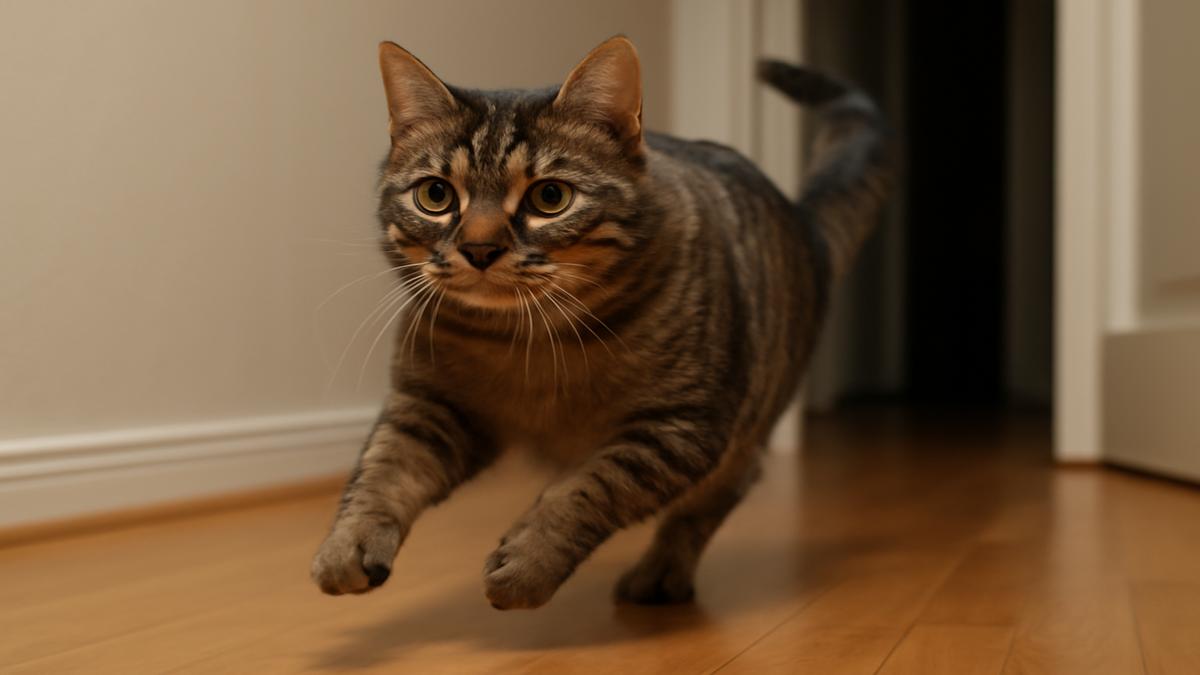
You wake to the sound of something sprinting across your chest. A soft thud. The skitter of claws on laminate. A jingle of a collar bell, then the unmistakable sound of your favorite mug being batted slightly closer to the edge of the counter. Your phone screen glares 4:02 a.m. into your sleepy face. And there she is: your cat, pupils like black moons, tail puffed, doing figure‑eights around an invisible ghost only she can see.
You mutter something eloquent like, “Why. Why now?” and pull the duvet over your head. She responds with a flying leap straight onto your feet and launches off like you’re a springboard. The zoomies have arrived.
The Midnight Madness You Can’t Quite Ignore
There’s something strangely wild about a cat at 4 a.m. In the thin, blue quiet of early morning, your home stops being a civilized human habitat and turns into a private jungle gym for a tiny, domesticated predator who has remembered—very suddenly—that her ancestors hunted in the dark.
It’s not just the running. It’s the whole experience: the frantic zigzags down the hallway, the scrabbling around the litter tray at an intensity that suggests she is digging a tunnel to another realm, the spontaneous vertical parkour up the back of the sofa, and those eerie pauses when she freezes and stares at absolutely nothing. There’s an energy in the air, the kind that crackles, makes your skin prickle with secondhand adrenaline. If you didn’t know better, you’d think your cat had just mainlined three espressos.
And you, soft and sleepy human, are stuck between amusement and pure, exhausted despair. Because it would be less painful if this show happened at, say, 8 p.m.—a civilized hour when watching a small panther slam‑dunk a toy mouse into a skirting board might be charming. But 4 a.m. unspools you. That’s the hour when your alarm clock isn’t a distant threat but an approaching train.
Hidden in this nightly chaos, though, is a story your cat is trying to tell you—about instincts, boredom, and a need you can meet with something that costs less than 20 pence.
The Wild Animal in Your Apartment
Under the lamplight, your cat looks wonderfully domestic. A neat silhouette on a windowsill, a warm loaf of fur draped over a cushion, whiskers twitching in some private dream. But her body is a blueprint written thousands of years ago in brush and desert dust, long before radiator beds and recycled cardboard scratchers were a thing.
Cats are crepuscular—most wired to be active at dawn and dusk. In the wild, this schedule makes perfect sense. Early mornings and evenings are prime hunting times. Mice skitter, birds stir, shadows make delicious cover. Your cat’s entire system is rigged to light up when the world is just tipping into or out of darkness. To her biology, 4 a.m. isn’t rude. It’s perfect.
Now put that ancient program into a modern apartment or house. No mice, no birds, no undergrowth to stalk through. The only moving things at 4 a.m. are the shadows on the wall and the way your hair sticks up from the pillow. Your cat’s brain wakes her up on schedule anyway: “Time to hunt.” Her environment replies: “There is nothing to do.” The result is a little animal with a full battery and nowhere to plug it in.
So she invents a hunt: dust motes as prey, hallway rugs as savanna, your ankles as fleeing gazelle. The zoomies are not her being “naughty.” They’re the overflow of energy and instinct looking for somewhere—anywhere—to go.
The 19p Fix Hiding in Your Cupboard
Here’s where it gets unexpectedly simple. We tend to think the solution to a cat problem involves something complicated: special gadgets, pricey toys, elaborate training plans. But the thing that can transform your 4 a.m. chaos into something calmer, quieter, and saner? You probably walk past it every week at the supermarket.
An ordinary, supermarket‑brand ping pong ball. Roughly 19 pence of hollow plastic.
Not the luxury “interactive LED smart ball” with USB charging and a marketing team. Just a light, bouncy, noisy‑enough, dirt‑cheap ping pong ball. It fits inside a cat’s innate hunting language in a way many expensive toys don’t. It’s fast. It’s unpredictable. It makes a satisfying click and bounce that your cat can follow with their whole body. It mimics the chase. And it requires zero technology and almost no effort from you—except a flick of the wrist and two minutes of play before bed.
It sounds too simple. But your cat’s 4 a.m. mayhem is less about “bad behaviour” and more about an unfinished story. Her day doesn’t end with a proper hunt. It just…ends. The ping pong ball is how you write the missing chapter.
| Evening Routine Option | What Your Cat Gets | Likely 4 a.m. Outcome |
|---|---|---|
| No structured play, bowl of food down, lights off | Full stomach, full battery, no “hunt” to complete the day | Zoomies, random pouncing, waking you up to create excitement |
| 10 minutes of ping pong ball play, then small meal | Hunt ➝ chase ➝ “catch” ➝ eat: a natural hunting cycle | Deeper sleep, calmer night, fewer frantic hallway sprints |
That’s the whole magic trick: use a tiny, fast, cheap object to let her chase something that’s not you, at a time of day that suits both your species.
The Two-Minute Hunt Before Bed
Picture this: it’s late evening, and instead of scrolling your phone until your eyes burn, you go hunting—with your cat. Not a big production, no special setup. Just a clear stretch of hallway, the soft hush of the house settling, and a small white ball cupped in your hand.
You drop the ping pong ball and tap it sideways along the skirting board. It wobbles off at a strange angle, the way a frightened animal might try to bolt in the wrong direction. Your cat’s ears twitch before the rest of her even moves. Then—snap. Her whole body wakes. Pupils widen. Leg muscles tighten. The world shrinks to that tiny, darting thing rolling away from her.
Tap. Bounce. Click. The sound of the ball on the floor rhythmically cuts through the fabric of the room, and your cat follows it like a thread. She pounces and misses. Skids a little. Regains control. Tries again. This time she pins the ball under her paws and rolls on her side as if subduing a much larger victim. She mouths it, kicks it with her back legs. The play is ferocious, but the mood is light. She’s not anxious, not overexcited. She is fulfilling a script her body recognizes: chase, tackle, conquer.
For two to five minutes you flick that little ball into corners, under chairs, along the hallway. The goal is not to exhaust her. It’s to let her complete a cycle—something fast and prey‑like to chase, catch, and “kill.” When she’s breathing a little faster and her movements slow on their own, you stop. That’s important. You let the hunt end with her feeling successful, not ripped away mid‑chase.
Then, just as a wild cat would, you pair the “kill” with food. A small meal, a portion of her usual dinner saved for this moment. It doesn’t need to be huge—just enough to say, in her language: “You hunted. You caught. You eat. Now you rest.” Her nervous system reads that sequence like a bedtime story with a peaceful last page.
Why This Simple Game Hits So Deeply
What looks to you like a cheap plastic ball is to your cat a whole unfolding world of sensation. The faint rattle as it hits the skirting board. The flash of white against dark floor. The micro‑adjustments her whiskers make as she tracks its path. Each element feeds information into a brain wired not for Netflix and radiators, but for forests, caves, and fields. You’re not just distracting her. You’re collaborating in a ritual older than your furniture, older than your walls.
And here’s the quiet, unexpected gift: as you play, something in you softens too. Your day’s scattered digital noise turns down as your focus narrows to this one silly, skipping ball. Your motions become deliberate: a soft tap, a careful pause. You breathe a little deeper. Time thins out. For five minutes, you and this animal are inhabiting the same story.
Making Your Home a Playground at Sensible Hours
Of course, the ping pong ball is only one character in this story. The real plot twist is in how you structure the waking part of your cat’s day so the sleeping part of your night can actually happen.
Think of your cat’s energy like a tide, not a tap. You don’t switch it off; you guide where and when it flows. If the whole day is a stagnant pool of naps and boredom, all that restless current rushes through the narrow channel of nighttime. So you widen the river.
Small Shifts, Big Quiet Nights
During the day, especially in the late afternoon and early evening, scatter little opportunities for movement and curiosity. A ping pong ball in a cardboard box with holes cut out. A few treats hidden in different rooms. A crinkly paper bag left open on the floor like a mysterious cave. You’re not running a cat amusement park. You’re just placing gentle invitations to explore, stalk, and claim.
Consistency is your secret ally. If, most evenings, there is at least one reliably exciting play session—your 19p ball dance, a feather wand, or a trailing shoelace that slithers around a doorway—your cat learns that the “good stuff” happens before bed, not at four in the morning. The body follows expectation. Over a week or two, those wild, feral zoomies start to migrate towards hours when you’re actually awake.
This doesn’t mean you will never again wake to the sound of a cat doing sprints on your ribcage. Cats are not apps; they’re lives, with moods and quirks and surprises. But the rhythm of your shared household shifts. The sharp, frantic edge of her nighttime energy dulls into something softer, more occasional. She has somewhere to put her wildness. And it’s not your face at 4 a.m.
When Zoomies Are a Message, Not Just a Game
Most of the time, the answer to “Why is my cat racing round at dawn?” is simple: because she is a cat, and the day didn’t quite give her the story her instincts demanded. But sometimes, those sudden bursts of energy come braided with something else—itchiness, discomfort, anxiety.
If the zoomies are always tied to the litter tray—lots of dramatic dashing away right after using it—or if your cat is over‑grooming, crying, or staring at you with pupils blown wide and fur puffed for no clear reason, it might be worth a chat with your vet. Pain, skin irritation, or even some neurological and digestive issues can all masquerade as “random crazies.” A healthy cat at full throttle is a joy. A cat running away from something you can’t see is a different story, and one that deserves extra care.
But let’s say the vet gives the all‑clear, and what you’re left with is simple, vintage, high‑octane feline chaos. Then that little plastic orb in your hand stops being a gimmick and becomes a kind of translation tool. You’re telling your cat: “I see the animal in you. I can’t give you a field of mice at dusk, but I can give you something to chase. I can help your body remember how to end the day.”
The Soft, Quiet After
On the nights when you remember to play, here’s what changes.
You turn off the living room lights. The world hushes into that strange, padded quiet that only exists at night. Your cat, who an hour ago was a feral hurricane in a fur suit, is now shaped like a comma at the end of your bed. Her breathing is slow, the tiny motors of her muscles resting after their brief, satisfying mission. Her paws flick once in her sleep, as though dreaming of another chase, but her body doesn’t rise to run it. She already did.
You feel it too—a subtle ease around the edges of your own nervous system. Something about honoring her wildness before bed has also honored your own need to step off the hamster wheel of your day. In the dim light, your home stops being a battlefield between your sleep and her instincts and becomes, finally, a place where both of you can do what your bodies quietly beg for. She gets to be a hunter. You get to be a sleeper. Nobody has to be the villain in the story.
And all it took was a clear patch of floor, a few spare minutes, and a small plastic ball that cost less than the coins hiding under your sofa cushions. The 4 a.m. zoomies weren’t a condemnation of your cat, or of you. They were a question. A plea, even. A little animal asking, in the only language she knows: “Is there room in this life for the wild part of me?”
With a 19p ping pong ball rattling happily along your skirting board, you’ve finally found a way to answer: “Yes. But let’s do it before midnight.”
FAQ
Do ping pong balls really make that much difference to cat zoomies?
They can. It’s less about the ball itself and more about what it creates: a quick, intense chase session that taps into your cat’s hunting instincts. When paired with a small meal afterward, it helps complete a natural hunt‑eat‑sleep cycle that often leads to calmer nights.
Is it safe to leave a ping pong ball out overnight?
For most cats, yes, as long as the ball is intact and not cracked or chewed. Always check it regularly for damage. If your cat is a heavy chewer or tries to swallow non‑food objects, supervise play and put the ball away afterward.
How long should I play with my cat in the evening?
Start with 5–10 minutes of focused play using the ping pong ball or another fast‑moving toy. Watch your cat’s body language: when she starts to slow down or loses interest on her own, that’s usually enough for that session.
What if my cat doesn’t seem interested in the ping pong ball?
Try bouncing it down a hallway, rolling it under furniture to trigger her curiosity, or tossing it so it hits a wall and changes direction. Some cats prefer toys that mimic birds (like feather wands) or insects (small, skittering toys), so experiment and see what sparks her inner hunter.
Can food timing really affect 4 a.m. zoomies?
It often does. Offering a small meal right after a play session in the evening tells your cat’s body, “The hunt is over; now we rest.” This mirrors natural feline behavior and can shift intense activity away from the middle of the night.
When should I worry that zoomies are a medical issue?
If zoomies come with other signs—yowling, sudden aggression, obsessive licking, difficulty using the litter box, or changes in appetite or weight—speak to your vet. Zoomies on their own are usually normal; zoomies plus other symptoms can signal discomfort or illness.
My older cat still gets zoomies. Is that normal?
Yes. Many senior cats have sudden bursts of energy, especially if they’ve napped a lot during the day. Gentle, shorter play sessions and predictable routines can help channel that energy without overtaxing aging joints or systems.

Hello, I’m Mathew, and I write articles about useful Home Tricks: simple solutions, saving time and useful for every day.