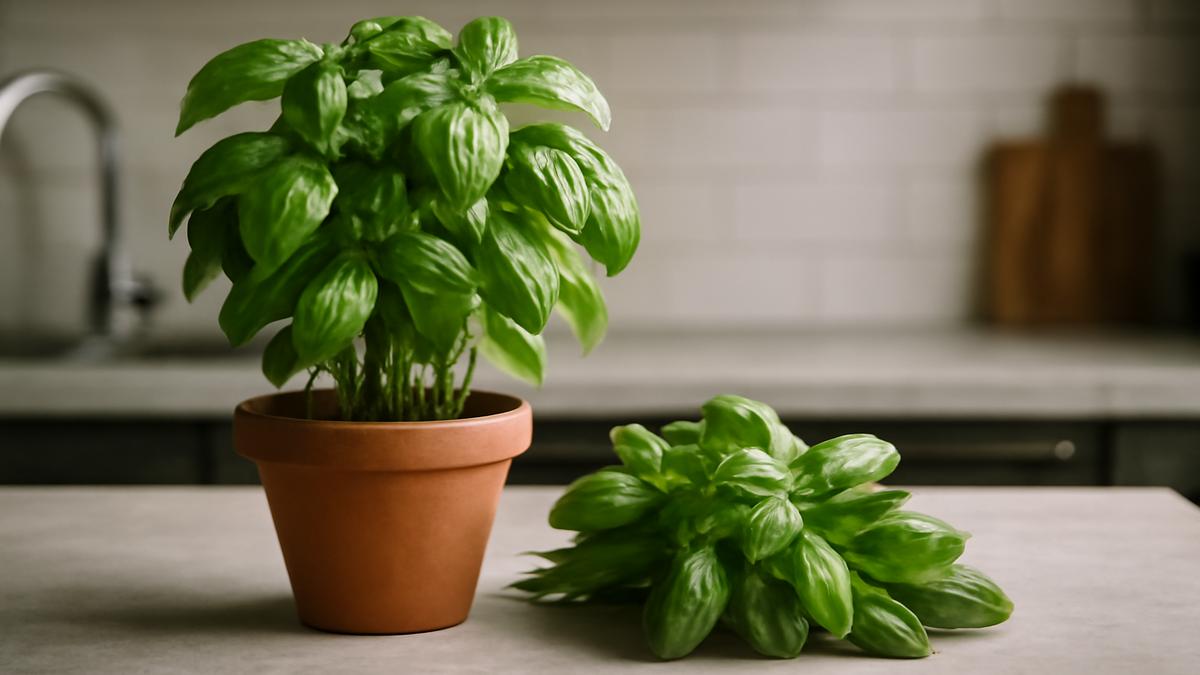
The basil on your cutting board still smells like summer. You slice through the bright green leaves, and that familiar, peppery sweetness rushes up at you: fresh pizza nights, backyard dinners, hurried weekday pastas suddenly made special. You toss the stems toward the compost and wipe the counter. Another bunch gone. Another few dollars. And in a week or two, you’ll be right back at the supermarket, bending over the herb section, picking through yet another plastic-wrapped bundle of basil that started its life in a greenhouse far away from your kitchen.
How One Supermarket Bunch Turns Into an Herb Jungle
Imagine, instead, that the story ends differently. You bring home a single bunch of basil, not as a one-time flavor hit, but as the beginning of a quiet little revolution on your windowsill. Instead of throwing away those stems, you slide them into a glass of water. Days later, fine white roots appear like spun glass. A few weeks after that, your windowsill is crowded with leafy green stems, pushing out more and more fragrant leaves — almost smug in the way they multiply.
This isn’t a gardening fantasy reserved for people with sun-drenched backyards and hours of free time. Basil is one of the easiest herbs to propagate, and that humble supermarket bunch already contains everything you need for an endless supply. No seed packets. No elaborate grow lights. No gardening pedigree required. Just a glass, some water, a bit of potting mix, and a willingness to look at your grocery herbs in a completely new way.
The first time you watch roots curl out from a basil stem you nearly threw away, something shifts. You begin to see how generous plants really are, how a single stem can become dozens if you learn to read what it needs: light, water, a bit of patience. You stop seeing basil as a consumable product and start seeing it as a living companion, one you can invite into your daily life — to be cut, regrow, and cut again, a soft green cycle of abundance.
The Secret Life Hiding Inside a Basil Stem
Look closely at a basil stem from the supermarket — really look. Run your fingers along the slightly square stalk, feel the faint ridges beneath your fingertips. Notice how the leaves emerge in pairs, opposite each other. Where each pair meets the stem, there’s a tiny bump or nub. Tucked into those subtle joints are nodes, little sleeping growth points full of quiet potential.
Plants, for the most part, are eager to keep going. Give them half a chance, and they’ll turn that potential into roots and new shoots, doing everything they can to stay alive and spread. A basil stem is like a map of possibilities: every leaf node is a doorway. When you place that stem in water, you’re not just “saving” it. You’re inviting it to step through those doors.
Within a couple of days, the cut end of the stem begins to change. First it swells, then soft white threads appear — new roots reaching for something to cling to. Sometimes they emerge from the bottom cut, sometimes from those side nodes. Either way, they’re a sign that the plant has decided: yes, I’ll stay. Yes, I’ll try again here.
That’s the quiet magic of propagation: recognizing that life is already there, just waiting for conditions to be right. You don’t coerce the basil into rooting; you simply make it comfortable enough that it chooses to.
Step-by-Step: Turning a Grocery Bunch into Rooted Cuttings
You don’t need a gardening manual to begin — just a kitchen counter and a few small choices made with attention. Here’s how the process unfolds when you slow down and let basil show you what it wants.
Start by selecting a basil bunch that still looks lively. The leaves should be vibrant, not yellowed or slimy. The stems should feel firm, not limp like overcooked noodles. This isn’t snobbery; it’s compassion. You’re inviting these stems to become plants again, and they need enough life left in them to say yes.
When you get home, set aside the prettiest stems for your meal. For propagation, choose stems that are at least 10–15 cm long (about 4–6 inches) with several pairs of leaves.
Now the quiet, intentional part begins:
- Trim the bottom of each stem at a slight angle, just below a leaf node. This gives a fresh surface and more area for roots to form.
- Strip off the leaves on the lower half of the stem so no leaves sit underwater (they’ll rot if submerged).
- Fill a glass or jar with room-temperature water and nestle the stems in so the bare nodes are underwater but the leaves stay dry.
Place the jar in a bright spot — a windowsill where light spills in gently, not a harsh, scorching glare. Above the sink is perfect in many homes, because you’ll see the jar every day and remember to check it.
Change the water every day or two. Each time, listen for the tiny shift: stems that were simply guests in a jar of water slowly becoming residents. After about a week, you’ll see the first pale roots unfurl. They look fragile at first, like they might break under the weight of a raindrop, but they’re tougher than they seem. Give them another week or so to lengthen. When the roots are 2–5 cm long (around an inch or two), the stems are ready to leave their glassy nursery.
From Water to Soil: Helping Basil Find Its Feet
Transplanting day has a certain ceremony to it, even if your hands are just moving between sink and windowsill. You’ll need a small pot with drainage holes and a light, airy potting mix. Not heavy garden soil, which compacts and suffocates delicate roots, but the kind that feels soft and springy when you squeeze it — a blend meant for containers.
Fill the pot about three-quarters full, then use your fingers or a spoon to make a small well in the center. Take one rooted basil cutting gently by the stem, supporting the fragile root mass with your other hand. Lower it into the well like you’re tucking someone into bed, then ease soil around the roots until the stem stands upright. Press the soil very lightly to remove large air pockets but don’t pack it down like a snowball.
Water slowly until you see moisture seeping from the drainage holes. This first drink settles the soil around the roots. You may see the plant droop a little from the shock of transitioning from water to soil — that’s normal. Think of it like someone who’s been on a boat all week suddenly stepping onto land. Give it a day or two to regain its balance.
For the next week, keep the soil evenly moist but not soggy. Run your finger across the top of the pot. If the surface feels dry to the touch, it’s time to water. If it still feels cool and slightly damp, wait a day. Basil loves consistency: it doesn’t like to be drowned or parched. A bit like us, really.
Light is the other half of the equation. Indoor basil is happiest with bright, indirect light for most of the day. A sunny window with gentle morning sun is ideal. Harsh afternoon rays behind glass can scorch tender leaves, leaving them with pale, crispy patches. Watch your plant like you’d watch a new pet: where does it perk up? Where does it sag? The basil will tell you what it likes, if you’re willing to observe.
Designing Your Own Little Basil System
One of the quiet pleasures of growing basil from a supermarket bunch is realizing how quickly one plant can become many. That first pot on the windowsill is just the beginning. With a little rhythm and planning, you can create a steady pipeline of new basil plants from the cuttings you take as you cook.
Once your original plants are growing strongly — plenty of leaves, stems that feel sturdy between your fingers — you can begin to trim them strategically rather than randomly snipping the nearest leaf. The goal is to prune in a way that makes the plant bushier, not barer.
Instead of cutting single leaves, look for a stem with a pair of leaves near the top. Just above that pair, tiny new shoots are usually forming where the leaves meet the stem. If you cut the main stem just above that junction, those side shoots will take over and branch out, creating a fuller, more compact plant.
Each of those trimmings can be eaten or, if it’s long enough, rooted again in water. In this way, your basil is not a static pot but a living cycle: cutting, regrowth, cutting again. A kitchen choreography.
To keep things organized, it can help to think in terms of a simple, almost playful “basil system.” The table below shows an example of how that might look in a small home setup:
| Stage | What You See | Your Role |
|---|---|---|
| Fresh supermarket bunch | Lush stems, aromatic leaves | Cook with leaves, select best stems for rooting |
| Stems in water | Leaves perky, nodes underwater | Change water, place in bright spot, wait for roots |
| Rooted cuttings | White roots 2–5 cm long | Pot into soil, keep evenly moist |
| Growing plants | Bushier stems, new leaves at tips | Harvest by pruning tops, root extra trimmings |
| Established basil “patch” | Several pots at different stages | Rotate harvests, refresh older plants with new cuttings |
Seen this way, your kitchen becomes its own miniature herb ecosystem. There’s always a jar of stems on the go, always a pot greening up, always another ready to be cut for tonight’s dinner. Instead of a one-time purchase, that first supermarket bunch becomes the ancestor of an entire lineage of basil plants thriving in your home.
A Different Kind of Abundance
There’s a small but meaningful shift that happens when the basil on your counter is something you’ve grown, even if it started life on a supermarket shelf. You stop counting leaves. You stop thinking in terms of “wasting” a few extra for that recipe, or hesitating to add a generous handful to a salad. You become suddenly lavish with flavor.
When basil is scarce, you ration. You carefully shred exactly five leaves over the pasta, knowing the rest of the bunch has to stretch all week. When basil is constantly regenerating a few steps from your stove, you build meals around it, not the other way around. A plain bowl of tomatoes becomes an excuse to go and harvest. The simplest bread and cheese turn into a feast when you tuck in a pile of bright green leaves, still warm from the afternoon sun behind the glass.
There’s another kind of abundance that sneaks in quietly: the emotional satisfaction of watching something thrive because of your care. Every time you walk past your basil and pinch a leaf between your fingers just for the scent, you’re not only “having fresh herbs.” You’re participating in a slow, living ritual of attention — noticing when the soil’s a bit too dry, when new leaves unfurl, when a flowering spike tries to appear and you snip it off to keep the energy in the plant.
Somewhere along the way, you forget this whole thing started as a way to save money on herb purchases. It becomes about intimacy with the small patch of green that shares your home. You see the seasons a little differently through it: basil sulking a bit in the dim, short days of winter, then perking up as the light slowly returns, echoing the way your own energy rises and falls.
And the act of propagating — of snipping, rooting, repotting — starts to feel like a small but insistent vote for a calmer pace of life. It’s hard to rush a plant. It will root when it’s ready. It will grow at the speed of chlorophyll and sunshine, not at the tempo of your inbox. To grow basil this way is to surrender, a little, to that slower clock.
Common Basil Hiccups (and How to Listen to Them)
Of course, like any relationship, things don’t always go perfectly. Basil has a way of speaking up when it’s unhappy; you just have to learn its language.
If your rooted cuttings suddenly collapse after transplanting, leaves drooping as if exhausted, the plant may be in shock. This can happen when the jump from water to soil is too abrupt or the light is too harsh. Moving the pot to a slightly shadier spot for a few days, and keeping the soil gently moist, often helps it regain strength.
Yellowing leaves near the bottom of the plant can mean overwatering — the roots suffocating in soil that stays too wet. Check your pot: is there standing water in the saucer? Are you watering because the plant needs it, or because you’re bored? Let the top centimeter of soil dry before the next drink.
Leggy, stretched-out stems with fewer leaves tell a different story: not enough light. The plant is reaching, elongating in search of more sun. In that case, move it to the brightest windowsill you have, or rotate it so all sides get their fair share of whatever sun comes in.
And if your basil starts putting out flower spikes — delicate white blooms at the tips of stems — it’s telling you it thinks its job is nearly done. Left to its own devices, basil wants to go to seed. For a constant supply of leaves, you’ll want to gently pinch those flower spikes off as soon as they appear, encouraging the plant to keep focusing on foliage instead of reproduction.
None of these “problems” are failures; they’re conversations. Each one invites you to pay closer attention, to adapt, to learn. Growing basil from a supermarket bunch is a tiny apprenticeship in listening to another form of life — one that rewards you in handfuls of perfume and flavor.
From Disposable Herb to Everyday Companion
When you stop buying basil plants and start growing your own endless supply from a single supermarket bunch, your kitchen quietly transforms. The window ledge becomes a thin, green border between indoors and outdoors, a line along which sunlight, soil, and water negotiate with your appetite.
You’re no longer at the mercy of last-minute grocery runs or wilted herbs in plastic sleeves. Instead, there is always a living, breathing cluster of basil within arm’s reach, its leaves textured like soft paper, its scent rising whenever you brush past. You cut what you need, and tomorrow, or the next day, more appears.
This way of growing doesn’t demand large plots of land or expensive equipment. It requires only a shift in how you see that bunch of basil in your hand: not as a final product but as the first chapter. A handful of stems, each one holding a quiet promise. Put them in water. Give them some light. Wait. Watch. And then, when the roots finally unfurl, welcome them into soil and into your daily life.
Over time, the act of tossing basil stems in the trash will start to feel strange, almost unthinkable — like throwing away the last pages of a book you haven’t finished reading. You’ll know, in your fingers and in your nose, that every stem is an invitation to begin again.
FAQ
Can I propagate any supermarket basil bunch?
Yes, as long as the stems are still fresh and firm. Avoid bunches with blackened, slimy, or heavily wilted leaves. Organic or minimally treated basil often roots more easily, but many standard bunches work just fine.
How long does it take for basil stems to root in water?
Under normal indoor conditions, you’ll usually see tiny roots within 5–10 days. Give them up to two weeks to grow a bit longer and stronger before moving them into soil.
Do I need rooting hormone for basil cuttings?
No. Basil roots readily without any added hormone. Clean cuts, fresh water, and good light are usually all you need for reliable rooting.
How many times can I keep propagating from the same plant?
Indefinitely, as long as the mother plants stay healthy. Each strong stem you trim can become a new plant. Over many months, it’s sensible to refresh your collection by rooting new cuttings and letting the oldest plants retire to the compost once they get woody or tired.
Why does my indoor basil sometimes taste bitter?
Basil can become more bitter if it’s stressed — from too little light, irregular watering, or allowed to flower heavily. Keep plants in bright light, harvest regularly, and pinch off flower spikes early to maintain that sweet, aromatic flavor.
Can I grow supermarket basil outside instead of indoors?
Yes, if your climate is warm enough. Basil loves temperatures above about 15°C (59°F) and dislikes cold drafts. Once cuttings are rooted and well established in pots, you can move them outdoors in warm weather, gradually acclimating them to direct sun.
How often should I harvest to keep basil bushy?
A light trim every week or so works well once the plant is growing strongly. Always harvest by cutting just above a pair of leaves, rather than plucking single leaves. This encourages branching and keeps the plant compact and lush.

Hello, I’m Mathew, and I write articles about useful Home Tricks: simple solutions, saving time and useful for every day.