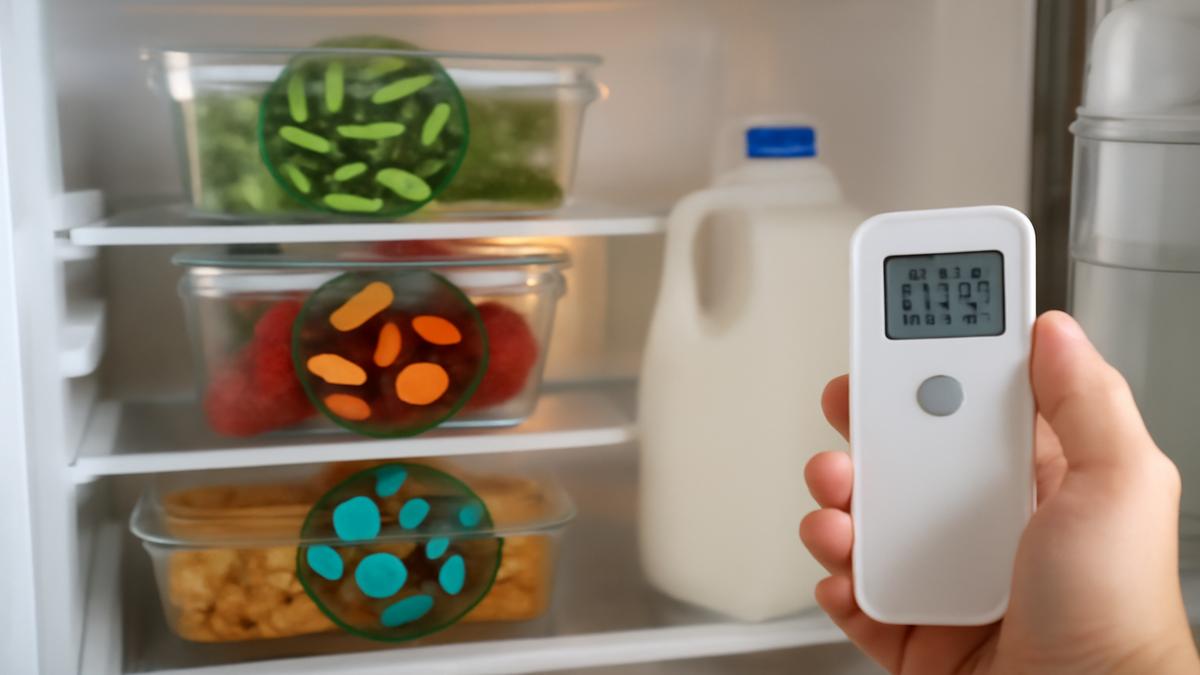
The sour smell hit you before the fridge door was even halfway open. Not terrible, not exactly rotten—more like a faint, tired funk, as if the vegetables and leftovers inside had collectively given up a few days ago. You pause, hand still on the handle, scanning past the yogurt, the carton of eggs, the half onion wrapped in plastic. Nothing looks obviously bad. Still, something feels off. You tap the little wheel at the back—the temperature dial you never really think about—and wonder, for the first time in years, what number it should actually be on.
Your Fridge Is Not As Safe As You Think
For most of us, the fridge is a trusted guardian: the cold, humming box that keeps danger at bay. You toss in raw chicken, last night’s pasta, leafy greens, open jars of sauce, assuming that once they’re inside, they’re safe. The light clicks off, the door seals, and you move on with your day under the quiet belief that cold equals clean.
But microbes don’t care about our beliefs. They care about conditions: moisture, nutrients, and temperature. And if your fridge is a little too warm—which many home fridges are—it becomes less a vault of safety and more a slow, quiet incubator. Doctors know this intimately, because hospitals and clinics store life-saving medicines, vaccines, and even donor milk at very specific temperatures. A few degrees too high, and fragile substances degrade. A few degrees too low, and other problems begin.
That exactness, that almost fussy precision, is the same attitude we should be directing toward the place we casually shove our groceries every week. The difference between a safe fridge and a bacteria-friendly fridge? It’s not a canyon. It’s a sliver—about the width of a human choice between “Eh, that’s cold enough” and “Let me actually check.”
The Quiet Bloom of Bacteria Behind the Door
Imagine your fridge at night. The kitchen is dark. The only sound is the low, rhythmic hum of the compressor cycling on and off. Inside, a half-used pack of deli turkey rests beside a container of cut melon. Some spinach leaves wilt in a crisper that never seems quite as crisp as advertised. You close that door each evening assuming time has slowed for everything within it.
But time hasn’t slowed. It’s just hidden.
Most of the bacteria that make us sick—like Salmonella, Campylobacter, E. coli, and Listeria—are perfectly comfortable at room temperature. At about 20–37°C (68–98.6°F), they thrive. Between 5–60°C (41–140°F) sits what food safety experts quietly call the “danger zone,” where microbes grow fastest. And your fridge is supposed to be your escape hatch from that zone.
“Supposed to be” is the key phrase. Many home refrigerators sit in a gray area—cool, but not quite cool enough. Often they hover at around 7–10°C (44–50°F). That feels cold on your hand, but to a bacterium, it’s more like a slow-motion summer. Growth doesn’t stop. It just drags on—the bacterial equivalent of a long, lazy afternoon where everybody still reproduces, just at a calmer pace.
Not every microbe is slowed in the same way. Listeria monocytogenes, a name you’ve probably seen in alarming salad or deli meat recalls, can grow even at fridge temperatures. That’s part of what makes it so dangerous for pregnant people, older adults, and those with weakened immune systems. A fridge that’s just slightly too warm is like rolling out a quiet, invisible welcome mat.
The Number Doctors Trust: A Temperature with No Guesswork
In hospital corridors and outpatient clinics, refrigerators don’t get to be approximate. There’s no “somewhere around here.” The temperature is monitored, logged, and often alarmed. When doctors store vaccines, insulin, or certain antibiotics, they aren’t guessing. They’re aiming for a tight window, the same way you might aim for a precise brew time with coffee or a specific internal temperature in a roast.
That critical range?
2–4°C (36–39°F).
It’s cold, but not freezing. Steady, not fluctuating wildly every time a door opens. Below 5°C (41°F) is where food safety guidelines land for home fridges, but doctors and pharmacists often live in that more exact 2–4°C sweet spot. It’s where microbial growth is slowed to a crawl, where delicate compounds stay potent, and where time stretches safely rather than collapses into a bacterial relay race.
Your fridge, if you want it to protect you instead of quietly working against you, should live there too—at 4°C (39°F) or slightly below. That’s the temperature sweet spot many doctors use to keep biological materials safe, and it works just as well for the chicken thighs defrosting on your bottom shelf.
| Temperature | Zone | What Happens |
|---|---|---|
| Above 60°C (140°F) | Hot zone | Most bacteria are killed with enough time. |
| 5–60°C (41–140°F) | Danger zone | Bacteria grow fast; food becomes risky quickly. |
| 0–5°C (32–41°F) | Safe fridge range | Growth slows dramatically, but some bacteria still survive. |
| 2–4°C (36–39°F) | Doctor’s choice | Goldilocks zone for vaccines, medicines, and safer food storage. |
| Below 0°C (32°F) | Freezer | Growth stops, but bacteria are often not killed—just paused. |
Those two little degrees, from 6°C down to 4°C (43°F to 39°F), don’t feel like much to you. To microbes, they mean the difference between “We’re still in business” and “We’re barely hanging on.”
How to See What Your Fridge Is Really Doing
Now comes the uncomfortable part: what if your fridge isn’t actually as cold as its dial claims? That little knob marked with 1–7 or a vague “cold/coldest” scale doesn’t tell you the actual temperature. It’s more like a mood ring than a measuring instrument. Two different fridges set to “3” can behave very differently depending on age, how full they are, and even the room temperature in your kitchen.
You can change that uncertainty in a few quiet, practical minutes.
Get a Real Thermometer
A simple fridge/freezer thermometer is inexpensive, and it changes everything. Instead of trusting a dial, you’re reading reality. Place it in the middle shelf—not shoved against the back wall, not in the door. Check the reading after it’s been there at least 12–24 hours. That’s your fridge’s true personality, stripped of wishful thinking.
Adjust Slowly, Then Recheck
If it reads above 4°C (39°F), turn the dial a notch cooler. Not all the way. Not aggressively. Just one step. Wait another 12–24 hours and check again. Think of it like calibrating a camera lens or tuning a guitar; small changes, repeated, bring you into focus.
Know Its Hot and Cold Spots
The back is usually colder, the door usually warmer. That’s why doctors and pharmacists avoid storing critical medicines in refrigerator doors. You should give your most vulnerable foods—raw meat, leftovers, pre-cut fruits—the safer real estate, away from the door and not on the warmest top shelf where warm air can hover when the door opens.
The moment you have a number you trust, your fridge stops being a mystery box and becomes a controlled landscape. You can decide where things go based on how much protection they need, instead of piling everything into whatever space is available at 6 p.m. on a Sunday.
Designing a Fridge That Works Like a Clinic
You don’t need medical-grade equipment to borrow a few principles from the hospital playbook. What you need is a bit of intention. Picture your fridge not as storage, but as habitat design—a small cold ecosystem you can shape.
Give Raw Meats the Safest Ground
Store raw meat, poultry, and fish on the bottom shelf, ideally in a shallow tray or plate to catch drips. This is gravity-aware hygiene: nothing leaks down onto your salad greens or yesterday’s casserole. That bottom shelf is also often a little colder, which is exactly where you want the risky stuff.
Keep the Door for the Survivors
The door is the most temperature-fluctuating area. Every time it swings open, warm kitchen air floods that space first. So fill it with the items that tolerate abuse: condiments, sauces, pickles, and juices. Milk and eggs—often seen lounging in door racks in advertisements—are actually safer inside the main cavity, where the temperature is more stable.
Watch the Clock on Leftovers
Doctors live by half-lives and expiry dates. You don’t need to label your containers like a pharmacy, but a bit of time-awareness helps. Most cooked leftovers are safest if eaten within 3–4 days in a properly chilled fridge. That’s assuming your temperature is around 4°C (39°F). If your fridge runs warmer, that comfortable 4-day window quietly shrinks.
Don’t Crowd the Cold
A fridge packed to the gills can’t circulate air properly. Cold air needs to move around containers, not slam into a solid wall of food. Hospitals often have strict “no overfilling” rules for medicine fridges for this exact reason. At home, leaving a bit of breathing room between items seems trivial, but it lets your fridge do its job evenly.
None of this requires fear. It’s more like gardening. You’re shaping conditions—light, space, temperature—so that the things you want to flourish (you, your family, your slow Sunday soup) do better than the things you don’t (the invisible bacteria waiting for their chance).
The Stories We Don’t See: When Temperature Becomes Illness
The aftermath of a too-warm fridge doesn’t always look dramatic. Sometimes it’s a day of nausea you chalk up to “something I ate.” Sometimes it’s a grandparent in the hospital with what everyone calls a “stomach bug,” but which might have started days earlier, in a softly humming appliance at home.
Bacteria don’t write clear narratives. They don’t tell you, “This began when your leftover chicken cooled too slowly,” or “The milk you kept another week because it didn’t smell bad yet was already harboring a quiet bloom.” We fill in those blanks with guesswork, rarely thinking to suspect the temperature setting we touched once, years ago, and never revisited.
Healthcare workers see the sharp end of that story: people whose defenses were a little lower, whose meals happened to carry just enough of the wrong microbe at the wrong time. They know how small details—a fridge that was one or two degrees too warm for too long—can ripple outward into real illness.
And they also know how much control you actually have.
Because unlike so many health variables that feel distant or uncontrollable—air quality, genetics, sheer bad luck—your fridge temperature is, quite literally, at your fingertips.
From Guessing to Knowing: A Tiny Ritual of Care
There’s a quiet satisfaction in setting something just right. The click of a thermostat, the level bubble floating perfectly between two lines, the moment a lens snaps into sharp focus. Adjusting your fridge to 4°C (39°F) and knowing it, not hoping it, belongs in that same category: small rituals that make your daily life just a touch more secure.
You might notice that food lasts a bit longer. That slimy sheen on bagged salad appears less often. Milk stretches closer to its “use by” date without turning into a science experiment. But beyond those small conveniences, you’ll also know you’ve narrowed the odds—pushed your home’s microbiological landscape a little more in your favor.
The hum of your fridge won’t sound any different. The light will still flare on when you open the door late at night, looking for a snack. But behind that light, behind the plastic shelves and your mismatched containers, the microbial math will have changed.
Doctors and pharmacists rely on that math every day. Temperature is one of their quiet, unsung tools. Now it can be one of yours too.
So tonight, when you open the fridge and feel that wash of cool air on your face, listen for the story it’s telling. Is it “cold enough” in the vague way we say when we shrug and close the door? Or is it the precise, steady 4°C that has protected vaccines, insulin, donor milk, and now—quietly, without any drama—your dinner?
The difference fits in the palm of your hand: a simple thermometer, a small twist of a dial, and a decision to stop guessing and start knowing.
FAQ
What is the best temperature for my fridge at home?
The safest target for a home fridge is around 4°C (39°F), and definitely below 5°C (41°F). This is the same range doctors rely on for many medicines and biological materials because it slows bacterial growth dramatically.
Is “colder” always better?
Not necessarily. Going a bit colder, down to about 2°C (36°F), is usually fine, but you don’t want food freezing in spots. Freezing changes the texture of many foods and can cause liquids like milk or eggs to expand and leak or crack their containers.
How can I tell what temperature my fridge really is?
Use a dedicated fridge thermometer and place it on a middle shelf away from the door and back wall. Leave it for 12–24 hours, then check the reading. Adjust the dial slightly and recheck after another day until you’re consistently around 4°C (39°F).
Why is the fridge door a bad place for milk and eggs?
The door warms up every time you open the fridge, making it the most unstable part of the appliance. That constant fluctuation encourages bacteria to grow faster, especially in items like milk and eggs. Keep those on an inner shelf where the temperature is steadier.
If my food looks and smells fine, is it safe?
Not always. Some harmful bacteria don’t change a food’s smell, taste, or appearance. That’s why temperature control and storage time matter so much. Properly chilling food below 5°C (41°F) and eating leftovers within 3–4 days is safer than relying on smell alone.
Does freezing kill bacteria?
Freezing usually doesn’t kill bacteria—it just puts them into a kind of pause. Once the food is thawed and warms back up, those bacteria can start multiplying again. That’s why safe thawing and proper fridge temperatures remain important even for previously frozen foods.
How often should I check my fridge temperature?
Check a few times when you first adjust it, then occasionally—about once a month or after big changes, like loading in a lot of warm groceries or moving the fridge. Any time you notice food spoiling faster than usual, it’s worth rechecking.

Hello, I’m Mathew, and I write articles about useful Home Tricks: simple solutions, saving time and useful for every day.