The sponge in your kitchen sink has a smell you don’t talk about. It’s faint, a little sour, almost metallic when you squeeze it under hot water. You tell yourself it’s just “kitchen smell,” the price of cooking real food, the ghost of last night’s tomato sauce and this morning’s coffee cup. But you know, deep down, that sponge is alive in the wrong ways. Tiny invisible colonies. A soft green planet of its own. And yet, you keep using it, because it’s there, and because buying a new one (again) feels wasteful, and because no one ever showed you how to actually keep it clean.
The dirtiest thing in the cleanest room
Walk into any home and the kitchen usually feels like the heart of the place. It smells like onions hitting olive oil, garlic blooming in a pan, bread toasting before the day really wakes up. Counters get wiped, dishes get rinsed, the sink runs with water that seems to promise cleanliness.
But lurking in the corner of that stainless-steel sink, or sagging on a small plastic ledge, is the quiet villain of the story: the sponge. It looks harmless—colorful, maybe a bit frayed at the edges, possibly still damp from the last round of scrubbing. It has washed baby bottles, cutting boards, lunch containers, and the coffee mug you love so much you use it twice a day.
Here is the uncomfortable truth: your kitchen sponge is probably dirtier than your toilet seat. That’s not an exaggeration for shock value; microbiologists have said as much for years. The sponge is full of pores and fibers—perfect real estate for bacteria to move into, settle down, and start a high-density neighborhood. Add warmth, moisture, and food particles, and it turns into a microbial city that never sleeps.
You might already have your own ritual to feel better about it. Maybe you rinse the sponge in scalding hot tap water and wring it out hard. Maybe you drizzle dish soap over it and leave it to “soak.” Maybe you toss it in the dishwasher and hope the hot cycle purges the bad stuff. These things help a little. But bacteria are stubborn. Some cling harder than you’d think. And that faint sour smell? That’s their calling card.
Somewhere between the guilt of throwing away yet another sponge and the quiet worry about germs, there’s a middle path—a way to keep the sponge you already have, make it last longer, and actually disinfect it. And that path runs, somewhat surprisingly, through NASA.
The NASA kitchen problem (in space, there’s no “just buy a new one”)
Imagine you are in orbit, floating in a metal tube two hundred miles above Earth. You’re an astronaut on the International Space Station. Your world is filtered air, humming machines, and panels of delicate equipment. Food arrives in packets. Every supply is carefully calculated: weight, volume, frequency. There is no convenience store. There is definitely no supermarket aisle lined with cheap sponges in plastic wrappers.
In that controlled environment, a sponge isn’t just a disposable cleaning tool—it’s part of a life-support system. Anything that holds moisture can harbor bacteria and other microorganisms, which in a sealed habitat can become a serious problem. You can’t afford a runaway bloom of germs in a place where people breathe the same recycled air, touch the same surfaces, share the same tiny sink area.
NASA engineers and scientists have to think about mundane things differently: crumbs, dust, mold, and yes, sponges. They ask hard questions about tiny details. How do you keep something clean when replacing it is not always an option? How do you disinfect quickly, reliably, using tools you already have on board?
The answer NASA leaned on is both high-tech and beautifully simple—because you probably have it sitting in your kitchen right now, humming softly over the stove or next to the fridge.
The quiet laboratory: your microwave
The kitchen microwave has always felt a little bit like friendly magic. You put in cold leftovers, press a few buttons, and a minute later, there’s steam rising from the plate. Inside, energy invisible to your eyes shakes water molecules until they vibrate with heat. It’s fast, efficient, and mostly taken for granted.
NASA didn’t invent the microwave, but the method that has become known as “NASA-approved” for sponges feels very much like something born from space thinking: using what’s already there, using physics instead of extra chemicals, and respecting the quiet power of heat.
The “hack” is straightforward: use your microwave to disinfect your kitchen sponge. Not symbolically, not just to make it feel hot and “clean-ish,” but to actually destroy a huge percentage of the microbes hiding inside it.
The self-disinfecting sponge: how the hack really works
Let’s slow down and walk through this as if we were standing in your kitchen together, sponge in hand. The sink smells faintly like dish soap and last night’s curry. The sponge is damp, maybe a little too damp, slumped into the curve of the sink.
Step 1: Rinse away the story of the day
Before anything else, rinse the sponge thoroughly under running water. Squeeze it again and again until the water runs mostly clear. You’re washing away food particles, oils, and visible grime—the outer layer of the story the sponge has lived through today.
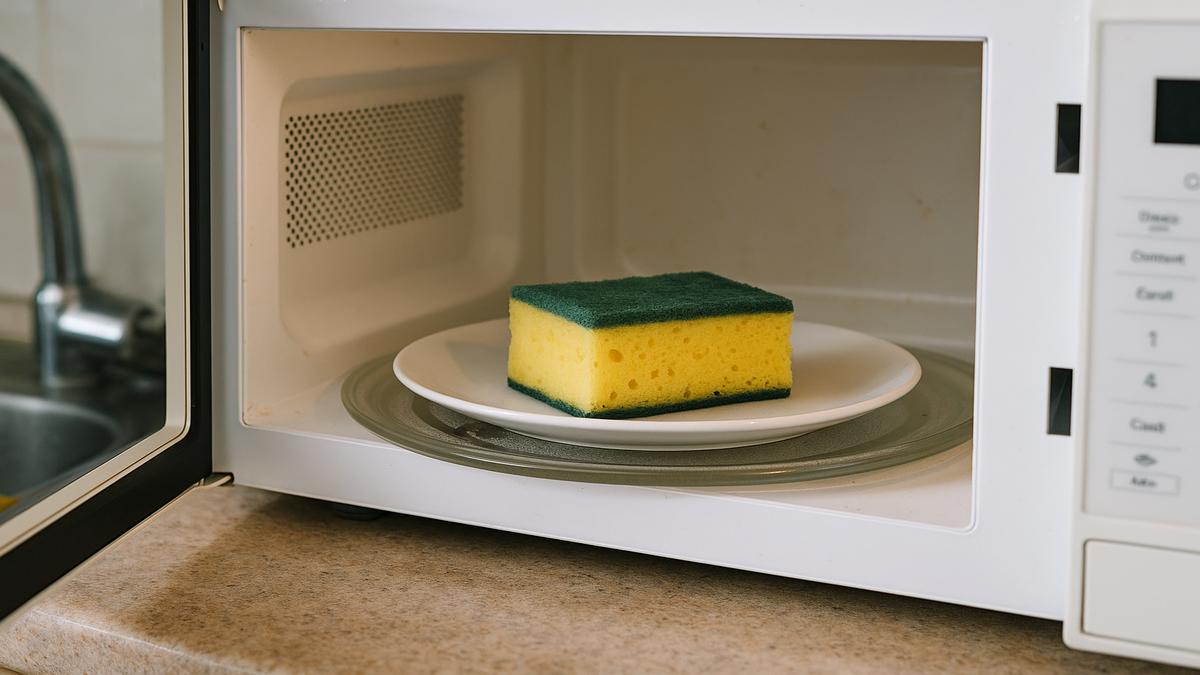
If it’s a scrub-sponge with a rough green side and a yellow foam side, make sure both parts are soaked. The sponge should end this step heavy with water, like a tiny waterlogged raft.
Step 2: Soak it like it matters
Now you add the small twist that makes this method more than just “zapping” a dry sponge. Place the sponge in a microwave-safe bowl or mug. Fill it with clean water until the sponge is fully saturated and slightly submerged. Add a splash of white vinegar or a small squirt of lemon juice if you like—the mild acidity can help, and it brings a clean, sharp scent.
This is crucial: the sponge must be very wet. Microwaves heat water molecules. Too little water, and you’re more likely to scorch the sponge than disinfect it. Think of the water as a conductor of heat and a bodyguard against burning.
Step 3: Into the “space chamber”
Slide the bowl with the sponge into the microwave. Close the door. Suddenly this everyday box feels like a tiny experiment module on a spaceship.
Set the microwave to high power. Run it for about 1–2 minutes. For thinner, small sponges, one minute can be enough. For thicker, denser sponges, aim toward two minutes. Stay nearby. Listen to the gentle hum and watch for steam building inside the microwave. You don’t walk away from something you’re transforming with invisible energy.
What’s happening inside is wonderfully simple: the water in and around the sponge is heating up rapidly, reaching temperatures that many bacteria cannot survive. You’re effectively giving the sponge a tiny, targeted pasteurization. NASA and other researchers have found that this kind of microwaving can kill a significant portion of microbes, including some of the most common kitchen culprits.
Step 4: The careful reveal
When the timer beeps, resist the urge to grab the bowl right away. That sponge is now a tiny furnace of boiling water and trapped steam. Open the microwave door and let the hot air roll out. Wait a bit—30 seconds to a minute—before reaching in, preferably using oven mitts or a thick towel.
Lift the sponge gently. It will be very hot, heavy with near-boiling water. Set it in the sink and let it cool. As it cools, something subtle has shifted: the invisible population inside it has been drastically reduced. The sponge has, in a sense, disinfected itself using nothing more than heat and water.
What changes when you do this regularly
Now imagine this isn’t a one-time science project, but a quiet ritual—maybe every couple of days, maybe at the end of a heavy cooking session. Your sponge gets its own little “space treatment,” a scheduled reset.
Over time, you start to notice differences. The sour smell that once lingered? It shows up far less often. The sponge feels less slimy between your fingers. You don’t stand in the cleaning aisle wondering if you should buy the jumbo pack of sponges “just in case.” You’re using fewer of them. You’re throwing away less. The life of each sponge stretches just a bit longer, without that creeping sense of ick.
Of course, nothing lasts forever. Even astronauts eventually replace tools when their time is up. Foam breaks down, fibers wear thin, the structure weakens. But between “brand new” and “must toss this out,” there is now a middle space—where your sponge isn’t pristine, but it’s not a bacterial carnival either.
And there’s something quietly satisfying in knowing that the same logic that helps keep equipment clean hundreds of miles above your head can help keep your own kitchen a little safer and saner.
A tiny kitchen ritual with big implications
There’s a larger story tucked inside this simple hack. It’s about how we think of cleanliness, waste, and the tools we rely on every day. We have been taught to see some things as disposable: sponges, paper towels, wipes. Use, toss, replace. And sometimes, yes, that’s the safest choice. But not always, and not mindlessly.
By taking a minute or two to deliberately disinfect your sponge, you’re doing three things at once:
- Reducing the microbial load on something you use constantly.
- Extending the sponge’s useful life, which means fewer sponges bought and thrown away.
- Engaging, even briefly, with the idea that everyday objects can be cared for, not just consumed.
There’s also the sensory shift. The next time you grab that sponge after its microwave “bath,” you’ll feel the difference. The scent leans more toward neutral, or a faint whisper of vinegar or lemon instead of that telltale sourness. The foam, once lukewarm and clammy, now seems cleaner in some almost emotional way—crisp edges, renewed purpose.
In a world that often feels complicated, the daily rituals we can control matter. You may not be able to redesign supply chains or engineer orbital habitats, but you can take a humble sponge and power it through a small, elegant cycle of renewal.
Quick comparison: common sponge “cleaning” methods
To put the NASA-approved microwave approach in context, here’s how it stacks up against a few familiar habits:
| Method | What People Usually Do | Effectiveness & Notes |
|---|---|---|
| Rinsing with hot tap water | Run sponge under hot water, squeeze, repeat. | Removes surface food and some microbes, but tap water usually isn’t hot enough to truly disinfect. |
| Soaking in dish soap | Leave sponge in a bowl with soapy water. | Helps loosen grease and grime, but many bacteria survive simple soaking. |
| Dishwasher cycle | Place sponge on top rack during a hot wash. | Can reduce bacteria if the cycle is very hot, but results are inconsistent and depend on your machine. |
| Microwaving dry sponge | Toss dry sponge into microwave for a short burst. | Risk of scorching or fire. Without enough water, heat distribution is uneven and can be hazardous. |
| Microwaving soaked sponge (NASA-style) | Fully wet sponge in water, microwave 1–2 minutes on high, then cool. | Uses high heat via water to kill many microbes. Simple, fast, and powerful when done safely. |
Safety, limits, and when to say goodbye
Like every good space-tested habit, this one comes with a few boundaries. You’re harnessing real energy and real heat, and it deserves respect.
- Always keep the sponge very wet. A dry or barely damp sponge in the microwave can scorch or even catch fire. Water is your safety net.
- Avoid metallic scrubbers. If your sponge includes metal fibers or a tiny steel scrub pad, don’t microwave it. Metal and microwaves are a dangerous pairing.
- Handle with care afterward. The sponge and water will be extremely hot. Let it cool before you squeeze it or use it.
- Don’t expect miracles. Microwaving dramatically reduces microbes, but it doesn’t “reset” an old, crumbling sponge back to new. If the foam is falling apart, if it smells bad even after treatment, or if it’s stained beyond recognition, retire it.
- Keep perspective. This method is a powerful tool, not a license to keep a single sponge for months on end. Think of it as a way to bridge the gap between wasteful over-replacement and risky neglect.
There is a quiet wisdom in knowing when something has reached the true end of its life. The same thoughtfulness that leads you to microwave your sponge can also guide you to toss it without guilt when its work is really done.
Bringing a bit of space-thinking to your sink
Somewhere high above, an astronaut is finishing a meal. Maybe it’s a pouch of reheated curry, or a tortilla smeared with peanut butter and honey—it’s always tortillas in space, because crumbs float. They wipe their utensils, tidy their workstation, and deal with the same ancient reality humans have always faced: where there is food, there is mess. Where there is mess, there must be cleaning.
The tools are different up there. The stakes are higher. But the mindset you borrow from them fits surprisingly well in your home kitchen. You begin to see not just the mess, but the systems that handle it. You start to notice which habits are truly helpful, which are theater, and which tiny changes ripple outward into safer, calmer routines.
In the soft hum of your microwave, with a sponge quietly steaming inside, you’re participating in a small act of modern domestic engineering. A little NASA know-how, repurposed at ground level. No lab coat, no flight suit—just a person standing by the sink, refusing to accept that “gross sponge” is the default state of things.
The next time you reach for that humble rectangle of foam and fiber, feel its weight in your hand. Remember that it doesn’t have to be a swamp of unseen life. It can be a well-tended tool, periodically reborn under a wave of heat and steam. A tiny, self-disinfecting helper in the endless story of making food, making mess, and making home.
FAQ
How often should I microwave my kitchen sponge?
If you use your sponge daily, microwaving it every 1–3 days is a good rhythm. After handling raw meat, seafood, or eggs, disinfect it as soon as you’re done cleaning those items.
Can I microwave any type of sponge?
Only microwave non-metallic sponges or scrubbers. Avoid anything with metal fibers, steel wool, or metallic threads, as they can spark and damage your microwave.
How long should I microwave the sponge to disinfect it?
Generally, 1–2 minutes on high power with the sponge fully saturated in water is effective. Thinner sponges often need about 1 minute; thicker ones may need closer to 2 minutes. Always stay nearby and watch for steam.
Do I need to add vinegar or lemon juice?
No, plain water works. Vinegar or lemon juice can add a bit of extra antimicrobial help and a fresher smell, but they’re optional. The main disinfecting force is heat.
Is this better than just buying new sponges frequently?
Microwaving extends the life of each sponge and reduces its microbial load between replacements. You should still replace sponges regularly, but this method helps avoid both unnecessary waste and long-term buildup of bacteria.
Can I use this method for cleaning cloths or dish rags?
Yes, many thin, non-metallic cloths can be microwaved when fully soaked in water. As always, make sure they’re very wet, and handle with care afterward. For larger loads, a hot washing-machine cycle may be more practical.
What if my sponge still smells bad after microwaving?
If strong odors persist even after a proper soak and microwave treatment, it’s usually a sign that the sponge is at the end of its useful life. At that point, it’s safer and more pleasant to replace it.

Hello, I’m Mathew, and I write articles about useful Home Tricks: simple solutions, saving time and useful for every day.