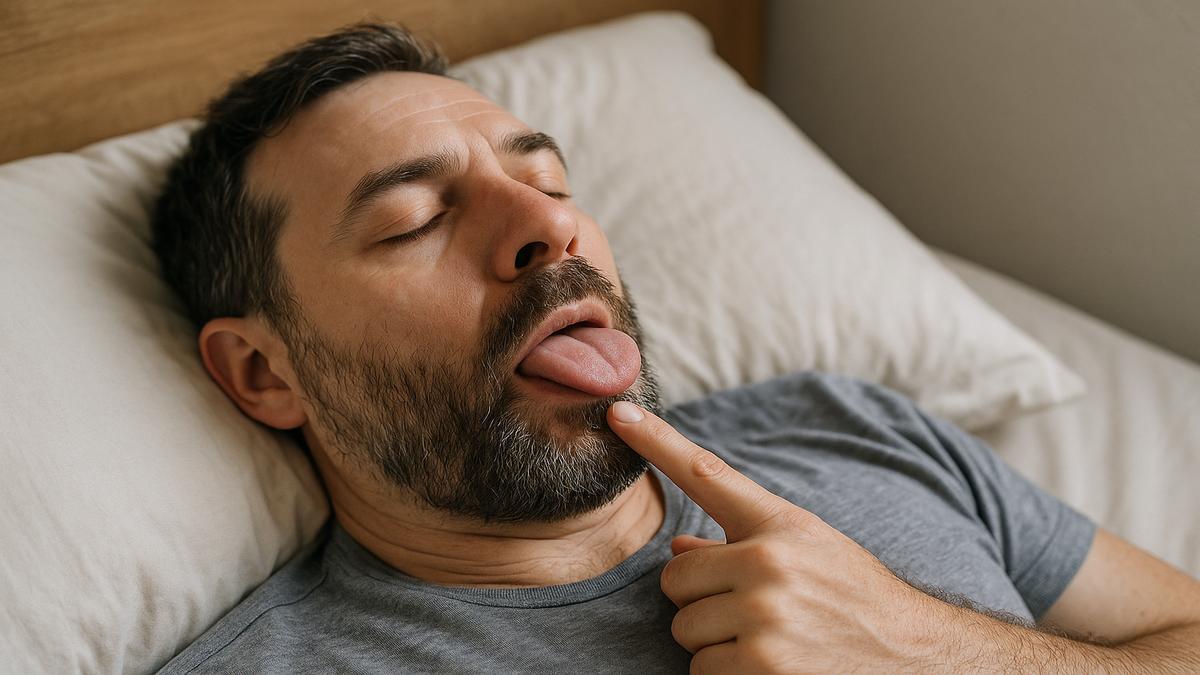
The first time I heard about the “7-second tongue trick,” I was standing in a pine-darkened campground, shivering in a flannel shirt and trying not to laugh. Someone in the next tent was sawing logs so ferociously the sound echoed off the trees. It was a raw, animal noise—the kind that makes strangers exchange glances and silently agree: nobody is sleeping tonight. Then, over the hiss of the campfire, an older woman in a wool hat leaned in and said, almost conspiratorially, “You know you can train your tongue to stop that, right? Takes about seven seconds.”
When Snoring Becomes the Night’s Main Character
Snoring is one of those sounds you don’t notice until you can’t escape it. In a small cabin, in a tent, or in the narrow bedroom you share with someone you love, it becomes the main character of the night. It vibrates through pillowcases. It clings to the shadows. It paints the dark with frustration.
Maybe you know the scene: the soft rustle of sheets, the quiet settling of the house, a long exhale of relief—and then it arrives. That first uneven rumble. It grows, thickening into a buzz-saw rasp or a low, gurgling thunder. You lie there, eyes open to the ceiling, counting the seconds between each blast like you’re timing storms. You shift. You nudge. You whisper their name. They startle, snore stops… and then, inevitably, the cycle restarts.
For many people, this nightly soundtrack becomes a quiet wedge between partners. One person wakes foggy and resentful, the other groggy and confused. “I’m not snoring that badly,” they insist, because they never really hear what their body is doing once consciousness loosens its grip.
But what if a subtle shift in how the tongue rests in your mouth could change that story? What if the answer wasn’t stuck to your nose, wrapped around your head, or strapped to a machine—but hidden in the quiet strength of a small muscle you almost never think about?
The Small Muscle at the Center of the Noise
The tongue is deceptively powerful. Forget its role in tasting or shaping language for a moment; think of it as a quiet, fleshy gatekeeper of your airway. In the soft darkness of sleep, when your body slackens and muscles relax, the tongue can drift backward like a lazy boat, slipping toward the throat and narrowing the passage where your breath passes.
Snoring often begins where air gets squeezed. When the tongue and soft palate sag toward the back of the mouth, the space behind them becomes a narrow tunnel. Air is forced through that tight gap, and soft tissues vibrate. That vibration is the growl, the buzz, the rattle.
Years of mouth-breathing, poor posture, and even scrolling in bed with your neck tilted forward can make the tongue weaker and lazier, training it to rest low and back instead of high and forward. Over time, the body forgets that the tongue can be something more than a passenger. It can be a stabilizer, a brace that holds the airway open like a silent support beam.
Most anti-snoring devices—strips, mouthpieces, straps—try to reshape the space from the outside. They tug, lift, stretch. Some work; many annoy. But the 7-second tongue trick flips the idea: instead of forcing the airway open, you train the muscles that live inside it. You make the tongue strong and smart enough to stay out of the way when it matters most.
The 7-Second Tongue Trick: Simple, Oddly Powerful
Here’s where it gets intriguingly simple. The “7-second tongue trick” isn’t magic. It’s a small, targeted exercise that nudges your tongue into a healthier, more stable resting position and gradually strengthens the muscles that hold your airway open at night.
Think of it as teaching your tongue a new home base.
Try this right now:
- Sit or stand comfortably with your spine long and shoulders relaxed.
- Close your lips gently, without clenching your jaw.
- Place the entire tongue against the roof of your mouth—tip just behind your upper front teeth, but not touching them; the middle and back of the tongue lifted as much as possible.
- Now, press the tongue firmly upward into the palate and hold that pressure for about 7 seconds while breathing slowly through your nose.
- Relax, then repeat.
It sounds too easy. But stay with it. As you hold that press, notice how the underside of your tongue tightens, how the muscles in your neck and under your jaw lightly engage. Maybe you even feel a stretch along the soft palate at the back of your mouth. All of this is your internal scaffolding waking up.
That’s the core move. The trick lies not in a single attempt, but in repetition—these short, seven-second holds practiced several times across the day. Over time, this helps your tongue default to a higher, more forward resting place, leaving more room in the back of the throat for air to glide through without turbulence.
Why Seven Seconds?
Seven seconds is long enough to recruit and fatigue the tongue’s support muscles, but short enough to avoid strain or awkwardness. It fits into quiet moments: waiting at a red light, standing by the kettle, walking under trees on a lunch break. Do it a few times in a row, and you’ve just slipped in a minute of targeted training without disrupting anything in your day.
This small dose of effort taps into the same principle athletes use: specific, consistent activation builds strength and coordination. In this case, you’re not preparing for a marathon. You’re preparing for midnight.
Putting the Trick to Work: A Tiny Practice With Nighttime Consequences
You don’t need gadgets, apps, straps, or strips to explore this. What you need is attention—and a little curiosity about the landscape inside your own mouth. To make the 7-second trick into something that can change your nights, it helps to build a rhythm.
A Simple Daily Rhythm
Think in small clusters of practice throughout the day:
- Morning: After you brush your teeth, do 5–10 rounds of the 7-second tongue press.
- Afternoon: Choose a regular moment—say, after lunch or during a short walk—and do another 5–10 rounds.
- Evening: Before bed, when the house is growing quiet, slip in 10 more rounds. Let this be your “airway warm-up” before you lie down.
Notice how it feels over a week. Many people describe a subtle shift: their tongue starts to “rest” on the palate more often without conscious effort. Mouth breathing softens; nasal breathing feels a little more natural. Some report snoring grows less frequent or less ferocious. For others, their partner notices first.
Pairing It With Nasal Breathing
The tongue trick works best when paired with nose breathing. Breathing through the nose naturally encourages the tongue to lift and the jaw to settle. If you habitually sleep with your mouth open, you’re more likely to invite snoring. During your 7-second holds, keep your lips closed and air flowing quietly through your nose. You’re not just training the tongue—you’re reminding your whole airway what calm, efficient breathing feels like.
Adding Gentle Variations
Once you’ve got the basic 7-second press down, you can experiment with tiny variations that still respect the same principle—short, focused engagement:
- Slide and hold: Start with the tongue pressed to the palate, then slowly slide the tip back along the roof of your mouth while keeping as much tongue contact as possible. Pause for 7 seconds when you feel the back of the tongue engage more strongly.
- Pulse holds: Press firmly for 2 seconds, ease slightly for 1, and repeat this micro-pulse rhythm for a full 7-second block.
- Soft palate lift: With the tongue pressed up, imagine the back of your throat gently “smiling” upward; feel the subtle dome of the palate rising as you breathe in through your nose.
All of these moves share the same mission: build a tongue that knows how to lift, hold, and stay out of the airway’s way.
How the Tongue Trick Stacks Up Against Strips and Gadgets
Most people turn to snoring solutions in desperation. Shopping late at night, eyes gritty, they toss nasal strips, chin straps, or mouthguards into carts, hoping one will hush the storm. Some do provide relief—especially for snoring caused by nasal congestion or jaw position. But nearly all of them treat the symptom from the outside.
The charm of the 7-second tongue trick is that it works from the inside out. No adhesives, no plastic in your mouth, no gear stretching across your face. Just one very human muscle, rediscovering its job.
| Method | What It Targets | Pros | Limitations |
|---|---|---|---|
| 7-second tongue trick | Tongue & airway-support muscles | No devices; strengthens root cause; usable anywhere | Requires consistency; results can be gradual |
| Nasal strips | Nasal passages | Easy; helps with congestion-related snoring | Doesn’t address tongue or throat collapse |
| Mouthguards / oral devices | Jaw & tongue position | Can be effective in mild–moderate cases | Bulky; adjustment period; cost |
| Chin straps | Mouth closure | Encourages nasal breathing | Can be uncomfortable; doesn’t build muscle |
Muscle training does something devices can’t: it changes your architecture over time. Think of it like tending a small, hidden garden rather than taping over a leaky window. The work is subtle and cumulative. Your tongue becomes more toned. The tissues at the back of your mouth less likely to flop backward in sleep. The airway, once prone to vibration, learns to stay wider and calmer.
For people with mild to moderate snoring that isn’t rooted in serious medical issues, this alone can make a noticeable difference. For those with more complex sleep-disordered breathing, it can still be a powerful companion to medical treatment, making devices more comfortable and effective.
The Quiet Payoff: Nights That Belong to You Again
Imagine, for a moment, a night unclaimed by noise. No sudden startles from the other side of the bed. No low, rattling chorus that drags your mind back from the edge of sleep. Instead, there’s only the tiny, almost imperceptible sound of air slipping in and out of noses in the dark. The room feels larger, somehow. Time stretches. You wake before your alarm and realize your jaw isn’t tight, your throat isn’t dry, your chest doesn’t feel like it fought for breath.
This is what’s quietly at stake when you spend a handful of seconds each day lifting your tongue to the roof of your mouth. Not just the absence of a noise, but the return of something gentler: shared rest that doesn’t come with resentment. Mornings where “How did you sleep?” is no longer a loaded question.
And there’s another, less obvious benefit. When you repeatedly choose an internal, body-based solution over another gadget, you’re sending yourself a quiet message: this body is capable of learning; it doesn’t always need to be strapped into compliance. You become a student of your own anatomy, noticing how your jaw hangs when you’re tired, how your tongue slumps when you’re stressed, how your breathing changes with posture. That awareness tends to spill into other corners of life—how you sit at your desk, how you walk, how you pause during the day.
Snoring is loud. But the solution doesn’t have to be. Sometimes it’s hidden in a motion so small it barely disturbs the air between your teeth and the roof of your mouth.
When to Go Beyond the Tongue Trick
Of course, not all snoring is created equal. There’s the soft, occasional rumble of a long day surrendered to deep sleep—and then there’s the kind that comes with gasps, choking sounds, or long silences followed by explosive snores. If the person snoring seems to stop breathing for stretches of time, or wakes feeling shattered no matter how early they went to bed, this can be a sign of obstructive sleep apnea, a medical condition that deserves real attention.
The 7-second tongue trick is a gentle, empowering tool, but it is not a cure-all. Think of it as part of a landscape that might also include:
- Speaking with a sleep specialist or doctor about loud, chronic snoring or suspected apnea.
- Getting a sleep study if pauses in breathing, morning headaches, or daytime exhaustion are common.
- Adjusting sleep position—some people snore far more on their backs than their sides.
- Exploring weight, alcohol use near bedtime, and nasal congestion as amplifiers of snoring.
There’s a kind of courage in looking directly at what happens to you in the dark. Tools like CPAP machines, oral appliances, or medical interventions aren’t admissions of failure; they’re acts of protection. In that larger picture, the tongue trick is more like daily trail maintenance, keeping the path as clear as possible so bigger supports don’t have to work quite so hard.
FAQs About the 7-Second Tongue Trick
How long does it take to see results from the 7-second tongue trick?
Some people notice small changes within a week or two—slightly quieter nights, less mouth dryness. For others, it may take 4–6 weeks of consistent practice for more obvious differences. Think of it like strengthening any other muscle: gradual, steady improvements rather than overnight transformation.
How often should I do the tongue exercise each day?
A realistic target is 2–3 sessions per day, with 5–10 repetitions each time. Each repetition is just a 7-second hold, so the total daily time investment is only a few minutes. Consistency matters far more than sheer volume.
Can this trick completely stop snoring?
It can significantly reduce snoring for some people, especially when tongue position and weak airway muscles are the main drivers. But not all snoring has the same cause. Structural issues in the nose, enlarged tonsils, excess weight, or sleep apnea may require additional strategies or medical care.
Is the 7-second tongue trick safe to do?
For most people, yes. It’s a low-risk exercise that simply engages the tongue and surrounding muscles. If you feel pain, dizziness, or unusual discomfort, ease off, shorten the holds, and speak to a healthcare professional, especially if you have known jaw, tongue, or throat conditions.
Can I use this trick along with other snoring aids?
Absolutely. You can still use nasal strips, positional pillows, mouthguards, or medical devices while training your tongue. In many cases, strengthening the tongue and improving nasal breathing can make other interventions work better and feel more comfortable over time.
What if I mostly snore when lying on my back?
Back-sleeping makes it easier for the tongue to fall backward into the throat. The 7-second tongue trick helps by training your tongue to rest higher and more forward, which can reduce this tendency. Combining the exercise with side-sleeping techniques often gives the best results.
How can my partner tell if it’s making a difference?
Ask them to notice not only the volume of your snoring, but also its pattern: fewer choking sounds, more steady breathing, shorter snoring episodes. Keeping a simple “snoring diary” over a few weeks—just quick nightly notes—can make subtle improvements easier to spot.
In the end, the 7-second tongue trick is a small act of reclaiming the night. No straps. No plastic. Just the quiet strength of a muscle you already carry, learning at last how to hold open the doorway to your own breathing.

Hello, I’m Mathew, and I write articles about useful Home Tricks: simple solutions, saving time and useful for every day.