The plant that purifies indoor air quietly
The first time I noticed it, the room went quiet in a way that had nothing to do with sound. It was a Tuesday, late, and the glow of a laptop screen had carved a rectangle of blue light into the dim apartment. The air felt thick, as if it had been breathed and rebreathed all day long—which, of course, it had. City windows that barely cracked open, radiators that hissed with dry heat, that faint metallic tang of dust and old paint. I remember rubbing my eyes and wishing, more than anything, for a forest—one of those deep, green places where your lungs stretch wide without even trying.
Instead, what I had was a pot of soil on the floor beside my desk and a tangle of glossy green spears rising from it. A humble houseplant. It didn’t bloom. It didn’t perfume the air. It sat there, half in shadow, like a quiet guest who never asked for anything. Yet if you’d looked closely, you might have seen what I finally noticed: the way the room’s mood seemed to shift around it. The way the air felt just a notch softer, cooler, easier.
The plant had been a gift from a friend who worked in a cramped office building and swore that having one on her desk made a difference. “It cleans the air,” she’d said simply, pressing the pot into my hands. “You won’t notice it at first. But give it time.”
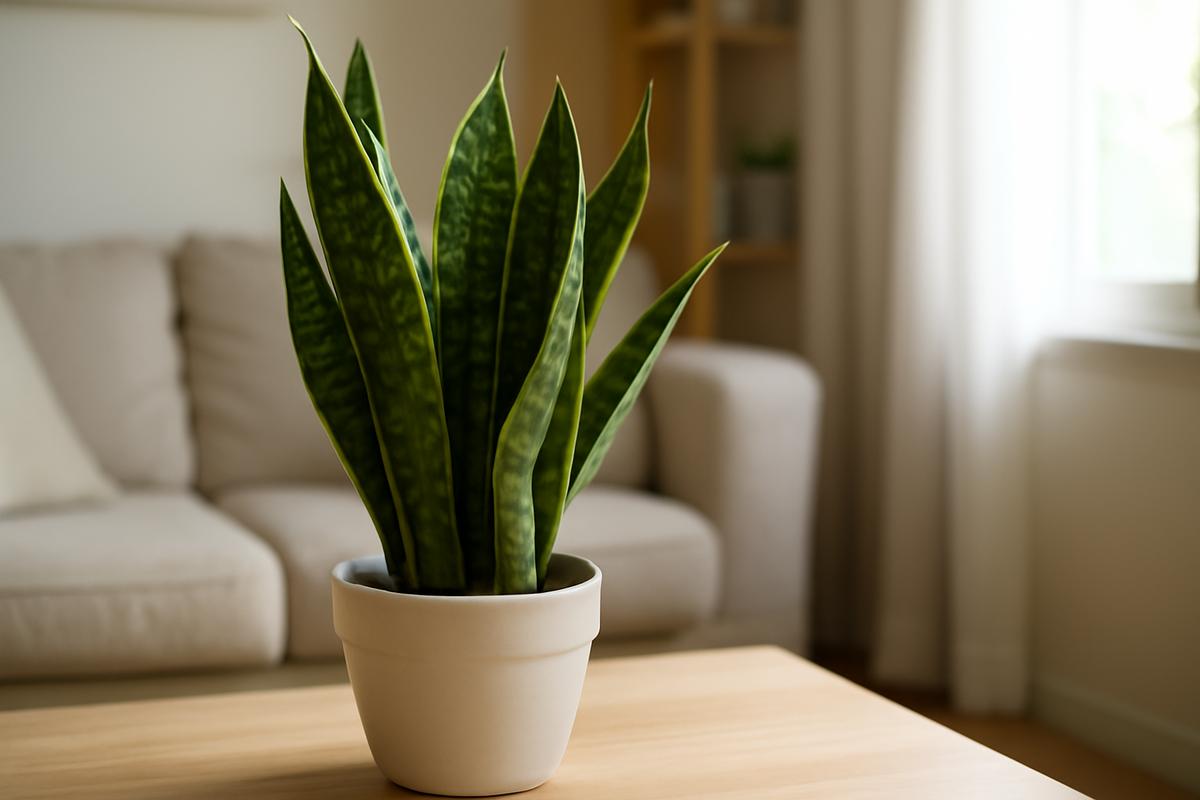
It was a snake plant—also called mother‑in‑law’s tongue—a name that makes you smile once you’ve lived with one: sharp leaves, yes, but a temperament so forgiving it borders on saintly. You can miss a watering. Or three. You can tuck it into a corner that hardly sees the sun. You can forget it on busy days. Through it all, it goes on doing something almost invisible, almost magical: filtering the unseen substances that drift through indoor air, exchanging them for oxygen you can’t see either, but absolutely can feel.
The quiet work happening in your living room
Spend enough time indoors and the walls start to close in—not literally, but molecule by molecule. The indoors is full of things that off‑gas: paints, pressed wood furniture, new mattresses, cleaning products that promise fresh scents and deliver something else entirely. Invisible chemicals, like formaldehyde, benzene, and trichloroethylene, become part of the air we pull into our lungs with every inhale.
You don’t necessarily smell this. It’s not the sour funk of last night’s dinner or the dusty smell when the heater kicks on. It’s quieter than that. Maybe it shows up as a dull headache at the edge of the day, a heaviness behind the eyes, a strange tiredness that settles on you by midafternoon inside a sealed office or apartment.
Now picture the snake plant in the corner.
Those stiff, sword‑like leaves aren’t idling. Slowly, steadily, the plant is drawing in air through tiny pores on its surface. It uses some of the chemicals as raw material, breaking them down, absorbing and transforming them in the quiet alchemy of plant metabolism. What started as a board of pressed wood or a coat of varnish becomes, through a series of almost microscopic steps, something less harmful—or gone.
Most of the time when we talk about air purification, the conversation jumps straight to technology: filters with ratings and replacement schedules, machines that hum and blink and remind you of their presence. Plants move differently through the world. They don’t whir. They don’t ping your phone. They stand in the soft light and do what they have always done—trade carbon dioxide for oxygen, trade harshness for gentleness, trade what we exhale and exude for something we can breathe more easily.
Snake plants, in particular, have a quiet specialty. Unlike many plants that only photosynthesize efficiently during the day, they’re known for continuing certain gas exchanges even at night. While you sleep, while the city outside pulses with late‑evening sirens and the slow roll of traffic, the plant at your bedside is quietly working, a tiny green lung on the floor.
Meeting the plant that forgives your busy life
If there’s a plant designed for modern life—small apartments, erratic schedules, overfull calendars—it’s the snake plant. The first thing you learn about it is how much it doesn’t need from you, and how much it offers in return.
You can skip a week of watering because you were on a business trip. You can forget to open the blinds on a rainy day. You can set it in a hallway where sunlight spills only in a narrow band for an hour or two. The plant will not sulk. It will not drop leaves in protest. Its roots, thickened and adapted to store water, simply wait, patient as stone, until you remember it again.
Run your fingers along one of its leaves and you’ll feel the subtle waxiness, the sturdy structure beneath the green. This isn’t a plant prone to drama. It doesn’t faint if you look at it too hard. Children can bump into it; cats might investigate and promptly lose interest. It holds its spires of green with calm determination, like sentinels posted along the windowsill.
In that resilience lies its second gift: longevity. Many plants in city apartments are short‑term experiments, fading within months because the light isn’t quite right, or because schedules don’t line up with their needs. Snake plants, on the other hand, are in it for the long haul. Given a pot with decent drainage and the occasional watering, they simply keep going—through new jobs, new roommates, new paint colors, and new winters.
And through all those seasons, it keeps purifying the air. Subtle, unannounced, but dependable.
A tiny forest you can carry up the stairs
Of course, one single plant in a corner is not going to transform a whole apartment into a mountain meadow. Yet there’s something powerful in the idea of creating a little forest ecosystem inside, scaled to a bookshelf rather than a hillside.
Imagine a pair of snake plants flanking your couch, their leaves catching the low morning light. A smaller one perched on your desk, its tips a gentle frame around your laptop screen. A taller specimen in the bedroom, standing guard near the window. Individually, each one is a quiet worker. Together, they begin to feel like a team.
There is a kind of design pleasure in this. Arranging plants is a bit like arranging furniture, but slower and more deliberate. You begin to notice how the light moves through your home over the course of a day. You realize that the patch of floor near the bookshelf actually glows in the late afternoon. You see the way a tall plant can soften the hard edge where wall meets ceiling, how the vertical lines of snake plant leaves echo the vertical lines of window frames and doorways.
With each new plant, the air seems to shift a little, as if the room has taken a deeper breath. This isn’t just about chemistry; it’s also about how the mind reads space. Green signals life, growth, and a slow, reliable rhythm that stands in gentle contrast to the pinging, flashing world of screens. The presence of plants has been tied, again and again, to lower stress and better focus. Their work is twofold: invisible filtration in the air, and visible calm in the mind.
What’s striking is how accessible this tiny forest can be. A snake plant doesn’t demand a sun‑flooded loft or a sprawling suburban living room. It thrives in rentals, in dorms, in the single narrow window of a studio apartment that overlooks a brick wall. You can carry a whole indoor grove up four flights of stairs, one pot at a time, and in an afternoon transform sterile space into something breathing and green.
How the snake plant quietly edits your air
Step closer and the leaves of a snake plant tell a story in green and gray, sometimes edged in yellow, sometimes marbled like stone. But the real story sleeps inside those leaves and their nearly invisible pores.
All plants live by exchanging gases with the air around them. For the snake plant, this exchange includes a knack for handling some of the less pleasant ingredients floating through modern rooms. Studies exploring plant‑based air purification have found that snake plants are particularly good at reducing certain volatile organic compounds—compounds that drift out of vinyl flooring, synthetic fibers, and even some cosmetics and cleaning sprays.
It’s not a perfect, all‑powerful system. The scale is modest; a single plant offers localized help, not a complete reset. But what makes this purification special is its constancy. There is no “on” button. No filter change reminder. The plant simply persists, adjusting its processes with the rise and fall of daylight, the humidity of the room, the temperature near the window.
At night, when many leafy plants slow their oxygen production, snake plants continue much of their gas exchange using a specialized system that conserves water and fits beautifully with dry indoor air. While you sleep, the plant’s metabolism hums along—quiet, unseen—and each small exchange contributes another tiny nudge toward cleaner, more balanced air.
You may never feel the exact moment the air grows easier to breathe. Instead, you’ll notice something subtler: the way your home feels when you return after a long day. Less stale. More alive. The almost imperceptible lift in your chest with the first deep breath after you drop your bag by the door.
Simple ways to help your plant help you
The grace of the snake plant is how little care it needs to perform this work. Still, a few small rituals turn the partnership into something richer.
- Water sparingly, but deeply. When you water, let the soil drink it in, then let it dry well before you return. Roots that sit in soggy soil for days are roots that struggle. Dry spells, on the other hand, are not a problem; they are part of this plant’s desert ancestry.
- Offer modest light. Bright, indirect light is ideal, but low light is acceptable. A corner that never sees direct sun is still a possibility. Only the darkest, windowless rooms will push its patience too far.
- Dust the leaves now and then. A soft cloth, a gentle wipe: free the surface to breathe. Much like our own lungs, the plant works better without a film of dust blocking its tiny openings.
- Choose a pot with drainage. A simple pot with a hole at the bottom and a saucer beneath it is all you need. This lets excess water escape rather than pool around the roots.
- Give it a little space. Leave room for the leaves to fan out without pressing hard against walls or furniture. Air movement around the plant helps it do its work.
None of this requires a gardener’s expertise. It takes minutes, folded into the week like a quiet conversation with a friend: a check of the soil with your fingertip, a turn of the pot so all sides see a bit of light, a glance to admire a new leaf rising from the center like a sword unsheathed.
The small science of feeling better at home
We talk a lot about wellness these days: about what we eat, how we move, how many steps we take or hours we sleep. Yet so much of how we feel is shaped by the air that wraps around all of it. It is the most intimate environment we inhabit, drawn into the body twenty thousand times a day, and yet it is the one we see the least, think about the least—until something goes wrong.
The snake plant does not demand you think about it constantly. It doesn’t flash a warning when particulate levels spike or send you graphs of your air quality. Its science belongs to a quieter realm: the slow, ongoing reduction of specific airborne pollutants, the steadier oxygen levels, the subtle increase in humidity from the leaf’s own processes.
And then there is the other science: the one that measures heart rates and stress markers and finds that rooms with plants are gentler on our nervous systems than rooms without them. The mind, it seems, reads the presence of living greenery as a sign that an environment is safe and supportive. Our bodies respond with tiny, measurable sighs of relief.
So the snake plant does double duty. On the chemical level, it sifts some of what we don’t want out of the air. On the emotional level, it offers a sense of companionship and calm. The ritual of tending—however minimal—nudges us to pause. To notice the color of the leaves, the height they’ve reached since last month, the new shoots pushing up to join the older ones. This small act of paying attention tethers us, briefly, to the slower tempo of the natural world.
In an age where so much of life is fast and flickering, there is quiet power in that slowness.
A quick guide to choosing your green roommate
When you step into a nursery or a corner of a grocery store lined with plants, you’ll usually find several varieties of snake plants, each a little different in shape and pattern. Choosing one can be as intuitive as picking a painting for your wall: which one makes you feel something when you look at it?
| Type | Look & Size | Best Spot Indoors |
|---|---|---|
| Tall classic snake plant | Long upright leaves, 2–4 feet tall, green with soft striping | Floor near a window, living room corners, hallway anchors |
| Compact rosette variety | Shorter, fan‑shaped clusters, about 6–12 inches high | Desktops, bedside tables, bookshelves |
| Variegated edge type | Green centers with yellow or cream leaf margins | Places you want a pop of color—entryways, kitchen counters |
Choose one that feels right in your hand, that seems sturdy, whose leaves rise firm and unblemished from the soil. Picture it in your space: guarding the bedroom window, gracing your dining table, or absorbing the glow of the computer screen on your desk. This plant will not be a fleeting accent; if all goes well, it will live with you for years, quietly making the air you share a little kinder.
Living side by side with a silent purifier
Over time, you stop thinking of the snake plant as an object and start thinking of it as a presence. You notice how the room looks wrong without it when you move it to repot. You catch yourself glancing at it for no reason other than the soft pleasure of that solid, upright green. You water it, and you feel—strange but true—a small satisfaction in doing something good for a living thing that is, in turn, doing something good for you.
On late nights, when the city hums just beyond the glass and you’re the only one awake, it becomes a kind of companion: not asking, not judging, just existing alongside you. It holds the day’s dust and exhalations in its leaves, quietly reworking them in the dark. In the early morning, as pale light slides across the floor, it greets the new day as it does every day: without fanfare, ready to keep going.
We tend to think of help as loud and obvious—a machine that roars to life, a device that glows and commands attention. But there is another kind of help, the kind that stands in the corner and simply is. The kind that purifies the air without a single blinking light. The kind that reminds us, gently, that we are still part of a living world, even three floors up in a concrete building.
The snake plant is that kind of help. Steady. Undramatic. Refreshingly low‑tech. A thin strip of forest edge, transported into a pot and placed within arm’s reach of where you sleep, work, and dream.
Next time the air in your room feels heavy, notice the plant in the corner. It has been working this whole time. It will go on working long after the laptop is shut and the lights are dimmed, long after the last message has been answered. While you rest, it will keep editing the air, leaf by patient leaf, so that when you wake and draw that first deep breath, your lungs meet something just a bit clearer, a bit softer, a bit more like the forest you once wished for on a tired Tuesday night.
Frequently Asked Questions
Do snake plants really purify indoor air?
Snake plants can help reduce certain airborne pollutants and contribute modestly to cleaner indoor air. They absorb some volatile organic compounds through their leaves and roots. While they don’t replace a full building ventilation system or an air purifier, they offer continuous, low‑maintenance support and add oxygen and humidity to your space.
How many snake plants do I need in one room?
There’s no strict rule, but a practical guideline is one medium‑sized plant for every 8–10 square meters of space if you want a noticeable plant presence and some added air‑quality benefits. Even a single plant in a small room can make the space feel fresher and more alive.
Are snake plants safe for pets?
Snake plants can be mildly toxic if chewed or ingested by pets, potentially causing stomach upset. If your cat or dog tends to nibble on leaves, it’s wise to place the plant out of easy reach, such as on a higher shelf or behind a barrier.
How often should I water a snake plant?
In most indoor environments, watering every 2–3 weeks is enough, and even less in cooler months. Let the top half of the soil dry out completely before watering again. Overwatering is the most common way to harm a snake plant; underwatering is rarely a serious problem.
Can snake plants live in low light?
Yes. Snake plants tolerate low light better than many houseplants, which makes them ideal for offices, hallways, and rooms with smaller windows. They will grow faster and look their best in bright, indirect light, but they won’t give up easily in shadier spots.
Do snake plants need special soil or fertilizer?
A simple, well‑draining potting mix—often labeled for succulents or cacti—works well. Fertilizer isn’t strictly necessary, but a light feeding once or twice during the growing season (spring and summer) can support new growth. Too much fertilizer is more harmful than too little.
Will a snake plant help me sleep better?
Many people find that having plants like snake plants in the bedroom creates a calmer atmosphere and may help them feel more relaxed at bedtime. The plant’s gentle contribution to air freshness and its visual presence can both play a role, even if the effect is subtle and personal.

Hello, I’m Mathew, and I write articles about useful Home Tricks: simple solutions, saving time and useful for every day.