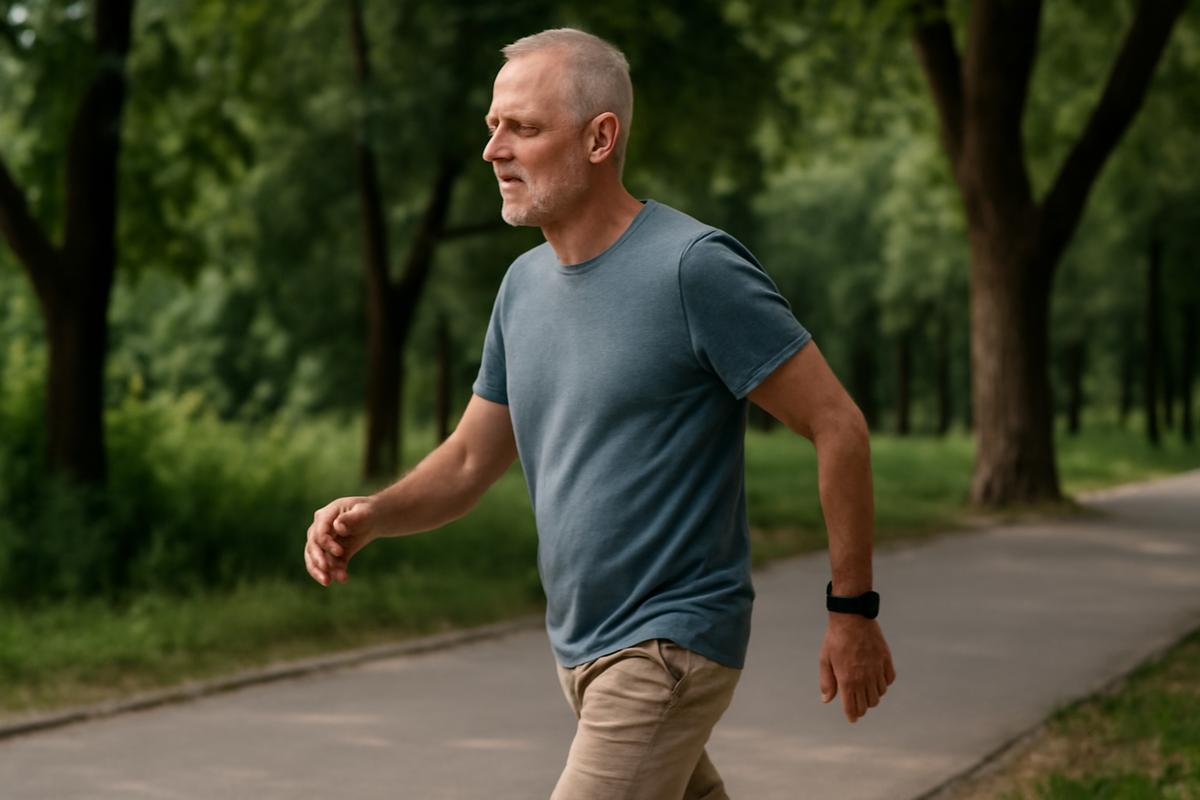
The first thing you notice is the sound. Not the birds, not the rustle of leaves, but the soft, deliberate hush of your own footsteps on the path. You’re walking a little slower than you used to, not because you’re tired, but because you’re listening—really listening—to your body. Your knees are sending subtle signals, your hips chime in every now and then, and your lower back has its own opinion about inclines. There was a time you sailed along without a second thought; now you’re wondering: Is there a right way to walk at this age? Is there a speed that doesn’t just feel good in the moment, but actually protects your joints for the long run?
The Quiet Conversation Between Your Feet and Your Joints
Every step you take is a quiet negotiation between your body and the ground. When you’re under 30, that negotiation is loud, reckless, almost naïve: You pound down stairs, stride across parking lots, jog across streets just because you can. Your joints absorb the impact and bounce back, almost insulted that you underestimated them.
After 55, that conversation changes. The cartilage in your knees, once glossy and plush like a new sofa cushion, has seen years of use. Tiny micro-tears and gradual thinning make every impact more noticeable. Your hips—those deep, ball-and-socket anchors—have been turning and swiveling and stabilizing you through decades of movement. Now, when you walk too fast or too hard, they respond with a dull, lingering complaint.
But here’s the twist most people miss: abandoning brisk walking altogether isn’t the answer. Your joints don’t want you to stop; they want you to be smart. They are, in a way, just asking for a different rhythm.
Inside each joint, movement is the pump that keeps everything alive. As you walk, joint fluid circulates, nourishing cartilage like rain seeping into soil. The right kind of walking actually feeds your joints. The problem isn’t walking. It’s walking at a speed that pushes your joints into the red zone—too much load, too little control, not enough time for muscles to help.
The Goldilocks Zone: Not Too Fast, Not Too Slow
Somewhere between a lazy shuffle and a breathless march lies a range your joints love—a walking speed that is protective instead of punishing. Think of it as your personal “Goldilocks pace”: not too fast, not too slow, but just right for the body you have now, not the one you had thirty years ago.
Biomechanics researchers talk about “preferred walking speed,” the natural pace your body chooses when you’re not rushing or dawdling. For many adults, this lands roughly between 2.5 and 3 miles per hour (about 4 to 4.8 kilometers per hour). Your steps feel smooth, you can hold a conversation, and you’re not gasping for air.
After 55, something interesting happens. The sweet spot usually shifts—not because you’re weaker by default, but because your joints, muscles, and balance systems are recalibrating. The safest, joint-friendly walking speed for many people in their 50s, 60s, and beyond tends to be in the gentle-to-moderate range:
- About 2.2 to 2.8 mph (3.5–4.5 km/h) for most people over 55
- Fast enough to feel purposeful, slow enough that your joints don’t feel hammered
This speed gives your muscles time to do their job—absorbing impact, stabilizing your knees and hips, and keeping your gait smooth and balanced. When you push above that, without the strength to back it up, more of the load shifts onto your cartilage and bones. When you drop way below that, you can actually move less efficiently, with a shuffling pattern that may strain your joints in a different way.
But here’s the key: the “right” walking speed isn’t a single magic number that fits everyone. It’s a narrow band where your body feels aligned, supported, and steady.
How Your Body Tells You You’re in the Safe Zone
You don’t need a smartwatch or a treadmill to sense your Goldilocks pace. Your body already has a built-in dashboard—if you pay attention to it. At a joint-protective speed:
- Your breath is deeper but still comfortable; you can talk in full sentences without stopping to gulp air.
- Your feet land quietly. You’re not slapping the ground; you’re placing each step.
- Your knees feel engaged but not pressured; there’s no sharp jolt with each heel strike.
- Your hips glide rather than grind. You’re not bracing with every step, just gently rolling forward.
This is what a protective pace feels like: alert but relaxed, stable but flowing. If your joints feel “lighter” during and after your walk—less stiff, more lubricated—you’re likely in that protective zone.
When Speed Becomes the Enemy: The Hidden Costs of Rushing
Imagine watching someone in their sixties stride across a crosswalk, shoulders tight, chin forward, eyes on the light. Their feet hit the pavement hard and fast, almost like they’re trying to outrun time itself. That kind of walking isn’t just stressful for the nervous system; it can chip away at the joints over time.
As speed increases, so does ground reaction force—the invisible pushback from the earth with every step. Faster walking shortens contact time with the ground but spikes the intensity of each landing. If your leg muscles are strong and well trained, they can cushion that load. If they’re not, the extra force filters straight into your knees and hips.
After 55, a lot of people carry a double burden: slightly thinner cartilage and slightly weaker muscles, especially in the quadriceps and glutes. In that context, brisk, hard-impact walking turns from “healthy exercise” into a quiet, repetitive insult to the joints.
On the flip side, walking too slowly—especially with a hesitant, unsteady gait—can cause its own issues. Tiny, shallow steps, a hunched posture, and a lack of hip movement change the way forces travel through your skeleton. Instead of smooth arcs, you get staccato stops and starts. Your knees and hips never fully extend, and the feeling of stiffness can grow, not shrink.
So the question isn’t “Should I walk fast or slow?” but “How do I find and hold the pace where my muscles—not just my cartilage—are doing the heavy lifting?”
Listening to Your Joints the Way You Listen to Weather
Your joints are like a hyperlocal weather report: they can’t tell you what’s happening across the country, but they know exactly what’s going on in your little corner of the world. Ignore them, and you’ll get caught in a storm you could’ve seen coming. Tune in, and you can adjust before things get rough.
On your next walk, treat your first five minutes as a weather check. Start slow. Notice:
- Do your knees feel stiff at first but gradually ease as you move?
- Does one hip feel tighter, heavier, or “grabbier” than the other?
- Does your lower back start to talk to you when you pick up speed?
Then gently increase your pace, notch by notch, until your breath deepens and your stride feels firm but not pounding. Stay there. That’s your joint-protective speed for today. It might be slightly different tomorrow, depending on sleep, stress, weather, and what you did the day before. Just like the sky, your body has its own shifting patterns.
The Sweet Spot in Numbers: A Simple Walking Speed Guide
For those who like clear markers, you can use a simple rule-of-thumb table to think about joint-friendly walking speeds after 55. These are broad ranges, not prescriptions, but they’re a useful starting point.
| Age Range | Joint-Friendly Speed (mph) | Joint-Friendly Speed (km/h) | How It Should Feel |
|---|---|---|---|
| 55–60 | 2.4–2.9 | 3.9–4.7 | Steady, purposeful, easy conversation |
| 61–70 | 2.2–2.7 | 3.5–4.3 | Comfortably brisk, joints feel “warmed,” not pounded |
| 71+ | 2.0–2.5 | 3.2–4.0 | Gentle, balanced, no rushing, no shuffling |
To roughly estimate your speed outdoors, pick a known distance—say a quarter mile (about 400 meters or one standard track lap)—and time how long it takes.
- 15 minutes per mile ≈ 4 mph (too fast for many joints after 55 unless you’re very fit and strong).
- 20–25 minutes per mile ≈ 2.4–3 mph (often the protective Goldilocks zone).
- Over 30 minutes per mile ≈ under 2 mph (fine for recovery days, but not ideal as your only pace).
But remember: if the numbers say “good speed” and your knees say “absolutely not,” your knees win.
How to Train Your Body for the Pace That Protects You
Here’s a secret no one tells you: the ideal joint-protective walking speed is not a fixed trait. It’s trainable. With the right support from your muscles and posture, your joints can tolerate a slightly faster, more confident walk—safely.
Strength: The Silent Bodyguard of Your Joints
If your joints are the hinges, your muscles are the doorframe. The stronger the frame, the less strain on the hinge. For walking after 55, three muscle groups matter most:
- Quadriceps (front of the thighs): support the knee when you land and push off.
- Glutes (buttocks): stabilize the hips and pelvis with every step.
- Calves: help absorb impact and assist in forward propulsion.
A few times a week, even 10–15 minutes of simple strength work can shift more of the workload from joints to muscles:
- Chair squats or sit-to-stands.
- Step-ups on a low step or curb.
- Heel raises while holding onto a railing.
As these muscles grow more reliable, your comfortable, joint-safe walking speed often nudges upward. Suddenly, 2.7 mph feels as kind to your knees as 2.2 mph did before.
Posture: How You Stand Changes How You Land
Picture two walkers. One is leaning forward from the waist, head jutting out, steps landing heavily on the heels. The other is upright, ribs stacked over hips, eyes scanning the horizon, feet landing under the body rather than far ahead. Both might be walking at 2.5 mph—but their joints are living very different lives.
A joint-protective gait usually includes:
- A gentle forward lean from the ankles, not the waist.
- Eyes looking ahead, not down at the ground.
- Shorter, quicker steps rather than long, pounding strides.
- Feet landing closer to under your torso, not way out in front.
This slight shift in posture can turn the same pace from jarring to fluid, especially for the knees.
Terrain: The Ground Beneath Your Feet Matters
As you age, the ground quietly becomes either your ally or your saboteur. Hard concrete and slanted sidewalks amplify joint stress, especially if you walk fast. Softer, more forgiving surfaces—packed dirt paths, well-kept grass, rubberized tracks—absorb some of the impact, letting your joints relax into the motion.
If your joints are already bothered, try this experiment: walk for ten minutes at your usual pace on concrete. The next day, repeat the same speed and time on a park path or track. Notice the difference. Many people feel their knees and hips sigh in relief on the softer surface, even at the same speed.
Turning Walking into a Long-Term Truce with Your Joints
There’s a quiet joy in realizing that your body, even with its creaks and aches, still loves to move. The goal after 55 isn’t to reclaim the reckless speed of your twenties. It’s to cultivate a sustainable rhythm you can keep for decades—a truce between ambition and anatomy.
Think of each walk less as a workout to be “crushed” and more as a conversation to be deepened.
- Start each walk in a gentle gear, giving your joints time to warm and your muscles time to wake up.
- Ease into your protective pace, the speed where your breath is smooth and your steps feel guided, not forced.
- On days when joints feel tender, slide your pace down slightly instead of canceling the walk altogether.
- On days you feel strong, you can play with short intervals of slightly faster walking—only if your joints stay calm during and after.
Over weeks and months, you’ll build not just endurance, but trust. Your joints will learn that movement doesn’t always equal threat. Your muscles will step up and help. Your speed might change a little. Your confidence will change a lot.
Out on the path—early morning light slanting through trees, gravel whispering underfoot—you may realize something quietly profound: protection is not the same as limitation. Walking at a joint-friendly speed doesn’t mean backing away from life; it means choosing a pace that lets you keep moving toward it, again and again, for as long as you can.
You won’t remember the exact miles per hour. But you’ll remember how it felt: your body cooperating with itself, your joints and muscles sharing the load, your breath matching the rhythm of the world around you. Not racing. Not drifting. Just moving, steadily, in the speed that protects you.
FAQs About Walking Speed and Joint Protection After 55
What is the best walking speed to protect my joints after 55?
For many people over 55, a joint-friendly walking speed usually falls between 2.2 and 2.8 mph (3.5–4.5 km/h). At this pace you can talk comfortably, your steps feel steady, and your joints don’t feel pounded. But the exact “best” speed is personal: choose the pace where your breathing is slightly deeper yet comfortable and your knees and hips feel supported, not strained.
How do I know if I’m walking too fast for my joints?
Signs you may be walking too fast include sharp or increasing pain in the knees or hips during the walk, joint stiffness that is worse several hours afterward, feeling like your feet are slapping the ground, or needing to brace or tense your body with each step. If you notice any of these, slow your pace slightly for a few days and see if symptoms ease.
Can walking slower actually be bad for my joints?
Consistently walking very slowly with a shuffling, hesitant gait can increase joint strain in a different way, because your body moves less efficiently and may stay in slightly bent positions. Very slow walking is fine for warm-ups, cool-downs, and recovery days, but for most people it shouldn’t be the only speed they ever use.
Is it okay to do brisk walking or power walking after 55?
Yes, many people over 55 can safely walk briskly if they have adequate leg strength, good balance, and joints that tolerate the load. The key is to build up gradually, starting from a comfortable protective pace and adding short intervals of slightly faster walking. If your joints remain calm during and after, you can slowly extend those intervals. If pain increases, return to your easier pace.
What if I already have arthritis in my knees or hips?
If you have arthritis, gentle to moderate walking is usually still beneficial, as it helps lubricate joints and maintain strength. Your joint-protective speed may be a bit slower, and softer surfaces and supportive shoes become even more important. Focus on a pace where pain stays in the mild range and does not spike later in the day. If you’re unsure, discuss a walking plan with a healthcare professional who understands your specific condition.
How often should I walk to keep my joints healthy?
Most people do well aiming for 20–40 minutes of walking at a comfortable, joint-friendly speed on most days of the week. This can be broken into shorter walks if needed. Short but frequent walks are often better for joints than occasional long, intense sessions.
Do I need special shoes for joint protection?
Supportive shoes with good cushioning and a stable heel can make a noticeable difference in how your joints feel. Look for shoes that feel secure around the heel, flexible at the forefoot, and comfortable at your usual walking pace. Replace them when the cushioning feels flat or the soles are visibly worn, as old shoes can increase joint stress.

Hello, I’m Mathew, and I write articles about useful Home Tricks: simple solutions, saving time and useful for every day.