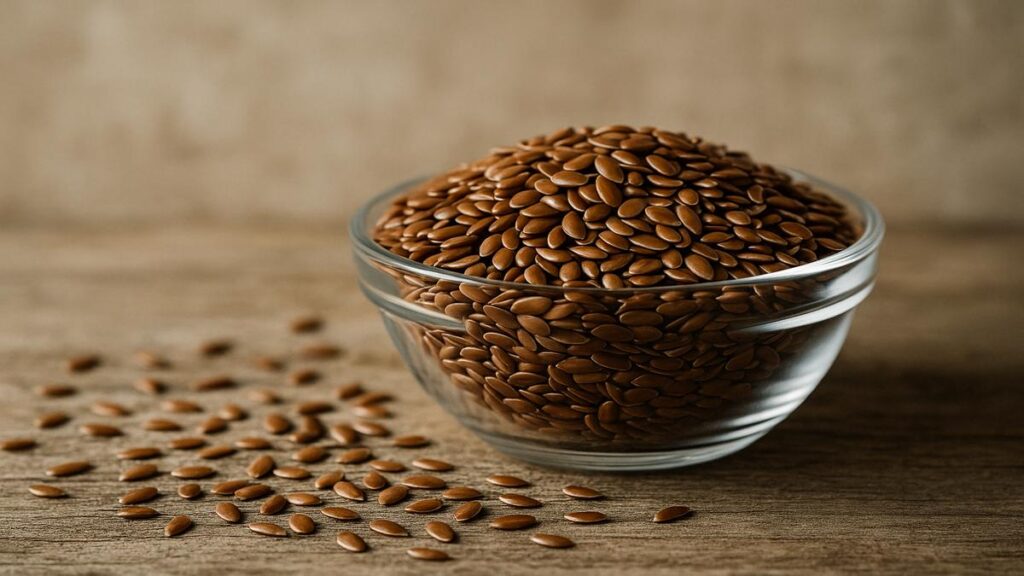
The first time I saw them, they looked almost too small to matter—no bigger than tiny brown commas cupped in my palm. The kitchen window was fogged by late-autumn rain, the kettle humming, the world outside painted in soft grays and dripping branches. I’d been told this seed could help tame the quiet, invisible current of cholesterol moving through my blood. It sounded almost mythical: that something so ordinary, so inexpensive, so ancient could stand up to a problem wrapped in lab coats, prescriptions, and nervously folded medical reports.
But there they were: modest, nutty-smelling flaxseeds. They didn’t glow or shimmer. They didn’t carry a pharmaceutical logo. They were just seeds—dull, brown, easy to overlook. Yet inside each one was a chemistry the human body has recognized and partnered with for thousands of years. That morning, as I tipped them into a small coffee grinder and listened to the quick whirl of metal blades, the air filled with a warm, toasty scent. It felt less like “supplementing” and more like striking up an old conversation with nature I’d somehow forgotten how to have.
The Hidden River in Your Blood
Cholesterol is not a villain, though it’s been cast as one in countless headlines and clinical pamphlets. It’s more like a river that runs through your body, carrying building materials to every cell, shaping hormones, helping you digest fats. Your liver makes it; your food contributes to it. The problem isn’t its existence—it’s its excess, and more specifically, where and how that excess settles.
Imagine that river flowing through a canyon of blood vessels. Over time, if there’s too much of the “sticky” kind of cholesterol—LDL—it can begin to leave behind thin, greasy films along the walls. Not overnight. Not dramatically. Just a slow layering, like lichen finding purchase on rocks. Your body tries to repair the irritation; inflammation stirs, plaques slowly grow, and the supple, flexible vessel walls can become narrowed and stiff.
You don’t feel it in the beginning. There’s no alarm chime when LDL creeps upward, or when HDL—the so-called “good” cholesterol—slips down. Everything seems fine: you go to work, you laugh with friends, you walk the dog. But inside, the river is changing its shape. This is where lifestyle shows up as an unseen sculptor: what you eat, how much you move, how deeply and often you rest. And this is where a humble seed can quietly step in, making the current a little smoother, the water a little cleaner.
The Seed with a Quiet Superpower
Ancient cultures didn’t talk about LDL particles or triglycerides. They talked about vitality, digestion, energy, and balance. Flaxseed, known in some traditions as a healing food, was given for constipation, for skin troubles, for general strength. People knew it “soothed the insides,” though they didn’t have microscopes to see exactly how.
Inside this tiny seed is a triumvirate of natural allies: soluble fiber, plant-based omega-3 fats, and lignans—plant compounds with gentle hormone- and antioxidant-like effects. Together, they form something like a small, loyal task force devoted to keeping that inner river clear and flexible.
Soluble fiber is the quiet cleaner. When you eat ground flaxseed, this fiber mixes with fluid in your gut and creates a soft, gel-like mash. It’s not glamorous. But as it moves through your intestines, it binds to bile acids—substances made partly from cholesterol. To replace what’s escorted out of the body, your liver must pull more cholesterol out of circulation and convert it into new bile. Bit by bit, this can help reduce LDL and total cholesterol, tending the river from the inside out.
Then there are the plant-based omega-3 fats—specifically ALA (alpha-linolenic acid). While not the exact same as the marine omega-3s found in fish, ALA can still support a smoother flow in the bloodstream: easing low-level inflammation, supporting more relaxed vessel walls, and participating in the body’s complex conversation about how blood should clot or not clot. It’s like adding a bit of oil to a rusty hinge, letting things move more gracefully.
And finally, lignans. These are polyphenols, plant chemicals with antioxidant effects that might help protect cholesterol particles from oxidizing—turning “rancid” in the bloodstream, which is one of the triggers for plaque formation. Lignans are also phytoestrogens, meaning they can gently mimic or moderate the effects of certain hormones, which may be especially relevant for women navigating menopause, a phase when cholesterol patterns often shift.
Grinding, Stirring, Sipping: How to Actually Use Flaxseed
You can buy flaxseed whole, golden or brown, and keep it in a jar that feels almost ceremonial to open each morning. But here’s the secret: your teeth alone are no match for the tough outer shell of a whole flaxseed. If you swallow them as they are, most will simply pass straight through your body, giving you a little fiber but not releasing that inner treasure of fats and lignans.
To access their full power, flaxseeds need to be ground. Just enough to crack them open—into a coarse, fragrant meal that smells faintly of nuts and warm earth. Many people keep a small, inexpensive coffee grinder just for this purpose, dedicating a corner of the counter to a daily ritual that borders on meditative: pour, whirr, open, breathe in.
Freshly ground flaxseed tastes gentle and mild. You can swirl it into a spoonful of yogurt, fold it into oatmeal, stir it through a smoothie like invisible armor. Some people bake it into breads or sprinkle it over roasted vegetables, where it clings to olive oil and herbs. You don’t need much, and you don’t need perfection. Just a steady companionship between you and the seed.
| Flaxseed Amount | How It Helps Cholesterol | Easy Ways to Use It |
|---|---|---|
| 1–2 tablespoons ground daily | Adds soluble fiber that helps lower LDL and total cholesterol over time. | Stir into oatmeal, yogurt, porridge, or soups just before serving. |
| 2–3 tablespoons ground daily | Provides more omega‑3 ALA and lignans, supporting vessel health and antioxidant protection. | Blend into smoothies, add to homemade energy balls, mix into pancake or bread batter. |
| Split doses (e.g., 1 tbsp twice a day) | Helps digestion adjust while maintaining a steady intake of fiber and healthy fats. | Morning: in breakfast; Evening: sprinkled over a salad or warm vegetables. |
Many people find that starting with a single tablespoon of ground flaxseed each day feels gentle on the digestive system, like meeting someone new over coffee instead of inviting them to move in right away. Over a week or two, they might increase to two tablespoons. More isn’t always better; it’s the consistency, the quiet rhythm of the habit, that matters most.
What the Body Whispers Back
The body speaks in subtle shifts. It may not send fireworks when something healing begins to happen, especially when that something is as patient as a seed. Instead, it whispers: a little less heaviness after meals, a digestive system that moves more easily, a slight softening of the edges of anxiety around your lab results.
Cholesterol changes slowly. That’s part of what can make it so frustrating. You can’t feel LDL dropping in real time, the way you feel your heart rate rise during a brisk walk. But beneath the surface, things are happening. Each day that flaxseed gel moves through your gut, it’s quietly escorting cholesterol-rich bile toward the exit. Each day that ALA and lignans circulate, they participate in a microscopic balancing act—tuning inflammation down, offering antioxidant backup, nudging blood lipids toward a kinder pattern.
After several weeks or a few months of steady use, some people start to see the story shift not in their feelings, but in their numbers. A lab result comes back with LDL a little lower, HDL a touch higher, triglycerides less unruly. Sometimes doctors raise an eyebrow: “What did you change?” Sleep, maybe. Movement, hopefully. And for some, a daily spoonful or two of a ground seed that costs less than a commuter coffee.
This is not magic. It’s biochemistry cooperating with daily choices. Flaxseed doesn’t replace medication when it’s truly needed. It doesn’t grant immunity from genetics or from years of habits that were never designed with arteries in mind. But it can be one of those simple, steady, earth-rooted practices that bend the trajectory of your health a few degrees toward safety and ease.
The Subtle Art of Pairing Seed and Lifestyle
Flaxseed’s gift shines brightest when it’s part of a chorus, not a solo performance. Picture a day shaped around your heart’s quiet needs: a walk that actually makes you breathe deeper; meals filled with colors from plants; less sugar and fewer processed fats; time outdoors where your nervous system can unclench a little.
Now imagine flaxseed woven through that day: in the breakfast bowl that replaces a hastily grabbed pastry, in the afternoon smoothie that edges out a sugary snack, in the evening soup that answers instead of greasy takeout. Cholesterol shifts most reliably when the whole pattern of a life leans toward health, and the seed becomes a dependable, nourishing thread running through it all.
Listening for Your Own Limits
Nature, for all its generosity, always asks for partnership. Flaxseed is widely considered safe for most people, but like anything powerful, it comes with nuances. That soluble fiber that helps escort cholesterol away can also stir up the gut if you add too much too quickly. Gas, bloating, or a sense of fullness might appear like uninvited guests at first.
This is why starting small matters. Let your digestive system learn the rhythm of this new companion. Make sure you drink enough water; imagine that gel-like fiber needing a small river of its own to move comfortably through you. For most, the body adapts, even appreciates the new pace. Bowel movements can grow easier, more regular. Your insides begin to feel as if someone has quietly opened a few windows to fresh air.
There are a few moments to be cautious. If you take blood-thinning medications, have a history of bowel obstruction, or manage hormone-sensitive conditions, it’s wise to speak with a healthcare provider before you invite flaxseed in as a daily guest. And if you’re on cholesterol-lowering medications, flaxseed is usually compatible, but it’s still worth letting your doctor know what you’re adding so they can interpret your improving numbers with full context.
Whole Seed, Ground Seed, and the Oil Question
In the grocery aisle, the choices can be quietly confusing: whole flaxseed, ground (or “milled”) flaxseed, flaxseed oil. They’re related, but not equal when it comes to cholesterol.
Whole seeds are shelf-stable, beautiful, and nearly indestructible. They’re ideal for long-term storage but, as noted before, most of their treasures pass through locked away unless you grind them.
Ground flaxseed is the sweet spot for cholesterol support: it delivers soluble fiber, lignans, and ALA together, just as nature composed them. Kept in an airtight container in the fridge or freezer, it stays fresh and pleasant.
Flaxseed oil, glistening in tiny dark bottles, is concentrated ALA without the fiber or lignans. It can offer some of the anti-inflammatory and vessel-supportive benefits of omega-3 fats, but it lacks the bile-binding power of the fiber. It’s delicate, prone to oxidation, and needs cool, dark storage. For cholesterol, oil can be a helpful addition, but it’s the ground whole seed that carries the broader, more stabilizing influence.
Inviting the Seed into Your Daily Story
Think of your days not as a list of tasks, but as a living story that your body is reading constantly. Every bite, every walk, every late-night screen scroll or deep laugh with a friend is a sentence in that story—some soothing, some stressful, some healing, some harmful.
When you decide to welcome flaxseed into that narrative, it shouldn’t feel like punishment or penance. Instead, it can feel like a small act of kindness repeated daily, a seed-based hymn to your future self.
Maybe it starts in the half-light of morning. You stand in the kitchen, feet warmed by the rug, hands wrapping the handle of your favorite mug. You reach for the container in the fridge, the soft thump of ground flaxseed hitting the bowl like a quiet promise. You stir it into your oats, watch it disappear, knowing it hasn’t really vanished at all—it’s waiting, patiently, to do its work inside you.
Or perhaps it’s part of an evening ritual: blender whirring, banana, spinach, a splash of plant milk, a spoon or two of flaxseed. A smoothie that tastes like ease instead of deprivation. You drink it knowing that while you sleep, your liver, your blood vessels, your heart will be processing not just the events of your day, but the nourishment you’ve offered.
None of this needs perfection. There will be days you forget. Days when takeout wins. Days when stress tightens your chest and sends your nervous system racing. But the more often you can return to these small, seed-laced rituals, the more your inner river can remember what it feels like to run clear and calm.
From Seed to Future
If you zoom out from your own kitchen, you see fields. Vast sweeps of flax plants with delicate blue flowers nodding in the wind, seeds ripening under the same sun that knits cholesterol inside your body and ripens fruit on distant trees. For centuries, these plants have been woven into human life—literally, as linen fibers for clothing and rope, and figuratively, as medicine and food.
In a world crowded with new solutions, high-tech interventions, and ultra-processed “health” products, flaxseed is a kind of gentle rebellion. It says: sometimes, what works has been here all along. It asks you to trust a process you cannot see, the slow architecture of change built into your cells, your vessels, your liver.
Cholesterol might show up on a screen as numbers and bars, but it is also a story of how you live inside this body, on this earth. A small, brown seed cannot rewrite everything on its own—but it can tilt the tale. It can give your heart more breathable space, your vessels more elasticity, your future more open pages.
There is a quiet power in choosing something as simple as flaxseed and saying, with every spoonful: I am participating in my health. I am not helpless against the river inside me. I can work with nature, not apart from it.
Frequently Asked Questions
How much flaxseed should I eat daily to help my cholesterol?
Many people aim for 1–2 tablespoons of freshly ground flaxseed per day. Some studies use up to 3 tablespoons. It’s generally best to start with 1 tablespoon and slowly increase, paying attention to how your digestion feels.
How long does it take to see changes in cholesterol with flaxseed?
Most people won’t see changes overnight. Research often looks at periods of 6–12 weeks or longer. With consistent daily use, alongside other healthy habits, you may begin to see improved cholesterol numbers within a few months.
Is whole flaxseed as effective as ground flaxseed?
No. Whole flaxseeds often pass through your digestive tract mostly intact, which means you miss out on a lot of the beneficial fats and lignans. Ground flaxseed is much better absorbed and more effective for cholesterol support.
Can I use flaxseed oil instead of ground flaxseed?
Flaxseed oil provides omega‑3 ALA but not the fiber or most of the lignans. It can support general heart health, but it doesn’t offer the same cholesterol-lowering potential as ground flaxseed. For cholesterol, ground seed is usually the better choice.
Are there any side effects or risks with flaxseed?
Most people tolerate flaxseed well, especially when introduced gradually with adequate fluids. Some may experience gas, bloating, or changes in bowel habits at first. If you have a history of bowel obstruction, use blood thinners, or have hormone-sensitive conditions, speak with a healthcare provider before using flaxseed regularly.
Can flaxseed replace my cholesterol medication?
Flaxseed is a supportive food, not a prescription drug. It should not replace medications without guidance. If your doctor has prescribed cholesterol-lowering drugs, discuss any changes with them. Flaxseed can often be used alongside medication to support better overall results.
When is the best time of day to take flaxseed?
There isn’t a single “best” time. Many people prefer breakfast, when it’s easy to add to cereal, yogurt, or smoothies. Others split their intake between morning and evening. The key is consistency—choose a time that fits naturally into your daily routine and stick with it.

Hello, I’m Mathew, and I write articles about useful Home Tricks: simple solutions, saving time and useful for every day.