The old man’s hands were what caught my eye first. Not his weathered face or the steam rising in fragile ribbons from his enamel mug, but those hands—knotted, brown, and still astonishingly strong. We were sitting on a wobbly bench beside a mountain trailhead, both pretending to rest, both watching the fog climb the ridge like something alive. When he lifted his pack—a heavy, old canvas beast—his fingers closed around the strap with the solid certainty of a vice. No shaking, no strain. Just easy strength, like a promise.
Later, driving home, I couldn’t stop thinking about that simple movement. How natural it looked, how rare it has become. Because all around me, in my own life and the lives of people I know, there’s a quiet erosion happening—something you can’t hear, can’t see unless you really look. Grip strength is fading, like an old photograph left too long in the sun. And the most dangerous part? We’re letting it happen while we sit still, in silence.
The Habit That Sneaks In While You’re Sitting Still
It doesn’t arrive like an injury. There’s no sharp pain, no dramatic moment, no one single day you’ll remember. It comes quietly, the way dust collects on a bookshelf. One more hour at the laptop. One more evening scrolling. One more commute where your hands simply rest, idle, on your thighs or loosely around a steering wheel. The silent habit that weakens grip strength is not just “not exercising”—it’s not using your hands against the world in any meaningful way.
Think about how your grandparents—or maybe that old man at the trailhead—used their hands. They carried groceries without handles. They scrubbed, hammered, squeezed, wrung, twisted, planted, chopped. Their days were stitched together by little acts of pressure and resistance. Every interaction with the world was tactile, physical, requiring the kind of strength you don’t notice until it’s gone.
Now consider an average day for many of us. Our fingers glide across glass screens. They tap politely on flat keyboards. They curl, feather-light, around a mouse. Maybe they hold a coffee cup, a steering wheel, a pen. The effort is minimal, the resistance almost non-existent. The hand, once a powerful instrument of survival, has become more like a cursor: a way to navigate abstract space, not real weight.
This is the silent habit: chronic underuse. Not just a general lack of exercise, but the specific absence of meaningful gripping, holding, pulling, carrying. A hand that rarely meets friction or weight slowly forgets how.
The Day You Notice Something Has Changed
For a long time, you don’t feel it. You open jars, carry bags, twist doorknobs without thinking. You hoist a suitcase into an overhead compartment. You pull a stubborn drawer. It’s just life, and your hands are background actors, doing their job, never asking for applause.
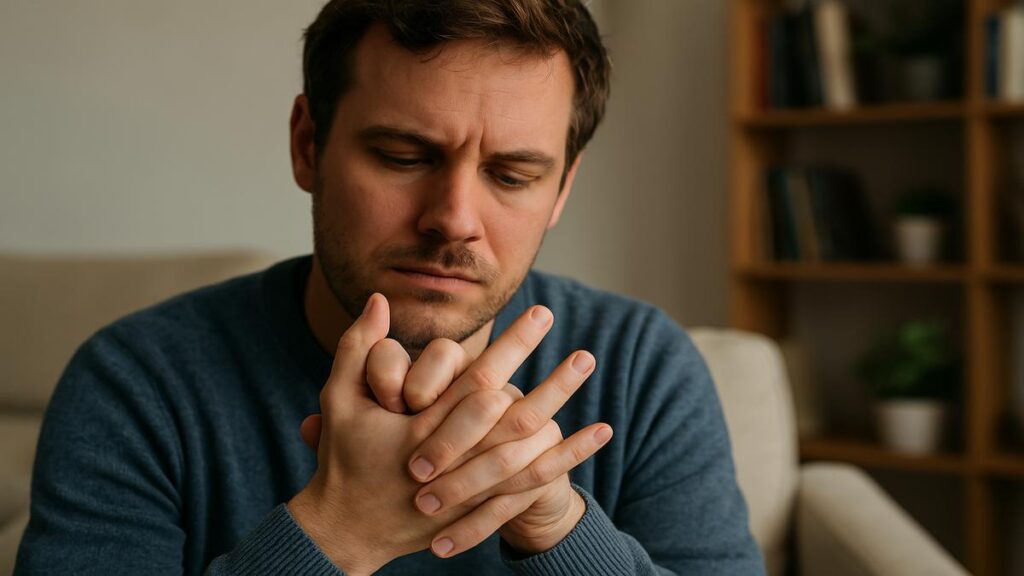
And then one day, the script changes. The jar won’t open. You twist harder and feel something strange: not pain, exactly, but a hollowness, a missing step in the chain of effort. You hand it to someone else. Maybe they’re younger, maybe not. They pop the lid with an easy flick of the wrist, and you laugh it off—but a quiet, unwelcome thought has already arrived.
Later, carrying groceries up the stairs, the plastic bags dig into your fingers more than they used to. You need to pause halfway, resting the load on your thigh. When did that start? When did your hands become the weakest link?
It’s not just inconvenience. Grip strength is one of those sneaky metrics that tell a much bigger story. Researchers have found that weaker grip is often linked with reduced overall muscle strength, poorer mobility, and even increased risk of health problems as we age. It’s not that your hands alone predict your future, but they are remarkably honest historians of your body’s relationship with effort.
Yet the erosion started years before you noticed. Every time you chose the elevator over the heavy door and the stairs. Every time you scooped up three light bags instead of one heavy one. Every hour your fingers skimmed across glass instead of curling around something with weight and texture. This isn’t about blame; it’s about awareness. Your hands have been whispering for a while.
What Grip Strength Really Measures (Beyond Muscles)
Grip strength, at first glance, seems like something only climbers, mechanics, or athletes care about. But it runs much deeper than that. When you clasp your hand around something and squeeze, whole stories come to life: about your nervous system, your circulation, your posture, your habits, even your confidence.
Think of a handshake. A flimsy one feels uncertain, hesitant. A crushing one feels performative, maybe insecure. But a steady, firm handshake? It communicates quiet competence, even if we don’t consciously analyze it. That firmness begins with the same muscles you need to carry a heavy bag or help yourself up from the ground without fumbling.
Under the skin, your forearms are dense with muscles and tendons that are meant to be challenged. When they aren’t, they gradually lose strength and coordination. Your brain, so efficient at managing energy, quietly reallocates resources. “We don’t need this much grip,” it decides, and your nervous system stops firing as many signals to your fingers and hands. Capacity shrinks. The floor drops, increment by tiny increment.
And yet, the fix is not to become a gym-obsessed, forearm-training machine. The real antidote lies in something much simpler, and in many ways, more ancient: reclaiming the kind of daily, natural handwork our lives quietly abandoned.
To understand how far we’ve drifted, it helps to see the contrast laid out plainly.
| Lifestyle | Daily Hand Use | Effect on Grip |
|---|---|---|
| “Old world” active life | Carrying, chopping, wringing, scrubbing, manual tools | Constant challenge, slow and steady strengthening |
| Modern sedentary life | Typing, tapping screens, light household tasks | Under-stimulation, gradual decline in strength |
| Hybrid “intentional” life | Desk work plus planned gripping & carrying | Maintained or improved grip over time |
Your goal isn’t to move back in time. It’s to move your hands back into the story of your life, instead of letting them hover on the edges, barely touching anything that fights back.
The Texture of Effort: Relearning How to Use Your Hands
So what does it look like to quietly reclaim grip strength in a world that seems designed to keep your hands idle? It’s less dramatic than you might expect, and much more sensory.
Start with weight. Not in a gym, not yet, but in your day. The next time you buy groceries, choose one or two heavier bags instead of many feather-light ones. Feel the plastic cut into your fingers; notice how your forearms come alive. Don’t overload to the point of pain or strain—just enough that your body registers, “Oh, we still do this.”
At home, pay attention to opportunities for friction. Twist open jars yourself, even if it takes a few extra seconds. Use a manual can opener instead of an electric one. When you carry laundry, gather it in your arms instead of dragging the basket by the handle. Feel the fabric’s weight, the tug on your hands, the slight ache afterward that says, you did something.
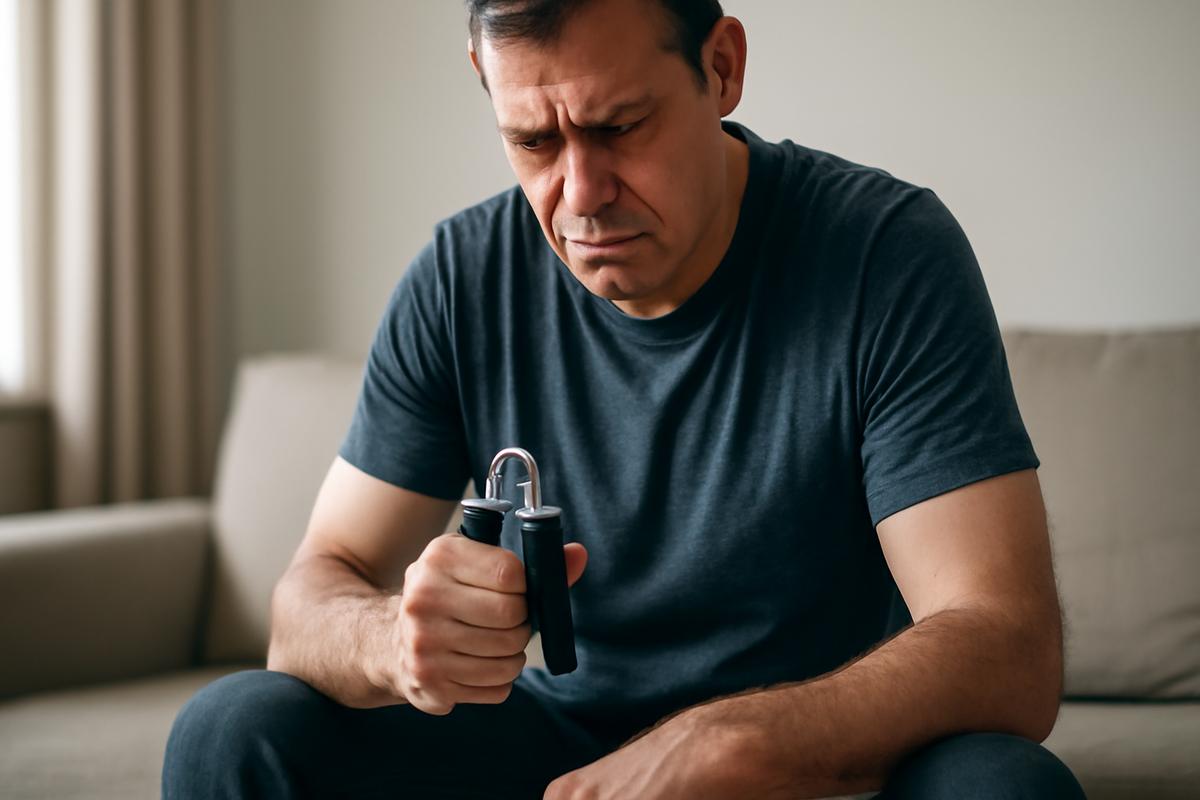
If you sit at a desk, keep a simple tool within reach—something that invites brief, regular engagement. A stress ball with actual resistance, a small, grippy ring you can squeeze, a light hand gripper that challenges you without straining your joints. Every time your attention drifts, let your fingers do a little work. Ten squeezes here, another ten later. Not a workout, just a reminder.
As this becomes familiar, you can start weaving in intentional challenges. A sturdy backpack instead of a rolling suitcase for shorter trips. A reusable water bottle you actually carry instead of leaving it behind. When you walk, occasionally hold something with a bit of weight in one or both hands—a bag, a book, a couple of filled bottles—and let your grip and shoulders share the load.
The magic isn’t in intensity. It’s in repetition, variety, and presence. You’re teaching your hands that they’re still part of the team, not just decorative extensions at the end of your sleeves.
Micro-Challenges: Turning Ordinary Days Into Hand Training
Improving grip strength doesn’t require a new membership, a schedule overhaul, or fancy gear. It asks for something more subtle: a shift in how you move through the world. Think in terms of “micro-challenges,” tiny decisions that nudge your hands into action. Here are ways to gently stitch grip work into the fabric of your day:
- Morning ritual: Keep a towel by the sink and actually wring it out fully after use. Feel every twist. It’s primitive, strangely satisfying, and surprisingly effective.
- Coffee or tea time: Use a heavier mug. Wrap your hand firmly around it, not just with fingertips. That extra bit of weight is small, but not meaningless.
- Work breaks: Once every hour, stand up and hold something moderately heavy—a backpack, a water jug, a stack of books—in each hand for 20–30 seconds. Let your grip work, then rest.
- Phone scrolling swap: During one social media session, trade half the time for holding a hand gripper or squeezing a ball. Same couch, different signal to your body.
- Cooking: Chop by hand when you can. Stir thicker mixtures with a sturdy spoon, feeling the resistance. Knead dough. Open stuck jars with a dish towel for more friction, giving your hands a mini-challenge.
This isn’t punishment. It’s closer to play—small experiments in effort. Over days and weeks, these moments accumulate like quiet deposits in a strength savings account. You may not notice a single turning point, but one day you’ll pick up something heavy and realize: this feels easier than it used to.
When Weak Grip Becomes a Wake-Up Call
There’s an honest discomfort that comes with recognizing your grip has slipped. It might show up when you’re trying to open a childproof bottle and feel oddly defeated. Or when helping someone move a couch, you realize you’re not afraid of hurting your back—you’re afraid your hands will give out first.
If that’s where you are, this isn’t evidence of failure. It’s a message. Your body is telling you, with unusual clarity: “We’ve paused this skill, not permanently lost it.” Muscles respond to attention at almost any age. Nerves re-learn patterns. Joints adapt, carefully, when given gradual, respectful challenge.
To move from concern to action, three principles matter more than any specific exercise list:
- Go slow enough to listen. A gentle ache the next day is fine; sharp pain or numbness is a red flag. You’re waking things up, not waging war.
- Be consistent, not heroic. Five minutes a day of mixed grip use will beat one intense hour you abandon after two weeks.
- Use real life as your gym. Tools, bags, doors, jars, towels, garden soil—these are not chores; they are invitations.
Over time, as your grip strengthens, you may notice side effects that have nothing to do with jar lids. Carrying groceries in one trip. Hanging from a playground bar for a few seconds, feeling wild and oddly young. Hoisting a suitcase into an overhead bin without that flicker of doubt. A body that trusts its own hands moves differently through the world.
The Quiet Power of Holding On
There is something deeply human about holding on—to a rock edge, to a tool, to another person’s hand. Long before we had desks or screens, we had fingers that curled around branches, stones, rough bark, woven baskets. Grip isn’t just strength; it’s connection. It’s how we tell the world, “I’m here, and I can meet you.”
The danger of the silent habit that weakens grip strength isn’t just physical decline. It’s that we lose a kind of tactile confidence. We avoid tasks that once would have felt ordinary. We let others carry the heavy things. We instinctively step back from effort instead of stepping into it. The hands, once our primary way of shaping the environment, become bystanders.
It doesn’t have to stay that way. You don’t need to chase extreme feats or hang from cliffs to reclaim what’s quietly slipping. You simply have to interrupt the underuse. To notice the dozens of moments each day when your hands could do more than hover—when they could grasp, lift, twist, pull, squeeze, and remember what they are built for.
I sometimes think back to that man at the trailhead, his hands closing around his pack straps with such easy certainty. His strength wasn’t loud. It wasn’t for show. It was simply there, earned over years of using his hands as if they mattered—because they did. Because they still do.
In the end, grip strength is less about how hard you can squeeze and more about this simple question: How willing are you to hold on—to weight, to effort, to your own capacity—before it quietly slips away? The next time your hand meets resistance, feel it fully. That tug, that strain, that brief burning in your forearm? That’s not weakness calling you out. It’s strength, knocking to be let back in.
FAQ
Is weak grip strength really a health concern, or just an inconvenience?
Weak grip strength is more than an inconvenience. While it shows up as trouble opening jars or carrying bags, research has linked lower grip strength with reduced overall muscle mass, poorer mobility, and a higher risk of health issues as we age. It’s a simple, practical marker of how well your body is maintaining strength and function.
Can grip strength actually improve if I’m older?
Yes. Muscles and the nervous system can adapt at almost any age when given gradual, consistent challenge. You might progress more slowly and need extra care around joints and tendons, but with regular, moderate gripping, carrying, and squeezing tasks, most people can reclaim noticeable strength over time.
Do I need special equipment to improve my grip?
No. Everyday objects work well: grocery bags, water bottles, towels to wring out, manual tools, and even heavier books. Simple devices like stress balls, grip rings, or light hand grippers can help, but the most powerful changes come from using your hands more in daily life.
How often should I work on my grip?
Short, frequent sessions are best. A few minutes of grip-related activity scattered throughout the day—carrying, squeezing, hanging briefly from a sturdy bar, or holding something heavy—will usually beat long, infrequent workouts. Aim to engage your hands with meaningful effort most days of the week.
What if my hands hurt when I start using them more?
Mild fatigue or a light, next-day ache can be normal as unused muscles wake up. But sharp pain, swelling, numbness, or burning sensations are warnings. In that case, ease off, reduce the load, and consider speaking with a healthcare or physical therapy professional to rule out issues like nerve compression or joint problems.
Is typing or phone use helpful for grip strength?
Not really. Typing and tapping require very little force and don’t challenge the muscles or tendons involved in gripping and holding. They train coordination and speed, but not strength. To build or maintain grip, your hands need to meet real resistance: weight, friction, and sustained pressure.
How long does it usually take to notice improvement?
Many people notice small changes within a few weeks—carrying groceries feels less taxing, jars open a bit easier, fingers feel steadier. More significant, lasting improvements tend to appear over a couple of months of consistent effort. The timeline will vary, but the important part is that the trajectory can change as soon as you begin using your hands with intention again.

Hello, I’m Mathew, and I write articles about useful Home Tricks: simple solutions, saving time and useful for every day.