You probably don’t remember the first time you folded yourself into this shape. Maybe it was on a classroom carpet, cross-legged with a crayon in your hand. Maybe it was in front of the TV, tiny legs pretzeled into a loose “W,” while cartoons washed over you in bright, flickering colors. It felt natural then—your knees splayed, feet tucked backward on either side of your hips, body sunk comfortably toward the floor. Somewhere along the way, it became a quiet habit: how you watched shows, how you worked on the laptop on the rug, how you sat to play with your dog or scroll your phone. You never thought of it as a position with consequences. But your body, patient and observant, has been taking notes all along.
The Sitting Style Your Hips Remember
The “W sit” is deceptive in its innocence. Picture it: knees bent, thighs dropping inward, shins flaring out to the sides, feet parked by your outer hips. From above, your legs trace the shape of a capital W. Many children move into this posture with the ease of water finding the lowest point in a riverbank. Adults—especially those who grew up with it—may still gravitate toward it on the floor without much thought.
It feels stable and grounding, like your body has found a broad base to relax into. You can lean forward, turn to one side, reach for a mug or a remote, without wobbling or adjusting. That sense of rootedness is part of what makes the W sit so appealing. But beneath the familiar comfort, your muscles and joints are doing quiet negotiations that may not serve you well over time.
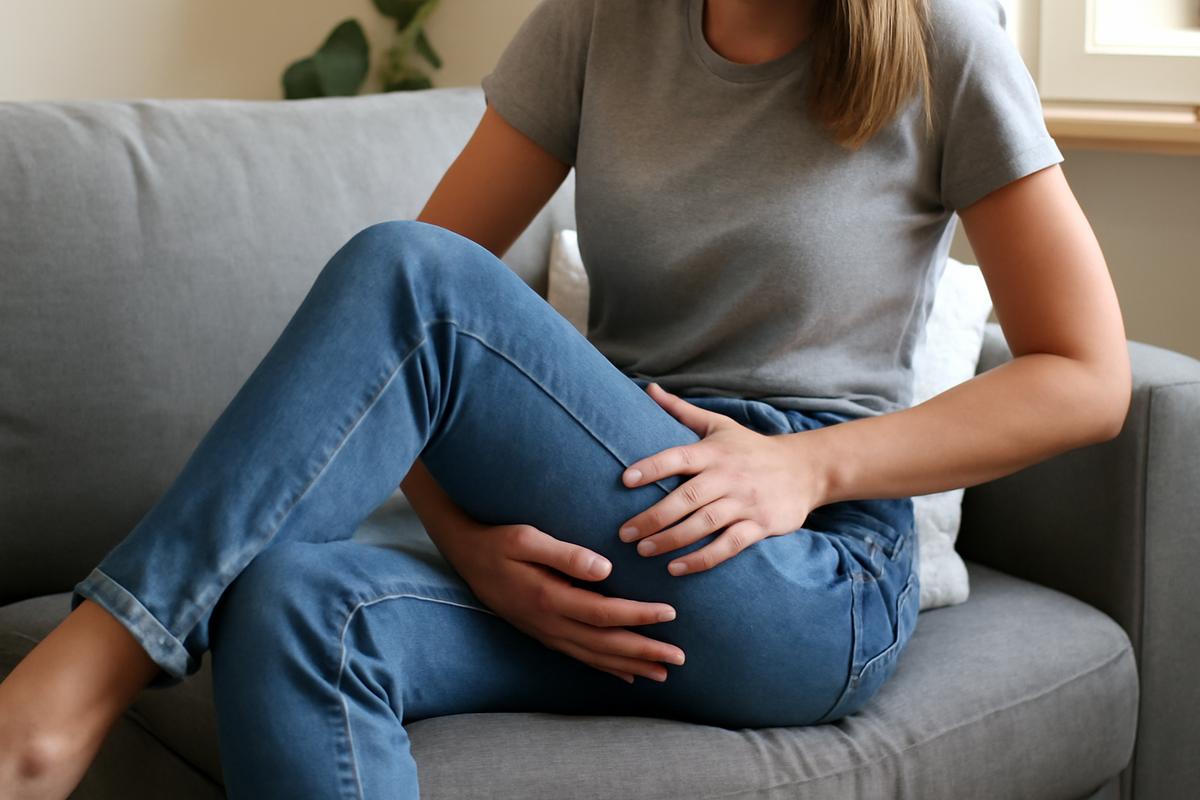
Your hip flexors—those deep, rope-like muscles that connect your thighs to your pelvis and spine—are especially attentive here. In the W position, your hips are drawn into a blend of internal rotation and flexion. The front of your hips shortens, your pelvis tips, and your lower back follows the curve. You get used to that. Your tissues adapt to that. Slowly, almost invisibly, a story of tension begins to write itself into your stride, your posture, your low back.
You might not notice it when you’re twenty-three, sitting on the floor at a game night, knees sprawling in that familiar W while you laugh with friends. But years later—when your hips feel stiff every morning, when your lower back whispers protest as you stand up from the couch—that’s when your body begins replaying old scenes, reminding you of the positions you once called home.
How the W Sit Shapes Your Hips
To understand why this sitting style is so impactful, you have to travel inward, into the geography of your hips. Imagine sliding your hand along the front of your pelvis, just below your belt line. Below the surface, the hip flexors run like taut cables from spine and pelvis into the upper thigh. The most well-known—your psoas and iliacus (often called the iliopsoas when they work together)—aren’t just moving your leg. They’re part of how your body orients itself in gravity, how your spine stacks, how your pelvis tilts.
When you bring your knees up, like sitting in a chair, you flex the hip. When you stride forward, they lengthen and shorten in a rhythm that quietly powers your walk. But when you fold into a W sit, hip flexion is layered with internal rotation. Your thigh bones twist inward, your knees glide forward, your shins sweep out to the sides. It’s a complex, loaded position that says to the front of your hips: “Hold right here. Don’t move. Stay short.”
Your body is superbly obedient. Muscles that are asked to stay shortened start to prefer that state. Connective tissues, fascia, and joint capsules adapt. The W sit doesn’t just compress your hip flexors; it reinforces a pattern that makes full hip extension—what you need when walking, standing tall, or climbing stairs—feel foreign and demanding.
Think about how you move through a normal weekday. You sit in a chair, hips flexed. You drive, hips flexed. You curl on the couch, hips flexed. If, on top of that, your default floor position is a W sit, your hip flexors rarely experience their full, natural length. Instead, they live in a world of partial flexion, making upright standing and open strides feel like a stretch, literally and figuratively.
Over time, this can echo outward as:
- A constant sense of tightness at the front of the hips
- Low back soreness from a pelvis that’s tugged out of balance
- Reduced stride length and stiff walking
- A tendency to arch the lower back instead of extending from the hips
None of this arrives all at once. It shows up in small, ordinary moments: the way you wince when getting up from the floor; the stiffness that greets you after a long meeting; that subtle reluctance your body feels when you try to stand tall after sitting for too long.
The Quiet Chain Reaction in Your Body
Human bodies are ecosystems. Nothing happens in isolation. When your hip flexors adapt to being short and tight, your pelvis starts to tilt forward more readily. That tilt increases the curve in your lower back. The spine, in turn, compensates further up—your mid-back may stiffen, your neck may crane forward. At first, it’s invisible to anyone but your nervous system. But your muscles feel it every day.
Imagine you’re kneeling by a low coffee table to work on a puzzle. Without thinking, you slide into the W sit. Your hips fold, internally rotated. Your thighs angle inward, knees forward, feet tucked. Your pelvis tips; your belly folds softly toward your thighs. You lean your chest toward the puzzle pieces. It feels natural. It feels easy.
Stay there for twenty minutes, an hour, an entire afternoon, and those hip flexors hum with a low, continuous effort to hold you there. Around them, deeper structures take on the posture too. The ligaments at the front of the hip and the joint capsule start to feel at home in this compressed shape. Your glutes are somewhat muted—they’re not being asked to support you much. And when your glutes go quiet, your hip flexors don’t have a counterbalance. They become the overachievers of your lower body, taking on more work than they should.
Later that evening, you stand up and feel a familiar tug at the front of your hips. Your steps are small at first. Your body has to coax those tight, shortened muscles into length again. The more often you repeat this pattern, the more your system learns it as normal. The W sit, once just a comfortable sprawl on the floor, becomes a low-grade architect of your movement habits.
For kids, the W sit has another layer of influence. It offers a wide, stable foundation that demands little from the core muscles or the hips’ external rotators. That might make sitting easier, but it also means important stabilizing muscles don’t get as much practice. Over time, hips can grow accustomed to internal rotation while disliking external rotation—the outward, open movement we use to sit cross-legged or stand with a neutral pelvis.
Adults, although less flexible than children, are not exempt. The pattern may be subtler but no less real. If you’re one of those people who still instinctively folds into a W on the floor, your hips have likely been rehearsing this movement for decades. It leaves a trace.
The Everyday Moments That Tighten Your Hip Flexors
You may not W sit for hours a day anymore. Life now may look more like office chairs, couches, and car seats. So why dwell on this one posture? Because it fits into a continuum of hip positions that keep you in a semi-folded shape most of your waking hours. The W sit is like a concentrated version of that flexed reality, turning up the intensity of what chairs already do so steadily.
Imagine your week as a simple ledger of hip positions:
| Activity | Hip Position | Effect on Hip Flexors |
|---|---|---|
| Desk work (sitting in chair) | Moderate flexion | Keeps flexors shortened for long periods |
| Driving or commuting | Moderate flexion | Reinforces seated posture |
| Lounging on couch | Deep flexion, often slouched | Adds tension and pelvic tilt |
| W sitting on the floor | Deep flexion + internal rotation | Intensely shortens and twists flexors |
| Walking, standing tall | Extension (hips more open) | Offers rare opportunity to lengthen |
If your days are heavy on the first four rows and light on the last, your hip flexors start living as though “short” is their natural state and “long” is a special occasion. The W sit, in particular, adds a twist—literally—by rolling your thighs inward, making it harder to easily access the outward rotation needed for stable, comfortable walking, running, squatting, or sitting cross-legged.
You might notice some telltale signs in your own body:
- That feeling of resistance when you try to stretch your quad or hip after a long day
- Needing to arch your lower back exaggeratedly to stand “tall,” because your hips won’t fully open
- Discomfort if you try to sit cross-legged for more than a few minutes
- A sense of vulnerability or tightness in the groin when you first start walking after sitting or W sitting
Your body isn’t malfunctioning when this happens—it’s simply following the rules of adaptation. What you do most, you get better at. Sit like a W often enough, and your tissues learn to live there.
Teaching Your Hips a New Story
Tight hip flexors aren’t a life sentence. They are, in many ways, a biography—a record of how you’ve spent your hours. And biographies can be revised. The first step is quiet, almost simple: notice how you sit. If you tend to slide into a W position on the living room floor, or while playing with kids or pets, begin to gently redirect yourself when you catch the pattern.
Instead of folding into that familiar W, experiment:
- Sit cross-legged, with your ankles in front of you and your knees gently open.
- Try a long sit, with your legs stretched out in front, propped on your hands.
- Side sit, with both legs bent to one side, then switch sides periodically.
- Kneel with your feet under you, shins straight back, hips resting on your heels.
At first, these positions may feel more effortful. That’s the point. They ask your muscles—core, glutes, hip rotators—to show up and participate. Where the W sit gave you passive stability, these options invite active support.
Next, add in some gentle lengthening practices for those hip flexors that have grown so accustomed to being short. You don’t need elaborate routines to begin changing the narrative. A few consistent minutes a day can start to shift your baseline.
Try this simple floor lunge: step one foot forward into a lunge while your back knee rests on a soft surface. Keep your torso upright, ribs stacked above your hips. Gently draw your pelvis under you—as if you’re zipping up a tight pair of pants—and lean your weight slightly forward until you feel a stretch across the front of the hip on the back leg. Breathe there. Let the sensation be firm but not sharp. This is your hip flexor, learning what space feels like again.
Or lie on your back near the edge of a bed or couch, hugging one knee toward your chest while allowing the other leg to dangle off the side. The weight of that hanging leg invites your hip flexors to soften and lengthen. Stay for several slow breaths, then switch sides. Over days and weeks, you may find that what once felt like a stubborn knot at the front of your hip begins to ease into something more pliable, more forgiving.
Movement is the other indispensable ingredient. Walking—unhurried, aware, and regular—gives your hips a natural cycle of flexion and extension. Each step is a quiet negotiation between your hip flexors and their counterparts. If you can, sprinkle short walks through your day: a quick lap around the block between meetings, a gentle stroll after dinner instead of sinking immediately into the couch. Think of each step as a small vote for more open, resilient hips.
Listening to the Signals Your Hips Send
If you’ve spent years in the W sit, whether as a child, a parent on the floor with little ones, or someone who simply finds it cozy, you may carry a trace of defensiveness when you hear it criticized. It’s just sitting, you might think. We all sit strangely sometimes. And that’s true. No single position, held occasionally, is inherently disastrous. The problem grows with habit, duration, and lack of variety.
Your hips are not trying to punish you; they’re trying to communicate. That dull ache at the front after a long movie night on the floor? A quiet message. That stiffness when you stand from a low seat? Another one. You can choose to treat those sensations as mere inconveniences or as invitations to shift how you inhabit your own body.
Check in with yourself on an ordinary day. The next time you find yourself sliding toward the floor, pause. Notice what your knees want to do. Are they drifting forward, your feet sneaking back, your thighs rolling inward toward that old familiar W? Can you offer your body an alternative—something less convenient, perhaps, but more generous in the long run?
This is the heart of changing any ingrained habit: not forcing, not shaming, but gently redirecting, again and again. Over time, your preferred rest positions can evolve. The floor becomes a place where your hips practice diversity—sometimes cross-legged, sometimes side-sitting, sometimes kneeling, sometimes even lying flat on your back and feeling the simple luxury of full extension.
As your options expand, those deep hip flexors no longer carry the same burden of constancy. They don’t have to be the guardians of your stability every time you settle your weight downward. Other muscles share the load. Your pelvis can rest in a more neutral tilt. Your lower back can stop arching so hard just to keep you upright. You might notice your stride feels a little more free, your posture a little less forced.
Letting Your Body Unfold
In the end, the story of the W sit and your hip flexors is a story about how bodies remember. Every posture you repeat is a sentence, every habit a paragraph in the quiet biography your muscles write every day. The W sit is just one powerful chapter—comfortable, familiar, and, if you’re not careful, quietly constricting.
You don’t need to banish it with fear or perfectionism. You don’t need to turn each moment on the floor into a policing exercise. But you can bring in curiosity. Notice what your body does. Offer alternatives. Give your hip flexors chances to lengthen, to loosen, to feel what it’s like not to be always folded, always shortened, always on guard.
Let your daily life become a little more like a landscape, with varied terrain for your joints and muscles—some sitting, some standing, some walking, some stretching, some lying down and listening to the quiet hum of your breath. The more terrain you explore, the less any one posture—especially the deep, twisting cradle of the W sit—gets to dominate the map.
One evening, months from now, you might find yourself again on the living room floor. Instinct kicks in, and your knees begin to slide into that old familiar shape. But something pauses you. Without quite knowing why, you tuck one leg in front, stretch the other to the side, and feel your hips open instead of close. Your body exhales in a new way. It’s subtle. No one else notices. But somewhere in the deep, quiet architecture of your hips, a new story is being written—one of space, balance, and a little more freedom with every breath.
FAQ
Why does the W sitting position tighten hip flexors?
In the W sit, your hips are in deep flexion and internal rotation. This shortens the muscles at the front of your hips and asks them to hold that position for long periods. Over time, those muscles adapt by becoming tighter and less willing to fully lengthen when you stand or walk.
Is W sitting always harmful?
Occasional W sitting isn’t likely to cause serious problems in an otherwise healthy body. The concern comes when it’s a primary or long-term sitting position, especially in children or adults who already have tight hips, weak glutes, or postural issues. Habit, duration, and lack of variety matter more than a single moment in the W.
Can adults still be affected by W sitting habits from childhood?
Yes. Years of favoring the W sit can shape how your hips move and what positions feel “normal.” Even if you don’t sit that way as often now, the patterns may persist as tight hip flexors, limited rotation, and altered posture. The good news is that new habits and gentle mobility work can help reverse many of these effects.
What are better alternatives to W sitting?
Try cross-legged sitting, side sitting (and switching sides regularly), long sitting with legs stretched in front, or kneeling with shins straight back. Rotating through several of these positions gives your hips more variety and reduces the constant short, twisted position of the W sit.
How can I tell if my hip flexors are tight?
You might notice difficulty standing fully upright after sitting, a tugging sensation at the front of your hips, lower back arching excessively when you try to stand tall, or discomfort when attempting hip extension stretches or lunges. A healthcare or movement professional can also assess hip mobility more precisely.
What simple exercises help release tight hip flexors?
Gentle lunges with a pelvic tuck, the “hanging leg off the bed” stretch, supported bridges to wake up the glutes, and regular walking are all helpful. The key is consistency: a few mindful minutes daily can be more powerful than an intense but rare stretching session.
Should I stop my child from W sitting completely?
Instead of constant correction, gently encourage variety. Invite them to sit cross-legged, side sit, or kneel, and make those positions fun and accessible. If W sitting is frequent or your child has motor delays, in-toeing, or posture concerns, consider consulting a pediatric physical therapist for tailored guidance.

Hello, I’m Mathew, and I write articles about useful Home Tricks: simple solutions, saving time and useful for every day.