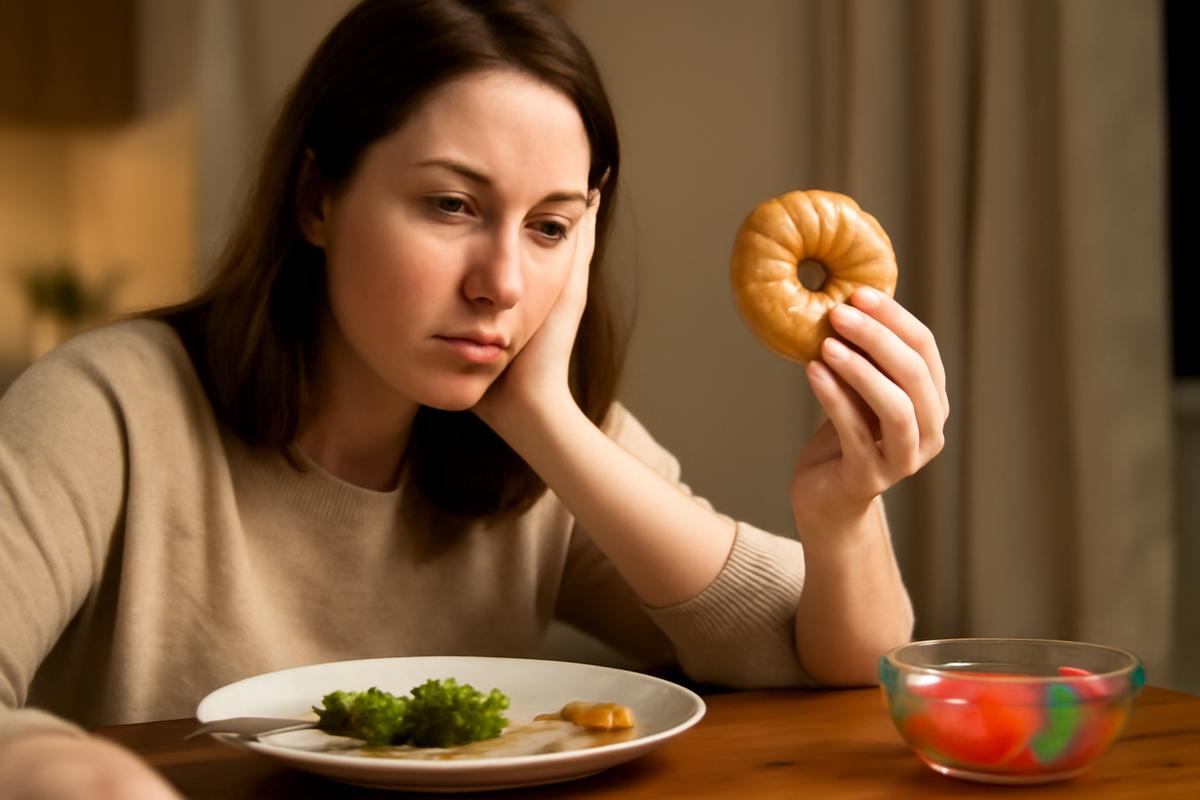
The craving starts as a whisper. The dishes are done, the kitchen hums with the soft tick of the cooling oven, and the night presses its face against the windows. You’ve eaten dinner. You’re not exactly hungry. And yet, there it is—this gentle, insistent pull toward the cupboard, the freezer, the secret stash of something sweet. Maybe it’s the last square of chocolate, a scoop of ice cream, a spoon drifting a little too purposefully through the jar of honey. You tell yourself you’re fine without it. But your body, or your mind—or both—seem to disagree.
If this sounds familiar, you’re in good company. After-dinner sugar cravings are one of those nearly universal human experiences, like checking your phone the moment it buzzes or wanting to stay in bed five more minutes. We explain them away with casual jokes: “I just have a sweet tooth,” or “My dessert stomach is separate from my real stomach.” But beneath the lighthearted excuses, there’s a story your body is trying to tell—a story of hormones and habit, emotion and light, fatigue and reward. To hear it properly, we have to slow down and listen, not with judgment, but with curiosity.
The Quiet Hour When Your Willpower Gets Sleepy
Picture the arc of your day as a curve. Morning starts out sharp and bright. You wake, maybe not fully rested, but powered by caffeine and intention. You make decisions, answer emails, resist the doughnuts in the office kitchen. By midday you’ve burned through a surprising amount of mental energy just choosing: what to wear, what to say, how to respond, what to ignore. Decision by decision, your inner “no” muscle, that invisible guardian of self-control, gets tired.
By the time dinner is over, you’ve already climbed a mountain of small choices. Now you exhale. You sit. The world around you softens—less doing, more drifting. And this is exactly when sugar often slips through the door.
It isn’t that you suddenly become a different person after 8 p.m. It’s that the part of your brain responsible for long-term planning and self-restraint, the prefrontal cortex, is flagging. The emotional, reward-hungry centers—the ones that love instant comfort—are only too happy to step in. For them, sugar is a quick fix: sweet on the tongue, soothing to the nervous system, and devastatingly easy to justify.
Think of that moment on the couch after dinner. The screen glows. The room is dim. Your body slow-breathes into the upholstery. There’s a natural exhale—“I’m done for the day; I deserve something.” That “something” often takes the shape of sweetness, not just because it tastes good, but because it marks a boundary: the workday is over; the night belongs to you.
Hormones in the Half-Light
While you’re rinsing plates and clearing the table, tiny chemical messengers inside you are already choreographing the evening. Hormones, those invisible conductors, help explain why cravings—especially for sugar—intensify after dinner.
Ghrelin, Leptin, and the Appetite Echo
There are two hormones that often show up in this story: ghrelin and leptin. Ghrelin is sometimes called the “hunger hormone.” It rises before meals, nudging you to eat, and falls afterward. Leptin, on the other hand, signals satiety—“You’ve had enough.” But these messengers don’t operate on an on/off switch; they move in waves, influenced by sleep, stress, and meal patterns.
If your sleep has been fractured or too short, ghrelin tends to whisper louder and longer, and leptin’s fullness message gets muffled. The result? Even after a decent dinner, your body may send out a faint echo: “We could still use something more.” And because sugar is one of the fastest forms of energy, your brain, ever efficient, steers your attention toward dessert-like foods.
The Late-Night Cortisol Drift
Then there’s cortisol, the stress hormone. In an ideal world, cortisol peaks in the morning to wake you up and slowly tapers as the day goes on, making way for melatonin and sleep. But in a modern world of buzzing phones, deadlines, late emails, and emotional overload, cortisol doesn’t always get the memo.
If stress lingers late into the day, your body may still be wired when it’s supposed to be winding down. Sugar feels like a balm here—one that sparks dopamine, the brain’s reward chemical, and offers a temporary sense of calm or pleasure. It’s no accident that the foods we reach for at night are rarely raw carrots. They’re often soft, creamy, crunchy, or melt-in-your-mouth sweet, sending rapid-fire signals of comfort through your nervous system.
Circadian Rhythms: Your Internal Clock and the Dessert Hour
Inside your brain, a tiny cluster of cells keeps time: your circadian clock. It’s tuned by light and darkness, meals and movement, and it doesn’t just tell you when to feel sleepy. It also affects hunger, metabolism, and how your body handles sugar.
Why Late Evenings Feel Like a Separate Food Universe
After sunset, your metabolism gradually slows. Your body is shifting from “day mode”—moving, digesting, doing—to “repair mode,” when cells restore, detoxify, and build. But your brain doesn’t necessarily turn off its desire for reward. In fact, for many people, the reward system becomes more sensitive in the evening. Food, especially hyper-palatable foods like sweets, can hit harder.
There’s also a timing mismatch. If your meals are irregular—maybe breakfast is a coffee, lunch is rushed, and dinner becomes the main event—your blood sugar can swing more dramatically. A big dinner may lead to a spike and then a gentle drop. That drop doesn’t always equate to true hunger, but it can feel like a hollow, a slight restlessness in your belly or your mood. Sugar presents itself as a quick patch to that subtle low.
Light plays a role too. Blue light from screens can delay melatonin, keeping you artificially “awake” inside, even as your body drifts toward its natural nighttime arc. In that blue-lit zone, snacks feel like companions. Sugar becomes less about calories and more about keeping you company as the night stretches on.
Emotion, Ritual, and the Story Behind the Craving
Not every sugar craving is about biology. Often, it’s about memory and meaning. Think back to childhood: dessert might have been a reward for finishing your meal, a treat on special occasions, or a small nightly ritual that signaled comfort and safety. Those associations don’t vanish when we grow up; they simply sink deeper, showing up as habits that “just feel right.”
When Dessert Becomes a Love Language
For some, sugar is tied to connection. Maybe your family gathered over bowls of ice cream while watching a favorite show. Maybe a grandparent always had candies in a glass dish, their sweetness wrapped in warmth and attention. Later in life, the simple act of eating something sweet after dinner can feel like slipping into a familiar blanket. It’s not just flavor; it’s emotional shorthand for “I’m okay,” or “This is my time.”
Even when you live alone, the ritual persists. The way the spoon clinks against the bowl, the sound of a wrapper torn open, the coolness of ice cream or the gentle crumble of a cookie—they’re sensory cues that mark the transition from obligation to ease. In a day filled with expectations, dessert is a moment of unstructured pleasure.
Stress, Loneliness, and the Sugar Shortcut
Nighttime can also amplify whatever feelings the day has left unresolved. Maybe you’re exhausted but wired, or lonely in a quiet house, or anxious about tomorrow. Sugar becomes a quick way to modulate the edges of those feelings. The sweetness distracts, occupies, and softens—at least for a little while.
Over time, this pattern can turn into a loop: discomfort, sugar, brief relief, then a flare of guilt or sluggishness, and more discomfort. The craving, in this sense, is a messenger: something in you is asking not just for food, but for comfort, relief, or soothing. Sugar happens to be the easiest way you’ve learned to respond.
The Subtle Role of What (and How) You Ate Earlier
What happens after dinner is quietly shaped by everything that came before it. The day’s meals, snacks, drinks, and even how quickly you ate contribute to whether that sugar craving hits like a passing thought or a tidal wave.
Blood Sugar Roller Coasters
Meals that are heavy on refined carbs and light on protein, fiber, and healthy fats tend to digest quickly. They give you a rush of energy, followed by a relatively quick drop. If your day has been stitched together with things like white bread, pastries, sugary drinks, or ultra-processed snacks, your blood sugar may be doing big, swooping arcs instead of gentle hills.
By evening, your body may be dealing with the aftermath of that ride. You ate dinner, yes. But if it mirrored the same pattern—lots of refined starch, not much fiber or protein—you may feel a post-meal slump, then a vague urge for “just a little something sweet.” That “something” is your body’s attempt to quickly smooth over the jagged edges of its energy curve.
Under-Eating, Then Over-Craving
Another quiet driver of nighttime sugar cravings is simple under-nourishment during the day. If you skipped breakfast or ate a small, unsatisfying lunch, your body will collect that debt. By the time dinner rolls in, you might be ravenous without fully registering it. You eat fast, maybe more than you meant to, and then an hour later, the dessert craving wakes up. It can feel irrational—“I just ate so much; why do I want more?”—but your body may still be asking for nutrients it missed earlier, or trying to store away quick calories in case tomorrow looks the same.
In this sense, the after-dinner sugar pull is sometimes a delayed reaction to not giving yourself steady, grounded nourishment earlier in the day.
Seeing Your Cravings in a New Light
There’s a quiet power in simply noticing patterns without judgment. Instead of treating your after-dinner sugar craving as a personal failure, you can start to see it as a signal. It’s coming from somewhere: a blend of hormones, habit, emotion, timing, and history.
Sometimes that signal is saying, “I’m genuinely low on fuel.” Sometimes it’s whispering, “I need comfort.” Sometimes it’s more like, “This is our little ritual, remember?” To respond more gently—and more effectively—it helps to understand which message you’re really hearing.
Below is a simple table that helps translate different types of nighttime cravings into their possible roots and some gentle experiments to try. It’s not a prescription, just a map you can adjust for your own terrain.
| What It Feels Like | Possible Root | Small Experiments to Try |
|---|---|---|
| “I’m stuffed, but I still want something sweet.” | Habit or emotional comfort, dessert as ritual. | Create a new ritual: herbal tea, a short walk, or a few pages of a book before deciding on dessert. |
| “I feel a bit empty or light-headed.” | Blood sugar dip, under-eating earlier. | Check your day: add protein and fiber to earlier meals, consider a balanced snack instead of pure sweets. |
| “I’m stressed, and sweets help me relax.” | Stress, elevated cortisol, emotional soothing. | Try 5–10 minutes of breathing, stretching, or journaling first; if you still want something, enjoy it mindfully. |
| “I’m just bored; I keep wandering to the kitchen.” | Habit loop, seeking stimulation. | Change the cue: brush your teeth, start a puzzle, call a friend, or do something with your hands. |
| “I crave sweetness every single night, no matter what.” | Combination of routine, hormones, and reward pathways. | Experiment with small shifts: earlier dinner, dimmer lights, more satisfying daytime meals, and a planned, modest dessert. |
Making Peace with the Sweet Part of the Night
There’s a temptation to tackle sugar cravings with rigid rules: no eating after 7 p.m., no dessert on weekdays, no sweets in the house. For some, these boundaries can offer structure. But for many, they turn the craving into a battle, sharpening the very urge they’re meant to tame. The sweeter the food is forbidden, the louder it calls.
What if, instead, you approached your after-dinner cravings with a kind of quiet respect? Not indulgence for its own sake, but curiosity. You might start by asking, each time the craving arises: “What am I really needing right now?” Energy? Comfort? Soothing? A sense that the day included something pleasurable just for you?
Sometimes the answer will still be dessert—and that’s okay. Eating something sweet with full awareness and genuine enjoyment is different from inhaling it while half-distracted and then scolding yourself afterward. When you slow down enough to taste, you give your brain more time to register satisfaction, and you reduce the urge to keep going past the point of pleasure.
You can also gently reshape the landscape that leads up to those evening hours. More consistent meals, with enough protein and fiber, can soften the peaks and valleys of blood sugar. A few minutes of real unwinding after dinner—a walk, a stretch, a quiet conversation—can cushion the drop from “busy” to “still,” making sugar less of an emotional life raft.
None of this has to be dramatic. Think of it like adjusting the dimmer switch in a room. You’re not flipping the lights off; you’re tuning the brightness until it feels kinder to your eyes.
Perhaps most importantly, you can let go of the idea that your cravings make you weak. They make you human. They tell a story about your day, your rhythms, your past, and your needs. When you listen closely, you may find that what you’re really hungry for, after dinner, isn’t only sweetness on your tongue, but a sweeter kind of relationship with yourself—one that allows pleasure, honors limits, and makes room for rest.
FAQ
Are after-dinner sugar cravings normal?
Yes. Many people experience stronger sugar cravings in the evening due to a mix of habit, hormones, fatigue, and emotional patterns. It’s a common human response, not a personal flaw.
Do nighttime sugar cravings mean I’m not eating enough?
Sometimes. If you regularly skip meals or eat very lightly during the day, your body may seek extra energy at night. But cravings can also arise from stress, routine, or emotional needs even when you’ve eaten enough calories.
Does eating sugar at night always lead to weight gain?
Weight changes depend on overall patterns, not a single snack. Frequent, large, late-night sugar habits can contribute to weight gain over time, especially if they add extra calories you don’t need. Occasional, mindful sweets are less likely to have a big impact.
How can I tell if my craving is physical or emotional?
Physical hunger tends to build gradually and can be satisfied by a variety of foods. Emotional cravings often arrive suddenly, feel very specific (like “I need chocolate now”), and may show up alongside stress, boredom, or loneliness. Pausing for a few minutes to check in with your feelings can help you tell the difference.
What are some gentler alternatives to dessert when cravings hit?
You might try fruit with yogurt or nuts, a warm mug of herbal tea, a small piece of dark chocolate savored slowly, or even a different comfort ritual like a bath, a phone call, or a short walk. The goal isn’t to banish sweetness, but to expand the menu of ways you can soothe and reward yourself at the end of the day.

Hello, I’m Mathew, and I write articles about useful Home Tricks: simple solutions, saving time and useful for every day.