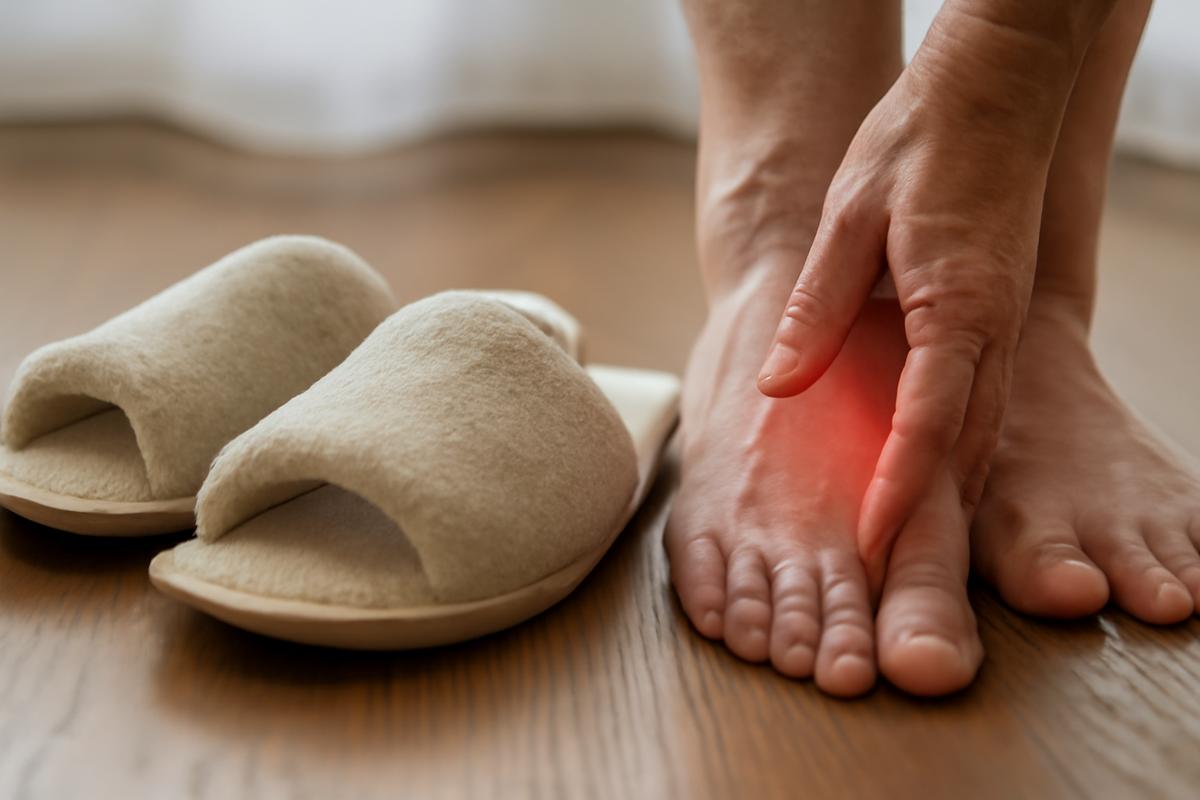
The first sound is soft: a shuffle across the kitchen tiles, the faint slap of foam against bare skin. You hobble toward the kettle, still half-asleep, your favorite slippers flopping lazily behind you. They’re cozy, familiar, maybe even a little flattened from years of loyal service. You slide them on without thinking. But this morning, like most mornings lately, there’s that same sharp whisper of pain in your heel, or a dull ache blooming in your arch. You pause, wince, wiggle your toes, and then keep moving, telling yourself it’s nothing. Just getting older. Just standing too long. Just life.
Except, it might not be “just life.” It might be your slippers.
The Quiet Sabotage Happening Under Your Feet
There’s something disarmingly innocent about slippers. They feel like the gentlest possible thing you can put between your feet and the ground—soft, forgiving, loose. After a long day in work shoes, sports shoes, or city pavements, the promise of plush cushioning can feel like coming home to a hug. But beneath that fuzz and foam, there’s often an uncomfortable truth: many slippers are built for coziness, not for your anatomy.
Imagine standing on a mattress that’s too soft. At first, it feels heavenly. But linger there long enough and your body starts to sag into odd angles. Ankles roll inward, knees strain, hips tilt. Your spine works quietly overtime, joints doing little micro-adjustments to keep you upright. Your feet, the unsung heroes of balance, are at the center of this constant negotiation.
Now shrink that mattress into the size of your slippers. Most common house slippers have three traits that sound comforting but are actually a perfect recipe for pain over time:
- Too soft and squishy with no real structure
- Too flat, offering little to no arch or heel support
- Too loose, allowing your foot to slide around with every step
That familiar “slap-slap” sound? That’s not just your slippers making noise—it’s your feet working extra hard to keep them on. With every step, your toes grip and curl, your arches strain, and your heels slam down with little protection. Multiply that by hundreds of steps a day at home, and you have the quiet sabotage of foot comfort taking place, one hallway stroll at a time.
When Comfort Turns into a Culprit
There’s a moment you might recognize: late afternoon, standing at the sink, washing dishes. You shift your weight from one foot to the other. At first, there’s only mild fatigue. Then something sharper—a throb in the ball of your foot, a pinch in your heel, maybe a burning across the arch. You flex your toes inside your slippers, but nothing changes. The floor feels strangely far away and yet uncomfortably present beneath the thin sole.
We often think of pain as a dramatic arrival—a sprain, a fall, a twist. But the most frustrating foot pain usually creeps in quietly. Tiny imbalances, repeated thousands of times, finally cross an invisible threshold. What felt like “a bit sore” becomes “why does this hurt every day now?”
Here’s the uncomfortable layer: slippers encourage the very patterns that make your feet howl over time. That thin, bendy sole lets your foot flatten out more than it should. If you already have even a slight tendency toward overpronation (where your foot rolls inward as you walk), a floppy slipper lets that motion go unchecked again and again. Your plantar fascia—the band of tissue running from heel to toes—gets stretched like an overused elastic, setting the stage for plantar fasciitis.
Then there’s the heel. Many slippers offer almost no meaningful heel cushioning, or they compress so quickly that you’re basically standing on a tired wafer of foam. Each step becomes a tiny hammering motion up the back of your leg. If you’re dealing with heel spurs, Achilles tenderness, or just that “first step out of bed agony,” wearing unsupportive slippers day after day is like nudging a bruise over and over.
Oddly enough, the very design that makes slippers feel “relaxed”—the wide, unstructured shape—often means your foot moves more than it should. That wobble isn’t just annoying; it means your muscles are on high alert to stabilize every step. Your feet get tired before the rest of you does, and the whispers of pain start earlier in the day.
How Your Slippers Shape Your Whole Body
Walk across your living room, barefoot, and notice how your feet move. The heel touches down, the arch softens, weight flows forward, and toes give a final push. It’s a beautiful chain reaction—a rhythm your body has been refining since you first staggered across the carpet as a toddler.
Now, add in a typical house slipper. Maybe it’s a backless slide, maybe a floppy mule. To keep it from slipping off, your toes curl downward ever so slightly, gripping the sole. The heel still tries to land, but now the path from ground to bone is muffled through flimsy material that compresses under pressure. Without enough structure, the slipper twists with your foot instead of guiding it. Your body is suddenly doing extra work just to stay stable.
This doesn’t just stay in your feet. Your ankles brace a little more. Your calves tighten to control the wobbly landing. Knees track slightly inward to compensate. Hips rotate subtly. Your lower back tinkers with its posture to keep you balanced. It’s like asking a series of dominos to lean instead of fall—every piece absorbs a little more strain than it was meant to.
You feel it later when you ease down onto the couch and rub your feet absentmindedly. The soreness isn’t only under your arch or at your big toe joint. Sometimes it’s a diffuse fatigue, a sense that your feet just “can’t be bothered” to carry you much longer today. Other times, it’s sharper: a stabbing pain near the heel on first steps after sitting, a burning around the toes that feels like they’re being squeezed, or an aching tightness along the inner arch.
Your slippers might not be the original cause of every foot problem; flat feet, high arches, old injuries, or long days on hard floors all play their part. But unsupportive indoor shoes amplify every weakness. They magnify pressure points, let alignment drift, and deny your feet the stable platform they quietly crave. It’s less like a single injury and more like a bad habit that your entire body pays for.
Not All Slippers Are Villains: What to Look For
Before you dramatically fling your favorite pair into the trash, it’s worth saying this: not every slipper is a problem. What matters is not the label “slipper,” but how it supports the architecture of your foot. Think of your indoor shoes less as fuzzy comfort objects and more as lifestyle equipment—like a good mattress, desk chair, or reading glasses. They should be kind to you, not just soft to the touch.
Here’s a simple way to understand the difference between pain-promoting and pain-reducing slippers:
| Feature | Slippers That Often Worsen Pain | Slippers That Help Your Feet |
|---|---|---|
| Sole firmness | Very soft, bends in half easily | Moderately firm, bends only at the ball of the foot |
| Arch support | Completely flat, spongy foam | Visible contour under the arch |
| Heel design | Backless, easy to slip off | Closed or secure heel cup that hugs the back of the foot |
| Fit | Loose, foot slides around | Snug but not tight, minimal slipping |
| Longevity | Flattens quickly, keeps your foot imprint | Keeps its shape for months of daily wear |
Pick up your current slippers and try a quick test. Can you fold the sole like a taco from heel to toe? Can you twist it easily like wringing out a rag? Does your heel sink straight to the floor when you press down with your thumb? Those are the telltale signs of shoes that are asking your feet to do all the structural work.
A better slipper behaves more like a gentle, stable platform. Its sole offers a bit of resistance when you try to bend it. There’s a slight ridge under the arch, a defined cup for the heel, maybe even a small lift at the back to reduce strain on your Achilles and plantar fascia. Instead of your toes clawing to hang on, the shape of the slipper holds your foot naturally in place.
This doesn’t have to mean giving up warmth or softness. You can still have fleece, wool, or cushioned linings, but they should sit on top of a more thoughtful foundation. It’s the difference between draping a cozy blanket over a supportive mattress versus a hammock that sags in the middle. The top layer can be plush; the bottom layer needs to be smart.
Listening to the Messages in Your Morning Steps
There’s a moment of truth almost everyone with foot pain knows: the first steps out of bed. That lightning-flash pain in the heel, the stiff hobble across the room, the way you hold onto the wall or dresser for a few seconds as your feet slowly “wake up.” We often blame the previous day’s workout, our weight, or our age. Those factors matter—but so does what your feet spent all day standing in.
Over time, your body leaves clues:
- Your slippers feel more comfortable than being barefoot, but your pain never really improves.
- Foot soreness sets in even on days when you hardly go outside.
- Standing to cook, fold laundry, or talk on the phone becomes something you dread because your feet “start complaining.”
- You find yourself kicking off your slippers to rub your arches or stretch your toes, only to slide them back on because the floor feels too hard.
These aren’t minor inconveniences; they’re conversations your body is trying to have with you. Pain is rarely random. It’s feedback. And sometimes, the message is simple: “I need better support down here.”
Start noticing how different surfaces and footwear feel. Compare a day in your usual slippers to a day in more structured indoor shoes or supportive sandals with straps and arch contours. Watch for how your feet feel not just in the moment, but by evening, or the next morning. Do you still wake up limping from your bedroom to the bathroom, or does that edge of pain start to soften?
There’s a quiet power in these small experiments. They turn frustration into curiosity. Instead of accepting pain as your new normal, you begin to map the conditions that amplify it—and the ones that calm it down. Slippers, once just background comfort, step forward as important characters in that story.
Tiny, Daily Choices That Change the Story of Your Feet
Picture, for a moment, an alternate version of your day. You wake up and, instead of sliding into the old, sagging pair, you reach for slippers that cradle your heel and support your arch. They feel firm at first, maybe even a little “proper.” You walk to the kitchen. No flopping, no gripping with your toes. Each step lands with quiet, grounded confidence rather than a sloppy slap.
Over weeks, this new routine starts to do something subtle. Your feet feel less like fragile, aching objects you’re hauling around the house, and more like the capable base of your body again. Maybe you stand a little longer to cook. Maybe you delay sitting down because—surprisingly—you don’t need to right away. That chronic end-of-day ache dulls from a roar to a murmur or, on some days, disappears entirely.
Indoor footwear is not a magic cure, but it is one of the most underappreciated tools for easing persistent foot pain. The hours you spend at home add up. The steps from couch to fridge, from desk to door, from bedroom to bathroom—they may not look impressive on a fitness tracker, but they shape your body just the same. Choosing slippers that respect your anatomy turns all that quiet movement into an ally instead of a slow wear-and-tear assault.
You don’t have to become a shoe expert. You don’t have to throw away every cozy thing you own. You just have to ask more of the things you put on your feet, even when you’re “only” at home. Look for structure. Look for support. Look for a stable hug, not a floppy cushion.
Most of all, listen. The next time you shuffle across the floor and feel that familiar jab or ache, pause for a heartbeat. Glance down at your slippers. Ask whether they’re really comforting you—or just quietly worsening the very pain you wish would finally let you walk away.
Frequently Asked Questions
Can soft, fluffy slippers really cause serious foot problems?
Yes, over time they can contribute to issues like plantar fasciitis, arch strain, heel pain, and even knee or back discomfort. The problem isn’t the fluff itself—it’s the lack of structure and support underneath that fluff.
Is walking barefoot at home better than wearing bad slippers?
Often, yes—especially on softer floors like wood or cork, and if your feet are generally healthy. However, on hard tile or concrete, or if you already have foot pain, supportive indoor footwear is usually kinder than going completely barefoot.
What features should I prioritize when buying new slippers?
Look for a firm sole that only bends at the ball of the foot, visible arch support, a secure heel (preferably closed-back), and a snug but comfortable fit. Avoid extremely soft, thin, or floppy designs that twist easily.
How long should a good pair of supportive slippers last?
With daily use, many supportive slippers last around 6–12 months before the cushioning and structure start to break down. If you notice more pain returning or see the sole flattening, it’s a sign to replace them.
Can I use my orthopedic insoles or inserts in slippers?
Yes, if the slippers have a removable insole and enough depth to accommodate your orthotics. Choosing slipper styles designed to hold inserts can give you the benefits of your custom or over-the-counter support while still feeling comfortable at home.

Hello, I’m Mathew, and I write articles about useful Home Tricks: simple solutions, saving time and useful for every day.